The architecture of a modern warehouse is defined by its storage
infrastructure. Selecting the correct racking
system for warehouse environments is a complex engineering problem
that balances vertical space utilization, inventory throughput, and structural
safety under dynamic loads. This decision directly impacts your cost per pallet
position and operational agility. This guide provides a technical framework for
analyzing these systems, focusing on load path mechanics, application-specific
configurations, and long-term asset protection, incorporating engineering best
practices from industry leaders like Guangshun.
1. Foundational Analysis: Matching System Architecture to Inventory
Profiles
Before specifying steel, a forensic audit of your inventory is required. The
optimal racking
system for warehouse operations is determined by three variables:
SKU velocity, pallet uniformity, and rotation method (FIFO or LIFO).
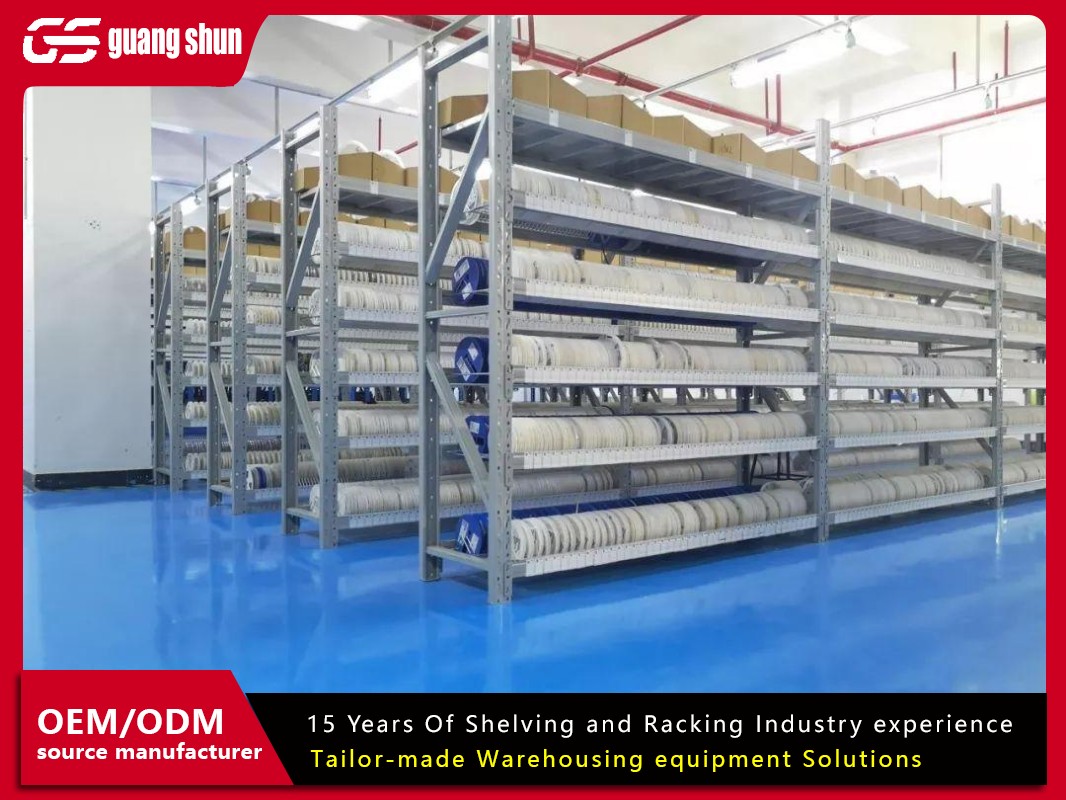
1.1 Selective Pallet Racking: The High-Access Standard
Load Profile: Best for operations with a wide variety of
fast-moving SKUs where every pallet must be instantly
accessible.
Structural Mechanics: This system uses welded or
roll-formed frames and step beams. The load path is direct: pallet weight
transfers to beams, through beam-to-column connections (typically relying on
integral safety locks), down the columns, and into the floor via baseplates. Its
primary limitation is spatial efficiency; access aisles typically consume 50-60%
of the floor area. However, for facilities prioritizing throughput and mix, it
remains the baseline.
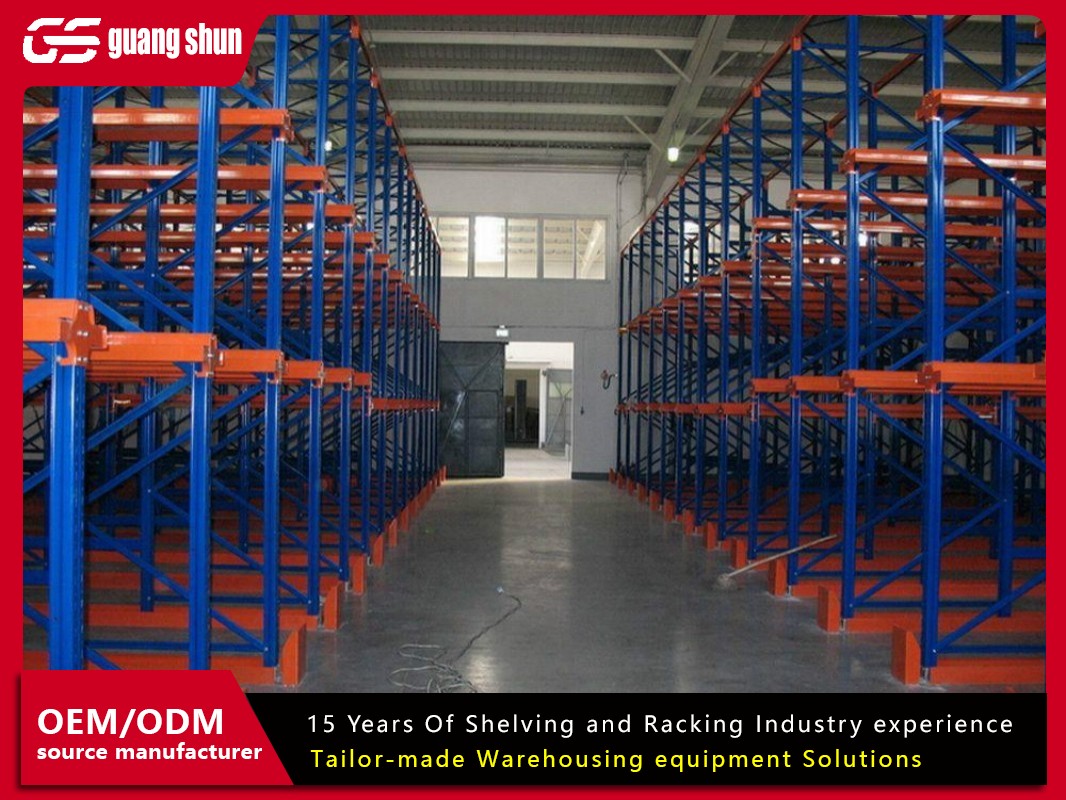
1.2 Drive-In Racking: Density Through Deep Lanes
Load Profile: Designed for homogeneous, non-perishable goods
where volume storage trumps individual access (e.g., bulk raw
materials).
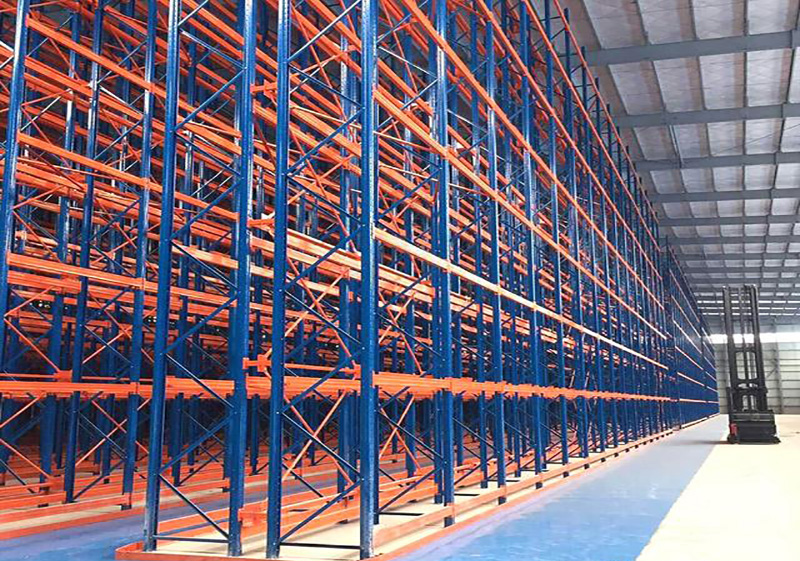
Structural Mechanics: This is a continuous
structure where forklifts enter the storage bay. Stability depends on the entire
block acting as a rigid unit. Horizontal and vertical bracing between frames
resists the dynamic forces of a moving truck. Rail-supported arms guide pallets.
The engineering trade-off is "honeycombing"—the creation of inaccessible empty
slots when lanes are partially emptied. This system achieves high density by
reducing aisle requirements.
1.3 Push-Back Racking: Density with Moderate Selectivity
Load Profile: Suitable for medium-velocity SKUs with 2-4
pallets per lane, operating on a Last-In, First-Out (LIFO)
basis.
Structural Mechanics: Nested carts on inclined rails
are installed within the rack. Placing a pallet at the front pushes the others
back. This design eliminates forklift entry into the structure, reducing impact
damage. Engineering precision is critical; rail alignment and cart tolerances
must be maintained to prevent jams.
1.4 Pallet Flow Racking: Gravity-Fed FIFO
Load Profile: Essential for perishable goods,
pharmaceuticals, or any inventory with expiration dating requiring strict
First-In, First-Out (FIFO) rotation.
Structural Mechanics: Uses slightly inclined lanes with rollers or wheels and integrated speed
controllers (brakes). The engineering challenge is calibrating these brakes to
handle varying pallet weights and conditions to prevent "racetracking" (pallets
accelerating) or stoppage. Lane depth is limited by the cumulative friction and
required flow reliability.
2. Structural Engineering Principles for Racking Systems
Every component of a racking
system for warehouse use must be analyzed as part of a continuous
load-bearing structure, subject to codes like ANSI MH16.1 (RMI).
2.1 Load Path and Frame Stability
Understanding the vertical load path is fundamental. The weight on the beams
creates a moment at the connection, which is transferred to the column. Columns
are not simple compression members; they are susceptible to buckling. The
slenderness ratio (height vs. radius of gyration) determines their capacity.
Frame bracing (the diagonal and horizontal members between columns) provides
lateral stability, preventing the frame from swaying under vertical load. This
bracing is what differentiates a rack from a simple shelf.
2.2 Seismic Design and Overturning Forces
In seismic zones, the analysis becomes significantly more complex. The rack
must resist base shear—the horizontal inertial force generated during an
earthquake. Engineers calculate the seismic weight of the structure and its
contents, then design connections and anchorages to resist the resulting
overturning moment. Guangshun utilizes Finite Element Analysis
(FEA) to model these forces, ensuring compliance with local building codes such
as the IBC or ASCE 7. Key parameters include the system's ductility and natural
frequency.
2.3 Impact Resistance and Redundancy
Racks are frequently subjected to forklift impacts. While not typically
included in design loads, good engineering anticipates this. Strategies
include:
Sacrificial Components: Column guards (bollards) and
replaceable beam end connectors.
Increased Section Modulus: Specifying heavier columns in
high-traffic aisles.
Connection Redundancy: Using bolts in addition to beam
locks in critical locations.
3. Safety, Compliance, and System Integration
A racking
system for warehouse operations does not exist in isolation. It
must integrate seamlessly with the facility's fire safety, lighting, and
material handling equipment.
3.1 Fire Protection and Flue Spaces
Racking dramatically alters fire dynamics, creating horizontal barriers that
can block ceiling-level sprinkler spray. This often mandates in-rack sprinklers.
The rack design must accommodate these lines by maintaining specific "flue
spaces"—vertical and horizontal gaps that allow water penetration to lower
levels. NFPA 13 provides strict guidelines on these dimensions, which directly
influence beam spacing and depth.
3.2 Tolerances for Automation
For warehouses employing Automated Guided Vehicles (AGVs) or AS/RS, the
tolerances tighten dramatically. The positional accuracy of the racking
system for warehouse automation interfaces must be within
millimeters. This requires laser-guided installation and specific floor flatness
specifications (often FM2 or better) to ensure reliable pallet pick-up and
drop-off.
3.3 Ongoing Structural Inspection
A rack is a dynamic structure that degrades over time through impact and
wear. A formal inspection program is critical and should include checks for:
Sway in frames or beams indicating potential overload or impact.
Bent or cracked columns, particularly at the base.
Damaged or disengaged beam safety locks.
Missing or loose anchor bolts.
Signs of overloading (e.g., visibly deflected beams).
Industry standards (RMI) recommend a professional inspection annually, with
more frequent internal checks by trained personnel.
4. Lifecycle Cost Analysis and Future-Proofing
The initial steel cost is a fraction of the total cost of ownership. A
comprehensive analysis includes:
Space Value: The cost per square foot of the facility saved
by opting for a denser system.
Labor Productivity: The reduction in travel time from an
efficient layout versus the increased handling time due to honeycombing or
re-staging.
Product Integrity: Reduction in damage from improved pallet
support and access.
Maintenance & Repair: Projected costs for replacing
damaged components over a 20-year horizon.
Scalability: Can the system be easily extended vertically
or horizontally? A modular design from a provider like Guangshun ensures the asset can adapt to
future inventory growth.
Selecting a racking
system for warehouse use is a high-stakes engineering decision that
defines safety, efficiency, and profitability for the life of the facility. It
requires moving beyond simple product specifications to a holistic understanding
of load physics, material flow dynamics, and regulatory compliance. Whether your
operation demands the high accessibility of selective rack or the volumetric
efficiency of a flow system, the engineering must be verified. By partnering
with a structural expert like Guangshun, you ensure your storage
infrastructure is built on a foundation of rigorous analysis and industry best
practice, creating a platform for sustainable logistics performance.
Frequently Asked Questions (FAQ)
Q1: What is the difference between drive-in and push-back racking in terms
of structural operation?
A1: Structurally, drive-in racking requires the forklift to
enter the rack structure, meaning the entire system must be braced to withstand
truck impact and dynamic loads. Push-back racking uses nested carts on rails
inside the rack; the forklift never enters the structure, remaining in the
aisle. This reduces required structural bracing but adds mechanical components
(carts and rails) that require precise alignment.
Q2: How does seismic design change for a racking system compared to a
building?
A2: Racking systems are typically non-building structures
with high center-of-gravity loads. Seismic design focuses on the connection
between the rack and the floor (anchorage) and the bracing between frames to
prevent "rack rocking" or collapse. The analysis must account for the flexible
nature of stored goods and the potential for load shifting. It is governed by
specific sections of codes like ASCE 7, separate from the main building
design.
Q3: Can I install a racking system myself to save costs?
A3: Professional installation is strongly recommended.
Improper assembly—such as incorrect shimming under baseplates, insufficient
torque on bolts, or misaligned frames—can drastically reduce the load capacity
and stability of the system, creating a serious safety hazard. Certified
installers, like those from Guangshun, ensure the structure meets
engineering specifications and warranty conditions.
Q4: What is the acceptable deflection for a rack beam under full load?
A4: Industry standards (RMI) typically limit beam deflection
to L/180, where L is the beam's clear span length. For example, a 108-inch beam
should not deflect more than 0.6 inches (108/180) at its center under its rated
capacity. Excessive deflection can cause pallets to become trapped or the beam
to permanently deform.
Q5: How does pallet quality affect the choice of racking system?
A5: Pallet quality is critical, especially in flow or
push-back systems. Warped, broken, or non-standard sized pallets can jam in
lanes, causing operational downtime and potential damage to the rack structure.
For these automated systems, specifying a consistent pallet gauge and condition
is as important as the rack design itself. For selective rack, poor pallet
overhang can create aisle hazards and snag on columns.