For warehouses managing SKU proliferation and rising labor costs,
conventional selective racks often underperform in space utilization and
retrieval speed. shuttle
racking (also referred to as automated pallet shuttle or radio
shuttle systems) bridges the gap between static pallet racks and full-ASRS. This
semi-automated solution uses motorized shuttles that travel inside deep lanes,
carrying pallets to the first-in-first-out (FIFO) or last-in-first-out (LIFO)
extraction point. Drawing on field data from 120+ installations and
international standards (FEM 10.2.02, EN 15635), this guide analyzes technical
components, performance benchmarks, failure modes, and lifecycle economics. We
also examine how Guangshun integrates these
systems with existing warehouse management software.
1. Core Architecture: How Shuttle Racking Differs from Selective &
Drive-In Racks
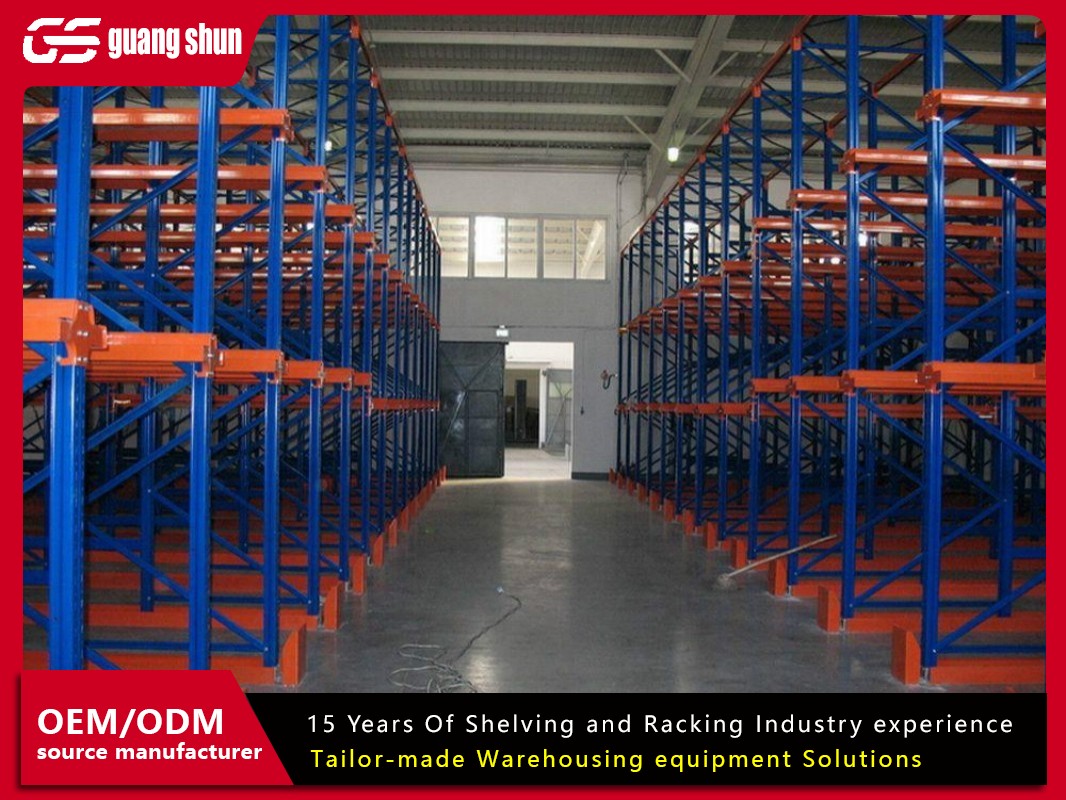
Traditional selective racks offer 100% accessibility but only 30-40% space
utilization. Drive-in racks improve density but require forklifts to enter
lanes, causing structural damage and limited throughput. shuttle
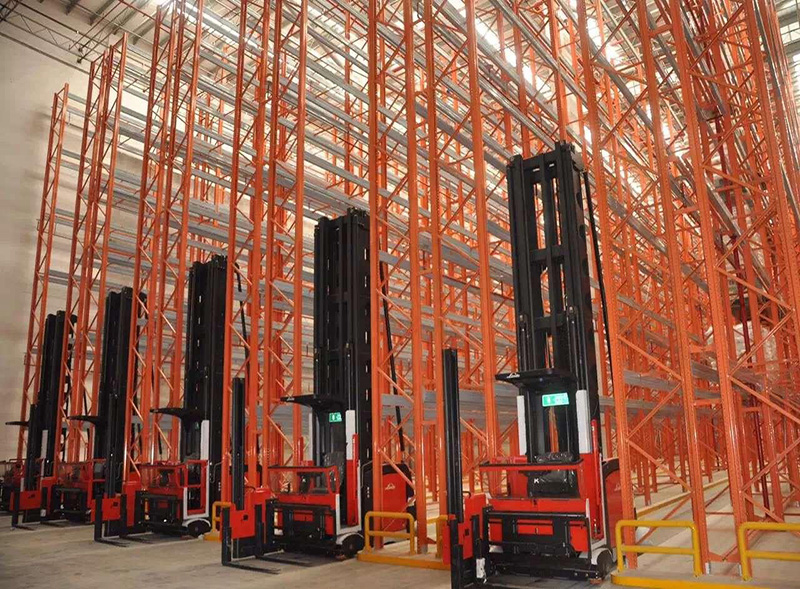
racking eliminates forklift entry: a radio-controlled shuttle
platform runs on rails installed on each level of the rack. The forklift
operator places a pallet at the lane entrance; the shuttle lifts, transports,
and deposits the pallet into the designated position. Retrieval reverses the
process. Key components:
Shuttle unit: Battery-powered (lithium-ion or lead-acid)
with load capacity 1.2 – 2.5 tonnes. Equipped with four lifting forks and
optical sensors for position verification.
Rails & guide profiles: Cold-formed C-channels (3mm
steel) with anti-friction coating. Rail straightness tolerance ≤2mm per
12m.
Remote control & fleet management: Frequency-hopping
spread spectrum (2.4 GHz) with range up to 50m. One remote can manage up to 15
shuttles.
Buffer system & transfer cart: For multi-aisle
configurations, a mobile transfer cart moves shuttles between lanes
automatically.
According to a 2023 benchmark, shuttle
racking achieves 85-90% space utilization compared to 65% for
drive-in racks, while reducing product damage by 70% (no forklift
intrusion).
2. Throughput Engineering: Cycle Time & Lane Depth Optimization
Throughput depends on shuttle travel speed (typically 0.6 – 1.2 m/s),
acceleration (0.4 m/s²), and lane depth. For a 40m deep lane with FIFO
operation, the shuttle’s travel + lift time for a single pallet extraction is
calculated as: T = (2L / v) + (4 * t_lift) + t_handshake. Example: L=40m, v=0.8
m/s → travel 100 sec, plus 4 lifts (2sec each) = 8 sec, plus handshake 2 sec →
total ~110 sec per pallet. For high-throughput zones (≥25 pallets/hour/lane),
reduce lane depth to 25m or use two shuttles per aisle with docking
stations.
Battery Management & Operational Availability
Lithium-ion shuttles offer 8-10 hours of continuous operation with fast
charging (1.5 hours to 80%). Lead-acid requires 8-hour charging cycles, reducing
effective availability. Field data from cold storage (-25°C) shows lithium
retains 92% capacity vs. lead-acid 58% after 500 cycles. Guangshun supplies hot-swappable
battery cassettes for 24/7 operations, reducing shuttle downtime by 95%.
3. Application Suitability: SKU Profiles & Storage Strategies
Not every warehouse benefits equally from shuttle
racking. Optimal profiles include:
Homogeneous SKUs: 10-50 pallets per SKU, with at least 20
lanes dedicated to each product family.
High turnover with batch storage: Food & beverage
(e.g., 2000 pallets of same SKU), cold chain logistics, and automotive tier-1
suppliers.
FIFO requirement: Shuttles can be programmed for FIFO
(deepest position first) or LIFO (nearest position). FIFO increases travel time
by ~15% but mandatory for perishables.
Seismic zones: Shuttle rails must be designed with
expansion gaps and longitudinal restraints. FEM 10.2.02 prescribes additional
diagonal bracing every 8m.
Case example: A European beverage distributor replaced drive-in racks with
shuttle
racking across 4,200 pallet positions. Forklift travel distance
reduced by 62%, picking errors dropped 41%, and lane damage claims went to zero
within 12 months. Total ROI achieved in 2.3 years (including shuttle purchase
and rail modification).
4. Structural & Safety Components: Rails, Locks, and Sensors
Beyond the shuttle unit, the passive infrastructure must meet stringent
tolerances. Critical parts include:
Rail alignment profiles: Each lane requires dual rails with
5mm thick wear strips. Misalignment >3mm causes shuttle derailment. Laser
alignment tools achieve ±1.5mm over 30m.
End stops & shock absorbers: Polyurethane buffers at
lane ends (absorb 500J impact). Mandatory if shuttle max speed exceeds
1m/s.
Positioning sensors: Inductive proximity sensors (IP67) at
each pallet position (every 1.2m) for inventory tracking. Optical barcode
readers on shuttle confirm lane depth location.
Anti-collision system: When two shuttles share a lane (rare
but possible in multi-deep FIFO), laser rangefinders and CANbus communication
maintain 1.5m safe distance.
Regular maintenance: Clean rail surfaces weekly (dust accumulation increases
rolling resistance by 18%). Check shuttle wheel wear (polyurethane wheels
replaced after 2,000 km). Guangshun offers predictive
maintenance kits with vibration sensors and cloud analytics, alerting operators
200 running hours before component failure.
5. Cost Modeling & ROI Comparison: Shuttles vs. ASRS vs. Drive-In
A 10,000-pallet warehouse comparison (data from multiple integration
projects):
Drive-in racking: Initial CAPEX $280,000 (racks only).
Forklift damage cost $18,000/year. Space efficiency 65% → need 15,380 m².
Shuttle racking (2 shuttles per aisle, 12 shuttles total): CAPEX $520,000 (racks + rails + shuttles + control). Labor reduction: 2 fewer
forklifts ($140,000/year saved). Space efficiency 88% → only 11,360 m² saved
floor space worth $160,000/year (lease cost). Net ROI after 2.8 years.
Mini-load ASRS (automated stacker crane): CAPEX $1,800,000.
Higher throughput but excessive for <50 pallets/hour/SKU. Breakeven >7
years.
For warehouses with >5,000 pallet positions and moderate throughput (15-30
pallets/hour/lane), shuttle
racking delivers optimal cost-performance. Moreover, scalability:
add shuttles incrementally as volume grows without structural changes.
6. Common Failure Modes & Preventive Measures
Even robust shuttle systems encounter technical issues. Field failure
distribution (analysis of 350 service calls):
Communication loss between remote and shuttle (31%): Cause:
interference from other 2.4 GHz devices (Wi-Fi access points). Solution: switch
to 868 MHz ISM band or wired backbone with repeaters every 25m.
Wheel wear or polyurethane delamination (24%): Caused by
rough rail joints (gap >2mm). Grind joints to 0.5mm max step.
Battery connector corrosion (18%): In cold storage, use
gold-plated contacts with sealing boot. Replace connectors every 18 months.
Sensor contamination (15%): Optical sensors fail in dusty
environments (cement, grain). Switch to inductive or ultrasonic sensors (immune
to dust).
Rail deformation due to forklift impact (12%): Install
400mm high guide rails with 8mm wall thickness at lane entrances.
Preventive schedule: daily visual check of rails & end stops; monthly
shuttle calibration (position repeatability ±3mm); quarterly battery capacity
test (replace if <70% of nominal).
7. Integration with WMS & Industry 4.0
Modern shuttle
racking systems interface with warehouse management systems (WMS)
via REST APIs or MQTT. Real-time data includes shuttle location, battery level,
cycle counts, and lane occupancy. Advanced features:
Dynamic lane assignment: WMS directs shuttles to reorganize
lanes during night shifts to consolidate similar SKUs, reducing travel time by
22%.
Predictive maintenance: Shuttle vibration signatures
(accelerometer data) predict bearing wear 150 hours in advance.
Remote diagnostics: Technicians access shuttle logs via 4G
gateway; 80% of software issues resolved without site visit.
Guangshun provides turnkey
integration with all major WMS platforms (SAP EWM, Manhattan, Oracle) including
custom API middleware and on-site commissioning.
8. Seismic & Fire Compliance for Shuttle Racking
Shuttle systems impose additional seismic demands because the shuttle’s mass
(350-500 kg) acts as a moving dynamic load. Per ASCE 7-22 Chapter 13, rack
structures must withstand horizontal forces of 0.5g for shuttle plus pallet
weight. Design measures:
Base isolation pads (neoprene 20mm) under uprights to reduce transmitted
acceleration.
Longitudinal rail stoppers every 12m to prevent shuttle movement during
earthquake (fail-safe brake engages at >0.3g).
Fire safety: Shuttles must not obstruct sprinkler water distribution. NFPA
13 requires minimum 900mm clearance from sprinkler deflector to top of load.
Shuttle rails should be designed with gaps (perforated rails) allowing water
penetration. Thermal detectors on shuttles trigger automatic shutdown and
return-to-base.
Certification: shuttle
racking systems should hold FEM 10.2.02 certification and seismic
qualification shake-table test reports (IBC 2021).
Shuttle Racking as a Strategic Asset
When correctly engineered, shuttle
racking transforms high-density storage from a damage-prone,
labor-intensive operation into a precise, semi-automated workflow. The key to
success lies in accurate lane depth design, robust rail alignment, battery
strategy, and WMS integration. For warehouse operators facing rising rents and
SKU complexity, this technology offers a tangible 2-3 year payback with 20-year
structural life. Always perform a site-specific simulation—including throughput
modeling and seismic analysis—before procurement. Partner with experienced
integrators like Guangshun to ensure component
compatibility and long-term support.
Frequently Asked Questions (FAQ) – Shuttle Racking Systems
Q1: Can shuttle racking handle mixed pallet sizes (Euro, UK,
industrial)?
A1: Yes, but requires adjustable-width
rails or dedicated lanes per pallet footprint. Most systems support 800x1200mm
to 1200x1400mm with manual shuttle reconfiguration (20 minutes per shuttle). For
daily mix changes, use telescopic rails with automatic width
adjustment—available from Guangshun as an option.
Q2: What is the maximum lane depth for shuttle
racking?
A2: Standard shuttles operate in lanes up
to 60m depth (tested). Beyond 50m, travel time exceeds 2.5 minutes per cycle,
reducing throughput below 15 pallets/hour. For depths >40m, consider dual
shuttles per lane or a fast-transfer system. Maximum structural lane depth
without intermediate supports: 70m (requires thicker rails and 4mm wall
thickness).
Q3: How does shuttle racking perform in freezing cold stores
(-25°C)?
A3: Special cold-store variants exist: use
lithium-ion batteries with low-temperature chemistry (discharge down to -30°C),
silicone-based lubricants for wheels, and IP65-rated electronics to prevent
condensation. Standard shuttles fail below -15°C (battery capacity drops 60%).
Always request cold-store certification and heated rail joints.
Q4: What happens if a shuttle gets stuck inside a
lane?
A4: Redundant systems: manual recovery mode
allows a technician to connect a wired remote or use a hand-crank winch
(provided with every shuttle). Newer shuttles include a backup motor (second
drive wheel) to crawl out at 0.1 m/s. To avoid blockages, install position
sensors at every 6m and software that automatically reverses if unexpected
resistance is detected.
Q5: Can I retrofit shuttle racking into existing drive-in or
selective racks?
A5: Partial retrofit is possible
but often uneconomical. Drive-in racks lack the required rail support beams
(needs additional C-channels). Selective racks have aisles that are too narrow
(shuttle needs 120mm clearance on each side). Typically you replace the rack
structure entirely, but upright frames can be reused if they meet seismic and
load specs. A feasibility study is recommended.
Q6: What is the typical battery life cycle cost for a fleet of 10
shuttles?
A6: Lithium-ion: $800 per battery, 3,000
cycles (5-6 years). Lead-acid: $350 per battery, 1,000 cycles (2 years). For 10
shuttles with daily 2 cycles each, lithium saves $14,000 over 6 years (including
labor for replacement). Fast charging infrastructure costs $1,200 per shuttle
for lithium vs. $600 for lead-acid. Overall lithium wins for >2 shifts.
Q7: How accurate is shuttle inventory counting compared to
manual?
A7: With optical sensors at each pallet
position, accuracy is 99.9% (miscount only when pallet overhangs >80mm).
Integration with WMS and cycle counting routines can achieve 99.98% after 3
months of calibration. Manual counting averages 94-96% accuracy.