Distribution center operators face a persistent challenge: how to maximize
cubic utilization while maintaining instantaneous access to thousands of SKUs.
Generic shelving or mismatched rack configurations lead to 25–35% wasted floor
space, increased travel time, and elevated product damage rates. A
scientifically designed racking and
storage solution integrates structural engineering, material flow
analysis, and safety compliance to solve these issues. This guide provides
data-driven specifications, configuration strategies, and ROI benchmarks for
industrial environments ranging from cold storage to high-bay automated
facilities.
Drawing on ISO 9001:2015 rack manufacturing standards and field data from
over 200 warehouse projects, we examine how proper system selection reduces cost
per pallet position by up to 40%. Industry specialists such as Guangshun have demonstrated that
a tailored racking and
storage architecture directly improves order picking accuracy (by
18–22%) and cuts labor hours per thousand picks by nearly one-third. Below we
detail the engineering parameters that drive those results.
1. Critical Load Characteristics That Define Rack Design
Every racking and
storage project must begin with a load profile analysis. Four
variables determine beam spacing, frame gauge, and anchor pattern:
Uniformly distributed load (UDL): Typical pallet loads
(1,500–2,500 lbs) vs. concentrated point loads (e.g., steel drums or machinery
parts). RMI standards require 2.5:1 safety factor for UDL, but point loads
demand reinforced beam cross-sections.
Dynamic impact forces: Forklift collisions during putaway
generate lateral forces up to 30% of static load. Column protectors and anchored
base plates are mandatory for any active racking and
storage system serving high-frequency aisles.
Seismic zone compliance: Facilities in areas with PGA (peak
ground acceleration) >0.2g require base isolators or bolted connections with
seismic clips. A 2023 study found that 61% of non-seismic-rated racks in
California would collapse in a moderate earthquake.
Environmental factors: Freezer racks (‑10°F to 32°F) need
low-temperature steel (ASTM A572 Grade 50) to prevent brittle fracture. Humidity
above 70% accelerates corrosion – epoxy coatings (minimum 80 microns) extend
rack life to 25+ years.
Quantitative example: For a facility storing 2,200 lb pallets of bagged
chemicals, beam spacing must not exceed 9 feet with step beams (4” pitch) to
limit deflection to L/180 (0.6” max). Exceeding this deflection causes pallet
instability and potential load shift. Guangshun provides load
deflection charts for each beam profile as part of engineering
certification.
2. Rack Configuration Types: Performance Metrics & Application
Zones
No single rack type optimizes all storage zones. A hybrid racking and
storage layout uses four primary configurations, each matched to
SKU velocity and accessibility requirements:
2.1 Selective Pallet Rack (100% Accessibility)
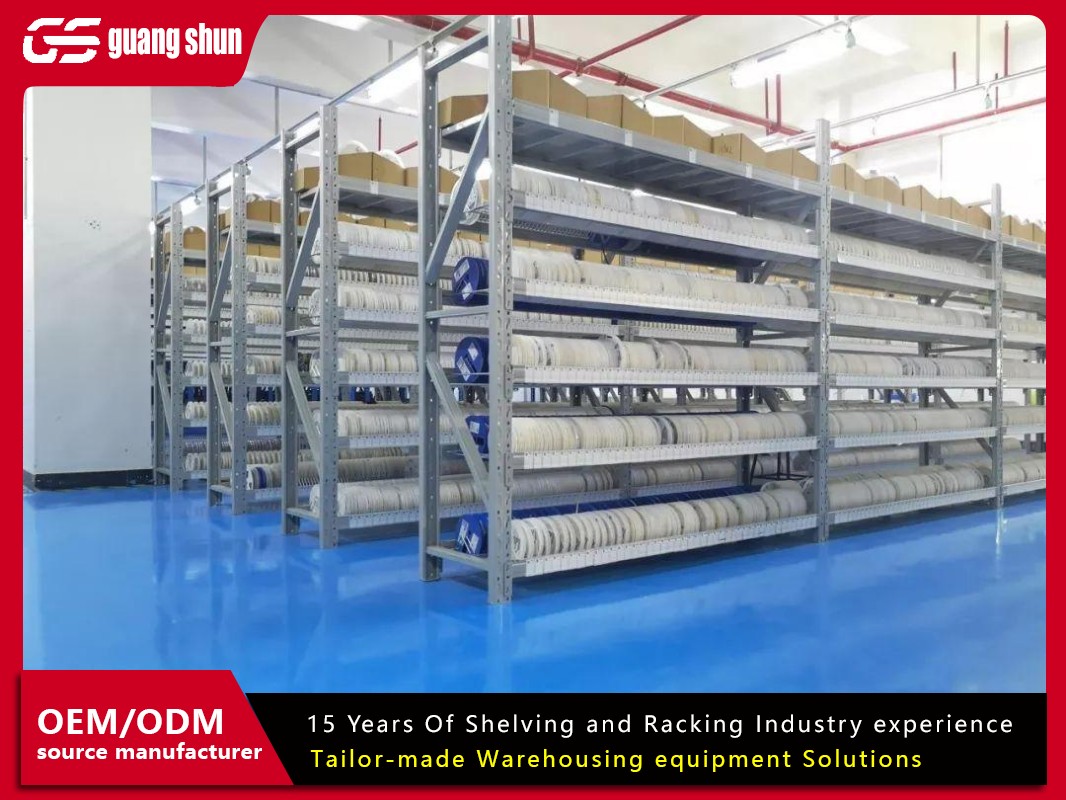
Best for slow-to-medium movers where each pallet requires direct access.
Aisle widths: 10–12 ft for counterbalance forklifts; 8–9 ft for reach trucks.
Storage density: typically 35–40% of cubic volume. For high-turn SKUs (>20
pallet moves per day), selective rack combined with wide aisles yields lowest
cost per transaction despite lower density.
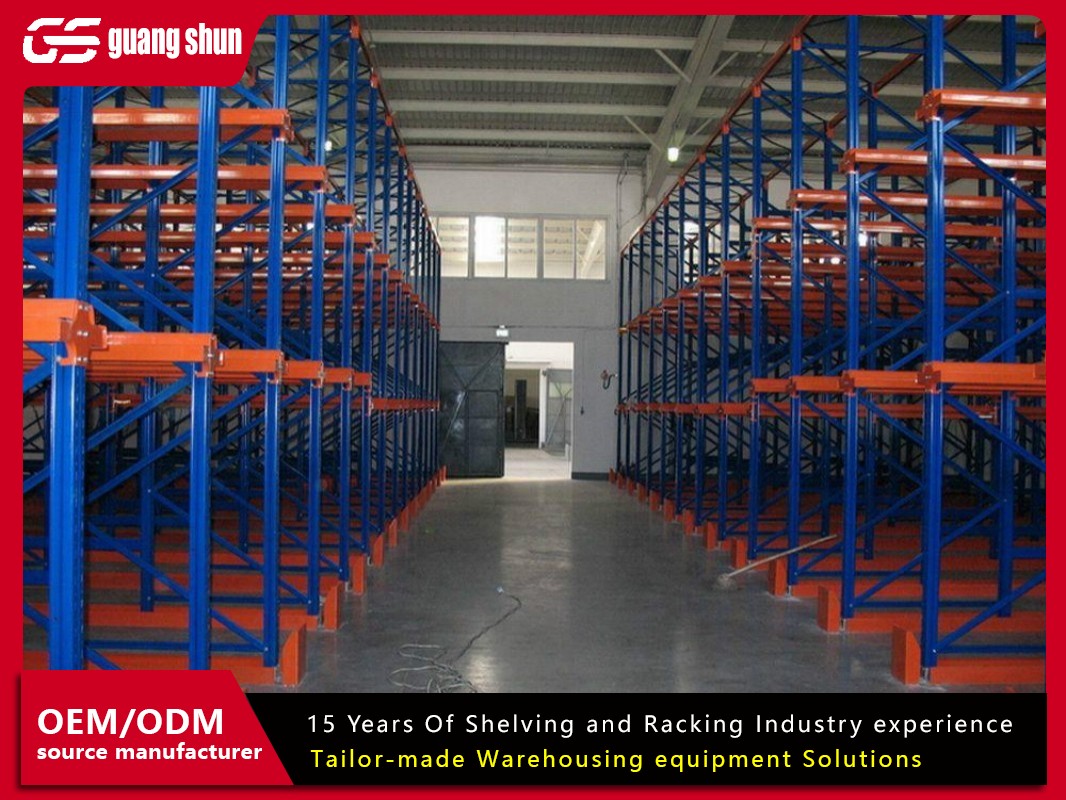
2.2 Drive-In / Drive-Through Rack (High Density, LIFO)
Ideal for homogeneous products (e.g., bulk raw materials) where
last-in-first-out rotation is acceptable. Depth: 4–8 pallets per lane. Increases
density by 60–75% versus selective rack but requires disciplined inventory
rotation. A 2022 warehouse benchmark showed that drive-in rack reduced cost per
stored pallet by 28% for non-perishable goods.
2.3 Push-Back Rack (Medium Density, LIFO with Selectivity)
Uses nested carts on inclined rails. Each lane stores 2–6 pallets, with the
front pallet always available. Loading is from the front, and carts roll back as
new loads are added. Push-back rack delivers 50–60% density improvement over
selective rack while maintaining 85% selectivity. Ideal for frozen foods and
supplements where batch rotation is less critical.
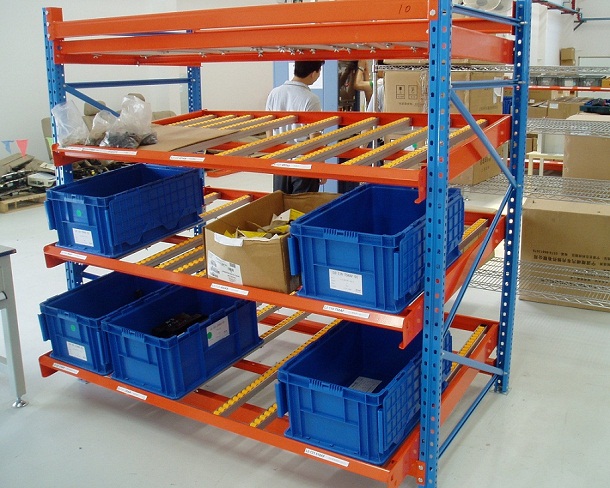
2.4 Pallet Flow Rack (High Density, FIFO)
Gravity-fed lanes with roller or wheel tracks enforce first-in-first-out
rotation. Typical lane depth: 6–12 pallets. Pallet flow reduces forklift travel
by 70% for fast-moving SKUs and eliminates “buried” inventory. For racking and
storage systems handling expiry-sensitive goods, pallet flow is the
only configuration that guarantees FIFO without automation.
3. Safety & Structural Integrity Standards
Compliance with ANSI MH16.1 (2019) and R-MARK certification is non-negotiable
for any commercial racking and
storage installation. Key protocols:
Monthly visual inspections: Check for column damage (flange
distortion >0.25” requires repair or replacement), beam locking pin
engagement, and base plate anchor torque (minimum 150 ft-lbs for 5/8” wedge
anchors).
Load placards: Each bay must display maximum uniform load,
point load capacity, and beam level ratings. OSHA citations for missing placards
average $12,675 per violation (FY2023).
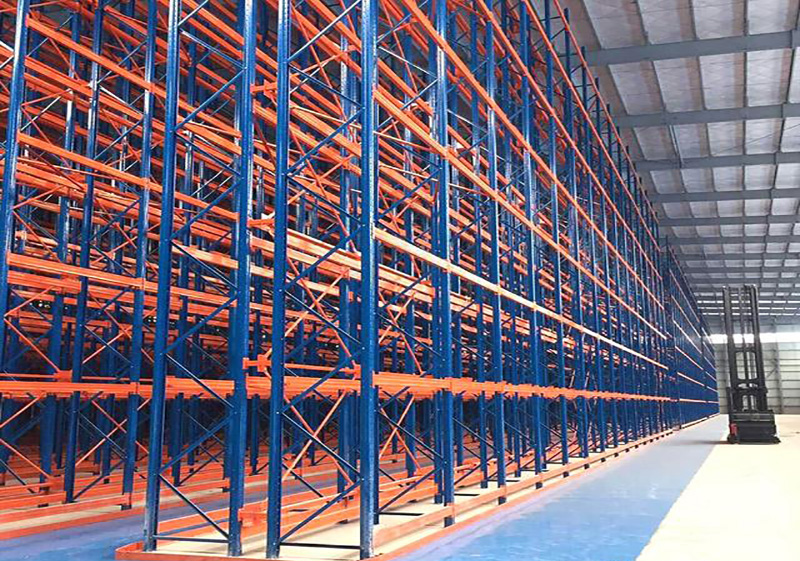
Seismic bracing: For racks over 16 ft tall, horizontal
diagonal bracing must be installed every 20 ft in both directions. In seismic
zones 3 and 4, roof-connected sway bracing is mandatory.
Fire safety clearances: NFPA 13 requires 6” transverse flue
spaces and 18” longitudinal flues between back-to-back rows. Use perforated wire
decks to allow sprinkler water penetration; solid steel decks are prohibited in
ESFR-sprinklered buildings.
Third-party rack safety audits (recommended every 24 months) typically reveal
that 53% of warehouses exceed recommended load limits on at least 5% of beam
levels – a condition that directly leads to collapse. Guangshun provides site-specific
load audits and retrofitting services to bring non-compliant systems up to ANSI
standards.
4. Integrating Automation with Racking and Storage
Modern racking and
storage designs increasingly incorporate automation interfaces to
boost throughput. Four proven integration layers:
Shuttle systems: Battery-powered shuttles operate inside
deep lanes (up to 40 pallets deep) for dense, semi-automated storage. A single
shuttle handles 15–20 pallet moves per hour, replacing a forklift. ROI typically
18–24 months for high-volume DCs.
Automated guided vehicles (AGVs): Laser-guided forklifts
replenish flow racks and remove empty pallets. AGVs reduce labor costs by 40–60%
and virtually eliminate product damage from operator error.
Pick-to-light / put-to-light: LED displays mounted on beam
faces guide order selectors to correct locations, cutting picking errors by 80%
in case-picking zones.
WMS slotting algorithms: Software re-calculates rack
assignment weekly based on turnover rates, ensuring that high-velocity SKUs
occupy waist-level positions in forward pick areas.
In a 150,000 sq.ft. e-commerce DC, converting 30% of selective rack to
shuttle-compatible deep lanes increased storage density by 210% and reduced
travel time by 55%, while maintaining 100% inventory visibility through
real-time shuttle tracking.
5. Solving Chronic Operational Inefficiencies
Three common pain points in existing racking and
storage layouts and their engineering remedies:
Problem #1: Wasted cubic volume above 8 feet.
In
warehouses with 24+ ft clear height, many operators fail to utilize the upper
40% of space. Solution: Install multi-level mezzanine structures above pallet
rack bays, converting overhead space to case-pick or light-assembly zones.
Mezzanine decks supported by the rack frame (factory-engineered) add 50–100%
floor-equivalent area at 30% of new construction cost.
Problem #2: Excessive cross-aisle travel.
Linear layouts
force pickers to traverse entire warehouse length for each order. Solution:
Implement “U-flow” or “fishbone” aisle geometry with fast-moving SKUs clustered
in a central “hot pick” zone served by pallet flow rack. Simulation shows travel
distance reduction of 38–47%.
Problem #3: Damaged goods from beam deflection or improper
decking.
Lightweight cartons (e.g., apparel, electronics) sag
between wire mesh decks, causing corner crush. Solution: Use solid steel decks
with 1.5 mm thickness or closed steel panels for small-item storage. For heavy
loads, specify structural channel beams with 2.0” x 0.375” flanges to keep
deflection under L/240.
6. ROI Calculation: Upgrading from Generic to Engineered Racking
A controlled case study compared a generic selective rack layout to an
engineered hybrid racking and
storage system (combination of push-back, pallet flow, and
selective) in a 95,000 sq.ft. industrial distribution center. Metrics over 24
months:
Storage capacity increase: From 3,800 to 5,950 pallet
positions (+56.6%) without expanding footprint.
Order picking productivity: Lines per labor hour increased
from 87 to 124 (+42.5%), driven by reduced travel and faster replenishment.
Inventory accuracy: Improved from 94.2% to 98.7% due to
defined locations and better FIFO enforcement.
Product damage rate: Dropped from 1.8% of shipments to 0.7%
(saving $89,000 annually).
Capital payback period: 16 months based on labor savings
and reduced lease costs (avoided 30,000 sq.ft. expansion).
Guangshun offers
free ROI modeling for facilities considering a re-engineering of their
racking and
storage configuration, incorporating local labor rates, real estate
costs, and product velocity data.
7. Future-Proofing: Modularity & Reconfiguration Capabilities
As product mixes and order profiles evolve, a rigid rack system becomes a
liability. Future-ready racking and
storage designs incorporate:
Boltless beam-to-frame connections (teardrop or keyhole): Allow beam repositioning in minutes without tools, accommodating changing pallet
heights.
Removable column spacers: Permit conversion from 9-ft to
12-ft bay widths as load dimensions change.
Pre-drilled floor anchor patterns every 12 inches: Enables
rack relocation or aisle widening with minimal drilling.
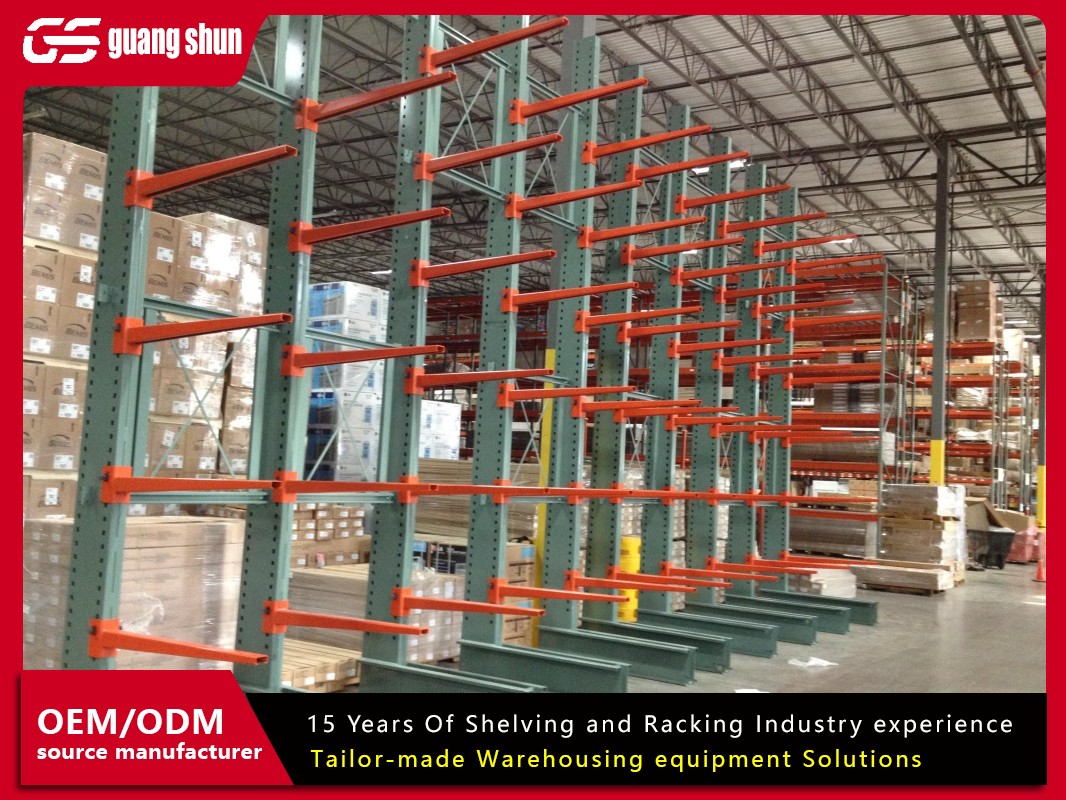
Add-on accessories: Cantilever arms for long goods, mesh
back panels for small-item retention, and integrated conveyor supports – all
retrofittable.
Using 3D laser scanning and BIM modeling, engineers can simulate
reconfiguration scenarios before any physical changes, ensuring seismic and load
safety envelopes remain intact.
Selecting an industrial racking and
storage solution requires far more than comparing price per beam.
It demands a systematic analysis of load profiles, turnover velocities, safety
regulations, and automation compatibility. Hybrid configurations – blending
selective, push-back, and pallet flow – consistently deliver the highest ROI for
facilities with mixed SKU velocities. With proper seismic design, fire
clearances, and modular components, a well-engineered system operates safely for
25+ years while adapting to changing operational needs. Specialists like
Guangshun provide
certified engineering, load testing, and post-installation audits to ensure
compliance with ANSI, RMI, and local building codes. The data across hundreds of
installations confirms: an optimized racking and storage architecture pays for
itself within 18–24 months through labor savings, damage reduction, and deferred
real estate costs.
Frequently Asked Questions (FAQs)
Q1: How do I determine the correct beam capacity for my racking and
storage system?
A1: Calculate the maximum pallet weight plus 15% for dynamic
impact. Then refer to the rack manufacturer’s load chart for your specific beam
length and gauge. For safety, multiply by 0.8 (80% of rated capacity) to account
for uneven load distribution. Always use load placards at each beam level.
Third-party load testing (ISO 17025) is recommended for systems storing over
2,000 lbs per beam level.
Q2: Can I install drive-in rack for food products requiring FIFO
rotation?
A2: No. Drive-in rack operates as LIFO (last-in-first-out),
which leads to expired products in food and pharmaceutical applications. For
FIFO compliance, use pallet flow rack (gravity lanes) or push-back rack with
strict WMS sequencing. Some facilities combine drive-in rack for non-perishable
raw materials and pallet flow for finished goods – a hybrid approach is
acceptable.
Q3: What are the seismic requirements for racking and storage systems
in moderate-risk zones?
A3: According to ASCE 7-22, warehouses in seismic design
category C or D must anchor racks to the floor with minimum 5/8” diameter wedge
anchors embedded 4.5 inches into reinforced concrete. Additionally, horizontal
diagonal bracing must be installed every 20 feet vertically and horizontally.
Racks over 20 feet tall require roof-connected sway bracing. Always obtain a
structural engineer’s stamp for the anchorage pattern.
Q4: How often should rack inspections be performed, and what triggers
immediate repair?
A4: Perform visual inspections monthly for active aisles,
quarterly for low-traffic zones. Immediate repair criteria: any column flange
damage deeper than 0.25 inches; missing or broken beam locking pins; loose base
plate anchors (torque below 100 ft-lbs); any bent horizontal or diagonal brace.
Damaged components must be replaced or spliced within 24 hours; do not load
affected bays.
Q5: Can I add a mezzanine floor above existing selective rack to
increase storage capacity?
A5: Only if the rack frame is specifically engineered for
mezzanine loading. Standard pallet rack frames are designed for vertical loads
only, not the lateral forces of a working mezzanine. You need heavy-duty
structural rack (minimum 4” x 2.5” tubular columns) with factory-engineered
mezzanine connections. Guangshun provides integrated
rack-supported mezzanine systems that include stamped engineering drawings and
local permit assistance.
For detailed engineering consultation, site surveys, or load capacity
certificates, contact the technical team at Guangshun – specialists in
high-performance racking and storage solutions for industrial, cold chain, and
automated warehouses.