First-in-first-out (FIFO) inventory discipline is mandatory for perishable goods, batch-controlled components, and date-sensitive SKUs. Standard selective racks require labor-intensive rotation, while drive‑in systems inherently promote LIFO. flow through pallet racking solves this by using gravity rollers or wheels to move pallets from the loading (rear) to the retrieval (front) face. This article provides quantitative methods for specifying lane slopes, dynamic braking, and lane depth limits, backed by field data and industry standards.
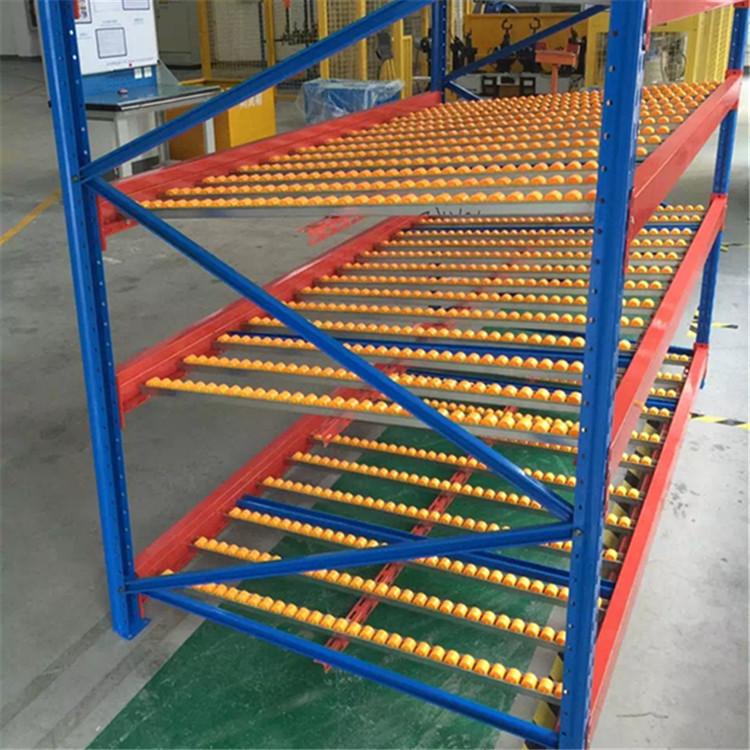
1. Operating Principle & Key Performance Variables
A gravity lane in flow through pallet racking relies on a controlled slope (typically 3‑5%) combined with low‑resistance rollers or wheels. When a pallet is removed from the front, the pallet behind it advances automatically. Five interdependent variables determine system reliability:
Slope angle – must overcome static friction but not cause excessive speed.
Roller/wheel material – steel, nylon, or polyurethane with sealed bearings.
Load range per lane – minimum to maximum pallet weight.
Lane depth – number of pallet positions (typically 6 to 15).
Brake mechanism – speed controllers or friction pads to prevent impact.
A 2022 study of 42 gravity lanes found that systems with adjustable brakes reduced front‑end impact force by 68% compared to non‑braked designs, extending component life by 4‑5 years.
2. Technical Design Parameters for Reliable Flow
2.1 Slope Calculation & Resistance Factors
The minimum slope required to initiate movement is given by tan(θ) = μs + (a/g), where μs is static coefficient of friction between pallet and roller. For clean steel rollers with wooden pallets, μs ≈ 0.12‑0.15. Adding a safety margin, the practical slope is 3‑4% (1.7°‑2.3°). However, for plastic pallets or humid environments, μs can rise to 0.25, requiring slopes of 5‑6%. Over‑sloping (above 6%) causes excessive terminal velocity, leading to pallet damage and rack impact. Standard flow through pallet racking designs from Guangshun include slope verification based on actual pallet samples.
2.2 Roller/Wheel Specifications & Bearing Selection
Three roller types dominate gravity lanes:
Steel rollers (1.5″‑2″ diameter) – high load capacity (up to 2,000 lbs per roller), but noisy and prone to corrosion. Require sealed ball bearings (Z‑type) with C3 clearance.
Nylon wheels on steel axles – quieter, lower rolling resistance (μr = 0.03‑0.05), but susceptible to creep under sustained load. Replace every 7‑10 years.
Polyurethane‑coated rollers – excellent grip for inclined lanes, reduce pallet skidding, but higher rolling resistance (μr = 0.08). Best for mixed pallet types.
Bearing life (L10) should exceed 50,000 hours at rated load. For lanes with more than 500 cycles per month, specify C4 bearing clearance to accommodate thermal expansion.
2.3 Lane Depth Limits & Braking Systems
Maximum lane depth is governed by accumulated pallet momentum. For a 10‑pallet lane (each 2,200 lbs) on a 4% slope, the kinetic energy at the front stop is approximately 8,500 ft‑lbs. Without braking, this will damage the end stop and the front pallet. Two braking solutions exist:
Mechanical speed controllers – centrifugal brakes mounted on roller axles, limiting speed to 0.3‑0.5 ft/s. Effective for lanes up to 12 deep.
Hydraulic dampers at lane end – absorb impact energy progressively. Required for lanes deeper than 15 positions or loads exceeding 3,000 lbs per pallet.
Most flow through pallet racking installations with depth >10 positions use a combination of speed controllers and a final shock absorber. Field data shows this reduces end‑stop replacement frequency from every 18 months to over 10 years.
3. Application Scenarios & Industry‑Specific Solutions
Three industries derive maximum ROI from gravity FIFO systems.
3.1 Food & Beverage (Date‑Sensitive)
Regulatory standards (e.g., FDA, BRCGS) require documented FIFO for perishable goods. Flow through lanes eliminate human error in stock rotation. A dairy processor installed 48 lanes of flow through pallet racking with stainless steel rollers (washdown‑compatible) and lane dividers. Within 12 months, expired product write‑offs dropped from 3.7% to 0.4% of revenue, repaying the racking investment in 14 months. The system also reduced fork‑truck travel by 42% because loading and unloading occur at separate ends.
3.2 Pharmaceutical & Batch‑Controlled Components
Traceability and batch separation are mandatory. Flow through lanes with dedicated lane IDs and barcode positions enable automated inventory tracking. A pharmaceutical distributor combined flow through pallet racking with a warehouse control system (WCS) that directs fork‑truck operators to load specific batches at the rear. The result: 100% FIFO compliance during audits and a 31% reduction in picking errors.
3.3 Automotive Just‑In‑Time (JIT) Sequenced Parts
JIT lines require precise part sequencing. Flow through lanes are integrated with conveyor take‑away systems at the front face. A tier‑1 automotive supplier uses 20‑deep gravity lanes for engine components. Each lane is assigned a single part number, and the front pallet is automatically released onto a roller conveyor when the line calls for it. This arrangement cut buffer stock by 28% while maintaining 99.5% line availability.
4. Structural Components & Material Selection
A complete gravity lane consists of five subsystems:
Upright frames – heavy‑duty C‑sections (100‑120 mm depth) with 50 mm beam pitch. For lanes >12 deep, use closed RHS columns to resist front‑end impact.
Roller beds – two or three roller tracks per lane (depending on pallet construction). Center guide tracks prevent pallet skew.
Lane separators – 2″×2″ angle iron or tubular guides mounted vertically between lanes.
End stops – shock‑absorbing bumpers (urethane or rubber) with steel back plates.
Safety netting or panels – installed on the rear face to prevent pallet over‑travel during loading.
Hot‑dip galvanizing (ISO 1461, 85 µm minimum) is recommended for cold storage or high‑humidity environments. For dry warehouses, electrostatic powder coating (60‑80 µm) provides adequate protection. Guangshun offers both options with 10‑year corrosion warranties.
5. Installation Tolerances & Maintenance Protocols
Precision installation is mandatory. The slope must be consistent across all lanes within ±0.1% to prevent pallet drift. Laser alignment tools verify roller bed flatness to ±1 mm over 12 m. After installation, a “flow test” is performed with empty and loaded pallets: travel time from rear to front should be 4‑8 seconds for a 10‑deep lane. Deviations indicate roller binding or excessive slope.
Quarterly maintenance includes:
Cleaning roller surfaces with compressed air and non‑residual degreaser.
Checking bearing play – any roller that spins more than 3 seconds after a hand push requires bearing replacement.
Inspecting brake units for wear – speed controller friction pads typically last 50,000 cycles.
Verifying end stop shock absorber stroke – replace if compressed more than 70% of original.
A neglected gravity lane can develop “rat holing” (pallets jam due to roller flat spots) or “runaway” (excessive speed). Annual certification per RMI/FEM standards includes dynamic load testing.
6. Economic Analysis: Flow Through vs. Drive‑In vs. Selective Racking
For a facility storing 3,000 pallets of date‑sensitive goods (turnover 6× per year), we compared three systems over 10 years:
Selective racking (FIFO by labor) – $210,000 initial, $78,000 annual labor for rotation, $15,000 annual expired product loss → TCO $210k + 10×($93k) = $1.14M.
Drive‑in racking (LIFO) – $165,000 initial, $42,000 annual labor (simpler but still manual rotation), $62,000 annual expired loss (due to LIFO) → TCO $165k + 10×($104k) = $1.205M.
Flow through pallet racking – $285,000 initial (higher component cost), $9,000 annual maintenance, $2,500 expired loss → TCO $285k + 10×($11.5k) = $400,000.
Flow through provides the lowest total cost of ownership despite higher upfront investment. Payback period vs. selective racking is 2.3 years. Many operators overlook these numbers and continue using inefficient methods.
7. Common Failure Modes & Remedial Actions
Even well‑designed gravity lanes experience three frequent issues:
Pallet jamming (skewing) – caused by uneven roller wear or missing lane guides. Remedy: install self‑centering rollers with a V‑groove profile or add side guides every 4 ft.
Accelerated roller wear – from dirty or abrasive pallets (e.g., concrete residue). Solution: specify nylon rollers with sealed bearings and schedule monthly cleaning.
End stop fatigue cracking – due to under‑sized shock absorbers. Upgrade to hydraulic dampers with 150% of calculated impact energy rating.
For facilities experiencing repeated jams, a root‑cause analysis often reveals that the slope was measured only at installation but changed due to floor settling. Re‑laser every 24 months and adjust shims.
Frequently Asked Questions (Engineering Focus)
Q1: What is the maximum lane depth for reliable flow through pallet racking without auxiliary drive?
A1: For standard wooden pallets (1,000‑2,200 lbs) on steel rollers with a 4% slope, the practical maximum depth is 12 pallet positions. Beyond 12, the cumulative momentum at the front exceeds 10,000 ft‑lbs, requiring active braking. With hydraulic dampers and speed controllers, depths up to 20 are feasible, but each additional position increases end‑stop wear exponentially. Always perform a dynamic simulation using the supplier’s energy dissipation curves.
Q2: How do I determine the correct roller spacing for different pallet types?
A2: Rollers must support the pallet’s bottom boards. For GMA standard pallets (40″×48″ with three bottom boards), roller spacing should be 4‑6″ on center to ensure at least two rollers contact each board. For plastic pallets with a solid bottom, spacing can be increased to 8‑10″. However, wider spacing increases point loading and may deform plastic pallets. The general rule: maximum unsupported span = 30% of pallet length. Guangshun provides a roller spacing calculator based on pallet drawings.
Q3: Can flow through pallet racking be used in cold storage (-20°C)?
A3: Yes, but with material adjustments. Standard steel rollers seize due to ice formation and lubricant thickening. Specify stainless steel rollers (grade 304) with synthetic low‑temperature grease (operating range -40°C to +80°C). Nylon wheels become brittle below -10°C and are not recommended. Also, the slope must be increased by 0.5‑1% to compensate for higher rolling resistance from ice. Defrost cycles must be scheduled to prevent ice buildup on roller tracks. Several cold‑storage operators use flow through pallet racking successfully with monthly dry‑ice cleaning.
Q4: How do I integrate flow through lanes with an automated pallet shuttle?
A4: Gravity lanes can be loaded by a shuttle at the rear, but retrieval at the front is typically manual or via conveyor. For fully automated retrieval, replace the standard end stop with a motorized roller section that transfers the pallet to a conveyor. The shuttle must communicate with the flow lane’s sensor (e.g., photo‑eye at the front) to avoid double‑stacking. A Belgian logistics center integrated 24 gravity lanes with a pallet shuttle system, achieving 120 picks per hour per lane – 3× faster than manual retrieval.
Q5: What fire safety requirements apply to flow through pallet racking?
A5: Per NFPA 13, in‑rack sprinklers are mandatory when storage height exceeds 12 ft for Class III commodities. Gravity lanes create horizontal flues (the open space between pallets), which accelerate fire spread. Therefore, sprinkler spacing must be reduced to 8 ft along the lane, and each lane must have a vertical barrier (solid steel panel) every 20 ft to prevent horizontal fire travel. Additionally, roller bearings should be tested for ignition temperature – only sealed, grease‑packed bearings with a melting point above 250°F are permitted. Consult a fire protection engineer for a CFD model of your specific lane configuration.
Q6: How often should I replace rollers and bearings in high‑throughput gravity lanes?
A6: For lanes with >1,000 pallet movements per month, replace bearings every 5 years and rollers every 8‑10 years. Use L10 bearing life calculation: L10 (hours) = (C/P)^3 × 1,000,000 / (60 × RPM). For a typical 1.5″ steel roller under 500 lb radial load, L10 ≈ 35,000 hours (4 years). When 10% of bearings show audible grinding or increased rolling resistance, schedule a full lane overhaul. Guangshun offers predictive maintenance contracts using vibration analysis on roller assemblies.
Specifying flow through pallet racking requires rigorous attention to slope accuracy, roller specification, braking capacity, and lane depth limits. When correctly engineered, these systems deliver verifiable FIFO compliance, reduce product expiration losses, and lower material handling labor by 40‑60%. For facilities with date‑sensitive or batch‑controlled inventory, gravity lanes offer the lowest total cost of ownership. Work with an experienced manufacturer like Guangshun to obtain certified slope calculations, roller load ratings, and seismic bracing designs that meet RMI/ANSI and local building codes.