Selecting among the various warehouse racking types is a strategic decision that directly impacts storage density, operational throughput, and long-term capital efficiency. From selective systems offering 100% accessibility to high-density solutions like drive-in or mobile racks, each configuration presents distinct structural characteristics, load limits, and space utilization profiles. At Guangshun, we engineer racking systems that balance these factors, ensuring compatibility with existing material handling equipment and compliance with international safety standards. This guide provides a technical breakdown of the primary racking types, supported by load data and application insights.
Selective Pallet Racking: The Benchmark for Accessibility
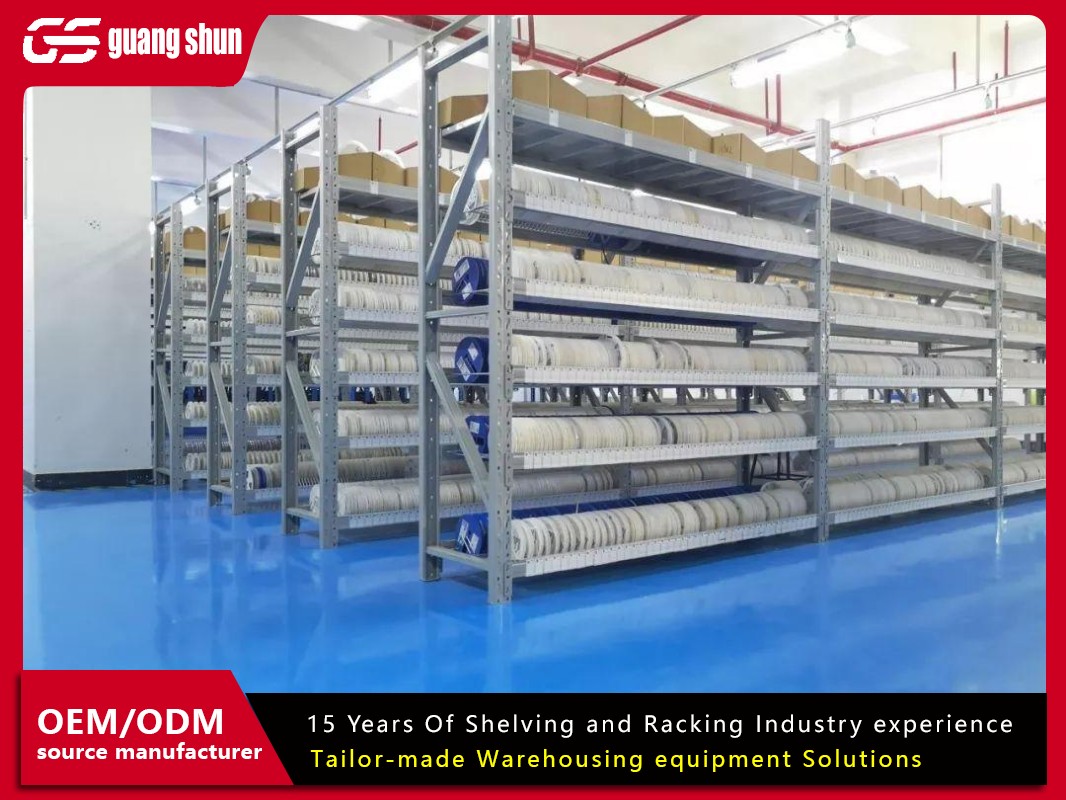
Selective racking remains the most widely adopted among warehouse racking types due to its direct access to every pallet position. It consists of upright frames and horizontal beams, forming bays that accommodate standard pallets (800x1200 mm or 1000x1200 mm).
Load capacity: Beams typically support 1,500–3,000 kg per level, with uprights rated for up to 12,000 kg per bay.
Advantages: 100% SKU accessibility, simple FIFO/LIFO operation, and compatibility with all forklift types.
Limitations: Aisle space consumes 40–50% of floor area, resulting in lower density.
Typical applications: E‑commerce fulfillment, mixed SKU warehouses, and environments requiring frequent picking.
Guangshun’s selective systems are available with various beam profiles (box section, step beams) and optional boltless connections for rapid reconfiguration.
Drive-In and Drive-Through Racking: Maximizing Cube Utilization
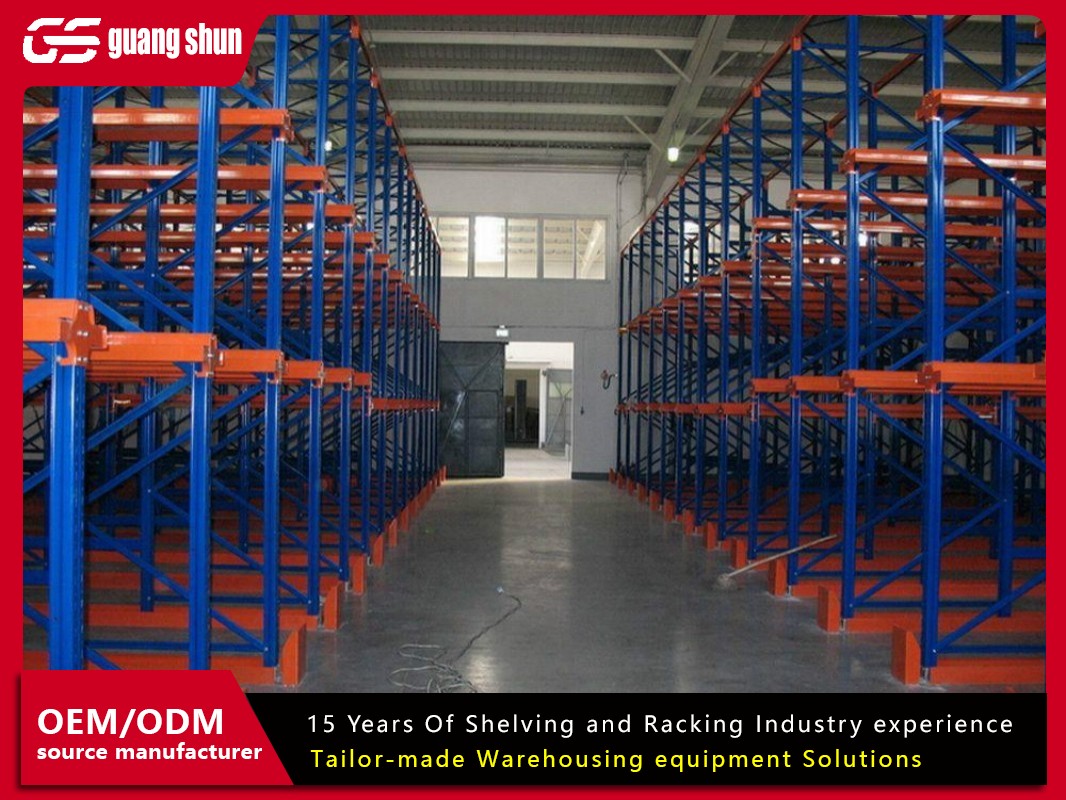
For uniform products with high pallet counts per SKU, drive-in and drive-through systems eliminate aisles by allowing forklifts to enter the rack structure. These warehouse racking types store pallets on continuous rails, with entry either from one side (drive‑in, LIFO) or both sides (drive‑through, FIFO).
Structural design: Uprights are spaced 1.0–1.2 m apart, with reinforced rails at each pallet level. Column protection (steel guards) is mandatory due to frequent forklift entry.
Load capacity: Rails support up to 1,500 kg per pallet; lane depths of 3–5 pallets are typical.
Space efficiency: Can increase storage density by 60–80% compared to selective racking.
Industry use: Cold storage, beverage distribution, and bulk dry goods.
Guangshun offers both galvanized and epoxy finishes for these systems, with optional rail guides to keep forklifts centered and reduce impact damage.
Push Back Racking: Gravity‑Assisted Density
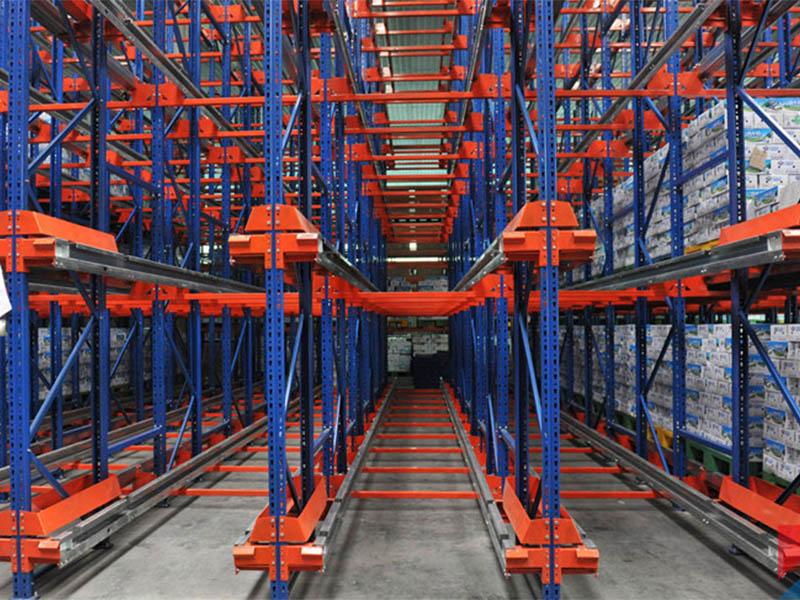
Push back systems use nested carts that move on inclined rails. When a new pallet is loaded, it pushes the existing pallets rearward. This configuration offers higher density than selective (2–4 pallets deep) while maintaining LIFO rotation.
Mechanism: Each level has a set of carts (usually 2–4) that travel on rails. The system requires a slight slope (3–5%) for smooth cart movement.
Load capacity: Carts are rated for 1,000–1,500 kg, with overall beam loads up to 3,000 kg per level.
Advantages: Reduced aisle count, good selectivity for up to four SKUs per lane, and no forklift entry into the rack (safer than drive‑in).
Typical applications: Moderate‑turnover products, cold storage, and warehouses with limited forklift maneuverability.
Guangshun designs push back systems with sealed bearings and adjustable slope to accommodate various load weights and environmental conditions.
Pallet Flow (Gravity Flow) Racking: Dynamic FIFO Solutions
Pallet flow racks use gravity rollers or wheels to move pallets from the loading (high) end to the unloading (low) end. These warehouse racking types are ideal for perishable goods requiring strict FIFO rotation.
Engineering parameters: Lane depth can reach 15 pallets; roller pitch and slope (typically 3–5%) are calculated based on pallet weight and condition (e.g., bottom boards, wrappers). Speed controllers regulate descent to prevent impact.
Load capacity: Roller tracks support up to 1,200 kg per pallet; multiple tracks per lane.
Applications: Food & beverage, pharmaceuticals, and any industry with expiration‑sensitive inventory.
Safety features: Pallet separators at the front end prevent runaway pallets and allow safe picking.
Guangshun provides customized roller configurations (galvanized steel, PVC) and can integrate braking systems for mixed load profiles.
Mobile Racking: Maximum Density with Movable Carriages
Mobile racking systems mount rack blocks on motorized carriages that move laterally along floor rails. By opening only one aisle at a time, these warehouse racking types can double storage capacity compared to selective systems.
Structural requirements: Heavy‑duty carriages, precision rails, and drive motors. Floor flatness must meet FM 2 standards (≤3 mm over 3 m).
Load capacity: Carriages can support up to 30 tons; racking itself is similar to selective but with reinforced base connections.
Advantages: Up to 90% space utilization, ideal for expensive real estate (cold stores, archives).
Safety systems: Passive infrared sensors, pressure mats, and emergency stops.
Guangshun supplies mobile systems with PLC controls and remote monitoring, ensuring reliable operation in high‑throughput environments.
Cantilever Racking: Specialized Storage for Long Loads
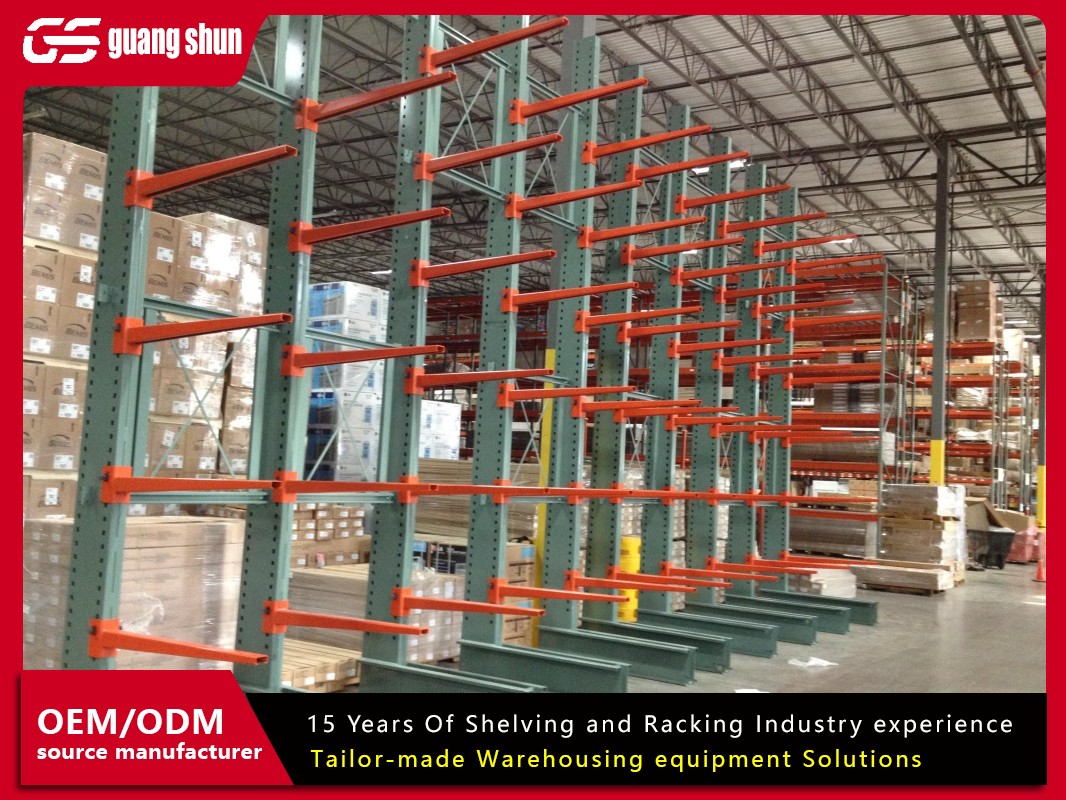
While not always included in general warehouse racking types discussions, cantilever systems are essential for lumber, pipes, and furniture. Arms extend from a central column, supporting long items without front obstructions.
Design: Columns braced with horizontal and diagonal ties; arms adjustable vertically (every 100 mm).
Load capacity: Arms typically support 500–2,500 kg per side; columns rated up to 10,000 kg.
Applications: Steel service centers, timber yards, and retail backrooms.
Customization: Guangshun offers tapered arms for easier loading and galvanized finishes for outdoor use.
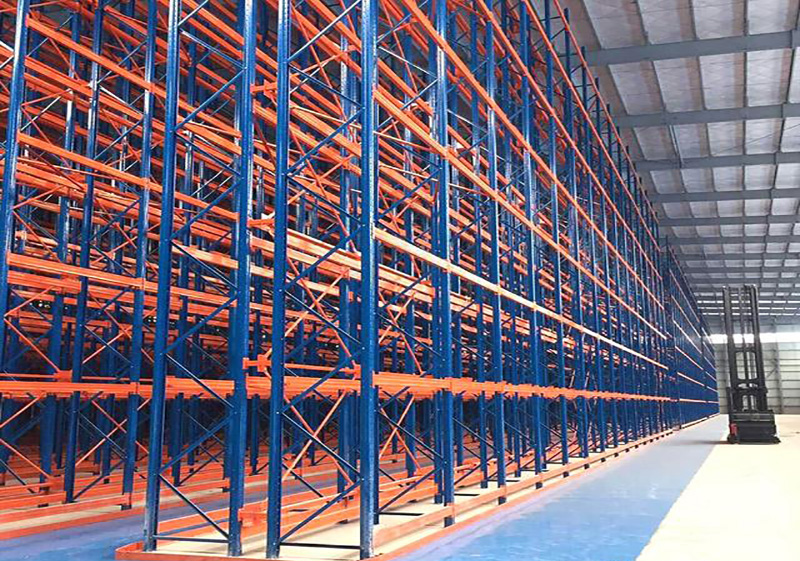
Engineering the Selection: Matching Racking Types to Operational Profiles
Choosing the appropriate warehouse racking types requires a systematic evaluation of four parameters:
1. SKU Proliferation and Turnover
High SKU count with low quantity per SKU → selective racking. Few SKUs with high pallet counts per SKU → drive‑in, push back, or pallet flow.
2. Inventory Rotation (FIFO vs. LIFO)
Perishable goods require FIFO → pallet flow or drive‑through. Uniform products where age is irrelevant can use LIFO → drive‑in or push back.
3. Throughput Requirements
High picks per hour → selective or mobile (with fast carriage movement). Low/medium → dense systems like drive‑in.
4. Building Constraints
Ceiling height, column spacing, floor flatness, and seismic zone influence maximum rack height and type suitability. Guangshun engineers perform on‑site surveys to verify floor conditions and recommend appropriate anchor systems.
Material Specifications and Structural Integrity Across Racking Types
All warehouse racking types must comply with recognized standards (FEM, RMI, EN 15512). Key material specs include:
Steel grade: S235JR to S355MC, with yield strength ≥235–355 MPa. Hot‑rolled for uprights, cold‑formed for beams.
Coatings: Powder coating (60–80 μm) for indoor use; hot‑dip galvanizing for cold stores or outdoor.
Tolerances: Upright verticality ≤1:500, beam deflection ≤L/200 under full load.
Safety factors: Typically 1.6–1.8 against yield, accounting for impact and seismic loads.
Guangshun provides certified test reports for all components, including weld integrity and coating thickness.
Installation Best Practices and Preventive Maintenance
Regardless of the warehouse racking types chosen, installation quality determines long‑term safety and performance:
Floor marking and anchor drilling: Use laser‑guided templates to ensure upright placement accuracy.
Torque control: All anchor bolts and beam connectors must be tightened to specified torque (e.g., M14 anchors at 80 Nm).
Plumbness verification: Check each frame with a digital theodolite; adjust with shims if needed.
Safety accessories: Install row spacers, wall ties, and protective guards per design.
Quarterly inspections should focus on damaged uprights, missing safety clips, and anchor integrity. Guangshun offers training for in‑house inspection teams.
Frequently Asked Questions on Warehouse Racking Types
Q1: What is the most cost‑effective warehouse racking type for a mixed‑SKU warehouse?
A1: Selective pallet racking generally offers the best combination of cost and flexibility for mixed SKUs. It provides 100% accessibility and can be reconfigured easily. For very high density with some selectivity, push back or mobile racks may be considered, but their initial investment is higher.
Q2: Can I mix different racking types in the same warehouse?
A2: Yes, hybrid layouts are common. For example, using selective racking for fast‑movers near shipping docks, and drive‑in or pallet flow for bulk storage of slow‑movers deeper in the facility. Guangshun can design integrated systems with seamless transitions.
Q3: How do I determine the maximum rack height for my building?
A3: Height is limited by forklift lift capacity, ceiling height, and seismic requirements. Typically, racks can be built to within 1 m of the ceiling, but seismic zones may impose lower limits. A structural engineer should evaluate column loads and building tie‑in points.
Q4: What safety certifications should I look for?
A4: Look for compliance with EN 15512 (Europe), RMI ANSI MH16.1 (USA), or AS4084 (Australia). Components should be tested for static and dynamic loads, and seismic certification if applicable. Guangshun provides certificates for all systems.
Q5: Are there racking types specifically for automated warehouses?
A5: Yes, for AS/RS (automated storage and retrieval) applications, specialized racking with tighter tolerances and integrated guide rails is used. These systems are often designed to interface with stacker cranes and may include captive pallet supports.
Q6: How often should racking be inspected?
A6: Industry best practice recommends monthly visual inspections by operators and a formal annual inspection by a qualified engineer. After any significant impact, an immediate inspection is required.
Q7: What is the typical lead time for custom racking from Guangshun?
A7: For standard configurations, 4–6 weeks from order approval. Custom colors, seismic designs, or special coatings may extend to 8–10 weeks. We provide 3D layout drawings within 3 days of receiving your warehouse plan.
Selecting from the diverse warehouse racking types available today requires a deep understanding of both structural engineering and operational logistics. Whether you prioritize accessibility, density, or FIFO compliance, the right system will pay for itself through improved space utilization and labor efficiency. Guangshun brings decades of expertise in manufacturing and installing all major racking types, backed by full technical documentation and after‑sales support. Contact our engineering department to discuss your specific storage challenges and request a preliminary load calculation.