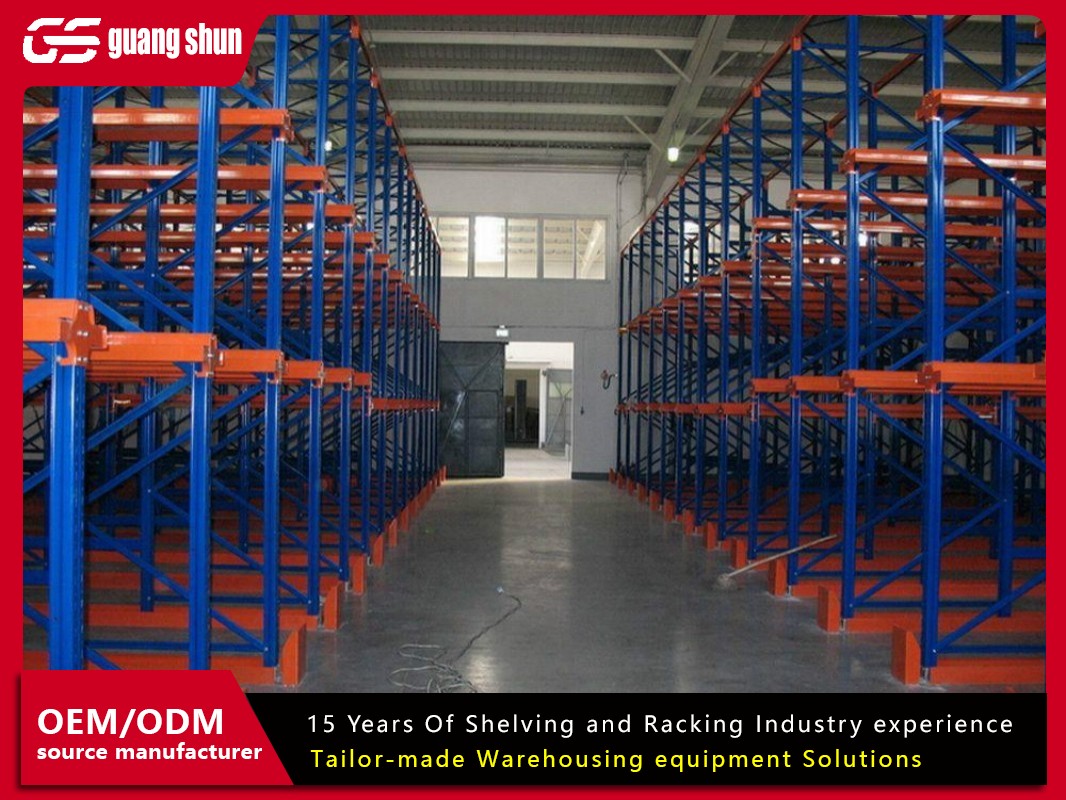
In warehouses where identical pallets must be stored in high volumes—such as beverage distribution centers or deep‑freeze logistics—conventional selective racking creates aisles that consume valuable floor space. drive through pallet racking eliminates this waste by allowing forklifts to enter the rack structure itself, depositing and retrieving pallets from continuous lanes. The result is a dense block of storage with minimal aisles, ideal for first‑in first‑out (FIFO) rotation when both ends are accessible. At Guangshun, we engineer these systems to withstand decades of forklift traffic while maintaining precise load distribution.
Structural Anatomy of Drive Through Systems: Frames, Rails, and Protective Elements
A drive through pallet racking installation consists of several engineered sub‑assemblies that work together to support dynamic loads and repeated forklift entry:
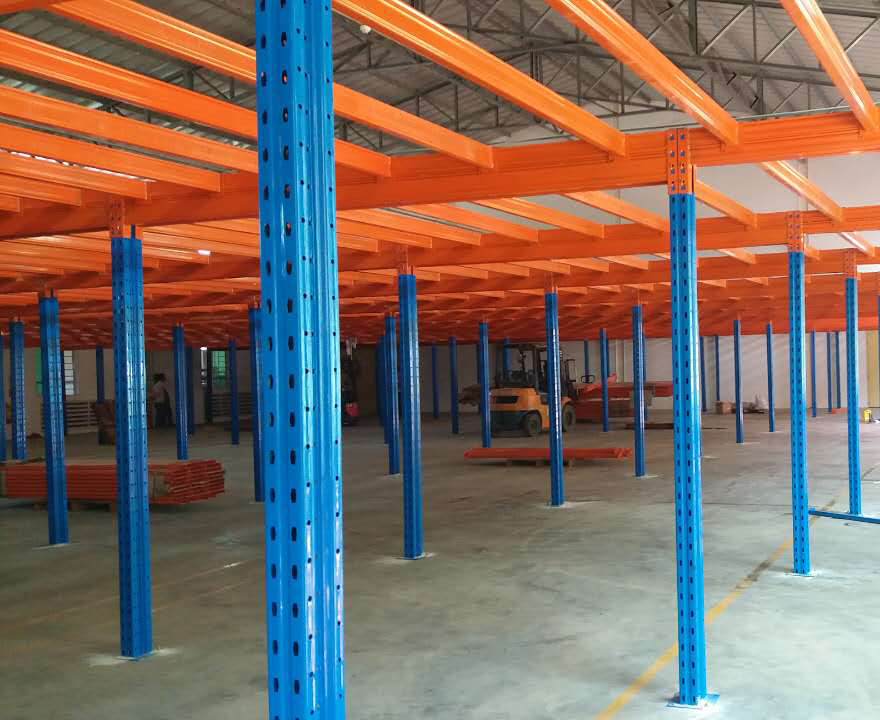
Upright frames: Roll‑formed from high‑strength steel (Q355B grade) with thicknesses of 2.5–3.5 mm. Frames are typically 8–12 m tall and include horizontal and diagonal bracing to resist longitudinal forces.
Beams and rail supports: Unlike selective racking, drive through systems often use horizontal beams at the front and rear, while pallets rest on continuous steel rails or reinforced beam levels. This configuration creates a tunnel‑like lane for the forklift.
Column protection: Because forklifts operate inside the rack, heavy‑gauge steel guard rails or impact‑absorbing polyurethane bumpers are installed on uprights facing the aisle. Guangshun offers double‑thick base plates and welded‑on corner protectors.
Rail guidance systems: To keep forklifts centered and avoid side impacts, floor‑mounted guide rails can be integrated. These reduce the required steering precision and increase safety.
The structural design must account for both static loads (up to 2,000 kg per pallet position) and dynamic forces when forklifts enter at speeds up to 8 km/h.
Solving the Cold‑Storage Dilemma: Maximizing Cube Utilization
In refrigerated warehouses, every cubic meter is expensive to maintain. drive through pallet racking is particularly effective in this environment because it reduces the number of aisles, allowing more pallets within the same refrigerated volume. A recent project for a European frozen food processor replaced 2,500 m² of selective racking with a drive through pallet racking block, increasing storage capacity by 70% while maintaining FIFO rotation for perishable goods. The system features:
Four‑pallet‑deep lanes on both sides of a central aisle.
Hot‑dip galvanized finish to withstand condensation and frequent wash‑downs.
Reinforced rail supports to handle 1,400 kg frozen pallets.
For dry goods like canned beverages or bottled water, the same density gains apply. A major Asian beverage distributor reported a 55% reduction in travel distance after converting to drive‑through blocks, directly translating to lower fuel costs and higher throughput.
Load Dynamics: Ensuring Structural Integrity Despite Continuous Forklift Impact
The greatest engineering challenge in drive through pallet racking is not the static load, but the repeated horizontal impacts from forklifts entering and exiting lanes. Guangshun designs for these forces by:
Increasing frame stiffness: Using closed‑section uprights and thicker steel in the lower 2 m of the column.
Adding sacrificial components: Replaceable impact guards absorb energy without damaging primary structure.
Designing for seismic zones: In earthquake‑prone regions, additional cross‑aisle bracing and larger base plates are specified. Finite element analysis (FEA) validates that the system remains stable under both seismic and operational loads.
All designs comply with FEM 10.2.02 or RMI standards, with safety factors typically 1.8 against yield. Regular inspection protocols are essential—any bent upright must be replaced immediately, never straightened.
How to Specify the Right Drive Through Pallet Racking Configuration
Selecting an optimal drive through pallet racking system requires a multi‑factor analysis:
1. Depth of lanes and forklift type
Lane depth is typically 2 to 5 pallets. Standard counterbalanced forklifts can handle up to 4‑deep with good visibility; for deeper lanes, reach trucks or specialized deep‑reach trucks are recommended. Aisle width inside the rack must accommodate the truck’s turning radius—usually 2,700–3,200 mm.
2. FIFO vs. LIFO requirements
If the operation requires strict FIFO (e.g., perishable foods), the system must be pass‑through, with entry and exit on opposite sides. For LIFO applications (e.g., uniform stock where age is irrelevant), single‑sided drive‑in racking may suffice, but the term “drive through” implies both ends open.
3. Floor flatness and load‑bearing capacity
Drive through racks transfer heavy point loads to the floor through base plates. A concrete slab of at least 200 mm thickness with reinforcement is required, and flatness must meet FM 2 standard (±3 mm over 3 m). Guangshun provides shim packs to compensate for minor irregularities.
4. Environmental factors
For cold stores, galvanized or epoxy‑coated systems resist corrosion. For outdoor applications, hot‑dip galvanizing is recommended.
Guangshun engineers work with clients to produce 3D layouts and load calculations, ensuring the system integrates seamlessly with existing warehouse workflows.
Installation Precision and Long‑Term Reliability
Proper installation of drive through pallet racking is as critical as its design. Key steps include:
Laser surveying: The floor is marked with grid lines, and anchor positions are drilled with tolerance ≤5 mm.
Frame erection: Uprights are plumbed to within 1:500 and anchored with torque‑controlled expansion anchors (typically M16–M20).
Rail alignment: If rail guides are used, they must be parallel and level to ensure forklifts track straight.
Impact guard installation: Guards are bolted to the uprights at precisely the height where fork contact is most likely (usually 300–600 mm above floor).
Maintenance inspections should be conducted monthly, focusing on:
Visible damage to uprights (dents, bends).
Missing or loose safety pins in beam connectors.
Anchor bolt integrity (torque testing annually).
With proper care, these systems routinely achieve service lives exceeding 25 years.
Frequently Asked Questions on Drive Through Pallet Racking
Q1: What is the difference between drive through and drive in pallet racking?
A1: Drive through racking has openings at both ends of the lane, allowing forklifts to enter from one side and exit from the opposite side, which supports first‑in first‑out (FIFO) inventory rotation. Drive in racking has only one opening, requiring last‑in first‑out (LIFO) handling. Both are high‑density systems, but the choice depends on your inventory turnover requirements.
Q2: Can I use drive through racking for FIFO with multiple SKUs per lane?
A2: Generally, drive through lanes are dedicated to a single SKU to maintain FIFO discipline. Mixing SKUs in one lane would complicate traceability and may cause picking errors. However, with modern warehouse management systems (WMS) and clear lane labeling, it is possible if products are identical in dimensions and rotation requirements.
Q3: What are the typical load capacities per pallet position?
A3: Standard designs support 1,000–1,500 kg per pallet. For heavier loads (up to 2,500 kg), Guangshun uses reinforced beams and closer upright spacing. The overall system capacity depends on frame strength and number of pallet levels.
Q4: How do I protect the rack from forklift damage?
A4: Install robust column guards (steel or polyurethane) on all uprights facing the aisle. Additionally, floor‑mounted guide rails help steer forklifts and prevent side collisions. Operator training and speed limits inside the rack are equally important.
Q5: Is drive through racking suitable for seismic areas?
A5: Yes, with proper engineering. The system must include extra bracing, heavier base plates, and be anchored to meet local seismic codes (e.g., IBC, Eurocode 8). Guangshun provides seismic calculations and can supply certified systems for high‑risk zones.
Q6: What is the maximum recommended lane depth for safe forklift operation?
A6: For standard counterbalanced forklifts, 4‑pallet‑deep lanes are common. With reach trucks or specialized deep‑reach models, depths of 5–6 pallets are feasible. Deeper lanes reduce visibility and increase the risk of product damage, so we recommend evaluating operator ergonomics before exceeding 4‑deep.
Q7: Can drive through racking be installed in an existing warehouse with uneven floors?
A7: Yes, but significant floor unevenness must be corrected with grinding or leveling compound. The system can be shimmed at base plates to compensate for minor deviations, but extreme slopes compromise stability. A site survey by Guangshun will determine if modifications are needed.
Implementing drive through pallet racking is a proven strategy to increase warehouse density while maintaining direct access to each pallet. Whether you operate a cold‑storage facility or a high‑volume distribution center, the engineering behind these systems ensures safety, durability, and a rapid return on investment. Guangshun combines decades of structural expertise with practical operational insights to deliver turnkey solutions tailored to your specific loads and workflows. Contact our engineering team today to discuss your density goals and schedule a preliminary site assessment.