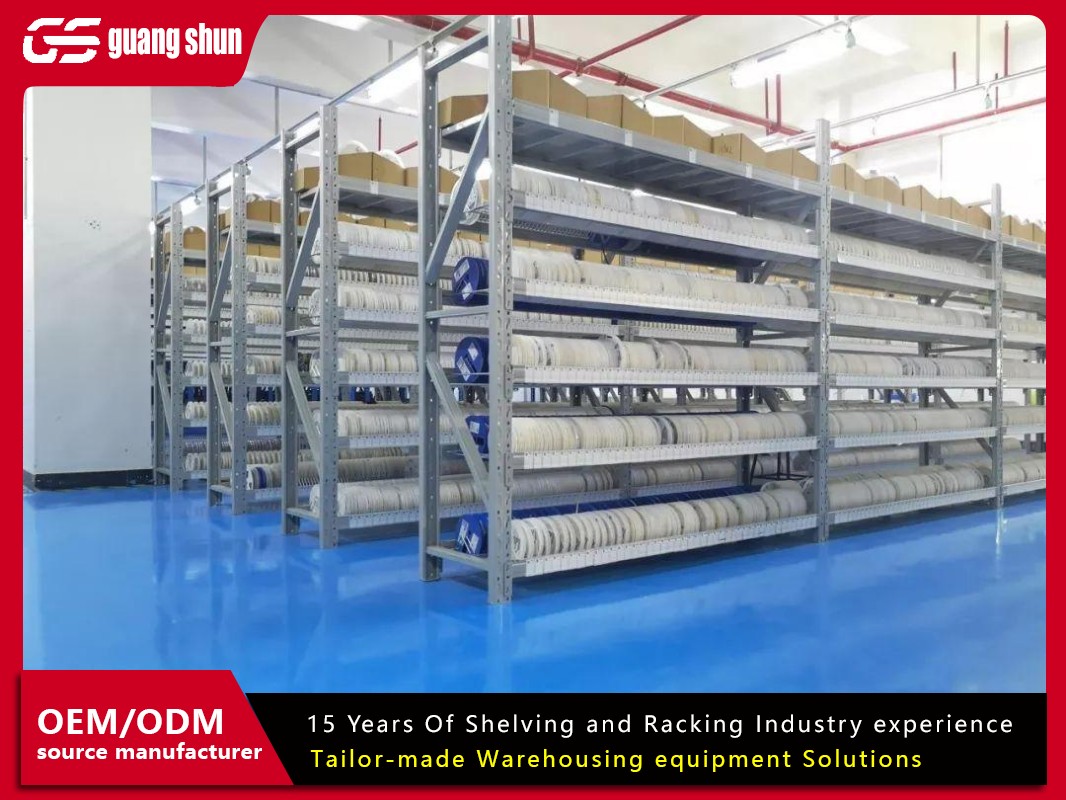
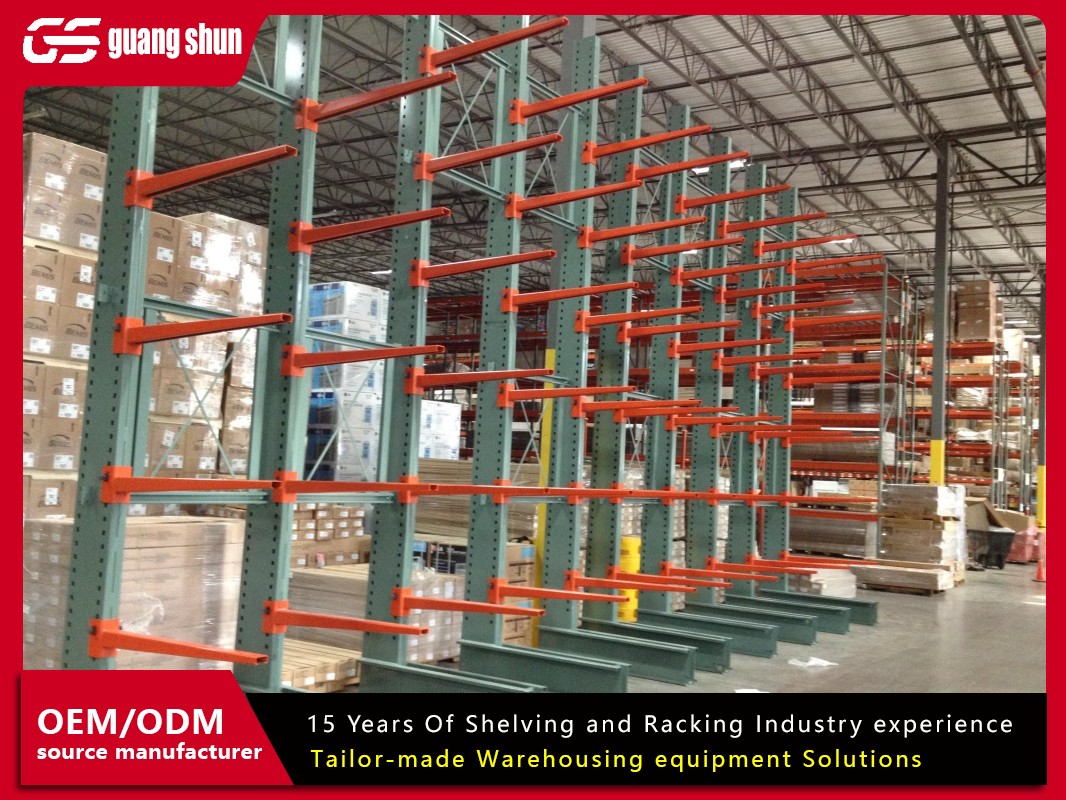
Across the logistics sector, the selection of warehouse shelving storage directly determines
order-picking accuracy, cubic utilization, and total cost of ownership over a
10‑year horizon. For distribution centers handling SKU proliferation—often
exceeding 50,000 items—the shelving architecture must balance static load
requirements with dynamic access frequencies. This article examines structural
mechanics, modular configurations, and real-world performance data, drawing on
installations executed by Guangshun across automotive, e‑commerce, and
cold-chain facilities.
1. Load Path Fundamentals and Material Selection
Every warehouse shelving storage system begins with
compressive strength of uprights and beam-to-column connections. Standard rolled
steel sections (ASTM A36 or equivalent) with gauge thicknesses from 1.5 mm to
2.5 mm are common, but high-corrosion environments demand galvanized or
powder-coated finishes. The critical metric is the column capacity at given
height: a 5‑meter upright with 100 mm × 80 mm cross-section can support
8‑12 tons per leg, provided bracing intervals do not exceed 1.2 m. Lateral
stability against forklift impact—often rated at 0.5 g horizontal
acceleration—requires base plates bolted to a reinforced floor slab of at least
150 mm thickness.
Beam design follows the moment of inertia (I‑value) relative to the span. For
a 2.7‑m beam span, a section of 120 mm height yields deflection under full
uniform load of less than L/240, meeting RMI (Rack Manufacturers Institute)
standards. When integrating wire decking or particle boards, the load
distribution changes from point loads to area pressure, reducing stress
concentrations by up to 30 %. These factors are non‑negotiable when specifying
warehouse shelving storage for heavy dies, palletized drums, or
long steel pipes.
2. Configurational Archetypes: Selective, Drive‑In, and Push‑Back
Choosing the right shelving topology requires mapping SKU velocity and batch
sizes. Below are three dominant models, each with distinct trade‑offs in density
versus accessibility.
2.1 Selective Pallet Racking
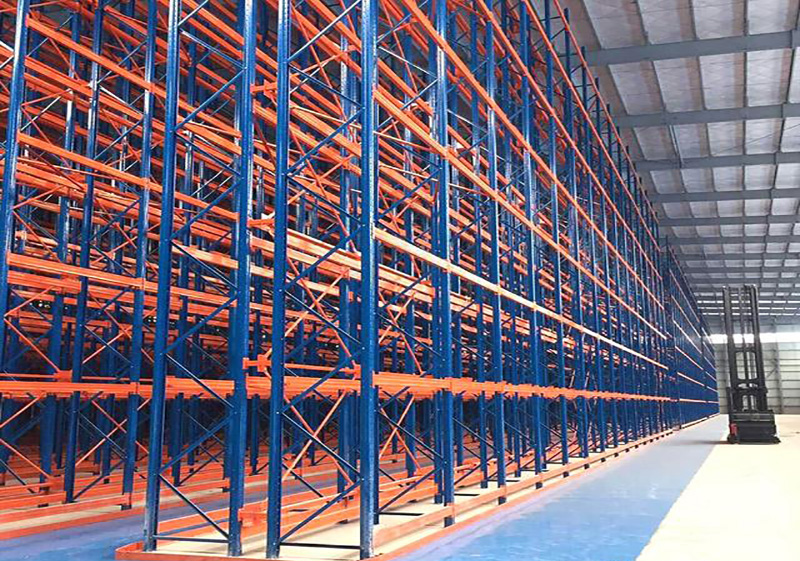
This remains the industry baseline: each pallet position is directly
accessible from the aisle. Floor‑to‑ceiling heights of 12 m are feasible with
narrow‑aisle reach trucks (1.8 m aisle width). The primary advantage is 100 %
selectivity, making it suitable for FIFO (first‑in, first‑out) inventory with
high turnover. However, cube utilization drops to 30‑40 % because aisles consume
nearly half the floor area. For operations with 2,000+ daily picks, selective
systems deliver a picking error rate below 0.5 % when paired with pick‑to‑light
indicators.
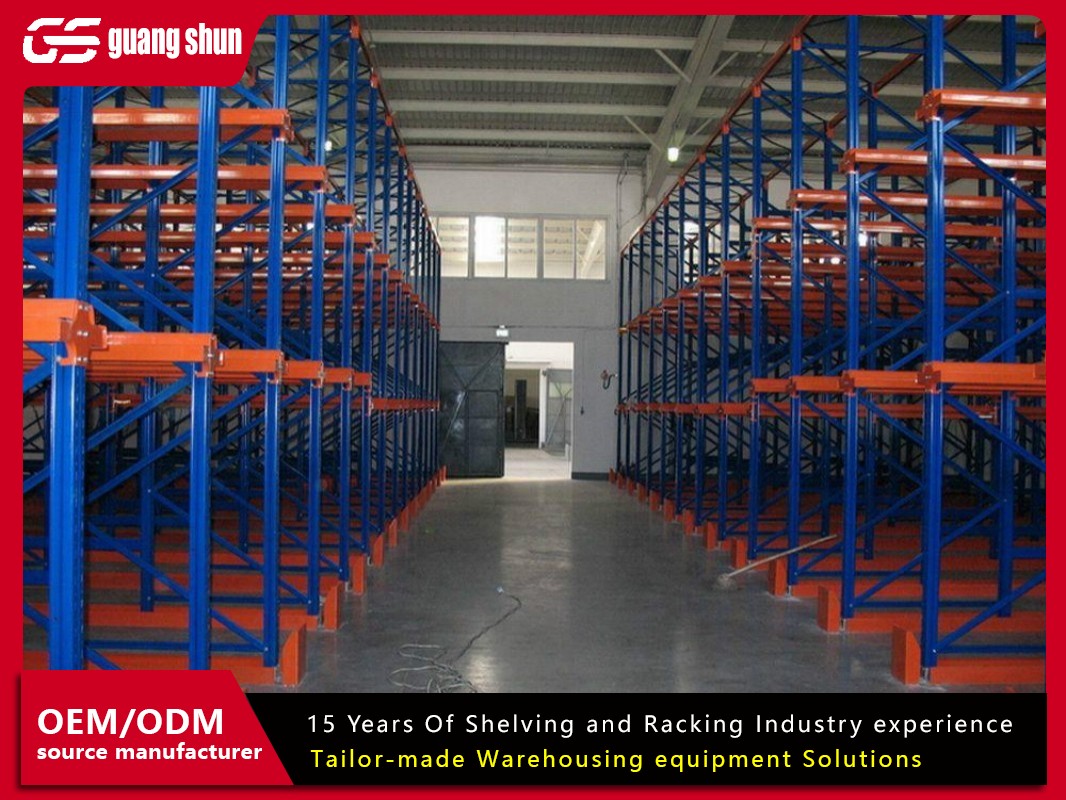
2.2 Drive‑In / Drive‑Through Racking
For bulk storage of homogeneous products—e.g., paper rolls, bagged
chemicals—drive‑in racks allow forklifts to enter the storage lane from one
side, storing pallets on cantilevered rails. Density improves to 60‑70 % floor
utilization, but LIFO (last‑in, first‑out) flow limits application. Structural
design must account for eccentric loads: the rail supports must withstand 6‑8 kN
per pallet without excessive deflection. Aisle depths up to 10 pallets deep are
possible, yet retrieval time increases linearly with depth, so this
configuration suits production‑line buffer zones rather than direct order
fulfillment.
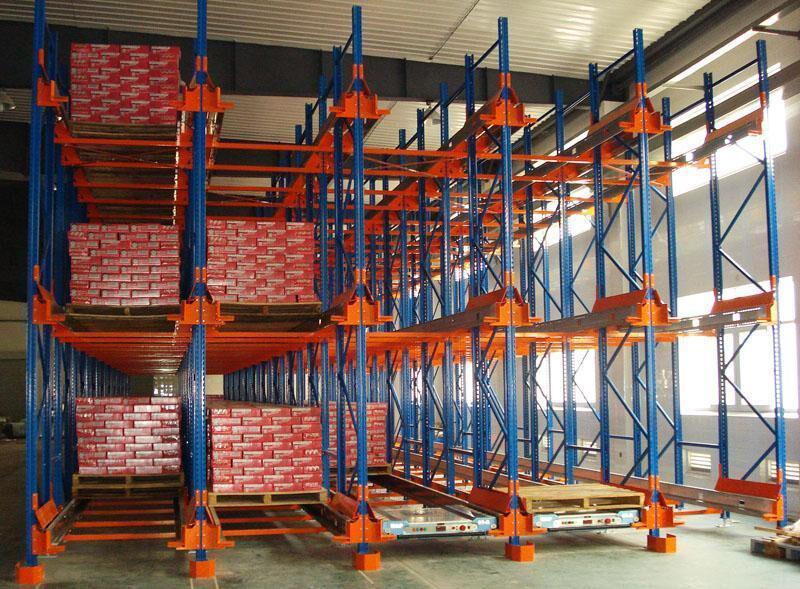
2.3 Push‑Back Racking
Push‑back systems incorporate nested carts on inclined rails; each new pallet
pushes the previous one backward. When the front pallet is removed, the rear
pallet glides forward. This combines density (up to 55 % utilization) with
improved selectivity over drive‑in. The engineering challenge lies in cart wheel
durability—polyurethane‑coated steel wheels must withstand 20,000 cycles without
flat‑spotting. Load capacities per cart typically range from 1,000 to 1,500 kg.
For cold stores at ‑25 °C, special low‑temperature grease and anti‑corrosion
bearings are mandatory.
At Guangshun, we have observed that hybrid
designs—combining selective racking for fast‑movers with drive‑in for
slow‑movers—often yield the best overall ROI, reducing travel time by 18 %
compared to single‑type layouts.
3. Seismic Performance and Anchoring Strategies
In seismic zones (e.g., California, Japan, Chile), the warehouse
shelving storage structure must be designed per ASCE 7‑22 or equivalent
codes. The base shear coefficient (Cs) depends on the site class and spectral
acceleration. For a 10‑m high rack with a fundamental period of 0.4 s, Cs often
exceeds 0.3 g. This demands anchor bolts embedded to 150 mm depth in concrete
with a compressive strength of 30 MPa. Additionally, horizontal diagonal bracing
should be placed every third bay, using angles of 50 mm × 50 mm × 5 mm.
Post‑earthquake inspections must verify that beam connectors have not
yielded. A common failure mode is the drop‑in connector loosening under cyclic
loading; therefore, many specifiers now require positive locking
mechanisms—e.g., spring‑loaded tabs or safety pins. Load testing after seismic
events should be performed at 80 % of nominal capacity until structural
integrity is confirmed. Data from the 2021 earthquake in Osaka showed that
properly braced racks suffered less than 2 % damage, whereas unbraced units
collapsed at 0.2 g lateral acceleration.
4. Throughput Optimization with Vertical Lift Modules (VLMs)
Although VLMs are technically automated storage and retrieval, they integrate
seamlessly with traditional warehouse shelving storage for
tote‑based items. A typical VLM offers 4‑6 m height, with extractors that bring
the required tray to an ergonomic pick window. The throughput can reach 200‑250
lines per hour, with an accuracy of 99.9 %. For e‑commerce operations, VLMs
reduce walking distance by 70 % compared to low‑level shelving. However, the
initial investment per unit is USD 50,000‑80,000, so a cost‑benefit analysis
must factor in labour savings—typically a 1.5‑year payback for high‑volume pick
modules.
When combining VLMs with static shelving, we recommend locating VLMs for
A‑items (top 20 % of SKUs) and static selective racks for B/C‑items. This zoning
strategy has been shown to increase overall pick productivity by 22 % in a
recent study by the Material Handling Institute. The key interface is the
conveyor or cart transfer station, which must align with the VLM tray
height—usually 0.9‑1.2 m from floor level—to minimize lift‑time.
5. Fire Protection and Sprinkler Clearance
NFPA 13 mandates specific clearance requirements between sprinkler deflectors
and the top of stored items. For standard‑response sprinklers, the clearance
must be at least 460 mm, while quick‑response heads require 300 mm. This affects
the top‑beam elevation of warehouse shelving storage: if the
maximum pallet height is 1.8 m, the beam level must be set lower to maintain
clearance. Alternatively, in‑rack sprinkler systems—with branch lines between
beam levels—provide superior fire control, but they reduce available storage
height by 150‑200 mm per tier.
Additionally, the flue spaces—vertical and horizontal openings that allow
heat and smoke to escape—must be at least 150 mm wide between rows. Many
operators ignore this, resulting in failed fire tests and higher insurance
premiums. A risk‑based design often incorporates a smoke extraction system with
0.5 m³/s extraction rate per 1,000 m². For high‑bay warehouses (over 15 m),
early‑warning aspirating detectors (ASDs) are recommended over conventional
point detectors, as they sense smoke particles before flaming combustion
occurs.
6. Total Cost of Ownership (TCO) Modelling
When evaluating warehouse shelving storage proposals,
purchasers should look beyond the initial price per bay. Our TCO model
includes:
Installation labour – typically 15‑20 % of equipment cost,
depending on floor flatness and column grid.
Maintenance – annual inspection and re‑torquing of
connections, budget at 0.5 % of initial cost.
Energy – lighting and refrigeration impacted by racking
density; denser racks reduce air circulation, increasing cooling load by 5‑8 %
in cold stores.
Downtime – structural repairs after impacts; each collision
costs an average of USD 2,500 in replacement parts and lost productivity.
Reconfiguration – adjustable beam levels allow future SKU
changes, saving up to 40 % of replacement cost.
In a 5‑year TCO comparison, a slightly higher initial investment (e.g.,
heavier gauge steel and better coating) reduces annual maintenance and collision
damage, resulting in a net present value improvement of 12‑15 %. Guangshun provides
a detailed TCO calculator for each client, factoring in local labour rates and
energy costs, to support data‑driven decisions.
7. Environmental Sustainability and Recyclability
Steel racks are inherently recyclable—over 98 % of structural steel is
reclaimed at end‑of‑life. However, the coating process (powder coating vs.
hot‑dip galvanizing) carries different environmental footprints. Powder coating
produces negligible VOCs and offers a durable finish, whereas galvanizing
requires zinc consumption but provides superior corrosion resistance for saline
environments. For indoor general‑purpose warehouses, powder‑coated systems with
a 60‑micron thickness yield a service life exceeding 20 years without rust.
Furthermore, modular designs enable reuse: when a facility changes location,
the entire racking can be disassembled and reinstalled, with only 3‑5 % part
replacement (bent beams or worn shims). This circular approach reduces metal
waste and aligns with green building certifications like LEED v4.1, which awards
points for material reuse. Operators can further reduce energy consumption by
integrating skylights or LED motion‑sensors above aisle‑ways—saving 30 % on
lighting electricity—without affecting rack structural integrity.
8. Implementation Roadmap: From Assessment to Commissioning
A successful warehouse shelving storage project follows a
phased methodology:
Data collection – item dimensions, weights, turnover rates,
and pallet types. This step typically takes 2‑3 weeks for a 10,000‑SKU
inventory.
3D simulation – using software like AutoStore or Cadmatic
to visualize pick paths, collision zones, and ergonomic reach. Simulations
reduce layout iterations by 40 %.
Structural engineering – compute beam loads, seismic
coefficients, and floor loading (kN/m²). This is critical for
mezzanine‑integrated systems.
Procurement and fabrication – lead times range from 6 to 12
weeks depending on custom sizes; hot‑rolled sections require longer than
cold‑formed.
Installation and leveling – laser‑guided floor alignment
ensures that beam levels remain within ±2 mm over 100 m length.
Load testing – apply 125 % of rated capacity for 24 hours
to confirm deflection and connector slip.
Operator training and handover – includes weekly inspection
checklists and damage‑reporting protocols.
Each milestone must include sign‑off by an independent structural engineer.
Our experience at Guangshun shows that adherence to this roadmap
reduces post‑installation modifications by over 70 %, ensuring that the final
system meets both immediate throughput targets and future expansion needs.
9. Common Pitfalls and Mitigation Measures
Even with robust design, certain operational errors degrade warehouse
shelving storage performance:
Overloading beams – operators often place heavier items on
upper levels to reduce reaching, but this increases overturning moment.
Solution: colour‑coded load labels per beam level.
Forklift impact – frequent collisions bend uprights.
Protective columns (steel sleeves filled with concrete) reduce damage by
absorbing impact energy.
Improper pallet placement – pallets overhanging beyond beam
ends reduce load capacity by up to 20 %. Enforce placement rules via warehouse
management system (WMS) alerts.
Ignoring floor flatness – deviations over 5 mm per 3 m
cause uneven load distribution. Floor grinding or shim plates correct this, but
must be done before rack erection.
Neglecting expansion gaps – thermal expansion can cause
lateral forces if racks are bolted rigidly to each other. Use expansion joints
every 50 m in length.
Regular audits—monthly for high‑activity zones—coupled with a digital
database of damages, ensures that minor issues are repaired before they escalate
to collapse risks.
10. Future Trends: Integration with Autonomous Mobile Robots (AMRs)
The next generation of warehouse shelving storage will be
designed for AMR interoperability. Instead of fixed aisle widths, mobile racks
can be repositioned by AMRs, enabling dynamic slotting. This demands
floor‑embedded magnetic tape or QR codes for navigation, and the shelving base
must include docking receivers. While still cost‑prohibitive for small
facilities, early adopters report a 35 % reduction in forklift traffic and a
20 % gain in storage density. Structural modifications include reinforced base
channels to withstand the lateral thrust of AMR tuggers (up to 2 kN).
Additionally, sensor‑equipped shelves—with strain gauges and
accelerometers—can provide real‑time load monitoring, alerting managers when a
beam is overloaded or a column is tilting. This predictive maintenance approach
is already deployed in several German automotive warehouses, lowering unplanned
downtime by 60 %. As 5G connectivity becomes ubiquitous, these IoT‑enabled
racking systems will standardise, making warehouse shelving
storage a vital data node in the broader supply chain.
Frequently Asked Questions (FAQ)
Q1: What is the typical lifespan of industrial warehouse shelving
storage under normal conditions?
A1: With proper
maintenance—regular tightening of connections, touch‑up painting, and prompt
repair of bent components—a steel racking system can last 20‑25 years. In clean,
indoor environments with controlled humidity, the lifespan often exceeds
30 years. However, heavy‑use facilities (over 3 shifts per day) may experience
fatigue in beam connectors after 15 years, requiring selective replacement.
Q2: How do I determine the maximum beam load for my specific pallet
dimensions?
A2: The beam load capacity depends on
the beam section modulus, span length, and support conditions. Most
manufacturers provide load tables per beam pair. For a 2.4‑m span with
100‑mm‑high beams, the safe working load (SWL) is typically 2,500‑3,000 kg per
level. You must also factor in the pallet’s footprint: a 1.2 m × 1.0 m pallet
distributes load differently than a 1.0 m × 0.8 m one. Always request a
certified load chart from the supplier and never exceed the stated SWL.
Q3: Can I install warehouse shelving storage on an uneven concrete
floor without costly grinding?
A3: Yes, using
adjustable base plates with shim packs up to 25 mm thickness. However, if floor
deviations exceed 10 mm over 10 m, the rack’s vertical alignment will be
compromised, increasing the risk of beam disengagement. In such cases, it is
more cost‑effective in the long run to perform floor levelling using
self‑levelling compounds or to install a secondary steel sub‑frame that corrects
the level.
Q4: What fire class is required for racking storing Class III
commodities?
A4: For Class III (wood, paper,
plastics) stored above 5 m in height, NFPA 13 requires either in‑rack sprinklers
at every level or a ceiling‑only system with a high‑density design (≥ 18 mm/min
over the rack area). Many warehouses opt for a combination: ceiling sprinklers
plus smoke vents. The specific fire protection plan must be approved by the
local authority having jurisdiction (AHJ), and an insurance carrier’s engineer
should review the design.
Q5: How do seismic bracing requirements differ for narrow‑aisle vs.
wide‑aisle configurations?
A5: Narrow‑aisle racks
(under 2 m aisle width) have higher slenderness ratios, making them more
susceptible to dynamic amplification. ASCE 7‑22 requires additional horizontal
bracing—often with X‑braces on every third bay—and a larger base plate.
Wide‑aisle racks (over 3 m) have lower seismic demand because of lower density,
but they still need anchor bolts designed for overturning. We recommend a
site‑specific response spectrum analysis for any facility in seismic zones D or
E.
This comprehensive overview of warehouse shelving storage engineering,
configurations, and operational considerations demonstrates that a
one‑size‑fits‑all approach fails to maximise ROI. By aligning structural design
with throughput patterns, safety regulations, and future‑proofing strategies,
facility managers can achieve a competitive edge. For bespoke designs and
load‑certified systems, consult with industry specialists who provide both
engineering analysis and on‑site commissioning support.