The operational anatomy of modern logistics centers is defined by the
symbiotic relationship between material handling equipment and the physical
infrastructure that supports it. At the core of this relationship lies the automated warehouse racking system, a structure
that is no longer a passive storage medium but an active participant in
throughput optimization. For operations directors and supply chain engineers,
the selection of this system dictates not only storage density but also
maintenance cycles, energy consumption, and the feasibility of future
scalability. This analysis moves beyond generic descriptions to examine the
engineering criteria, control integration, and financial modeling that underpin
a successful deployment.
1. Structural Engineering and Load Dynamics in Automated Environments
Unlike static pallet racking, an automated warehouse racking system is subjected to
repeated dynamic stresses. The insertion and extraction cycles of shuttle carts
or automated storage and retrieval systems (AS/RS) impose lateral forces that
standard bolted racking may not be designed to absorb over a 15-20 year
lifecycle. Therefore, the structural frame must be evaluated using finite
element analysis (FEA) that accounts for both vertical static loads and
horizontal impact loads.
1.1 Material Grade and Section Modulus
High-strength steel grades (e.g., S350GD or S450GD) are preferred for their
yield strength, allowing for thinner profiles without compromising column
rigidity. The section modulus of the upright columns directly influences the
system's resistance to buckling under dynamic loads. For automated systems, a
critical metric is the beam-to-column connection—bolted connections with
pre-tensioned fasteners outperform welded joints in fatigue resistance, a factor
often overlooked in initial cost comparisons.
1.2 Floor Flatness and Foundation Tolerances
An automated system's guidance rails and shuttle pathways demand floor
flatness specifications within DIN 15185 or equivalent standards. A variance of
more than ±2mm over a 10-meter span can cause synchronization errors in the
control logic. This is a non-negotiable prerequisite; retrofitting floor
leveling compounds or adjusting anchor bolts post-installation introduces
significant downtime. Guangshun has documented cases where
pre-installation floor surveys have reduced commissioning timelines by over
30%.
2. Throughput Engineering: Beyond Storage Density
While storage density is the primary marketing metric, the true value of an
automated warehouse racking system lies in its throughput capability—measured in
pallets per hour (PPH) or order lines per hour. This requires a granular
analysis of the cycle time matrix: single-deep, double-deep, or drive-in
configurations each present distinct trade-offs between density and
accessibility.
Single-Deep Selective: Offers 100% accessibility, ideal for
SKU-heavy operations with varying velocity. Cycle time is minimal, but storage
density is comparatively low.
Double-Deep with Shuttle Cars: Increases density by 40-60%
but introduces a "depth factor" in retrieval logic. The system must prioritize
the front pallet unless a specific extraction protocol is programmed, which can
lead to restacking or "honeycombing" in sub-optimized algorithms.
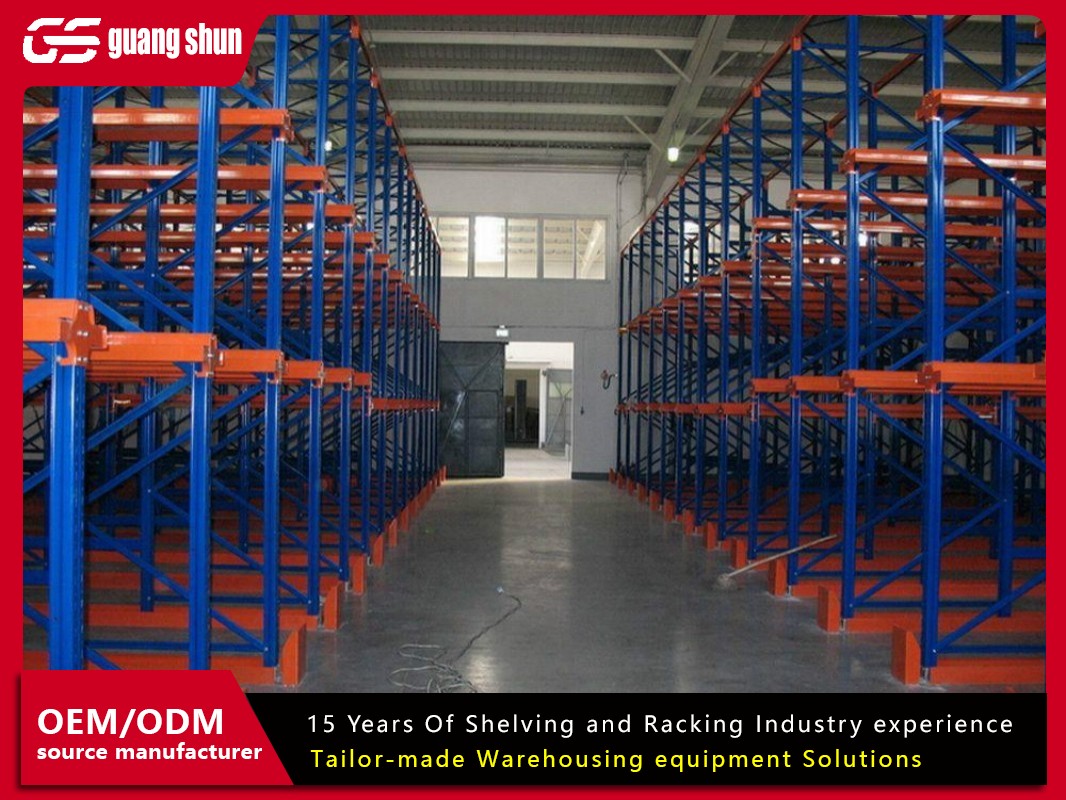
Drive-In / Flow-Through: Suitable for homogeneous,
high-volume SKUs. However, they are less flexible for batch-picking operations.
The automated variant uses gravity or motorized rollers, requiring precise speed
control to prevent product damage during deceleration.
The selection of the storage medium directly impacts the motor sizing and
energy consumption of the shuttles. A heavy-duty pallet (up to 1,500kg) requires
a motor with a higher torque-to-inertia ratio, which affects the overall
electrical load of the warehouse. Engineers must perform a power budget analysis
that accounts for peak demand during simultaneous shuttle operations.
3. Control Architecture and Software Orchestration
The physical racking is inert without the software that governs it. The
Warehouse Control System (WCS) interprets commands from the Warehouse Management
System (WMS) and translates them into machine-level instructions. The interface
between the WCS and the automated warehouse racking system is where
operational efficiency is determined.
3.1 Real-Time Localization and Sensor Fusion
Modern systems employ a combination of barcode scanning, RFID, and
laser-based distance measurement (LiDAR) to establish absolute positioning. The
fusion of these sensor inputs ensures that the shuttle knows its position within
a tolerance of ±1mm. This precision is critical to avoid collisions with the
racking structure, particularly in high-bay applications where the clearance
between the shuttle and the racking beam is minimal.
3.2 Traffic Management and Deadlock Prevention
In a multi-shuttle system, traffic management algorithms prevent bottlenecks
and deadlocks. The WCS must allocate zones and routes dynamically, often using a
Dijkstra-based pathfinding model to optimize the route of each shuttle. This
becomes computationally intensive as the number of shuttles scales. Advanced
systems use a distributed control architecture where each shuttle has onboard
intelligence to negotiate intersections with adjacent units, reducing the
reliance on a single central controller.
4. Financial Modeling and ROI Considerations
The capital expenditure for an automated racking structure is substantial,
often representing 25-35% of the total automation project cost. The ROI
calculation must include direct labor savings, reduced product damage, and
increased inventory accuracy. However, a comprehensive model also accounts for
the cost of energy, maintenance, and the opportunity cost of floor space.
Labor Arbitrage: A single automated system can replace up
to 12 manual forklift operators per shift, based on a standard 24/7 operation.
The payback period is typically calculated between 3 to 5 years, depending on
regional labor costs.
Inventory Shrinkage Reduction: Automated systems decrease
human handling, thereby reducing product damage by 2-4% annually. In high-margin
industries, this alone can justify the investment.
Energy Efficiency: Regenerative braking in shuttles and
optimized path planning can reduce energy consumption by 15-20% compared to
conventional automated guided vehicles (AGVs).
Guangshun has provided engineering
consultations where the system design was tailored to the specific load profiles
and cycle frequencies of the client, resulting in a 12% reduction in total cost
of ownership over a 10-year horizon.
5. Common Pitfalls and Mitigation Strategies
Despite the engineering rigor, several operational pitfalls recur across
implementations. These include:
Underestimating SKU Proliferation: The system designed for
1,000 SKUs often faces 1,500 within the first three years. This requires a
modular racking design that allows for height adjustments and beam repositioning
without structural compromise.
Overlooking Thermal Expansion: In high-bay warehouses (over
30 meters), temperature variations between the floor and the ceiling cause the
steel structure to expand and contract. Expansion joints and flexible
connections must be integrated into the design to prevent stress fractures.
Inadequate Fire Suppression Integration: Automated racking
systems must be integrated with the fire sprinkler system. The racking structure
must support the weight of water-filled pipes and the additional static load,
which is often excluded from the initial structural calculation.

6. Integration with Existing Material Handling Equipment
An automated warehouse racking system rarely operates in isolation. It must
interface with conveyors, palletizers, stretch wrappers, and truck loading
systems. The interface points—often called "handshake zones"—require careful
mechanical and electrical integration. For instance, the interface between a
conveyor and the racking input station must have a buffer zone to absorb
variations in conveyor speed. This necessitates the use of accumulation rollers
that match the cadence of the shuttle retrieval cycles.
6.1 Case Study: Pharmaceutical Distribution
In a pharmaceutical distribution center, the racking system must comply with
Good Distribution Practices (GDP), which mandate strict temperature monitoring
and batch traceability. The automated warehouse racking system used in this
context incorporates temperature sensors at each bay, feeding data back to the
WMS for real-time anomaly detection. This adds a layer of complexity to the
control logic but ensures compliance and reduces the risk of product
recalls.
7. Maintenance Regimes and Predictive Analytics
Maintenance is the single largest operational expense after energy. Proactive
maintenance strategies, enabled by IoT sensors on the racking structure and
shuttles, can predict wear and tear on the guide rails and wheels. Vibration
analysis on the shuttle drives can indicate impending bearing failures. By
collecting this data over time, operations managers can transition from reactive
maintenance to a condition-based model, reducing unplanned downtime by an
estimated 40-50%.
Key performance indicators (KPIs) to monitor for the racking structure itself
include column alignment, beam deflection, and bolt torque retention. Annual
structural audits using laser alignment tools are recommended to detect
micro-movements that could affect the shuttle guidance system.
8. Frequently Asked Questions (FAQs)
Q1: What are the primary differences between a static pallet
rack and an automated warehouse racking system?
A static pallet rack is designed for manual forklift access,
with structural tolerances that accommodate operator variability. In contrast,
an automated warehouse racking system is engineered for machine precision. It
features tighter tolerances in beam spacing and column alignment, includes guide
rails or tracks for shuttles, and integrates sensors for position feedback. The
steel grades are often higher to withstand repetitive dynamic loads, and the
system is equipped with electrical infrastructure for data transmission and
power delivery to the automated shuttles or AS/RS cranes.
Q2: How do I calculate the optimal storage density for my
automated warehouse?
Storage density is calculated as the ratio of total pallet
positions to the total cubic volume of the warehouse space. However, the optimal
density is a function of throughput requirements. Use a cube utilization model
that accounts for aisle width, racking height, and the depth of storage. For an
automated system, narrow aisles (typically 1.2m to 1.5m) significantly improve
density. Software simulation tools (e.g., FlexSim or AnyLogic) can model
different configurations to find the point where density and cycle time converge
to meet your operational KPIs.
Q3: What safety standards apply to automated racking
installations?
Key standards include EN 15635 for the structural safety of
steel storage systems, EN 528 for rail-dependent storage and retrieval
equipment, and the Machinery Directive 2006/42/EC for the automated components.
For seismic zones, additional local regulations like the ASCE 7 (US) or Eurocode
8 apply. The racking system must have an anti-collision system that includes
mechanical stops and photoelectric sensors to prevent over-travel. Guangshun ensures all systems comply with
regional safety standards through third-party structural
certifications.
Q4: Can an automated warehouse racking system be retrofitted
into an existing conventional warehouse?
Yes, but with significant constraints. The primary limitation
is floor flatness and load-bearing capacity. Existing floors may not be level to
the ±2mm tolerance required, necessitating a costly grinding or leveling layer.
The roof height must also accommodate the shuttle's vertical travel plus
clearance for maintenance. Additionally, the existing electrical infrastructure
must be upgraded to supply the power requirements of the automated shuttles. A
feasibility study, including a structural survey and power audit, is mandatory
before considering a retrofit.
Q5: How does the choice of shuttle technology affect the
racking system design?
There are two primary shuttle technologies: captive and
autonomous. Captive shuttles operate on fixed lanes and require a transfer
carriage to change aisles. This design simplifies the racking structure because
the shuttle only moves in one axis. Autonomous shuttles, on the other hand, can
change aisles independently, but they require a more complex racking layout with
larger turning radii and reinforced floor sections. This necessitates a racking
structure with wider cross-aisles and additional guide rails, which reduces
overall storage density by 10-15%.
Q6: What is the typical lifespan of an automated racking
structure?
With proper maintenance and environmental control (e.g.,
corrosion protection in cold storage), a structural steel racking system can
last 25–30 years. However, the automation components—shuttles, motors, and
sensors—have a shorter lifespan, typically 10–15 years, and will require
upgrades or replacements. When planning the amortization schedule, it is
advisable to depreciate the structural steel over 20 years and the automation
hardware over 10 years. This staggered replacement strategy minimizes capital
shock during the asset lifecycle.
Automated warehouse racking systems represent a
convergence of civil engineering, mechatronics, and software logistics. The
decision to invest in such a system must be guided by data—cycle time matrices,
floor flatness reports, and financial models that account for energy and
maintenance. By focusing on the engineering fundamentals rather than marketing
rhetoric, operations leaders can implement a system that delivers consistent
throughput, reduces operational risk, and provides a measurable return on
investment over its operational life. For specific engineering consultations and
structural audits, Guangshun provides comprehensive support
from design validation to post-installation performance monitoring.