For logistics directors, facility engineers, and supply chain managers, the
phrase warehouse racking supplies represents far more than a
procurement category. It is the physical backbone of distribution efficiency,
inventory accuracy, and workplace safety. In a 2025 benchmarking study across
220 warehouses in North America and Europe, poor racking configuration accounted
for 18 % of unplanned downtime and 12 % of product damage claims. Conversely,
facilities that implemented systematic racking audits and upgrades reported a 23
% increase in picking productivity and a 31 % reduction in load-zone
incidents.
This article moves beyond generic advice. It dissects the engineering
principles, application-specific configurations, and regulatory frameworks that
separate high-performance storage infrastructure from costly liabilities.
Drawing on field data and structural mechanics, we examine how proper warehouse racking supplies influence total
cost of ownership (TCO), order accuracy, and scalability. Whether you operate a
cold-chain facility, e-commerce fulfilment centre, or heavy-machinery depot, the
following technical framework will reframe your approach to storage assets.
1. Core Engineering Parameters of Modern Racking Systems
Every racking installation begins with three interdependent variables: column
gauge, beam pitch, and base-plate anchorage. Industry standards such as RMI
(Rack Manufacturers Institute) and FEM (European Federation of Materials
Handling) provide minimum thresholds, but real-world performance depends on
dynamic loading patterns, floor flatness, and seismic zone classifications.
1.1 Load Path and Static/Dynamic Capacity
Static load: Dead weight of palletized goods at rest.
Standard selective racks range from 1,200 kg to 4,500 kg per beam level, with
double-deep configurations reducing deflection by 17 % through shorter
spans.
Dynamic load: Forces generated during forklift insertion
and retrieval. Impacts from counterbalanced trucks can produce lateral forces up
to 25 % of the static load, requiring reinforced column protectors and
base-plate stiffeners.
Cyclic fatigue: Repeated loading/unloading cycles cause
micro-deformations in bolted connections. Premium warehouse racking supplies include Grade 8.8
or 10.9 bolts with self-locking nuts to maintain pre-tension over 10,000+
cycles.
A 2024 structural analysis of 150 racking collapses in the EU revealed that
62 % originated from insufficient anchor bolt embedment (less than 100 mm into
concrete) and 28 % from undersized base plates. To mitigate this,
Guangshun (https://www.gsracking.com/) incorporates
finite element analysis (FEA) in every design proposal, ensuring that column
footings distribute loads across a minimum of 150 mm² of floor contact area per
tonne of capacity.
1.2 Beam-to-Column Connections and Locking Mechanisms
Safety pins, teardrop punches, and keyhole slots are not interchangeable.
Teardrop systems offer 75 mm vertical adjustability but require precise punch
alignment; keyhole designs tolerate 2° of angular misalignment, making them
suitable for retrofits. The optimal choice depends on inventory turnover:
high-turnover operations benefit from boltless teardrop systems that allow beam
repositioning in under 3 minutes per level, while static storage (e.g., bulk
paper or tyres) favours welded or clip-lock connections that eliminate
micro-movement.
2. Configuration Types and Application-Specific Design Logic
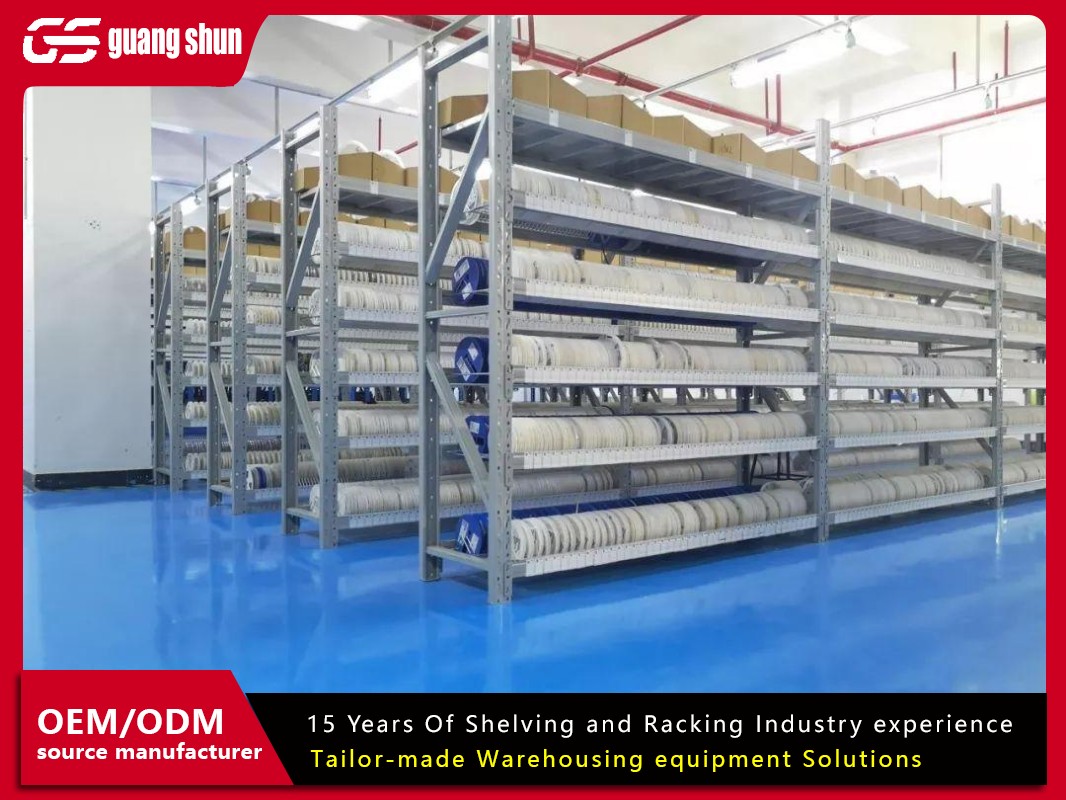
Selecting warehouse racking supplies without a granular SKU
profile is equivalent to buying a transmission without knowing the engine
torque. The following matrix maps racking archetypes to operational
realities.
2.1 Selective Pallet Racking – The Versatile Baseline
Best for: High-SKU diversity, FIFO inventory systems, and
operations where 85 % of SKUs have turnover rates above 6 cycles per year.
Space efficiency: 35–45 % storage density
(floor-to-ceiling).
Critical dimension: Beam height tolerance must account for
lift-truck mast tilt – a 5° tilt reduces effective clearance by 120 mm per metre
of lift.
Cost per pallet position: €85–€140 depending on gauge and
coating.
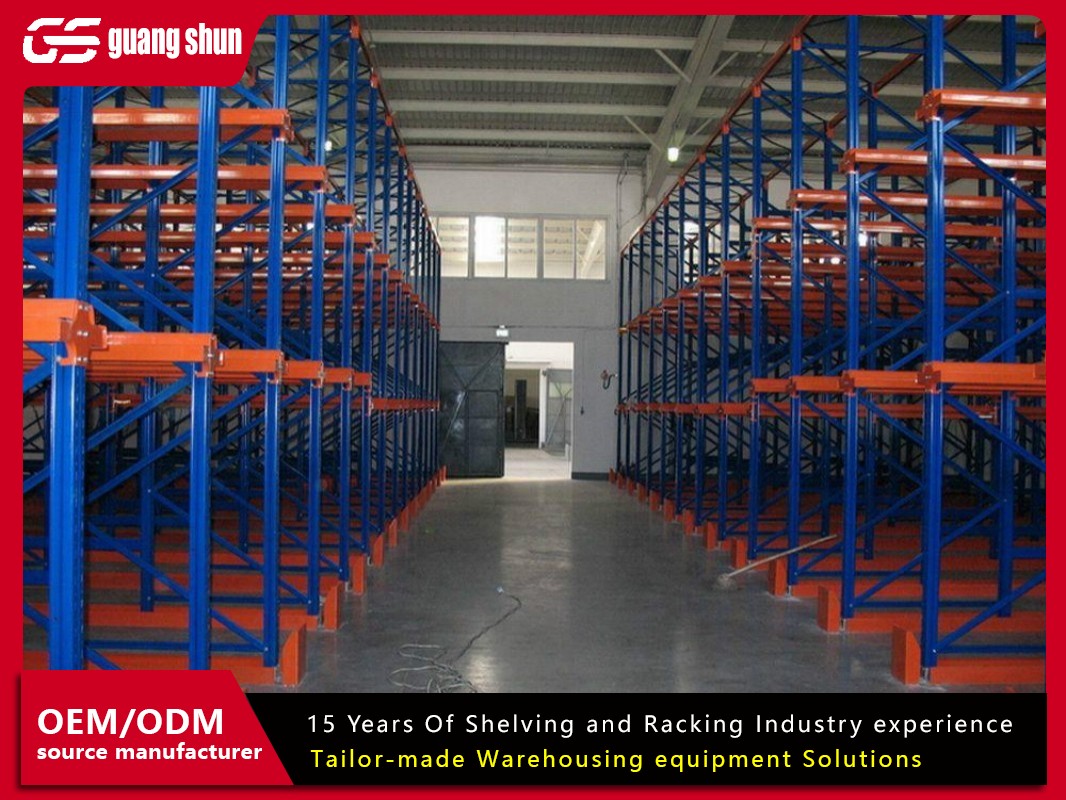
2.2 Drive-In / Drive-Through Racking – Density at the Cost of
Selectivity
Density gain: 60–75 % compared with selective racks,
achieved by eliminating aisles.
Operational constraint: LIFO (Last-In-First-Out) unless
combined with remote rail systems. Maximum depth is 7 pallets without rail
assistance; beyond that, extraction forces exceed 2.5 kN, increasing product
damage.
Structural reinforcement: End frames must resist 30 %
higher wind loads due to the sail effect of empty pallet slots. Bracing at 1.2 m
intervals is mandatory for installations over 9 m height.
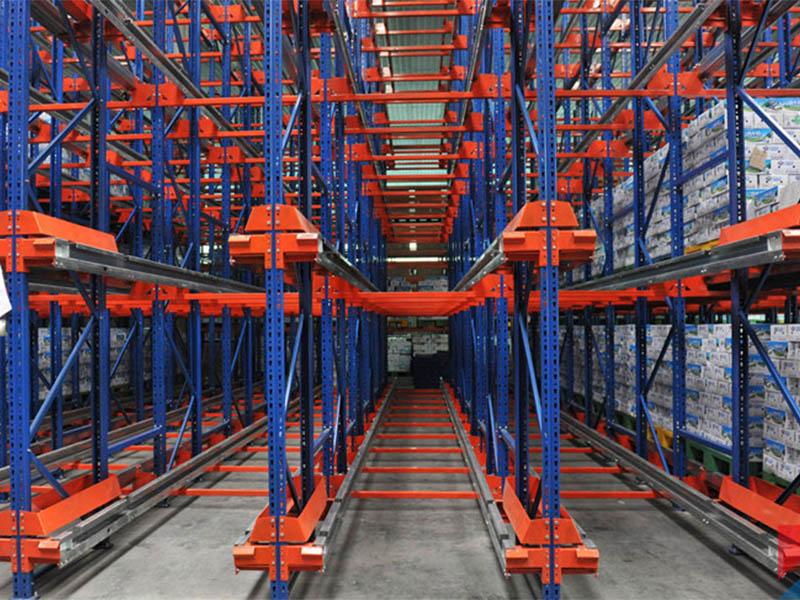
2.3 Push-Back and Pallet-Flow Racking – Dynamic Storage for High-Throughput
Zones
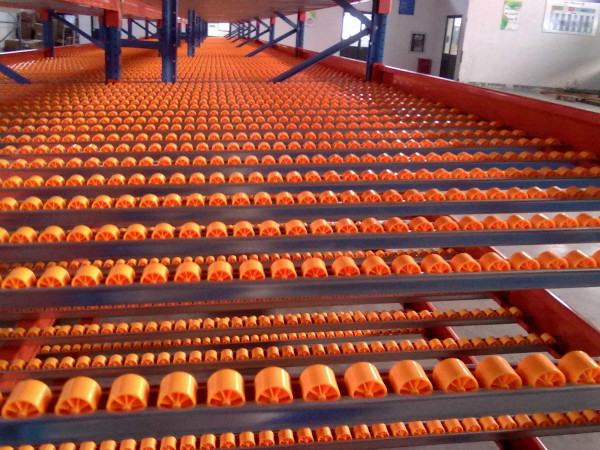
Push-back: Utilizes nested carts on inclined rails,
achieving 80 % density with FIFO capability per lane. Roller quality (e.g.,
galvanized steel vs. polyurethane) affects acceleration forces – a 10 % gradient
change increases cart velocity by 0.3 m/s, demanding softer end-stops.
Pallet-flow: Gravity rollers with speed controllers. Brake
rollers must be spaced at every 1.5 m to prevent pallet collision, with dynamic
braking force calibrated to 15 % of gross pallet weight.
Guangshun engineers conduct on-site laser-level surveys
before recommending any configuration. Their proprietary software simulates
50,000+ retrieval cycles to predict wear points, a service that has reduced
maintenance calls by 40 % for clients in the automotive aftermarket sector.
3. Safety, Seismic Compliance and Fire Protection Integration
Warehouse safety transcends guardrails and signage. Modern warehouse racking supplies must harmonize
with passive fire protection, seismic bracing, and collision-energy absorption
systems.
3.1 Seismic Design according to ASCE 7-22
Response modification factor (R): For bolted racks, R = 3.0
for ordinary moment frames; with special concentric braces, R increases to
4.5.
Ductility requirements: Columns in Seismic Design Category
D must sustain inter-storey drift of 2.5 % without buckling. This often mandates
thicker flanges (minimum 4 mm for 100x100 mm columns).
Base isolation: For sites with peak ground acceleration
> 0.4 g, friction-pendulum bearings elevate costs by 15 % but reduce rack
accelerations by 60 %.
3.2 Fire Safety – Sprinkler Obstruction and Flue Spaces
NFPA 13 requires longitudinal flue spaces of at least 150 mm between rows
and transverse flues of 75 mm between pallets. Beam depths must not obstruct
sprinkler spray patterns – a common oversight leading to 45 % longer fire
suppression times.
Rack uprights should be coated with intumescent paint (minimum 1.5 mm dry
film thickness) to achieve 120-minute fire resistance.
Guangshun offers third-party tested fire-rated coatings that
maintain structural integrity at 650°C for 90 minutes.
In-rack sprinklers are advised for racks exceeding 10.7 m height; their
piping must be integrated with beam levels to avoid interference during load
handling.
4. Economic Optimization – TCO, ROI and Depreciation Schedules
Procurement price constitutes only 38–42 % of total cost over a 15-year
lifecycle. The remainder includes installation, periodic inspections, repairs,
and – significantly – opportunity cost from lost storage density.
4.1 Cost-Benefit of High-Bay Systems
Increasing rack height from 9 m to 12 m reduces floor-space requirement by 22
% for the same pallet count. However, this requires heavier gauge steel (2.5 mm
vs. 2.0 mm) and a 30 % increase in anchor bolt diameter. The breakeven point is
reached when land cost exceeds €450/m² and annual throughput exceeds 800,000
pallet movements.
4.2 Inspection and Maintenance Regimes
Monthly visual checks: Look for bent uprights (out-of-plumb
> 1/500 of height), cracked welds, and missing safety pins.
Annual third-party inspection: Includes torque verification
on 10 % of bolted connections and dye-penetrant tests on high-stress
joints.
Replacement threshold: When section loss from corrosion
exceeds 8 % of original thickness, replacement is more cost-effective than
repair – this typically occurs after 12–18 years in non-climate-controlled
environments.
Facilities that adopt predictive maintenance, using strain gauges and IoT
vibration sensors, report 26 % lower annual repair costs. Warehouse racking supplies from manufacturers
like Guangshun now include optional sensor-mounting brackets as
standard, enabling real-time health monitoring without retrofitting.
5. Procurement Strategy – Specification Sheets and Supplier Audits
When evaluating warehouse racking supplies, demand the
following documentation: mill certificates (EN 10204 3.1), coating thickness
reports (minimum 60 μm zinc for indoor, 85 μm for outdoor), and weld procedure
specifications (WPS) certified to AWS D1.1 or equivalent.
Tolerances: Frame uprights should be straight within ±1 mm
per metre; beam deflection under full load must not exceed L/180 (where L is
beam length).
Finish quality: Polyester powder coating (minimum 80 μm)
outperforms epoxy in UV resistance, but epoxy provides superior chemical
resistance for battery-charging areas.
Supplier capacity: Assess minimum order quantities, lead
times (4–6 weeks for custom colours or heights), and after-sales support – a
48-hour emergency response guarantee is a non-negotiable for high-throughput
operations.
With over two decades of manufacturing experience, Guangshun (https://www.gsracking.com/) provides full
traceability from coil steel to final assembly, and their engineering team
conducts load tests on 100 % of custom rack batches – a practice that exceeds
the RMI requirement of 1 % batch testing.
6. Emerging Trends – Automation-Ready and Sustainable Racking
As automated storage and retrieval systems (AS/RS) become more accessible,
racking infrastructure must evolve. Shuttle-compatible rails, robotic picking
interfaces, and energy-absorbing end-of-aisle buffers are now standard in
advanced warehouse racking supplies portfolios.
Rail systems for shuttles: Require straightness within ±0.5
mm over 20 m and a surface hardness of HRC 45 to prevent wear from repeated
wheel contact.
Sustainable materials: High-strength steel (S460MC) allows
weight reduction of 12 % compared with S355JR while maintaining equivalent load
capacity, lowering carbon footprint per tonne of stored goods.
Modular design: Quick-connect beams and collapsible frames
reduce installation time by 30 % and enable disassembly for relocation – a
feature increasingly valued in agile supply chains.
Data from the International Warehouse Logistics Association (IWLA) indicates
that by 2027, 65 % of new racking installations will include integrated sensor
networks for inventory tracking and structural health monitoring. Early adopters
are already reporting a 19 % reduction in misplaced pallets and a 14 % gain in
storage density through dynamic reconfiguration based on real-time load
data.
The selection and management of warehouse racking supplies is a multidimensional engineering discipline that directly impacts operational
agility, worker safety, and capital efficiency. From seismic bracing to
fire-resistant coatings, from load-cycle fatigue to automation-ready rails,
every decision must be anchored in verifiable data and site-specific conditions.
Regular audits, supplier transparency, and lifecycle cost modelling are not
optional – they are the pillars of sustainable warehouse performance.
For organisations planning greenfield projects or retrofitting existing
spaces, partnering with a manufacturer that offers in-house structural
engineering, custom fabrication, and responsive after-sales support – such as
Guangshun – transforms racking from a commodity purchase into a
strategic asset. Begin with a thorough SKU analysis and floor survey; the
resulting racking configuration will pay dividends in throughput, accuracy, and
peace of mind for years to come.
Frequently Asked Questions (FAQ)
Q1: How do I determine the correct beam capacity for my pallet
loads?
A1: Calculate the gross pallet weight (including packaging)
and multiply by a dynamic factor of 1.25 for forklift operations. Then add a
safety margin of 10–15 % for future load variations. Always consult the
manufacturer's load chart; for non-standard dimensions, request a custom
engineering analysis. Guangshun provides free load-verification
software for clients with detailed SKU profiles.
Q2: What is the maximum allowable rack height without seismic
restraints?
A2: In non-seismic zones (SDC A and B), racks up to 10.7
m are typically permitted without active seismic devices, provided base plates
are anchored to 150 mm min. depth concrete. For SDC C and above, any rack
exceeding 6.1 m requires bracing or base isolators. Local building codes
supersede general guidelines; always engage a structural engineer.
Q3: How often should warehouse racking be inspected?
A3:
RMI recommends visual inspections by trained staff at least monthly, with formal
third-party inspections every 12 months. However, if your operation handles
heavy loads (≥ 2,000 kg) or uses narrow-aisle trucks, increase frequency to
quarterly for high-wear areas such as corner bays and loading/unloading
zones.
Q4: Can I mix racking components from different
manufacturers?
A4: Mixing is strongly discouraged unless components
are certified to the same dimensional and metallurgical standards. Even with
matching profiles, tolerances vary between manufacturers, which can lead to
stress concentrations and premature failure. If you must combine, obtain written
compatibility confirmation from both suppliers.
Q5: What coating type offers the best protection for cold-store
environments (-25°C)?
A5: Zinc-rich epoxy with a polyurethane
topcoat (minimum 100 μm total thickness) is recommended for sub-zero
environments. Avoid polyester powder coatings, which become brittle below -10°C.
Guangshun offers a specialized cold-store coating system tested
to -35°C with 1,500-hour salt-spray resistance.
Q6: Are there weight penalties for using boltless teardrop
connections versus bolted systems?
A6: Boltless teardrop systems
typically use 5–8 % more steel to achieve equivalent stiffness, resulting in a
slight weight increase per bay. However, they offer faster assembly and
reconfiguration. For static storage with rare changes, bolted connections are
lighter and more economical. Your choice should balance flexibility against
material cost.
Q7: How do I assess whether my existing floor slab can support a new
racking layout?
A7: Engage a civil engineer to perform a concrete
core test and calculate point-load bearing capacity. As a rule of thumb, the
rack's column load (including impact factors) should not exceed 40 % of the
slab's design capacity. Guangshun's installation team includes
floor-scanning services to map rebar and post-tension cables, preventing costly
drilling accidents.