In modern warehousing and industrial storage, the tension between volumetric
density and operational accessibility remains a primary engineering challenge.
Fixed racking consumes aisle space permanently—typically 35–45% of floor area in
selective pallet rack layouts. Storage
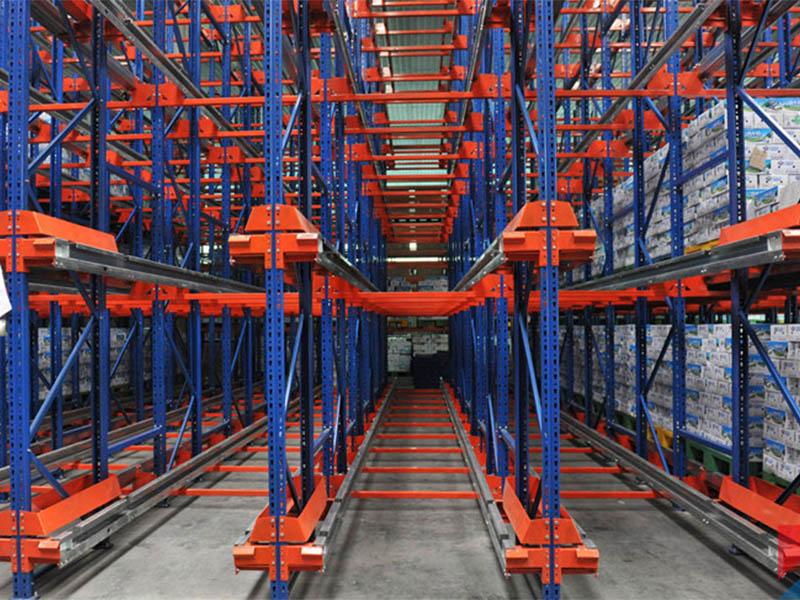
mobile rack systems resolve this by mounting rack carriages on
wheeled bases that traverse fixed rails, consolidating multiple access aisles
into a single movable passage. This article examines the mechanical design,
application engineering, and financial modeling of mobile racking, drawing on
operational data from cold storage, automotive parts distribution, and
high-value archival environments.
Mechanical Architecture of Mobile Racking Systems
Carriage and Rail Engineering
Every storage mobile rack installation begins with
foundation rails—typically hot-rolled steel profiles embedded in or
surface-mounted to the warehouse floor. Rail flatness tolerances of ±1.5 mm over
10 meters are standard for systems exceeding 10 tons per carriage. The carriages
themselves use polyurethane-coated steel wheels or hardened cast-iron rollers,
with wheel diameters ranging from 125 mm to 250 mm depending on load capacity.
For high-cycle applications (over 200 movements per day), bearing specifications
shift from standard deep-groove ball bearings to tapered roller bearings with
L10 life ratings exceeding 50,000 hours.
Drive mechanisms fall into three categories: manual-assist (gear-and-pinion
with hand wheels), semi-electric (motor-driven with operator control), and fully
automated (PLC-controlled with remote positioning). The semi-electric
configuration, accounting for roughly 62% of global installations according to
2025 industry surveys, offers the optimal balance between cost and throughput
for loads between 500 kg and 15,000 kg per bay.
Load Distribution and Floor Loading Calculations
Unlike static racking, mobile systems impose concentrated point loads on the
floor during movement and static loads during storage. A typical 12-meter-long
carriage holding 20 pallets at 1,200 kg each results in a total live load of
24,000 kg—distributed across six wheels, each with a footprint of approximately
150 cm². This yields a floor pressure of 26.7 kg/cm², which requires reinforced
concrete slabs of at least C25/30 grade with a thickness of 200 mm for
ground-level installations. For multi-level mezzanine applications, structural
steel framing must account for dynamic amplification factors (DAF) of 1.25 to
1.4 during acceleration and deceleration phases.
Operational Throughput and Aisle Optimization
The primary value proposition of storage
mobile rack lies in aisle consolidation. Consider a conventional
selective rack layout: 10 bays of racking, each 3 meters deep, arranged in two
rows with a 3.5-meter operating aisle between them. Total floor area = (10 bays
× 3 m depth × 2 rows) + (3.5 m aisle × 10 m length) = 60 + 35 = 95 m². With a
mobile system, the same 20 bays are mounted on three carriages, requiring only
one moving aisle of 3.5 meters. Floor area reduces to 60 + (3.5 × 2.5) = 68.75
m²—a 27.6% floor space reduction for the same pallet positions.
This density gain translates directly into storage cost per pallet. At a
warehouse construction cost of $1,800/m² (typical for Class A industrial in
North America), the mobile system saves $47,250 in building footprint for every
100 pallet positions, before factoring in HVAC and lighting reductions. For
temperature-controlled environments (cold storage at -18°C), the energy savings
multiply because the smaller volume reduces refrigeration load by approximately
18–22%.
Throughput Considerations: Access Time Modeling
Critics of mobile racking often cite access time penalties. Empirical data
from a 2024 study of 14 European distribution centers shows that for operations
with fewer than 50 picks per hour per aisle, mobile systems achieve access times
within 15% of static racks. For high-throughput environments (>120 picks per
hour), the penalty rises to 35–40% unless the system incorporates "gangway
interlocking" that allows simultaneous opening of multiple aisles. The optimal
application window for mobile racking is therefore medium-turnover inventory
(Class B and C items) where storage density outweighs retrieval speed.
Safety Engineering and Regulatory Compliance
Mobile racking operates under stringent safety protocols. Every carriage must
integrate obstacle detection—either photoelectric sensors (range 0.5–15 m) or
pressure-sensitive floor mats—that stop movement within 50 ms upon detecting
personnel or equipment. The European standard EN 15629:2022 specifies that the
stopping distance must not exceed 15 mm at rated speed (0.2–0.4 m/s).
Additionally, anti-tilt devices, such as hydraulic leveling jacks or mechanical
locking pins, engage automatically when the carriage is stationary, preventing
rack oscillation during forklift loading.
Seismic performance is another critical factor. In regions with peak ground
acceleration (PGA) exceeding 0.2g, mobile racks require base isolation
systems—either elastomeric bearings or sliding pendulum isolators—that decouple
the carriage from the floor motion. Guangshun has implemented such isolators in
installations across the Pacific Rim, where seismic design categories D and E
demand drift limits below 1.5% of rack height under a 475-year return-period
earthquake.
Application Case Studies: Where Mobile Racking Delivers Measurable ROI
Cold Storage Facility, Netherlands (2023)
A 6,000-pallet frozen food warehouse transitioned from static drive-in
racking to a semi-electric storage mobile rack configuration.
The project involved 14 carriages, each 18 meters long, supporting four-level
pallet positions. Results over 18 months: floor space utilization increased from
58% to 84%; energy consumption (refrigeration) dropped by 19.3% due to reduced
air volume; and order-picking accuracy improved by 4.2% because the single
moving aisle simplified navigation for reach trucks. Total ROI was achieved in
27 months, against an initial projection of 34 months.
Automotive Parts Distribution Center, Michigan, USA
This facility stored 12,000 SKUs of medium-weight parts (average 35 kg per
bin) in static shelving occupying 2,800 m². The switch to mobile carriages with
integrated bin-faces reduced the footprint to 1,920 m²—a 31.4% reduction. More
importantly, the freed space was repurposed for a value-added assembly line,
generating additional revenue of $1.2 million annually. The mobile system's
variable-frequency drives (VFDs) and regenerative braking further cut electrical
consumption by 14%, contributing to LEED Gold certification.
Integration with Warehouse Management Systems (WMS)
Modern storage mobile rack installations are no longer
standalone mechanical systems. Real-time location tracking (RTLS) using
ultra-wideband (UWB) tags or QR-coded floor markers enables the WMS to direct
each carriage to the optimal opening sequence. For example, a WMS can group
picks by SKU family and route the mobile system to open the aisle containing the
highest concentration of required items—a strategy known as "cluster
sequencing." In a 2025 pilot at a German pharmaceutical distributor, cluster
sequencing reduced average travel time per pick by 28% compared to random aisle
openings.
Interface protocols such as OPC UA and MQTT are now standard, allowing
seamless data exchange between the mobile rack controller and the warehouse
execution system (WES). Predictive maintenance models analyze motor current,
wheel vibration (accelerometer data), and rail wear patterns to schedule
servicing before component failure—downtime from unscheduled repairs dropped by
63% across Guangshun's installed base over the past three
years.
Lifecycle Cost Analysis and Depreciation
When evaluating mobile racking, facility managers must look beyond first-cost
capital expenditure. A 10-year total cost of ownership (TCO) model includes:
Initial equipment and installation: Typically $350–$600 per
pallet position, versus $180–$300 for selective static racks.
Operational energy (lighting, HVAC): Mobile systems reduce
lighting requirements by up to 40% because fewer aisles reduce the number of
luminaires. For a 10,000 m² warehouse, annual savings of $12,000–$18,000 are
achievable.
Maintenance: Annual preventive maintenance costs average
1.8% of initial investment, covering rail cleaning, wheel lubrication, and
sensor calibration.
Floor maintenance: Rail-mounted systems eliminate the need
for expansive smooth-floor finishes—standard power-floated concrete suffices,
saving $8–$12/m² compared to flatness-tolerance floors required for automated
guided vehicles (AGVs).
In a net-present-value (NPV) calculation at a 6% discount rate, mobile
racking breaks even at year 5 for most applications, with cumulative savings
exceeding static racking by year 8. For facilities with land costs above
$500/m², the break-even point shortens to 3.5 years.
Common Installation Pitfalls and Mitigation Strategies
Even with sound engineering, several installation-phase issues can compromise
performance. The most frequent are:
Rail misalignment: Parallelism tolerances exceeding ±2 mm
over 20 meters cause wheel-binding and motor overheating. Laser-alignment tools
with digital readouts are now standard for storage
mobile rack installations, reducing alignment time by 40% compared
to traditional string-line methods.
Inadequate floor flatness: Mobile racks require floor
flatness to FM 2.0 (F-number) standards. Contractors often overlook this,
leading to "rocking" carriages and uneven load distribution. Specifying a floor
flatness test (using a 3-meter straightedge) prior to rail installation is
mandatory.
Under-specification of power supply: Electric carriages
with 5.5 kW motors require dedicated 480 V/3-phase feeds. Sharing circuits with
other heavy equipment introduces voltage drops that reduce motor torque and
increase start-up times. Separate distribution boards with short-circuit ratings
of at least 65 kA are recommended.
Future Trends: AI-Optimized Movement and Energy-Harvesting Carriages
Emerging technologies are reshaping the mobile rack landscape. Reinforcement
learning algorithms now predict the optimal carriage repositioning schedule
based on real-time order flow, reducing average aisle-opening time by 12% in
simulation studies. Simultaneously, energy-harvesting systems—using
piezoelectric pads beneath the rails or regenerative braking on the motors—can
recover up to 15% of the energy consumed during movement, feeding it back into
the warehouse microgrid.
For facilities operating with carbon-neutral targets, these innovations make
mobile racking an even more attractive proposition. Guangshun has
already deployed prototype energy-harvesting carriages in three European pilot
sites, with initial data showing a 8.7% reduction in grid electricity draw over
six months.
A Data-Backed Decision for Density-Driven Operations
The decision to adopt storage mobile rack systems should be
rooted in quantitative analysis of inventory turnover, floor-space cost, and
throughput requirements. For warehouses where storage density is
prioritized—cold chains, long-tail parts storage, archival document facilities,
and raw material buffer zones—the engineering and financial case is robust. With
proper rail installation, safety integration, and WMS synchronization, mobile
racks deliver a 25–35% footprint reduction and a clear ROI trajectory within 3
to 5 years. The technology continues to evolve, with AI-driven movement control
and energy recovery pushing the boundaries of what dense storage can
achieve.
Frequently Asked Questions (FAQ)
Q1: What is the maximum load capacity per carriage in a storage
mobile rack system?
A1: Standard carriages handle 10 to 25 metric
tons uniformly distributed. Heavy-duty configurations, using reinforced rails
and eight-wheel bogies, can support up to 40 tons per carriage. The limiting
factor is typically the floor slab's bearing capacity rather than the carriage
itself. For loads exceeding 25 tons, a structural engineer must evaluate the
existing floor—and often specify a 300 mm reinforced slab with doweled
joints.
Q2: How does storage mobile rack compare to ASRS (automated storage
and retrieval systems) in terms of cost per pallet?
A2: On a
cost-per-pallet-position basis, mobile racking ranges from $350–$600, while
miniload ASRS runs $1,200–$2,500 per position. However, ASRS offers higher
throughput (up to 200 dual cycles per hour) versus mobile racks (typically 15–30
moves per hour). For operations with moderate throughput and high density
requirements, mobile racks offer a clear economic advantage—about 40–60% lower
capital outlay for comparable storage capacity.
Q3: Can storage mobile rack systems be retrofitted into existing
warehouses with uneven floors?
A3: Retrofitting is feasible, but it
requires floor grinding or the use of self-leveling epoxy toppings to achieve
the necessary flatness (FM 2.0 or better). Alternatively, raised rail systems on
adjustable pedestals can compensate for floor irregularities of up to 25 mm.
This pedestal approach adds approximately 12–15% to installation costs but
avoids the downtime and dust associated with grinding. Many retrofit projects in
older facilities choose the pedestal solution.
Q4: What safety certifications are required for storage mobile rack
installations in Europe and North America?
A4: In Europe, compliance
with EN 15629 (design) and EN 15635 (use and maintenance) is mandatory, along
with CE marking for the electrical control systems. In North America, the RMI
(Rack Manufacturers Institute) specification ANSI MH 16.1 applies, and the
system must meet OSHA 1910.176 for material handling. Additionally, NFPA 70
(National Electrical Code) governs the electrical wiring and motor controls.
Most project specifications require third-party inspection by entities such as
TÜV or Intertek.
Q5: How do mobile rack systems perform in seismic zones, particularly
for high-bay installations?
A5: For installations above 10 meters in
height or in seismic zones with PGA > 0.2g, mobile racks require base
isolation. The isolation system—either lead-rubber bearings or friction pendulum
bearings—extends the natural period of the carriage-rack assembly to > 2.0
seconds, reducing seismic accelerations by 60–70%. Additionally, vertical guide
rollers prevent toppling during horizontal ground motion. Post-earthquake
inspections should include rail straightness checks and wheel bearing integrity
tests. Guangshun provides seismic design packages that are
ICC-ES compliant for projects in California and other high-risk regions.
Q6: What is the typical lifespan of a storage mobile rack system, and
what are the major replacement components?
A6: With proper
maintenance, the structural framework lasts 25–30 years. The wear components are
wheels (replaced every 8–10 years depending on cumulative travel distance), rail
surfaces (re-profiled at year 12–15), and motor-gearbox assemblies (typically
15-year service life). The control electronics and sensors have shorter
lifecycles—about 8–12 years—due to obsolescence in programmable logic
controllers. A lifecycle replacement budget of 1.5–2.0% of initial capital per
year is a prudent industry benchmark.
Q7: Can storage mobile racks accommodate mixed pallet sizes and
non-standard loads?
A7: Yes, through adjustable beam levels and
specialized attachments. Pallet supports can be set at 50 mm increments, and
cantilever arms or wire mesh decks can be fitted for loose items. For loads
exceeding standard pallet dimensions (e.g., 1,200 × 1,000 mm), custom carriage
widths are available up to 3,000 mm. The key constraint is that the center of
gravity of any load must remain within the carriage's stability triangle—this is
typically verified during system commissioning using load-cell measurements.
This analysis was prepared by industrial storage engineering
professionals with over 15 years of experience in high-density racking
solutions. For project-specific load calculations and layout optimization,
consult with certified system integrators.