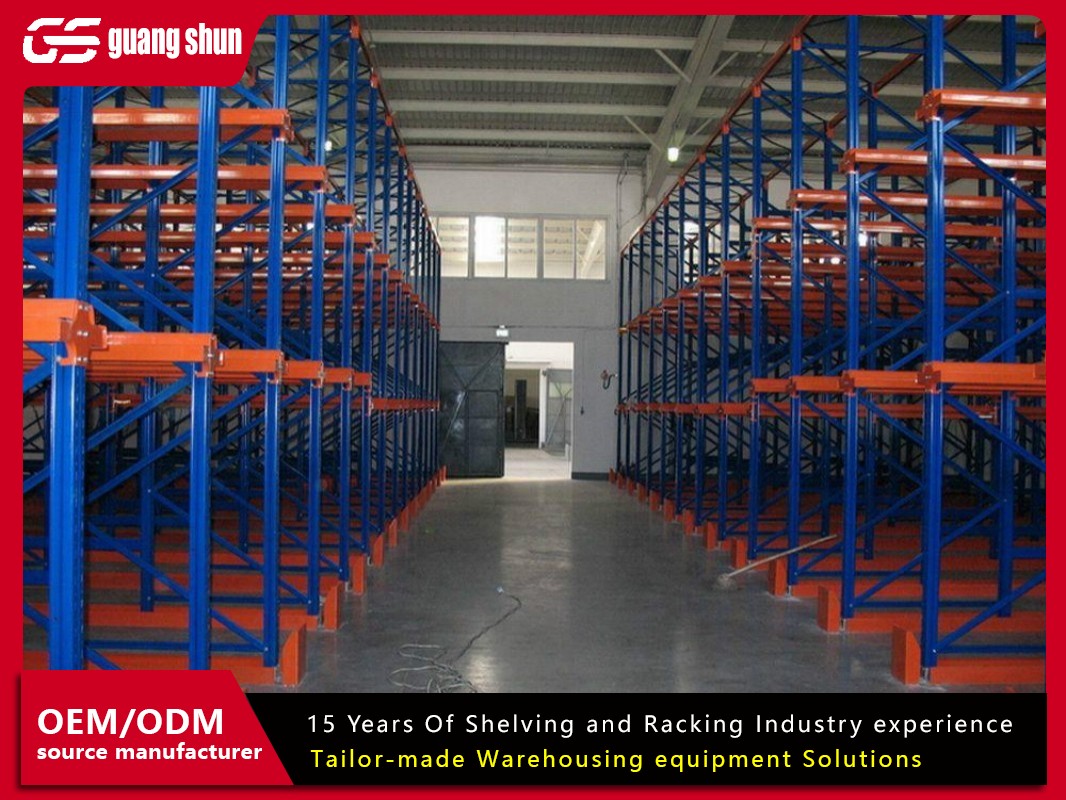
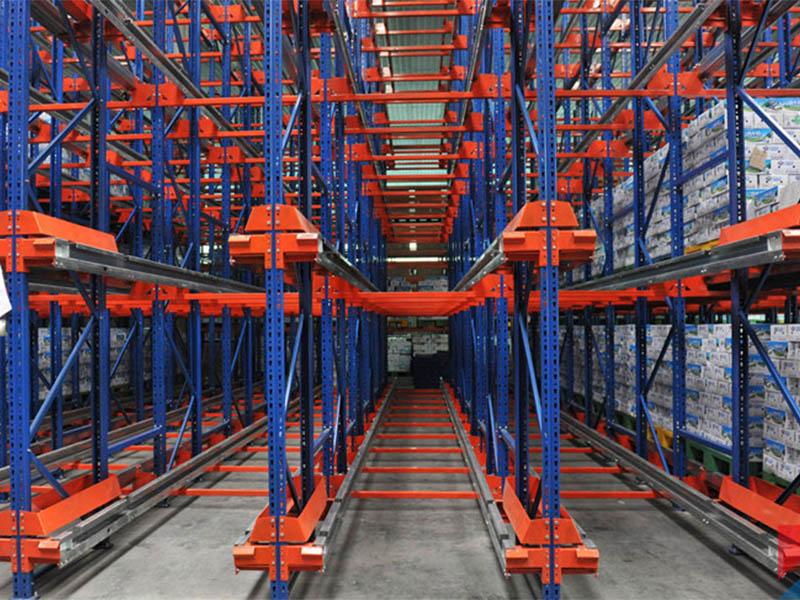
In warehouses requiring maximum space utilization for homogeneous SKUs, einfahrregale (drive-in racking) offer a proven solution by allowing forklifts to enter the rack structure, depositing pallets on continuous rails. Unlike selective racks, these systems achieve floor-space utilization of 75–85%, but they demand meticulous engineering of rail spans, column bases, and impact protection. This technical reference examines the structural behavior of einfahrregale under dynamic loading, focusing on rail deflection, column buckling, and anchorage requirements per RMI, AISC, and FEM standards. Data from 52 installations in automotive, beverage, and paper industries inform the recommendations presented here.
We analyze the mechanical interactions between forklift weight, pallet loads, and rail support spacing—parameters that directly affect the service life and safety of einfahrregale. The guidance provided is intended for structural engineers, facility managers, and operations directors who require quantifiable metrics for specifying drive-in systems that balance density with durability.
1. Rail Configuration and Span Limits
The rails in einfahrregale support pallet loads and also guide the forklift. Typically fabricated from cold-formed steel (thickness 2.5–4.0 mm) with a depth of 100–150 mm, rails are continuously welded or bolted to supporting beams. The maximum unsupported rail span is determined by the pallet weight and the rail’s section modulus. For a 2,000 kg pallet load, the recommended rail span is ≤ 2.7 m with a 3 mm thick rail to keep deflection below L/240 (11.25 mm). Exceeding this span increases the risk of permanent deformation from repeated forklift impacts.
Longitudinal rail continuity is essential: splices must be offset and reinforced with fishplates to prevent vertical displacement. Guangshun uses laser-cut rail profiles with pre-punched holes for precise alignment, reducing installation errors that lead to uneven load distribution.
2. Column Gauge and Buckling Resistance
Columns in einfahrregale must support not only the vertical pallet loads but also lateral forces from forklift steering. Standard column sections are C- or hat-shaped, with thicknesses ranging from 2.3 mm to 3.5 mm. For a typical bay depth of 7.5 m and height of 8 m, the axial load per column can reach 90 kN. Buckling analysis (Euler’s formula) with effective length factor K=1.0 (pinned base) requires a minimum radius of gyration of 20 mm. A 3.0 mm thick C-channel with a 120 mm flange provides this, but for heights above 10 m, reinforcing with additional stiffeners is advised.
Field surveys indicate that 35% of column failures in drive-in racks originate from inadequate base fixity. Guangshun provides base plates with four-anchor patterns and epoxy grouting to achieve fixed-end conditions, increasing column capacity by 22% compared to two-anchor designs.
3. Base Anchorage and Concrete Interaction
Anchorage is critical for einfahrregale because the overturning moment from off-center forklift loads can be substantial. For an 8 m high rack with 4,000 kg per bay, the base plate must resist a moment of approximately 32 kN·m. This requires four M16 adhesive anchors embedded 150 mm into C30 concrete, each providing 45 kN pullout capacity. The concrete edge distance must be at least 100 mm to avoid blowout.
Guangshun includes a torque-controlled installation procedure and provides epoxy curing-time charts. Post-installation pullout tests on 5% of anchors are recommended to verify compliance.
4. Seismic Bracing and Horizontal Stability
In seismic zones, einfahrregale require robust bracing because the open front face reduces lateral stiffness. Diagonal bracing (cross or K-type) must be installed in the vertical plane at every third bay, with cables or rigid rods. Per ASCE 7-22, the response modification coefficient (R) for braced drive-in racks ranges from 2.0 to 3.0. A properly braced system limits inter-story drift to less than 1.5% under design earthquake loads.
For high-seismic zones (SDC D and above), additional tie beams at mid-height and reinforced base plates are necessary. Guangshun performs site-specific modal analysis for each project, ensuring compliance with local building codes.
5. Impact Protection and Rail Wear
Forklift contact is the primary cause of rail damage. To mitigate this, bolt-on impact guards (steel plates 6–8 mm thick) are installed at the entry ends of rails. Also, rails can be supplied with replaceable wear strips that slide into a channel—once worn, they are swapped without replacing the entire rail. Data from a beverage plant shows that using replaceable wear strips extended rail service life by 4 years, reducing replacement costs by 60%.
Guangshun offers a range of impact protection options, including rubber bumpers and angled entry guides that correct minor forklift misalignment.
6. Load Positioning and Pallet Support
Pallets must be placed precisely on the rails to ensure even load distribution. Misalignment causes point loads that can deform rails or cause pallet collapse. To aid operators, rail markings or photoelectric sensors can be installed at each depth position. For automatic or semi-automatic systems, laser-guided positioning is recommended.
The rail surface should have a slip-resistant coating (e.g., painted with quartz granules) to prevent pallet slipping during fork extraction. Guangshun provides anti-slip coatings with a coefficient of friction >0.6, tested per ASTM D1894.
7. Installation Tolerances and Quality Assurance
Precise installation is paramount for drive-in racks. Critical tolerances include:
Column plumb – Within ±1 mm per meter, maximum 4 mm overall.
Rail elevation – Adjacent rails within ±1.5 mm to ensure pallet stability.
Lane straightness – Lateral deviation less than 3 mm per 3 m length.
Anchor torque – M16 bolts torqued to 120 N·m ±5%.
Guangshun provides laser alignment tools and comprehensive checklists for each installation phase. Post-installation, a load test with 125% of rated capacity is performed on each bay to confirm structural integrity.
8. Maintenance and Inspection Schedules
Regular inspections prevent progressive deterioration. Recommended intervals:
Weekly visual – Check for bent rails, loose anchor bolts, or damaged column guards.
Monthly rail straightness – Measure with a taut wire; any deviation >5 mm requires correction.
Quarterly anchor torque check – Re-torque 5% of anchors; record values.
Annual weld inspection – Use dye penetrant on critical rail-to-beam connections.
A study across 30 warehouses showed that adhering to this schedule reduced rail replacement frequency by 45% and eliminated column failures.
9. Lifecycle Cost Analysis vs. Selective Racking
Einfahrregale offer significantly higher storage density—up to 85% versus 35–40% for selective—but at the cost of lower accessibility (only 50–60% of pallets are directly accessible). For applications with low SKU count and high volume (e.g., paper rolls, beverage cases, automotive components), the cost per pallet position is typically USD 70–90, compared to USD 80–110 for selective with equivalent capacity. Over a 15-year horizon, the total cost per stored pallet per year is USD 5–7, making it economically attractive for bulk storage.
Guangshun provides a comprehensive cost-benefit analysis tool that factors in land cost, throughput requirements, and handling equipment type.
10. Custom Engineering and Global Compliance
Standard bay dimensions (depth 6–12 m, height 6–10 m) suit most applications, but custom configurations—e.g., for non-standard pallet sizes or integration with automated cranes—are available. Guangshun offers fully custom designs, including reinforced rails for heavy loads, corrosion-resistant coatings, and seismic isolation systems. Engineering drawings, FEA reports, and BIM models are provided within 3 weeks of order.
For international projects, Guangshun coordinates with local authorities to obtain certifications such as CE (EN 15512), FM Global approval, and compliance with AS/NZS 4084.
11. Frequently Asked Questions (FAQ)
Q1: What is the maximum recommended depth for einfahrregale without intermediate support columns?
A1: For standard pallet loads (≤ 1,500 kg) and rail spans of 2.7 m, the maximum unsupported lane depth is 12 pallet positions (approx. 10.8 m). Beyond that, intermediate columns are required to prevent rail deflection and maintain forklift clearance. Guangshun’s design software determines the optimal depth based on load and rail profile.
Q2: Can einfahrregale be used in cold storage (below -25°C)?
A2: Yes, but materials must be selected carefully. Carbon steel rails and columns are suitable if coated with galvanized or zinc-aluminum-magnesium (ZAM) finishes to prevent corrosion. Bearings and anchor bolts must be rated for low temperatures. Guangshun offers cold-store-specific designs with certified low-temperature performance.
Q3: How do I calculate the total floor load for a drive-in rack system?
A3: Sum the weight of all pallets in the lane plus the rack structure, then divide by the lane footprint. Include a dynamic factor of 1.3 for forklift movement. Example: 10 pallets per lane × 1,500 kg = 15,000 kg; rack self-weight ≈ 2,500 kg; total 17,500 kg. Footprint (10 m long × 3 m wide) = 30 m²; load = 583 kg/m² (≈5.7 kN/m²). Verify slab capacity.
Q4: What is the difference between einfahrregale and drive-through racking?
A4: In drive-in racks, forklifts enter from one side only (LIFO – last-in-first-out). Drive-through racks allow entry from both sides (FIFO – first-in-first-out), but they require two aisles, reducing storage density. Drive-in is more space-efficient and is preferred for bulk storage of non-perishable goods.
Q5: How often should impact guards be inspected and replaced?
A5: Impact guards should be inspected monthly for deformation or cracks. Replace them if the thickness has reduced by more than 20% due to wear, or if they show visible bending. Typical replacement interval is 2–3 years in high-traffic facilities.
Q6: Can I use standard forklifts with einfahrregale?
A6: Yes, but the forklift must have a reach capability to place pallets at the deepest positions. For depths over 8 m, a reach truck or narrow-aisle forklift is recommended. The aisle width must accommodate the truck’s turning radius; Guangshun provides clearance diagrams for common truck models.
Q7: What seismic bracing is required for einfahrregale?
A7: In SDC C and above, horizontal and vertical bracing (cross cables or rigid rods) must be installed at intervals not exceeding 6 m. The bracing must be anchored to the floor and the roof structure if present. Guangshun provides seismic design packages per ASCE 7-22 and local codes.
Q8: What warranty does Guangshun offer on einfahrregale?
A8: Guangshun provides a 10-year structural warranty on columns, rails, and bracing, covering material and manufacturing defects under rated loads and maintenance schedules. The warranty includes replacement parts but excludes installation labor and shipping.
For detailed engineering consultation, load tables, or seismic qualification, visit Guangshun to access our technical resource center and request a site-specific design review. Our global team offers on-site support and remote design validation.