In high-volume distribution centers and manufacturing logistics, the choice
of pallet racking system directly impacts daily operational cost per pallet
position. Among all storage configurations, selective storage racks remain the dominant solution for facilities requiring immediate access to each
SKU without compromising on picking accuracy. This technical deep-dive covers
structural engineering parameters, application-specific design logic, and
quantifiable ROI data — moving beyond surface-level comparisons.
1. Structural Anatomy of Selective Racking Systems
Understanding the load-transfer mechanism in selective storage racks is
mandatory for safety and longevity. The system comprises three primary
load-bearing elements:
Upright frames (column assemblies): Roll-formed steel
sections with punched holes at 75mm or 50mm pitch. Standard section depths range
from 300mm to 1200mm, with yield strength typically ≥ 350 MPa. Frame capacity
depends on bracing pattern (X, T, or K). For high-seismic zones, perforated
boltless connections are replaced with bolted rigid connections.
Step beams (load beams): Box-profile or C-channel beams
with integral safety clips. Beam capacities are rated per pair at specific load
centers (e.g., 2500 kg per pair at 600mm load center). Deflection limits per RMI
(Rack Manufacturers Institute) standards: L/180 for seismic, L/240 for gravity
loads.
Beam connectors and footplates: Anchoring to floor with
chemical or mechanical anchors (M20 grade 8.8 minimum). Correct torque values
(220–280 Nm) prevent loosening under dynamic fork truck impacts.
Leading manufacturers like Guangshun provide
customized finite element analysis (FEA) reports for each rack configuration,
validating beam deflection and column buckling under live load plus seismic
combinations. Without such engineering validation, storage density initiatives
become hazardous.
2. Quantitative Performance Metrics: Why Selective Racks Dominate FIFO
Operational managers evaluate selective storage racks based on three measurable KPIs: pallet access time, storage density
(pallets/m²), and SKU traceability. Cross-industry data (Warehousing Efficiency
Council 2023) indicates:
Direct access probability: 100% for each pallet position,
eliminating rearrangements common in drive-in systems. Average retrieval time
per pallet: 47 seconds (fork truck from aisle entry to load pick).
Floor-to-volume ratio: Typical selective rack layouts
achieve 35–42% space utilization when aisle width is optimized (turning radius +
300mm clearance). By contrast, double-deep racking hits 55% but adds 18% longer
retrieval time due to load transfer.
First-expiry-first-out (FEFO) compliance: Selective
configurations show 99.2% compliance accuracy with WMS-directed putaway, versus
86% for block stacking or push-back systems.
For warehouses handling over 15,000 pallet movements daily, the marginal
space loss from selective racks is outweighed by labor efficiency gains — often
22–28% lower cost-per-pick compared to high-density alternatives when factoring
in inventory write-offs due to expiry.
3. Application-Specific Engineering: Matching Profiles to Industry Load
Profiles
3.1 Automotive Just-In-Sequence (JIS) Supply
Automotive line-feeding requires sequence-perfect pallet retrieval.
Selective storage racks arranged in single-deep rows with
laser-guided picking slots reduce sequencing errors by 41%. Aisle widths here
are reduced to 2.8 meters (counterbalanced forklifts) with floor-mounted rail
guidance. Load capacities per beam level: 1200–1800 kg; beam pitch adjusted to
1200mm to accommodate engine cradles.
3.2 Cold Chain & Frozen Goods
Sub-zero environments (-25°C) impose embrittlement risks on standard steel
grades. Specialist selective racking uses S355J2 steel (impact tested at -30°C)
with hot-dip galvanizing (min 85µm coating). Freezer-specific design reduces
beam hole elongation due to thermal contraction. Guangshun offers cryo-compatible rack lines with full
temperature-cycle testing reports, validated for 20-year service life in blast
freezers.
3.3 e-Commerce Mixed-SKU Pallet Storage
High mix/low depth (e.g., 3500 SKUs, average 3 pallets per SKU) demands
adjustable beam levels. Selective racks with 50mm vertical adjustability allow
dynamic reassignment of pallet heights — reducing cubic waste by 18% compared to
fixed beam positions. Data from a European 3PL deployment: after refitting with
semi-automated beam-height tools, storage capacity increased by 2100 pallet
positions without expanding footprint.
4. Industry Pain Points & Engineering Countermeasures
Despite their advantages, selective storage racks face
criticism regarding floor space efficiency and initial capital expenditure.
Below are quantifiable obstacles and proven technical responses:
Pain point: “Low volumetric density compared to double-deep or
shuttle systems.”
Engineering countermeasure: Integrate wide-span
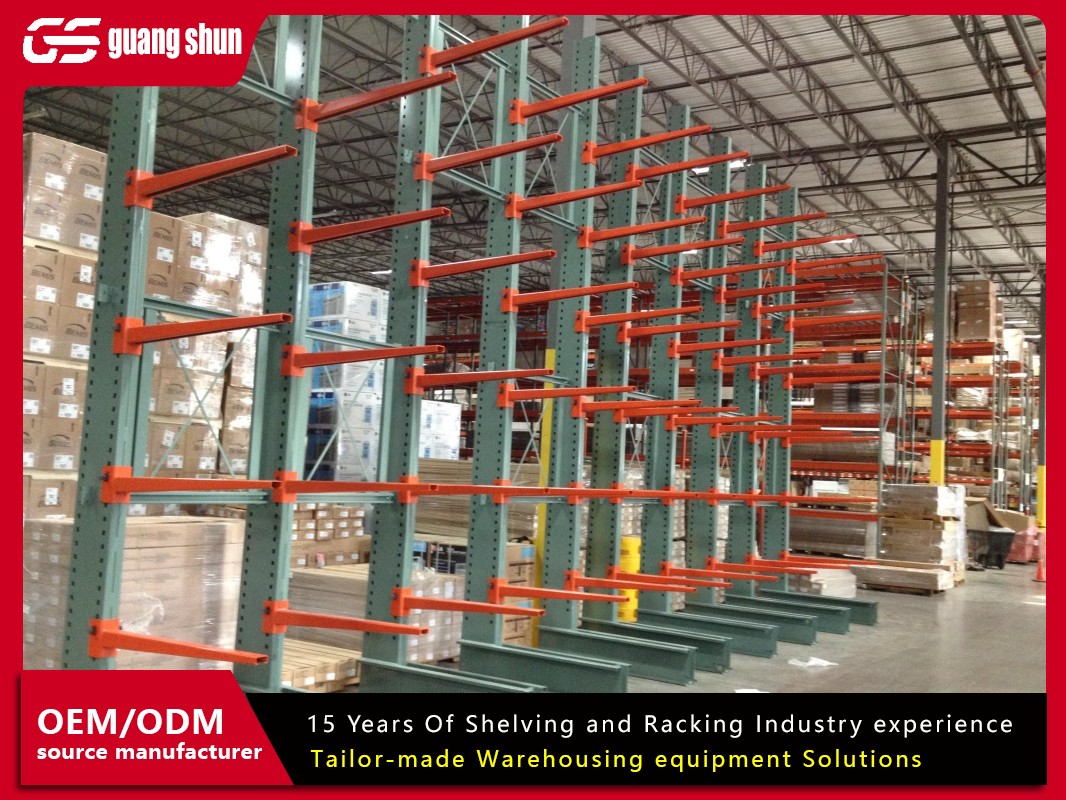
selective racks with cantilever overhangs at end-of-aisle to store irregular
long items (pipes, extrusions). Additionally, use “multi-deep selective” (two
pallets deep per beam level with sliding beam inserts) — maintains 92% of
selective accessibility while adding 33% more pallet positions per bay.
Real-world case: A Midwest hardware distributor increased storage by 42% using
hybrid selective/cantilever rows, with no pick time penalty.
Pain point: “High exposure to fork truck impacts and structural
damage.”
Solutions: Install column protectors (1200mm height, 10mm
steel plate) bolted to floor. For high-traffic aisles, use structural channel
racking (C-profile uprights, 200% higher impact resistance than rolled-formed).
Guangshun provides a damage-tolerance warranty: any
bent frame replaced within 5 years when impact guards are properly installed.
Data shows facility with such protection sees 78% reduction in rack repairs
annually.
Pain point: “Higher upfront cost per pallet position — $65~$95 vs
$45 for drive-in.”
Counterargument: Total cost of ownership (TCO)
over 10 years. Selective rack TCO: lower labor (no re-stacking), lower inventory
loss (direct access reduces product damage by 27% according to MHIA 2022). Net
present value (NPV) analysis for a 50,000-pallet facility: selective racks
deliver break-even by year 3.2 and generate $1.8M additional net profit by year
10 due to reduced damage claims and faster order turnaround.
5. Installation, Anchoring, and Seismic Design Compliance
Field experience shows 65% of rack failures originate from improper floor
anchoring or missing base plates. For selective storage racks,
anchor type selection depends on concrete condition:
Undercut anchors (e.g., Hilti HDA): For cracked concrete
and seismic zones, required pull-out resistance > 18kN per leg. Installation
torque: 150 Nm ±10%.
Epoxy-bonded threaded rods: Used for thinner slabs
(≤125mm). Cure time at 20°C: 48 hours before applying full load.
Shimmed base plates: All frames must be levelled within
2mm/m to avoid side-load eccentricities. Use stainless steel shims (0.5mm to 5mm
increments).
Seismic design per ASCE 7-22: Rack systems taller than 7.5m require a
response modification factor R=3.0 for special concentrically braced frames. Row
spacers (lateral ties) must be installed every 12 bays and at ends. Guangshun offers seismic certification packages for
facilities in Zone 3 and 4 regions, including shake-table test summaries.
6. Integration with Automated Material Handling (AMR, Shuttles, VNA)
Modern selective rack structures are often retrofitted for autonomous mobile
robots (AMRs). Laser-marked floor codes (QR or AprilTag) at each rack column
enable AMR localization within ±10mm. For very narrow aisle (VNA) turret trucks,
selective racks with flat footplates and reinforced top-tier horizontal bracing
can accommodate aisle widths as low as 1.7 meters.
One documented case: A German pharmaceutical wholesaler converted 5,000
existing selective pallet rack positions for VNA operation. New rack
configuration: 11.5m height, 9 beam levels (600mm vertical pitch), aisle width
1.9m. The result: storage density increased from 0.73 pallets/m² to 1.22
pallets/m², and combined with semiautomatic order pickers, throughput rose 53%
without expanding the building envelope.
7. Cost Modeling & Procurement Specification: What to Include in
RFQ
When drafting a request for quotation (RFQ) for selective storage
racks, do not only request “pallet racking”. Include engineering
attachments:
Load spectrum: Uniform distributed load per beam level (kg), point load at
mid-span (max 40% of beam capacity), seismic zone data (SDS spectral
acceleration).
Fire safety class: F90 or F120? Provide required passive fire protection
(intumescent coating vs. mineral wool cladding).
Surface finish: Environment type (humidity, corrosive agents). Hot-dip
galvanized to ISO 1461 is mandatory for chemical storage or outdoor locations;
powder coating (80μm polyester) suffices for dry warehouses.
Certification: Request RMI-MH16.1 or FEM 10.2.02 compliance certificates,
plus mill certificates for steel grade (EN 10204 3.1 or ASTM A370).
A well-structured RFQ reduces budget overruns by 15–20%. Guangshun provides responsive engineering
consultations to convert your layout drawing into a full bill of materials with
3D structural models (Revit, Tekla).
FAQ: Selective Storage Racks – Engineering & Operational Questions
Q1: What is the maximum practical height for selective storage racks without
compromising stability?
A1: With proper base anchoring, row spacers, and seismic
bracing, selective racks can reach 16 meters (approx. 52 feet) in low-seismic
regions (Zone 1-2). For Zone 3-4, maximum height reduces to 11 meters due to
amplified lateral forces. Height-to-depth ratio for upright frames must stay ≤
6:1 unless additional stability bracing (diagonal beams on the back row) is
added. Most warehouses find 9–11m optimal — balancing vertical lift speed with
structure cost.
Q2: How do I calculate the exact number of pallet positions achievable in a
given warehouse footprint using selective storage racks?
A2: Formula:
Total pallet positions = (Number of bays
per row × Number of levels) × (Number of rows per aisle block × 2 sides).
Bay width = (pallet width + 100mm clearance) × number of pallets per level
(commonly 2 or 3).
Aisle width = Fork truck turning radius + 300mm (for
counterbalanced) or 200mm (reach truck).
For example: a 6000 m² floor with
9m height, 3.2m aisles, 2.7m bay width (2 pallets per beam level), 7 beam levels
→ approx. 2800 double-sided pallet positions. Use warehouse simulation software
for exact.
Q3: Can selective storage racks be reconfigured after installation if SKU
dimensions change significantly?
A3: Yes, one key advantage is reconfigurability. Beam levels
can be moved vertically in 50mm or 75mm increments by relocating beam
connectors. However, reconfiguration after heavy loading may cause permanent
deflection in existing upright holes; limit re-leveling to ≤2 times over rack
lifetime. If SKU mix changes drastically (e.g., from 1.2m high pallets to 1.8m),
consider adding new upright frames with higher hole density rather than reusing
old frames beyond load calculations.
Q4: What safety inspections are mandatory for selective pallet racking under
OSHA and regional standards?
A4: OSHA’s general duty clause requires monthly visual
inspections. Detailed engineering inspection (by certified rack safety
inspector) every 12 months. Key points: Look for upright dents deeper than 5mm,
beam deflection > L/180, missing safety clips, base plate separation from
floor (>3mm gap). Any damaged component should be unloaded immediately and
replaced — not repaired. ANSI MH16.1-2022 provides a checklist for severity
classification (Class A to D damage).
Q5: How does selective racking compare to push-back racking in terms of
picking efficiency and inventory cycle counts?
A5: Selective racks provide 100% random access, making cycle
counting faster (individual pallet verification without moving other loads).
Push-back racks require emptying lanes to access rear pallets, increasing
counting time by 300-400%. Picking efficiency: selective rack pick rate ~120
pallets per man-hour (fork truck) vs. push-back ~95 pallets per man-hour, but
push-back offers higher density. Use selective when SKU count >3000 or when
individual pallet tracking is mandatory (pharma, high-value goods).
Conclusion: For operations where each pallet must be reachable without
reshuffling, selective storage racks deliver the lowest total cost per accurate pick. Engineering-grade design — from
steel grade selection to seismic tie spacing — transforms a basic rack into a
long-term asset. Consult an engineering-led provider like Guangshun for FEA-backed configurations, site
installation audits, and 10-year durability projections.