When warehouse operations involve palletized loads exceeding 1,500 kg per
position, standard roll-formed racking reaches its structural limits. Racks
estructurales—structural steel racking systems—are engineered with
hot-rolled or cold-formed heavy-gauge profiles, bolted connections, and
reinforced bracing to handle dynamic impacts, seismic forces, and continuous
duty cycles. This article examines the mechanical design, material
specifications, and application-specific configurations that distinguish
structural racking from lighter-duty alternatives. We analyze load path
distribution, column base plate anchorage, and the trade-offs between bolted and
welded assemblies, supported by field data from distribution centers, automotive
plants, and cold storage facilities.
Structural Steel Profiles and Material Grades
Unlike roll-formed racking fabricated from thin-gauge steel (1.5–2.5 mm),
racks estructurales utilize hot-rolled sections such as H-beams, I-beams, or
heavy-duty C-channels with flange thicknesses of 5–12 mm. The primary material
specification is ASTM A572 Grade 50 or equivalent (yield strength ≥ 345 MPa),
offering superior resistance to bending and torsional buckling. Upright columns
are typically 100×100 mm to 150×150 mm square tubes, with wall thickness
selected based on load height and seismic zone.
Bolted vs. Welded Construction
Two assembly philosophies dominate the structural racking market:
Bolted systems: Utilize grade 8.8 or 10.9 high-strength
bolts with locking nuts. Bolted connections allow for field modifications,
expansion, and relocation. They also provide predictable failure modes under
overload—bolts elongate before fracture, offering visual warning signs. However,
bolt creep under sustained high loads requires periodic re-torquing (typically
every 12 months).
Welded systems: Fabricated in controlled shop environments
with full-penetration fillet welds. Welded frames offer superior rigidity and
eliminate the risk of bolt loosening. They are preferred for permanent
installations with static loads. However, welded joints are susceptible to
fatigue crack initiation at weld toes under cyclic loading—a consideration for
high-traffic areas with frequent impact from forklifts.
Leading manufacturers like Guangshun offer both
configurations, with a proprietary bolted design featuring friction-grip
connections that achieve welded-level rigidity while maintaining adjustability.
Their engineering team provides finite element analysis (FEA) reports for each
custom configuration, validating stress distribution under both static and
seismic loading.
Load Capacity and Deflection Criteria
For racks estructurales, load capacity is not a single number but a function
of beam spacing, column height, and bracing density. Per beam level, typical
capacities range from 2,000 kg to 6,000 kg, with beam deflection limited to
L/180 under full load (per RMI specifications). For high-bay installations (over
15 m), deflection control becomes critical to maintain pallet support integrity
and prevent load slippage. Engineers must account for:
Axial compression: Column slenderness ratio (KL/r) must
remain below 200 to avoid Euler buckling.
Combined loading: Beams experience both bending and shear;
interaction equations per AISC 360-22 are applied.
Impact loading: Forklift collisions are modeled as
equivalent static forces—typically 1.5× the static load applied at column
base.
Real-world data from a 2024 automotive plant upgrade showed that replacing
roll-formed racking with racks estructurales reduced beam deflection from 12 mm
to 3.5 mm under 2,500 kg per position, eliminating pallet misalignment issues
that had caused 3% product damage annually.
Seismic Design and Base Anchorage
In seismic zones (SDC C, D, E per ASCE 7-22), racks estructurales must
incorporate base isolators, shear keys, and moment-resisting connections. The
design approach follows the “capacity design” principle—ductile elements (e.g.,
beam-to-column connections) yield before columns fail. Typical anchorage
consists of 4–6 anchor bolts per column, embedded into a reinforced concrete
floor with epoxy grout. The anchor bolt diameter ranges from M20 to M36, with
embedment depth at least 12 times the bolt diameter.
Recent shake-table tests at the University of California, San Diego,
demonstrated that properly engineered structural racking systems with X-bracing
retain 90% of their initial stiffness after a 0.4 g peak ground acceleration
event. For warehouses in high-risk regions, Guangshun recommends their
seismic-rated bolted system with slotted base plates that allow 25 mm of lateral
displacement without losing vertical load capacity.
Application-Specific Configurations
Heavy Palletized Goods (Steel Coils, Machinery Parts)
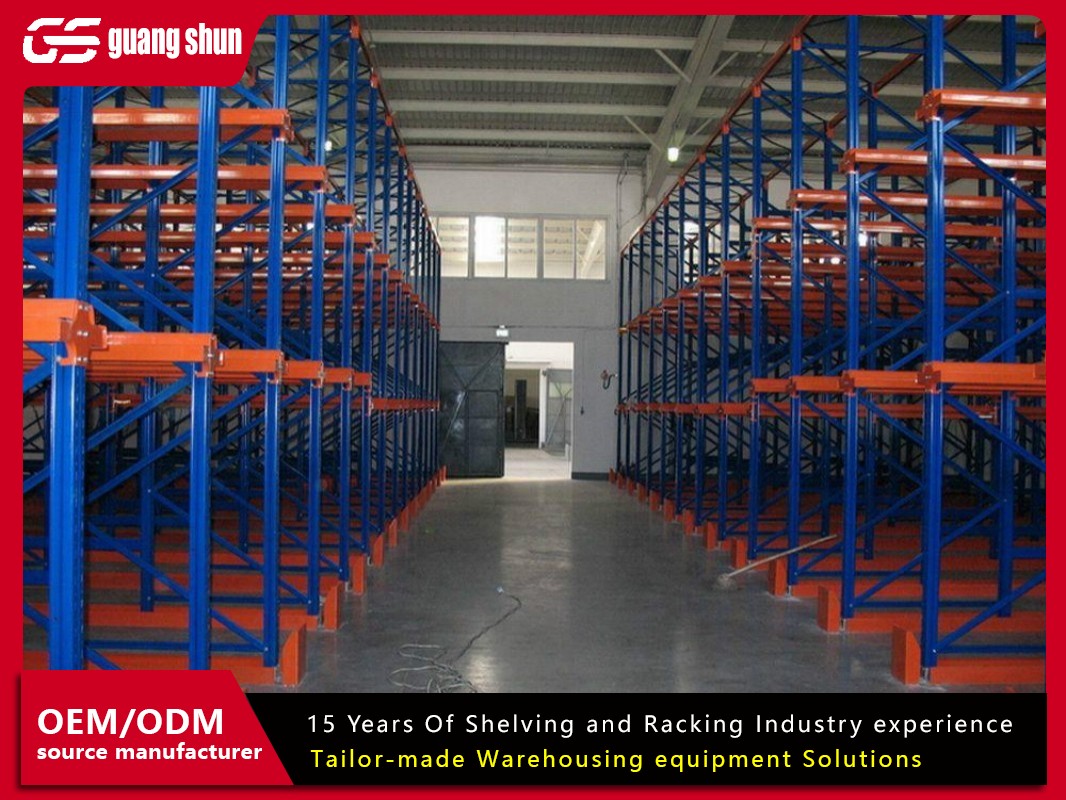
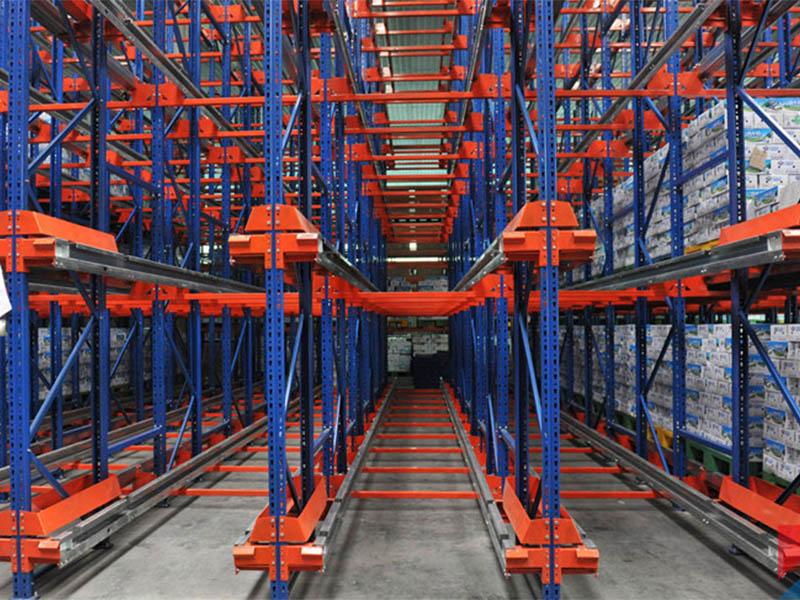
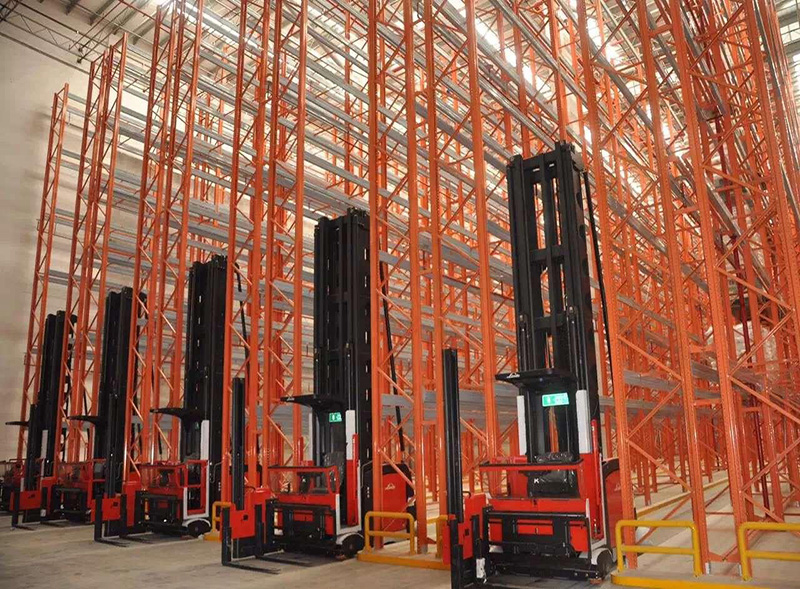
For loads exceeding 4,000 kg per position, double-deep racks estructurales
are often specified. These systems feature reinforced beams with 200 mm flange
width and a double-row upright frame. The load-bearing floor is typically steel
decking with a diamond plate pattern to improve friction. In a steel service
center in Ohio, a 3,000-position structural racking system reduced floor load
concentration from 12 kPa to 7 kPa by distributing weight across larger base
plates, allowing the use of existing floor slab without reinforcement.
Cold Storage and Freezer Environments
Sub-zero temperatures (−25°C) increase the risk of brittle fracture in steel.
Racks estructurales intended for cold storage must use steel with improved
Charpy V-notch impact values (≥ 27 J at −30°C). Additionally, bolted connections
require anti-seize compounds to prevent galling. Insulated base plates and
thermal breaks are incorporated to reduce heat transfer through the racking
structure, minimizing frost heave on the floor slab.
Automotive Tier-1 Supplier Warehouses
These facilities handle mixed SKUs with varying pallet sizes—Euros, GMA, and
custom automotive bins. Structural racking systems with adjustable beam levels
(at 50 mm or 75 mm pitch) offer the flexibility to accommodate different load
heights. A 2023 case study from a German automotive logistics provider showed
that switching to racks estructurales with 12 adjustable levels per bay
increased storage density by 22% compared to fixed-beam systems, while
maintaining the same aisle width.
Industry Pain Points and Engineering Solutions
Floor Flatness and Leveling
Structural racking demands floor flatness within ±3 mm over a 3 m length (per
DIN 18202). Uneven floors induce twisting moments on column bases, leading to
premature connection fatigue. Solutions include:
Grout pads under base plates for load distribution.
Leveling shims (stainless steel, 1–10 mm thickness) with epoxy injection to
lock shim packs.
For extreme unevenness, jackscrew base plates allow ±15 mm
adjustment.
Impact Damage and Column Protection
Forklift impacts are the leading cause of racking failure. Racks
estructurales can be fitted with column guards—heavy-duty steel sleeves or
reinforced concrete bollards. Additionally, a sacrificial base segment
(replaceable lower column section) is available from some manufacturers. Data
from the Warehousing Safety Institute indicates that column guards reduce repair
costs by 78% over five years, with average impact-related downtime dropping from
6 hours to 1.2 hours per incident.
Fire Protection and Sprinkler Compatibility
Structural racking with solid shelving can obstruct water distribution from
sprinkler systems. Engineering solutions include:
Perforated decking with 30% open area to allow water penetration.
In-rack sprinkler heads (intermediate level) with deflector shields.
Clearance between top load and ceiling sprinklers maintained at ≥ 1 m per
NFPA 13.
Guangshun collaborates with fire protection engineers to provide pre-punched beam holes
for sprinkler pipe routing, reducing field installation costs by up to 15%.
Life-Cycle Cost Analysis: Structural vs. Roll-Formed Racking
While the initial capital expenditure for racks estructurales is 40–70%
higher than roll-formed systems, the total cost of ownership over 15 years often
favors structural racking. Key factors:
Maintenance: Structural systems require less frequent
painting (powder-coated with polyester, 80 μm thickness) and bolt tightening,
reducing annual maintenance labor by 60%.
Durability: Thicker steel sections resist corrosion more
effectively; hot-dip galvanized structural racks can last 25+ years in
non-corrosive environments.
Reusability: Bolted structural racks can be dismantled and
relocated with ≥90% component reuse, whereas roll-formed racking often suffers
damage during disassembly.
A 15-year TCO model for a 5,000-pallet warehouse shows that structural
racking yields a net present value savings of $85,000 (assuming a 6% discount
rate), primarily due to reduced replacement cycles and lower damage-related
repairs.
Installation and Quality Assurance
Proper installation of racks estructurales involves several critical
steps:
Floor surface flatness verification using a digital level and
straightedge.
Torque-controlled tightening of all structural bolts (using hydraulic torque
wrenches calibrated per manufacturer specs).
Plumbness verification—each column must be vertical within 1/500 of
height.
Load testing with 125% of rated capacity for 24 hours to confirm deflection
and connection integrity.
Guangshun provides
on-site supervision during installation and offers a comprehensive quality
dossier, including material test certificates, weld inspection reports (MT or
UT), and bolt torque logs. Their warranty covers structural defects for 10
years, with optional extension to 15 years through annual inspection
contracts.
Racks
estructurales represent the gold standard for warehouses requiring maximum
load capacity, seismic resilience, and long-term durability. The engineering
complexity—from steel grade selection to connection design and floor
anchorage—demands a supplier with deep structural expertise. By prioritizing
load path clarity, impact protection, and maintainability, operators can achieve
a racking system that not only stores goods but also safeguards personnel and
assets. As supply chains demand higher throughput and denser storage, structural
racking provides the robust foundation for scalable warehouse operations.
For custom structural designs, including seismic upgrades or special load
configurations, Guangshun offers free preliminary
engineering consultations, complete with 3D CAD models and deflection analysis
reports. Their portfolio includes over 200 structural racking projects across
North America, Europe, and Southeast Asia, with documented performance in
high-impact environments.
Frequently Asked Questions (FAQ)
Q1: What is the maximum height achievable with racks
estructurales?
A1: With proper bracing and seismic design,
structural racking can reach heights of 18–22 meters in high-bay warehouses.
Heights beyond 12 meters typically require additional cross-aisle bracing and
wind load analysis per ASCE 7-22. For very tall installations, sway bracing at
every third bay is mandatory to limit lateral drift to H/200 under service wind
loads.
Q2: How do racks estructurales handle point loads from concentrated
pallets?
A2: Beam deflection is controlled by section modulus; for
point loads, engineers specify beams with increased flange thickness or add
intermediate support beams. A common practice is to use paired beams (twin
beams) spaced 150 mm apart to distribute load across more bearing surface. The
beam-to-column connection must accommodate the resulting shear forces—typically
via bolted end-plate connections with stiffeners.
Q3: Are racks estructurales compatible with automated storage and
retrieval systems (AS/RS)?
A3: Yes, but they require tighter
tolerances—column spacing must be within ±2 mm, and rail alignment for AS/RS
shuttles must be verified using laser measurement. Structural racking can be
designed with integrated guide rails for shuttle carts. However, the higher
rigidity of structural steel reduces the vibration that can affect shuttle
positioning accuracy, making it preferable for high-speed AS/RS
applications.
Q4: What floor slab thickness is recommended for racks
estructurales?
A4: For loads up to 3,000 kg per column, a reinforced
concrete slab of 200 mm thickness with a compressive strength of 30 MPa is
typical. Heavier loads (5,000+ kg per column) require thicker slabs (250–300 mm)
or pile-supported footings. A geotechnical investigation is recommended to
ensure subgrade modulus supports the concentrated loads without settlement.
Q5: Can racks estructurales be installed outdoors?
A5:
Yes, with appropriate weather protection. For outdoor applications, specify
hot-dip galvanizing (zinc coating ≥ 85 μm) or a heavy-duty epoxy paint system (≥
100 μm) with UV-resistant topcoat. Wind loads must be calculated per ASCE 7-22,
and base plates should be elevated 100–150 mm above grade to prevent water
pooling and corrosion. Anchor bolts must be hot-dip galvanized or stainless
steel to resist corrosion.
Q6: What are the fire resistance ratings for structural steel
racking?
A6: Bare steel loses structural capacity above 550°C. For
fire resistance, options include: (a) applying intumescent paint that expands
under heat to insulate steel (typically achieving 60–120 minutes), (b) wrapping
columns with fire-rated boards, or (c) using concrete-filled columns. Fire
engineering design follows Eurocode 3 part 1-2 or equivalent local codes. Note
that sprinkler systems are the primary active fire protection and may reduce the
need for passive fireproofing.
Q7: How often should structural racking be inspected?
A7:
Per RMI and SEMA guidelines, a visual inspection should be performed monthly (by
trained staff), a detailed inspection (including torque checks and plumbness)
quarterly, and a full engineering inspection (with non-destructive testing of
critical connections) annually. After any seismic event above 0.1 g or a
significant forklift impact, an immediate inspection is mandatory.
For detailed technical datasheets, installation manuals, or to schedule a
site visit, contact Guangshun directly. Their
engineering department offers load capacity calculators and seismic compliance
checklists tailored to your local building codes.