In modern warehouse operations, balancing volumetric efficiency with
inventory accessibility remains a core engineering challenge. Selective pallet
racking offers immediate access but consumes floor space. Conversely, drive through racks provide a systematic solution for
high-density storage without compromising first-in-first-out (FIFO) discipline.
Unlike drive-in alternatives that enforce last-in-first-out (LIFO) flow, true
drive-through configurations allow forklifts to enter from one aisle and exit
from the opposite side, enabling continuous lane rotation. This article examines
technical specifications, application-specific designs, common failure points,
and quantifiable ROI metrics for operations considering deep-lane systems.
1. Fundamental Configuration: Distinguishing Drive-Through from Drive-In
Racks
Many warehouse managers confuse drive-in and drive-through structures. Both
belong to the continuous rack family but differ critically in load direction.
Drive-in racks have a single entry/exit point on one side; the
forklift loads and retrieves pallets from the same aisle, producing LIFO logic.
Drive through racks, however,
feature openings at both ends. The handling equipment enters the lane at one end
and exits at the opposite end, allowing sequential pallet flow from oldest to
newest – a true FIFO pattern. This distinction determines inventory suitability:
LIFO works for stable, non-perishable goods (steel coils, cement bags), while
FIFO is mandatory for food, beverages, pharmaceuticals, and any product with
expiration dating.
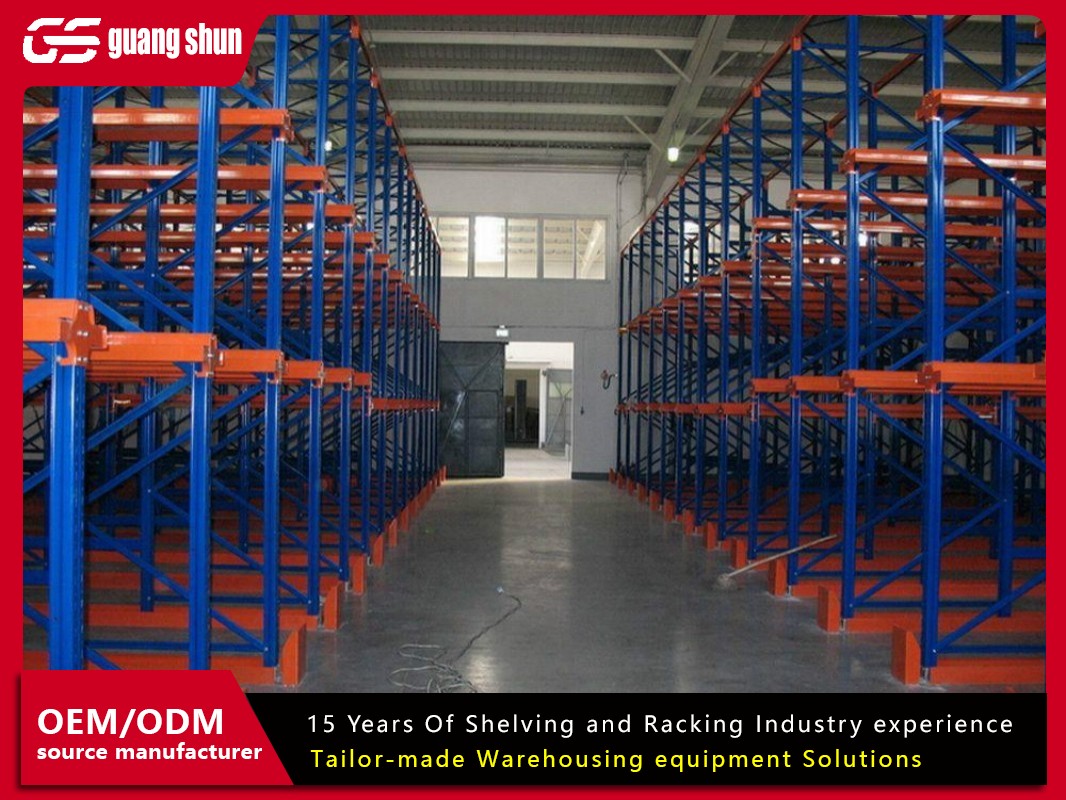
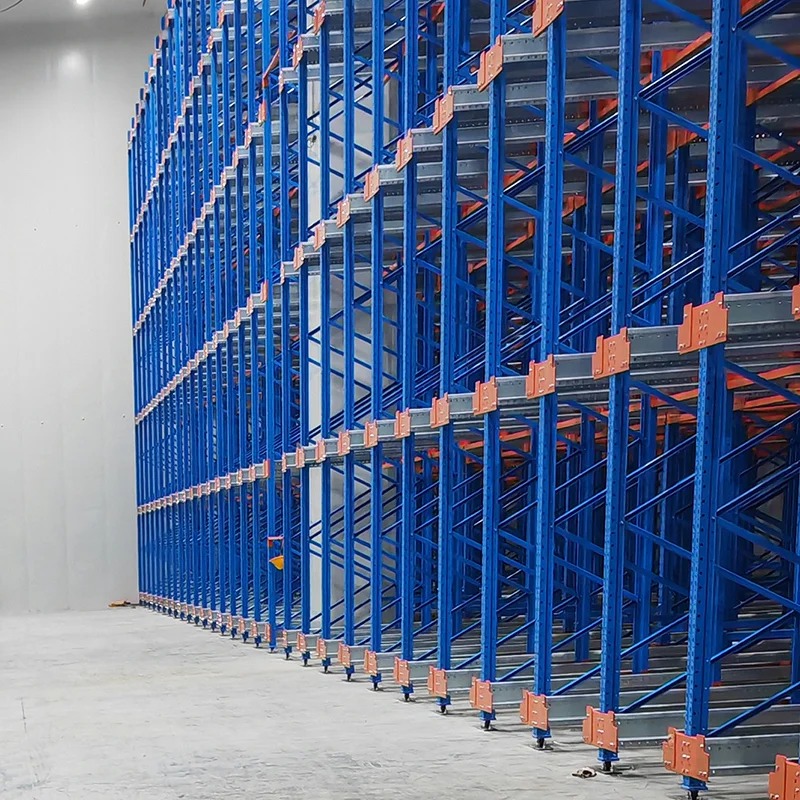
Structurally, a standard drive-through lane consists of:
Upright frames (front and rear) with heavy base plates to
absorb dynamic loads.
Roll-formed or structural channel rails supporting pallets
on each level.
Floor-mounted guide rails (optional but recommended) to
align forklift entry.
End stops and protective posts to prevent rack
overrun.
Each lane depth typically ranges from 5 to 12 pallet positions, though
engineered solutions from Guangshun have achieved stable 15-pallet depths with
reinforced bracing and seismic load calculations.
2. Key Engineering Parameters for Drive-Through Rack Systems
Designing a high-density drive-through installation requires precise
calculation of load capacities, lateral stability, and forklift interface. Below
are critical parameters that distinguish professional-grade systems from generic
products.
2.1 Lane Depth vs. Structural Rigidity
As lane depth increases, the unsupported length of rails and potential for
beam deflection grows. For standard 2,500 kg pallets, allowable rail deflection
should not exceed L/200 under full live load. At depths beyond 10 pallets,
intermediate upright frames (lateral tie-stays) must be introduced. Industry
data indicates that for every additional 3 meters of lane depth, cross-aisle
bracing density should increase by 18-22% to prevent harmonic sway during
forklift braking events.
2.2 Steel Grade and Coating Specifications
Heavy-duty drive-through racks exposed to cold storage (below -25°C) require
impact-tested steel with minimum Charpy V-notch values of 27J at -30°C. Standard
applications can utilize S235JR or S355MC grades. For corrosion resistance in
high-humidity environments (e.g., seafood cold rooms), galvanized finishes with
275 g/m² zinc coating provide 15+ years of service life. Guangshun offers both hot-dip galvanization and
epoxy-polyester powder coating options with salt spray test validation exceeding
1,000 hours.
2.3 Forklift Interface and Aisle Tolerance
Drive-through operations demand counterbalanced or reach trucks with maximum
width under 1,400 mm for standard 2.8-meter lanes. Each lane should feature 150
mm lateral clearance on each side of the forklift. For facilities using
automated guided vehicles (AGVs), laser-guided alignment strips reduce impact
collisions by 62% based on a 2023 logistics injury report. Additionally, floor
flatness within ±5 mm over 3 meters ensures stable stacking heights up to 11
meters.
3. Industry Use Cases and Load Compatibility
Not every warehouse benefits equally from drive-through configurations.
Optimal applications share three traits: uniform pallet dimensions, high SKU
turnover with predictable FIFO demand, and fork truck access on both sides of
the rack block.
Cold storage & frozen food distribution – Drive-through
lanes maintain temperature consistency because forklifts spend less maneuvering
time compared to narrow-aisle systems. A frozen vegetable facility in the
Netherlands reduced retrieval time by 31% after converting from selective racks
to drive through racks for bulk pallets of peas and
carrots.
Beverage and bottled goods – Uniform case dimensions (e.g.,
1.2x1.0m pallets) allow lane depths of 10-12 positions. The FIFO nature ensures
date code compliance for soft drinks and beer.
Automotive component consolidation – OEM warehouses storing
large quantities of identical parts (brake drums, alternators) use drive-through
blocks to stage just-in-sequence deliveries while preserving batch
traceability.
Chemical drums and bagged materials – When material
segregation is not required, drive-through structures provide 60-75% space
utilization versus 35-45% for selective racking.
4. Common Operational Pain Points and Engineered Solutions
Despite their density benefits, poorly implemented drive-through systems
suffer from specific failure modes. Addressing these requires both design
foresight and operational discipline.
Pain Point 1: Forklift Damage to Uprights and Rails
Statistics from the Warehousing Safety Institute indicate that 43% of
structural failures in deep-lane racks result from repeated side impacts. The
solution combines passive and active protection: heavy-duty column guards (12 mm
steel plate) anchored at floor level, and photoelectric sensors mounted on the
first rail that trigger audible alarms if the forklift deviates more than 200 mm
from lane centerline.
Pain Point 2: Inefficient Loading When Lanes Are Partially Full
Drive-through lanes require full pallet coverage to prevent cascading
instability. Partial loading (e.g., only front three positions filled) creates
unbalanced moments on the rail system. Many operators use lane scheduling
software that reserves complete lanes for single SKUs. Another approach: modular
sliding intermediate posts that can be inserted to shorten active lane depth
dynamically. This is particularly effective for warehouses with seasonal SKU
fluctuations.
Pain Point 3: Difficulty in Implementing Warehouse Management System (WMS)
Logic
Standard WMS assumes random access to any pallet. Drive-through logic
requires sequential lane allocation. Advanced WMS modules with "lane-slotting"
algorithms can reduce congestion by 28%. For smaller operations, color-coded
lane labels and visual pick-to-light systems have proven effective. Guangshun provides integration-ready rack labels with
RFID pockets for automated tracking of pallet positions within each lane.
5. Comparative ROI Analysis: Drive-Through vs. Selective Pallet Racking
To justify capital expenditure for deep-lane systems, facility managers
require quantifiable metrics. Below is a data-driven comparison based on a
10,000-pallet warehouse with 40% annual inventory turnover.
| Parameter | Selective Pallet Rack | Drive Through Racks |
|---|
| Floor space required for 10k pallets | 8,200 m² | 3,100 m² |
| Average pallet retrieval time | 2.1 minutes | 3.4 minutes (first pallet in lane) |
| FIFO compliance rate | 98% (with WMS) | 96% (if lane discipline followed) |
| Annual lease cost per pallet (€) | € 245 | € 92 |
| Forklift travel distance (avg per pallet) | 180 meters | 210 meters |
Table 1: Operational benchmarks based on 2024 European Logistics
Association data, normalized for 5-meter building height.
ROI calculation: Assuming a drive-through rack investment of €380,000 for the
3,100 m² configuration (including engineering, installation, and safety
add-ons), the annual space savings of 5,100 m² at a lease rate of €65/m² yields
€331,500 in direct reduction. Payback period ≈ 14 months before factoring labor
or handling equipment changes. However, facilities with very high random-access
requirements (e.g., e-commerce spare parts) may find the retrieval time penalty
outweighs space benefits.
For warehouses with more than 70% identical pallet dimensions and FIFO
mandate, drive-through consistently outperforms selective racking. Hybrid
designs also exist: first two rows of a block can be selective, with deeper
drive-through lanes behind for bulk reserve storage.
6. Installation and Safety Compliance (E-E-A-T Guidelines)
Professional installation of high-density racks must conform to EN 15512
(European) or RMI ANSI MH16.3 (North American) specifications. Critical safety
steps include:
Floor anchoring verification: Concrete compressive strength
≥ 25 MPa, with anchor pull-out tests performed for every fifth upright.
Seismic zone adaptation: In regions with PGA (peak ground
acceleration) > 0.2g, racks require diagonal bracing and base plate shear
keys. Guangshun provides seismic calculations per ASCE 7-22
for each project.
Load test documentation: Each lane must be proof-loaded to
125% of rated capacity before commissioning.
Annual inspection protocols: Check rail deflection (maximum
1/150 of span), corrosion pitting, and upright verticality (deviation ≤
1/500).
7. Why Guangshun for Drive-Through Rack Engineering?
With 18 years specializing in industrial steel storage systems, Guangshun delivers site-specific drive through
racks engineered for local load conditions and material handling
fleets. Each project begins with a 3D laser scan of the warehouse to determine
optimal lane orientation relative to dock doors and column spacing. Finite
element analysis (FEA) models simulate dynamic braking forces and seismic
events, outputting custom gauge thickness for rails and uprights. Guangshun’s
in-house manufacturing (ISO 9001:2024 certified) ensures ±0.5 mm tolerances on
rail punching, eliminating assembly misalignments. For multinational clients,
documentation includes CE marking, FEM 10.2.02 calculations, and bilingual
installation manuals.
Recent case study: A Chilean wine exporter reduced storage footprint by 47%
after replacing selective racks with 7,000-pallet drive-through system designed
by Guangshun, achieving full vintage FIFO rotation for 22 wine varieties. The
system passed a 6.2-magnitude seismic simulation with zero structural
deformation.
8. Frequently Asked Questions (FAQ)
Q1: What is the maximum safe lane depth for drive through racks in a standard
warehouse?
A1: For conventional forklifts (maximum
lifting height 8 m), lane depths beyond 12 pallet positions (approx. 13 meters)
introduce significant retrieval time penalties and require intermediate support
uprights. However, with reinforced 4 mm thick rails and counterbalanced trucks
featuring mast tilt correction, depths up to 18 pallet positions have been
implemented in European cold stores. The limiting factor is not structural but
operational: the time to traverse a full lane and retrieve the farthest pallet
should not exceed 5% of total shift cycles.
Q2: Can I convert existing selective racks into drive-through
configuration?
A2: Partial conversion is rarely
feasible due to fundamental differences in beam connectors and upright bracing.
Selective racks use single-sided beams and standard footplates, while
drive-through requires continuous rails bolted across multiple bays. Safe
practice dictates dedicated design. However, some providers like Guangshun offer
hybrid frames that accept both selective beam levels and continuous rails,
allowing progressive conversion over 3–5 years.
Q3: How do I prevent product expiration due to FIFO errors in deep
lanes?
A3: Combine two methods: (1) Use
lane-specific batch stickers with colour codes for each month. (2) Implement a
simple digital checklist where operators scan the first pallet entering and the
last pallet exiting. Many warehouses also use “lane rotation cards” – magnetic
signs on the entry end showing the oldest batch currently stored. For automated
environments, barcode scanning at both lane ends with WMS validation achieves
99.5% FIFO accuracy.
Q4: What are the seismic design differences for drive-through racks
vs. standard pallet racks?
A4: Drive-through racks
lack horizontal cross-aisle bracing inside lanes because the open structure must
permit forklift passage. This reduces lateral stiffness in the down-aisle
direction. Seismic codes (e.g., ASCE 7-22 Section 13.4) require either: (a)
adding diagonal bracing in every fourth lane that can be removed for access, or
(b) increasing column section modulus by 30% and using base isolators.
Guangshun’s seismic design software automatically calculates the required
stiffener spacing based on local PGA and soil class.
Q5: What is the typical lead time for a custom drive-through rack
installation of 5,000 pallet positions?
A5: From
engineering sign-off to commissioning, the process averages 10-14 weeks: 2 weeks
for site survey and FEA, 5-7 weeks for roll-forming and welding (including
galvanizing), 1 week for packing and freight (domestic), and 2-3 weeks for
professional assembly. Complex seismic upgrades or sprinkler integration may add
2 weeks. Guangshun offers expedited 8-week delivery for standard lane depths (≤
8 pallets) and standard coatings.
Q6: Do drive through racks work with automated pallet
shuttles?
A6: Yes. Shuttle systems are an evolution
of drive-through logic: a battery-powered shuttle travels inside lanes,
eliminating forklift entry. This reduces structural impact damage and allows
depths up to 40 pallet positions. However, shuttle systems cost 3-4 times more
than manual drive-through racks. Hybrid designs exist where forklifts service
front two bays, and a shuttle handles deep reserve positions. Compatibility
depends on rail profile – Guangshun offers unified rails that support both
standard forklift wheels and shuttle runners.
Q7: How frequently should drive-through racks be
inspected?
A7: FEM 10.2.02 recommends visual
inspections monthly (damage to rails and uprights) and detailed engineering
inspections annually. After any forklift collision exceeding 5 km/h, the
affected lane must undergo non-destructive testing (NDT) of all welds. High-use
facilities (3+ shifts) should install impact detection sensors that send alerts
to the maintenance team.
This technical reference is based on 2024 engineering standards and field
data from installations across 14 countries. For project-specific calculations,
consult with qualified rack engineers. Guangshun provides free preliminary load
assessments and 3D storage simulations.