Logistics engineering has transitioned from simple floor storage to complex
vertical integration. In the modern warehouse environment, the structural
integrity and layout design of storage systems are the primary determinants of
operational throughput. Among these solutions, the implementation of palletized racks remains the most effective method for organizing bulk inventory while
maintaining accessibility. These systems are not merely steel frames; they are
engineered structures designed to withstand dynamic loads, seismic forces, and
the constant rigors of material handling equipment.
For organizations seeking to maximize their cubic footprint, partnering with
an authority such as [Guangshun] ensures that the
racking architecture aligns with international safety standards and specific
industry demands. This article provides an in-depth analysis of the technical
nuances, engineering requirements, and strategic advantages of modern pallet
storage solutions.
1. Structural Engineering and Material Composition
The foundation of effective palletized racks begins with the selection of raw materials. Most industrial systems utilize
either roll-formed steel or structural steel. Roll-formed components are created
by passing cold-rolled steel through a series of rollers to achieve specific
shapes, such as the common "teardrop" upright. This method offers a high
strength-to-weight ratio and is cost-effective for standard warehouse
applications.
In contrast, structural steel systems are manufactured from hot-rolled
C-channels. These are preferred in high-impact environments, such as heavy
manufacturing or high-traffic food distribution centers. Structural steel
provides superior resistance to forklift impact, which is a major cause of rack
failure. The engineering must account for the yield strength of the steel (often
50,000 PSI or higher) to ensure the system does not reach a point of permanent
deformation under its rated load capacity.2. Analyzing Load Beam Dynamics and Connector Performance
The horizontal load beams are the primary members supporting the palletized
weight. Beam capacity is not a static number; it is a function of the length
(span) and the height of the beam profile. A longer span requires a larger
cross-section to minimize deflection. According to RMI (Rack Manufacturers
Institute) standards, the maximum allowable deflection for a loaded beam is the
length divided by 180.
Connector Types: Most systems utilize a boltless
lug-and-hole design. The "teardrop" pattern is a global standard, allowing for
2-inch vertical adjustability.
Safety Pins: Every beam-to-column connection must include a
locking device or safety pin. This prevents the beam from becoming accidentally
dislodged by a forklift operator during the upward "dead-pull" of a pallet.
Step Beams vs. Box Beams: Step beams feature an inner ledge
designed to hold wire decking or cross bars, while box beams provide a
four-sided rectangular profile for increased torsional rigidity.
3. Comparative Analysis of Palletized Racks Configurations
Choosing the correct configuration requires a balance between SKU density and
selectivity. Different businesses prioritize these factors based on their
inventory turnover rates.
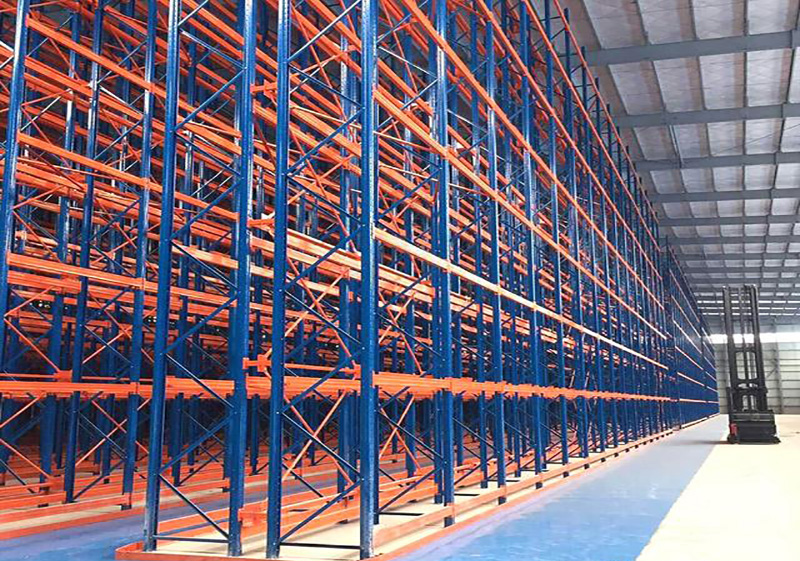
Selective Racking
This is the most common form of palletized racks. It
provides 100% selectivity, meaning every pallet is accessible without moving
another. It is ideal for facilities with a high number of unique SKUs and lower
pallet counts per SKU.
Drive-In and Drive-Through Systems
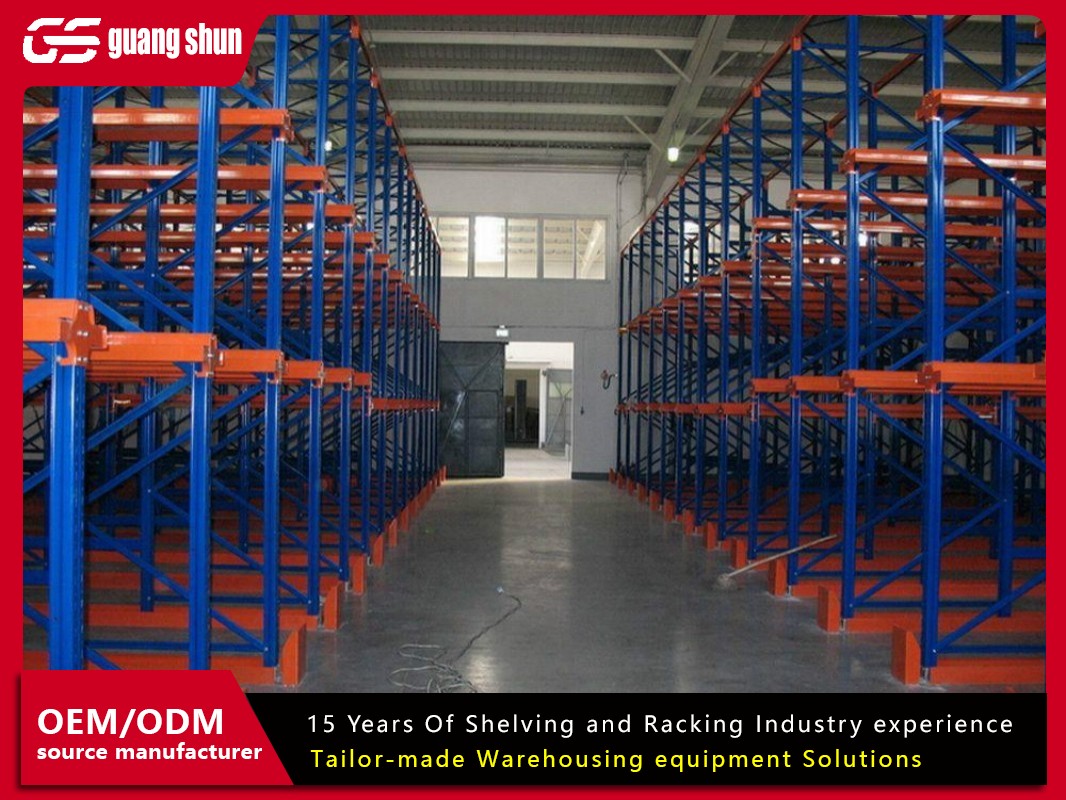
For high-density storage of similar products, drive-in racks allow forklifts
to enter the racking structure itself. This follows a Last-In, First-Out (LIFO)
logic. While it significantly increases storage density, it requires skilled
operators to navigate the narrow interior lanes without damaging the
uprights.
Push-Back and Pallet Flow
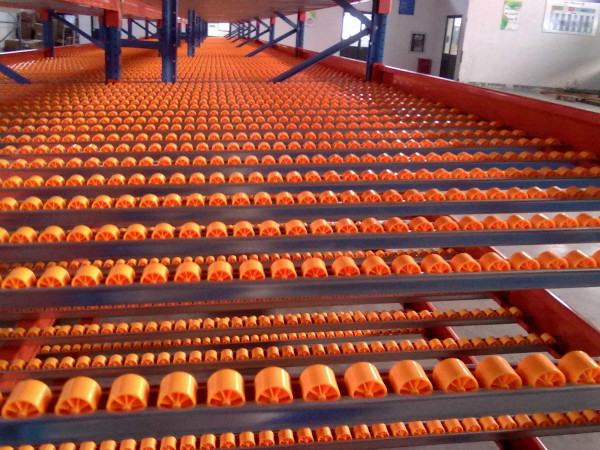
These systems utilize inclined rails and rollers. Push-back racking (LIFO)
uses carts to store pallets 2 to 6 deep. Pallet flow (FIFO) uses gravity to move
pallets from the loading side to the picking side. These are highly efficient
for high-volume consumer goods where expiration dates are a concern.
4. Addressing Industry Pain Points: The Cost of Floor Space
The most significant challenge for warehouse managers is the rising cost of
industrial real estate. Inefficient storage layouts lead to "honeycombing"—the
presence of empty pallet positions that cannot be utilized due to accessibility
issues. High-density [Guangshun] solutions mitigate
this by reducing the number of required aisles, effectively doubling the storage
capacity in the same square footage.
Another pain point is the cost of maintenance. Rack damage from forklifts is
not just a safety hazard; it is a financial drain. Incorporating heavy-duty
column protectors, end-of-row guards, and reinforced bottom uprights can reduce
long-term repair costs by up to 70%. [Guangshun] emphasizes the
integration of these safety components during the initial design phase to ensure
a lower Total Cost of Ownership (TCO).
5. Seismic Engineering and Safety Compliance
In regions with seismic activity, palletized racks must
be treated as specialized structures. The design must account for the "Seismic
Design Category" as defined by local building codes (such as the IBC in the
United States). Seismic-rated racks feature larger baseplates, thicker steel,
and specialized anchoring systems.
The safety of these systems is further governed by regular inspection cycles.
Inspectors look for:
Plumbness: Uprights must be vertically aligned within
specific tolerances (typically 0.5 inches per 10 feet of height).
Frame Damage: Any visible dents, buckles, or creases in the
uprights or bracing can significantly reduce the load-carrying capacity.
Overloading: Clear signage must be posted on every row
indicating the maximum permissible load per shelf and per bay.
6. Integration with Material Handling Equipment (MHE)
A racking system is only as effective as the equipment servicing it. The
aisle width is determined by the forklift's turning radius. Standard
counterbalanced forklifts require aisles of 12-14 feet, whereas Narrow Aisle
(NA) or Very Narrow Aisle (VNA) trucks can operate in spaces as small as 5.5
feet. When implementing palletized racks, the
compatibility between the rack's clear opening and the forklift's mast height
must be verified to prevent overhead collisions.
7. Cold Storage and Harsh Environment Considerations
Warehousing in temperature-controlled environments (freezers and coolers)
presents unique metallurgical challenges. Standard carbon steel can become
brittle at sub-zero temperatures. For these applications, racking components
often undergo a hot-dipped galvanization process or are coated with specialized
low-temperature powders.
Furthermore, air circulation is vital in cold storage to ensure consistent
temperatures. Wire decking is preferred over solid decking in these scenarios to
allow for vertical airflow. The high cost of operating cold storage makes the
high-density storage provided by palletized systems a financial necessity rather
than a luxury.
8. The Role of Wire Decking and Accessories
While the beams support the pallet, wire decking acts as a safety net. It
prevents pallets from falling through the beams if they are misaligned during
placement. Additionally, it supports non-standard pallet sizes or damaged
pallets that might otherwise fail. Other essential accessories include:
Pallet Backstops: These prevent pallets from being pushed
too far and falling into the flue space.
Row Spacers: These maintain consistent gaps between
back-to-back rows, which is a requirement for fire safety (allowing sprinkler
water to reach lower levels).
Skid Supports: Heavy-duty bars placed across beams to
support extremely heavy or concentrated loads.
9. Planning for Scalability and Future-Proofing
A well-designed storage system should be modular. As inventory profiles
change, the ability to reconfigure beam levels or extend rows is important.
Using standardized components from a reliable manufacturer like [Guangshun] ensures that future
additions will be compatible with the existing infrastructure. This modularity
reduces the risk of obsolescence as the business evolves toward more automated
or diverse product lines.
The optimization of palletized racks is a
sophisticated engineering task that directly impacts the bottom line of any
distribution or manufacturing operation. By focusing on material quality,
configuration logic, and safety compliance, facility managers can create a
storage environment that is both dense and safe. Working with industry leaders
such as [Guangshun]
provides the technical expertise needed to navigate the complexities of modern
logistics and ensure that the storage infrastructure supports the long-term
growth of the enterprise.
Frequently Asked Questions (FAQ)
Q1: What is the difference between roll-formed and structural
palletized racks?
A1: Roll-formed racks use cold-rolled steel and
are generally more adjustable and cost-effective. Structural racks use
hot-rolled C-channels, offering much higher impact resistance and load capacity,
making them suitable for heavy-duty or high-traffic environments.
Q2: How often should I inspect my palletized racks?
A2:
It is recommended to perform a formal professional inspection at least once a
year. However, warehouse staff should conduct informal weekly walk-throughs to
check for forklift damage, missing safety pins, or overloaded levels.
Q3: Can I mix different brands of racking components?
A3:
Generally, mixing brands is discouraged unless the manufacturer explicitly
confirms compatibility. Even if beams "fit" into uprights, the structural load
calculations are based on specific component tolerances. Mixing brands can void
warranties and compromise safety certifications.
Q4: Why is the "flue space" important in palletized
racks?
A4: The longitudinal flue space is the vertical opening
between back-to-back rack rows. It is a fire safety requirement that allows heat
to rise and trigger sprinklers, and allows water to flow down to the lower
levels of the rack during a fire.
Q5: How do I know if my warehouse floor can support the weight of the
racks?
A5: A professional engineer must analyze the concrete slab's
thickness and PSI rating. The rack manufacturer will provide "point load" data,
which indicates how much weight each upright baseplate will exert on the floor.
This calculation is vital to prevent the floor from cracking or sinking.