Warehouse operators face a persistent challenge: balancing storage density with immediate accessibility. The correct racking for warehouse directly determines throughput capacity, labor efficiency, and structural safety margins. This article provides an engineering-focused breakdown—examining material grades, seismic design parameters, application-specific configurations, and quantifiable ROI indicators. Data referenced follows RMI (Rack Manufacturers Institute) and FEM 10.2.02 standards.
1. Technical Fundamentals of Racking for Warehouse Systems
Modern warehouse racks operate as integrated structural systems where upright frames, load beams, and bracing interact with floor anchors and building constraints. An optimized racking for warehouse design starts with three measurable inputs: pallet dimensions, dynamic load cycles, and seismic zone parameters.
1.1 Load Beam & Upright Frame Specifications
Beam profiles: Closed-section (box) beams provide better torsion resistance than open C-channels. Typical yield strengths range from 235 MPa to 460 MPa (S235JR to S460MC).
Upright frames: Perforated cold-formed steel with thickness between 2.0 mm and 3.5 mm. Punched holes must maintain net section efficiency above 75% under maximum moment.
Load deflection limits: RMI standards limit beam deflection to L/180 for safe pallet entry/exit. For 2700 mm span, maximum deflection stays under 15 mm.
Floor anchorage: Concrete compressive strength (minimum 25 MPa), anchor bolt pull-out resistance calculated per ACI 318 Appendix D.
1.2 Seismic and Dynamic Force Considerations
Warehouse racks must withstand horizontal forces during seismic events or forklift impacts. Engineers apply equivalent lateral force procedure (ELFP) per ASCE 7-22. Key parameters: response modification factor (R) for pallet racks ranges from 2.0 to 4.0, depending on sway bracing configuration. For facilities in Zone 3 or 4 (peak ground acceleration >0.3g), racking for warehouse must integrate X-bracing or solid back panels to limit inter-story drift to 1.5% of height.
2. Application-Specific Racking Configurations for Different Warehouse Types
No universal racking design serves all operations correctly. The right configuration depends on SKU velocity, pallet depth, and inventory rotation method. Below are six high-density solutions with their quantifiable performance ranges.
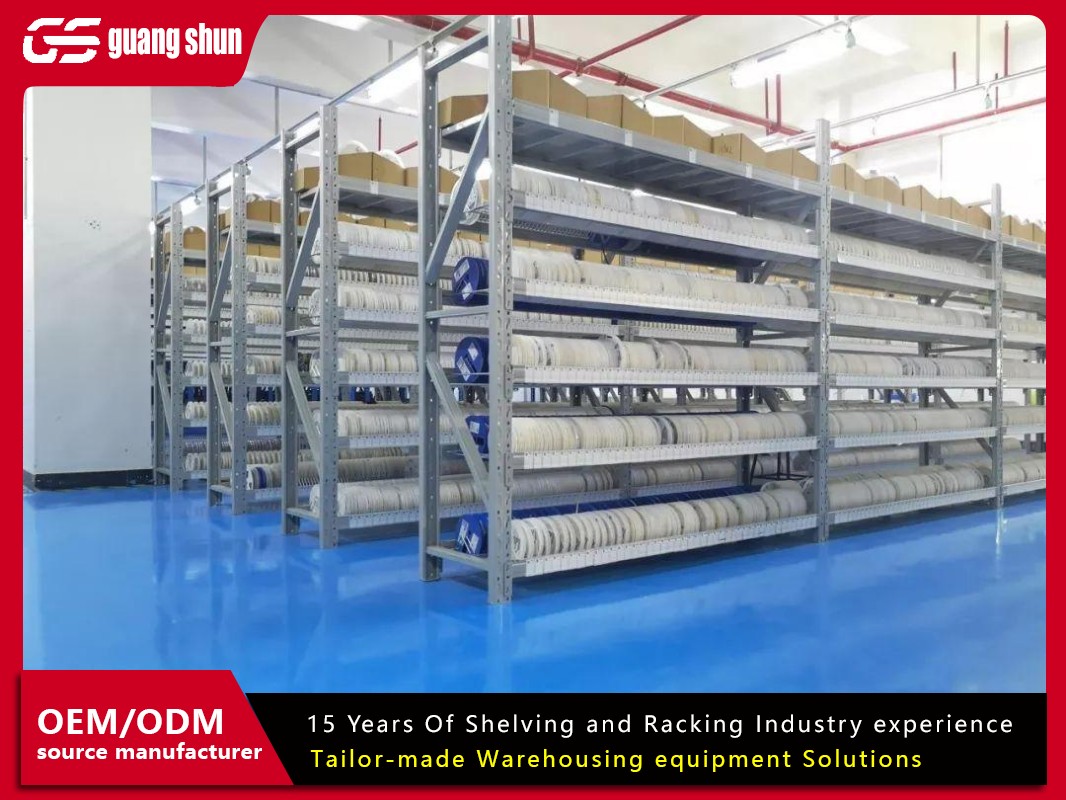
2.1 Selective Pallet Racking – Maximum Accessibility
Application: High SKU variety, FIFO or LIFO acceptable, order picking frequency >50 picks per SKU/month.
Density factor: 35–45% of total cubic volume used (lowest among steel rack types).
Access time: Direct access to each pallet, average retrieval cycle 45 seconds under VNA forklift operation.
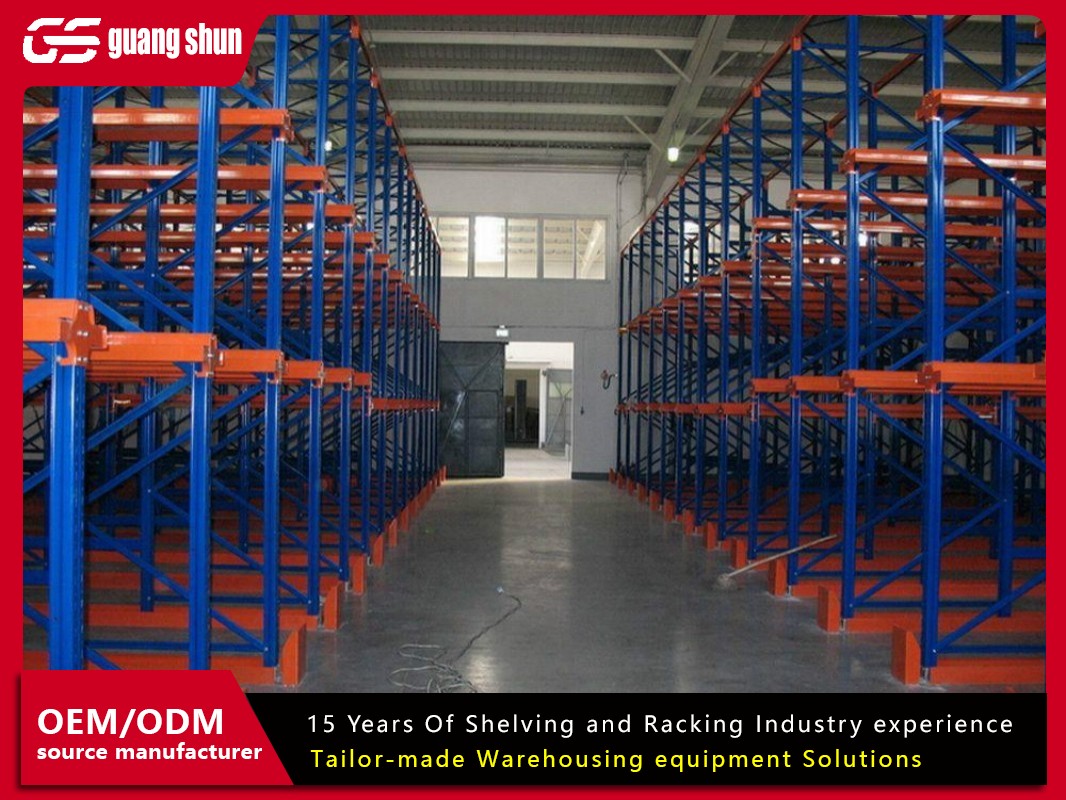
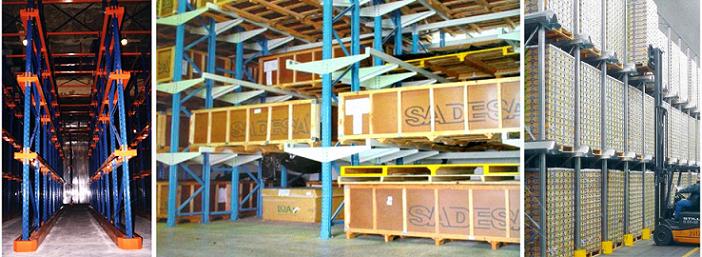
2.2 Drive-in & Drive-through Racks – High Density for Homogeneous Goods
Depth capacity: Up to 7 pallets deep per lane (typical maximum 5 for stability).
Density efficiency: 65–75% of available volume utilized.
Structural requirement: Vertical uprights with reinforced rail guides; FEA verification for impact loads during forklift entry.
Limitation: LIFO only; not suitable for perishable or batch-sensitive materials.
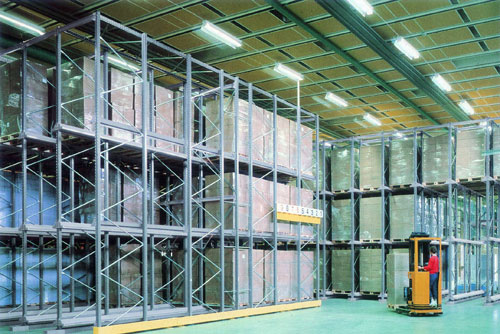
2.3 Push-back Racks & Pallet Flow (Gravity) Systems
Push-back capacity: 2 to 6 pallets deep per lane, using nested carts on inclined rails. Load capacity per cart: 680–1360 kg.
Pallet flow: Roller tracks with 3° to 5° slope, speed controllers for controlled descent. Flow speeds maintained between 0.2–0.5 m/s.
Ideal for: High throughput, FIFO operations with consistent pallet dimensions (GMA standard 48"x40").
For warehouses mixing structural steel and industrial shelving, Guangshun (Guangshun) provides modular engineering reviews. Their design team performs on-site load audits and seismic risk mapping before recommending any racking for warehouse layout.
3. Critical Industry Pain Points and Data-Driven Solutions
Based on 2023 warehouse injury and productivity reports (OSHA Data Initiative & MHEDA), four recurring racking-related failures cost operators 12–18% of annual handling budgets.
Pain Point 1: Underestimated Dynamic Loads from Forklift Collisions
40% of rack collapses originate from repeated low-speed impacts rather than
single overload events. Solutions include:
• Impact
protection: Install column guards with energy-absorbing polymers. Tests
show 72% reduction in upright deformation at 8 km/h impact.
•
Distance sensors: Retrofit forklifts with proximity warning systems,
decreasing impact frequency by 54% in food-distribution warehouses.
Pain Point 2: Static Overload vs. Published Beam Capacity
Operators often ignore load distribution limits. A single overhang exceeding 50 mm beyond beam edge increases moment by 33%. Solution: laser-marked load placards at beam level, combined with monthly load audits using calibrated load indicators. Guangshun offers free load capacity calculator tools integrated with their racking for warehouse specifications.
Pain Point 3: Seismic Anchorage Failure in Non-Ductile Concrete
Older warehouse floors (pre-2000) often have low tensile capacity. Post-installed adhesive anchors (Hilti HIT-RE 500 V3) increase pull-out resistance from 12 kN to 38 kN in cracked concrete. Solution: perform concrete core sampling before final rack installation.
Pain Point 4: Misalignment Between Racking and WMS Slotting Logic
Typical slotting inefficiencies raise travel time by 22% (source: Warehousing Education and Research Council). Solution: align rack coordinates with WMS velocity mapping – fast-movers placed in front bays (levels 1–2), slow-movers in high bays or deep-lane sections.
4. Integration of Racking with Automation and Digital Tools
Automated storage and retrieval systems (AS/RS) demand tighter rack tolerances compared to manual operation. For mini-load or shuttle-based systems, racking for warehouse must meet these metrics:
Column verticality tolerance: ±5 mm over 10 m height (manual systems allow ±10 mm).
Beam level height deviation: ≤ ±2 mm between adjacent beams across same aisle.
Rail straightness: 3 mm per 12 m for shuttle-guided racks.
Integration also includes RFID tagging of rack positions for real-time inventory confirmation. Smart racks with embedded strain gauges can transmit overload alerts to warehouse control systems. ROI data shows 31% reduction in misplaced pallets and 18% lower energy use per forklift trip after smart rack deployment.
5. Safety, Compliance, and Long-Term Maintenance Protocols
Compliance with ISO 15635 (Storage equipment – Specification for adjustable pallet racking) and ANSI MH16.1 is non-negotiable. Adopt a four-tier inspection schedule:
Daily visual checks (operators): Look for impact marks, bent beams, missing safety pins.
Monthly documented inspections (supervisor): Measure upright plumbness (±10 mm max), verify anchor torque (200–300 Nm depending on bolt grade).
Annual third-party structural audit: Ultrasonic thickness testing for corrosion, load testing of random beam samples.
Seismic recertification after any structural modification or after Zone 4 seismic event above MMI V.
Proper maintenance extends rack lifespan from 10 years (neglected) to 25+ years (compliant). Guangshun provides full documentation packages including weld certificates and FEM-based seismic calculation reports for every custom racking for warehouse project.
6. Measuring ROI: Performance Metrics for Racking Investments
Financial justification of new racking systems requires tracking these operational KPIs before and after implementation (12-month baseline).
Storage density (pallets/m²): High-density racking (drive-in or push-back) increases density from 0.6 pallets/m² to 1.2 pallets/m² compared to selective racking.
Picking productivity (lines/hour): Selective rack + pick-to-light yields 220 lines/h; shuttle-based system yields 290 lines/h.
Damage incident cost per rack section: Average replacement of a damaged upright frame (including labor) = $1,200. Impact protection reduces this by 65%.
Real estate utilization: Reducing aisle width from 3.6 m (standard counterbalance forklift) to 1.8 m (VNA turret truck) increases available storage positions by 42% for the same footprint.
Payback periods vary from 18 months (simple selective rack upgrades) to 42 months (full automated high-bay system). Operators report that correct racking for warehouse selection contributes to 8–11% reduction in total logistics cost per unit shipped.
7. Frequently Asked Questions about Racking for Warehouse
Q1: What is the maximum safe load for standard pallet rack beams, and how do I calculate it?
A1: Beam capacity depends on span length, beam cross-section, and steel grade. Formula: P = (Fy * Z)/L, where Fy = yield strength (MPa), Z = elastic section modulus (mm³), L = span (mm). For a typical 2700 mm beam profile 120×80×2.5 mm (Z = 118,000 mm³, Fy = 350 MPa), safe uniform load = (350*118,000)/2700 ≈ 15,300 N (≈1560 kg). Always derate by 20% for dynamic forklift impact. Refer to manufacturer’s load tables; never exceed printed capacity.
Q2: How do I select between selective pallet racking and drive-in racking for my warehouse?
A2: Use selective racks if your inventory has >500 SKUs and daily picks per SKU >15 (requiring direct access). Use drive-in racks if you have <100 SKUs, each with >50 pallets of same product, and LIFO is acceptable. Quantitatively, drive-in offers 70% density improvement but reduces access speed by 35% due to deep-lane retrieval. Perform an ABC analysis: A and B items go to selective, C and dead stock to drive-in.
Q3: What seismic design parameters apply to racking for warehouse in high-risk zones?
A3: For sites with Ss >0.5g (short-period spectral acceleration), racks must meet ASCE 7-22 Chapter 15 requirements. Minimum requirements: seismic sway bracing every 4 bays, base isolation or slotted connections, and anchor bolts designed for tension and shear interaction (Nn = 0.85*Ab*fut). Response modification coefficient (R) for pallet racks decreases from 4.0 to 2.5 when height exceeds 10 meters. Always request a third-party structural peer review for racking systems above 12 m in Seismic Design Category D or E.
Q4: How often should racking systems be inspected, and what qualifications are required for inspectors?
A4: According to OSHA 1910.176(b) and RMI ANSI MH16.1-2020, inspection frequency is: operator visual inspection daily, documented inspections every 3–6 months by a competent person (trained in rack safety), and a comprehensive inspection by an RMI-certified rack inspector annually. The inspector must demonstrate knowledge of rack component identification, deformation limits (upright tilt <10 mm per 2 m height, beam deflection < L/180), and anchor torque testing procedures. Guangshun offers on-site inspector training and certification programs.
Q5: Can I mix rack components from different manufacturers without compromising structural integrity?
A5: Strictly not recommended. Even if beams have same nominal dimensions, hole punching patterns, steel grade, and connection tolerances differ between brands. Mixed components lead to uneven load distribution and potential beam disengagement under dynamic load. If mixing is unavoidable, obtain written engineering approval with explicit compatibility calculations (including moment-rotation testing). RMI standards state that non-matching components void all load warranties. Always use same-brand connectors and safety clips.
Q6: What is the correct method to repair a damaged upright frame without full replacement?
A6: Partial replacement is allowed only if damaged section is less than 15% of total height and the repair splice follows RMI guidelines. Procedure: cut out damaged segment with 45° scarf cut, insert internal splice plate (same steel grade, minimum thickness 1.2× original), and bolt with grade 8.8 bolts at 150 mm spacing. Post-repair load test to 125% of rated capacity with dial gauge monitoring deflection. For any damage exceeding 5° tilt or permanent deformation > 12 mm, complete column replacement is mandatory. Never attempt welding on cold-formed racks without pre-qualified WPS.
Q7: How do automation interfaces (AGV, shuttle, AS/RS) affect racking design parameters?
A7: Automated guided vehicles require rack aisle tolerances of ±10 mm for laser navigation, floor flatness tolerance Fmin = 35 (per ASTM E1155). For shuttle systems, rack rail levels must be set with ±2 mm vertical accuracy. AS/RS with mast-guided cranes demands upright plumbness ≤5 mm over full height (conventional manual racks allow 10 mm). Additionally, impact loads from automated systems are lower but more frequent; rack design should use infinite fatigue life analysis (S-N curve method for 2 million cycles). Provide dedicated alignment sleeves for AGV positioning markers at each bay.
Engineering-Led Decisions Drive Racking Performance
Selecting racking for warehouse involves more than comparing price per pallet position. The most cost-effective approach integrates load path analysis, seismic resilience, automated system interfaces, and a strict inspection regime. Brands like Guangshun (Guangshun) deliver engineered solutions with full FEA reports, 3D layout optimization, and post-installation structural validation. By quantifying each design choice—beam yield strength, upright perforation geometry, anchor pull-out resistance—operations achieve measurable improvements in storage density (≥50% uplift) and a reduction in damage-related downtime below 2% of total operational hours. Evaluate your current racking system against the load and tolerance criteria listed above; targeted upgrades consistently generate payback periods under 24 months for high-volume distribution centers.