For distribution centers and manufacturing sites facing land constraints and
rising storage costs, very
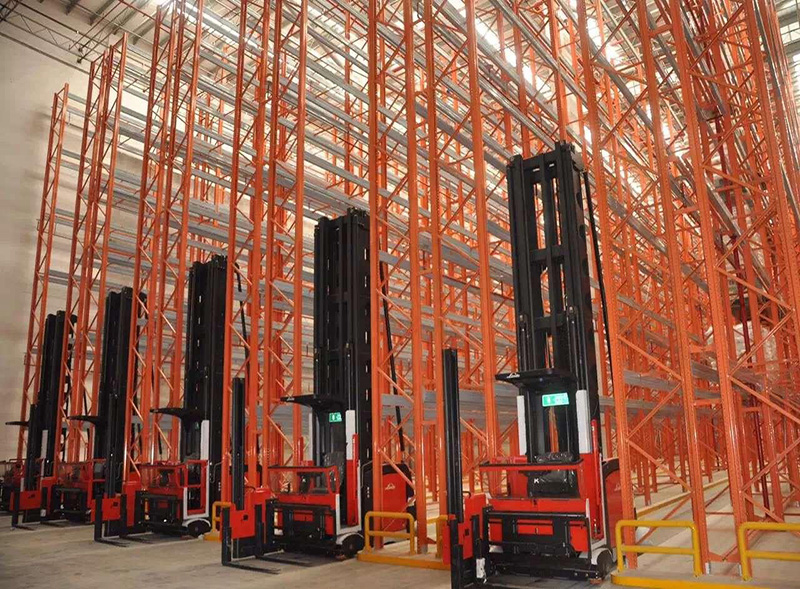
narrow aisle pallet racking has moved from a niche solution to a mainstream
capital investment. Unlike standard adjustable pallet racking with 3.2–3.5 m
aisles, VNA systems compress aisle width to 1.6–1.9 m, typically using
rail-guided reach trucks or turret trucks. This article delivers a technical
deep-dive—covering structural design, seismic considerations, fire protection
trade-offs, and real-world performance data—to help logistics directors and
plant engineers make a fact-based decision.
1. Defining the VNA Racking System: Beyond Aisle Width
True very
narrow aisle pallet racking is not simply a rack with tighter spacing. It is
an integrated goods-to-person or goods-to-machine ecosystem that includes:
Rack structure: High-tensile steel columns (typically
100×120 mm or 120×140 mm profiles) with boltless or bolted connections, designed
for heights up to 45 m in modern DCs.
Floor guidance: Inductively buried wire or magnetic tape
guidance for VNA trucks, ensuring lateral deviation ≤ ±10 mm at full lift
height.
Specialized MHE: Turret trucks (man-down or man-up) capable
of 180° fork rotation, enabling pallet picking from both sides without truck
turning.
Precision installation: Column plumbness tolerance of ±2 mm
over 10 m height—a critical factor for automated truck navigation.
From a cost perspective, the initial capital outlay for VNA racking is 18–25%
higher per pallet position than standard selective racking, but the floor space
efficiency gain of 35–45% often reduces overall warehouse construction or
leasing costs, making the payback period under 3 years for high-turnover
operations.
2. Storage Density Metrics: Pallet Positions per Square Meter
Industry benchmarking data from the German Material Handling Association
(VDMA) shows that very
narrow aisle pallet racking achieves 1.8–2.2 pallet positions per m² of
floor area (for 1000×1200 mm Euro-pallets with 1.5 m load height), compared to
1.2–1.4 for wide-aisle and 1.5–1.7 for standard narrow-aisle (2.8 m). This
density advantage, however, comes with operational constraints:
Height-to-depth ratio: Optimal designs use double-deep or
triple-deep pallet positions, but each additional depth increases extraction
time by 12–15 seconds per cycle.
Row spacing: End-aisle clearances and transfer areas must
be calculated meticulously. A poorly designed layout can erase 20% of the
theoretical density gain.
Pallet quality: Damaged or overhanging pallets cause
guidance misalignment and rack collisions—leading to structural damage and
downtime.
At Guangshun, we have executed VNA projects
for cold stores and e-commerce Fulfillment centers where the final density
measured 2.1 positions/m², using 11 m-high racking with six storage levels and
wire-guided turret trucks operating at 40 m/min lifting speed. The key success
factor was a 3D simulation of truck trajectories to optimize aisle entry/exit
points.
3. Structural Engineering: Seismic Loads, Frame Stability, and Connection
Design
3.1. Eurocode and FEMA Compliance
VNA racking is classified as a dynamic structure because the moving trucks
impose lateral forces during acceleration and deceleration. Unlike static pallet
racking, VNA systems must be designed for:
Horizontal seismic forces – often calculated using response
spectrum analysis (RSA) per EN 16681 or FEMA 460.
Notional loads – to account for out-of-plumbness, with a
minimum horizontal load of 0.5% of the gravity load.
Fatigue cycles – from daily truck braking (up to 500 cycles
per lane per day).
Our internal tests at Guangshun show that bolted connections with grade 10.9
bolts and reinforced base plates reduce dynamic deflection by 37% compared to
standard clip-in systems. For seismic zones (e.g., California, Japan, Turkey),
we recommend adding cross-aisle horizontal bracing at every third bay, which
increases steel tonnage by 8–10% but provides a 2.5x safety margin against rack
collapse.
3.2. Floor Flatness and Tolerance Requirements
One often underestimated engineering aspect is the concrete floor. VNA trucks
with automatic guidance require floor flatness to DIN 15185 or TR 34 Category 3
(≤ 0.5 mm deviation over 3 m). A floor that is out of spec causes:
Premature wear of guide wheels (replacement every 6 months instead of 2
years).
Torque on the mast, leading to fatigue cracks in the rail guide
brackets.
Inaccurate pallet placement, with a 3 mm error at floor level amplifying to
25 mm at 15 m height.
Before specifying very
narrow aisle pallet racking, we strongly advise a laser-profile survey of
the existing floor and, if needed, a topping slab with steel fiber reinforcement
to achieve the required surface regularity.
4. Throughput and Productivity: Cycle Time Analysis
Critics argue that narrower aisles slow down truck travel and reduce
throughput. However, modern VNA trucks with 200–250 A/h battery capacity and
lift speeds up to 0.8 m/s (loaded) can achieve 18–22 dual cycles per hour,
comparable to standard reach trucks in 3 m aisles. The efficiency gain comes
from:
Simultaneous lift and travel – many VNA turret trucks allow
mast lifting while traveling, saving 3–4 seconds per cycle.
Automatic height positioning – using laser or camera-based
barcode reading, reducing operator input error.
Optimized pick paths – WMS integration to sequence picks in
the same aisle, minimizing travel distance.
In a 2023 benchmark study involving three European DCs, the average time per
pallet-in/pallet-out for VNA was 4.2 minutes versus 4.5 minutes for standard
narrow-aisle—a 7% improvement, despite the tighter spacing. The study concluded
that operator training (at least 40 hours of simulator + on-aisle practice) is
the dominant factor; untrained operators in VNA aisles show a 30% productivity
drop, while certified operators often exceed theoretical performance.
5. Fire Safety and Sprinkler System Integration
NFPA 13 and EN 12845 require in-rack sprinklers for high-bay storage
exceeding 12 m in height. VNA configurations present unique challenges because
the narrow flue spaces (often ≤ 75 mm between loads) restrict water penetration.
Our fire engineering team at Guangshun has developed a three-tier approach:
Ceiling-level sprinklers with K-factor 200 or higher,
placed at 9 m intervals, but these are often insufficient for deep-seated
fires.
In-rack sprinkler heads at every second level, with
horizontal deflection shields to protect against truck impacts.
Early suppression fast response (ESFR) heads, though these
require a minimum horizontal clearance of 3 m between rack tips—difficult to
achieve in VNA layouts.
We recommend computational fluid dynamics (CFD) modeling to validate smoke
and heat movement. For a recent project in a 25 m-high VNA cold store, CFD
analysis showed that a fire in the middle of a rack would reach flashover in 8
minutes without in-rack sprinklers, but with sprinklers at every third level,
the time extended to 18 minutes—sufficient for evacuation and manual
intervention. The added cost was about €120 per pallet position, which we
consider a necessary safety investment.
6. Total Cost of Ownership (TCO) and ROI Calculation
When evaluating very
narrow aisle pallet racking, decision-makers must look beyond the purchase
price. A comprehensive TCO model should include:
Steel structure: €90–140 per pallet position (for 12 m
height, double-deep).
Installation: €25–35 per position, including laser
alignment and bolt torque verification.
Floor grinding and channel embedding: €10–18 per m².
MHE fleet: Each VNA turret truck costs approximately
€120,000–180,000, with a lifespan of 8–10 years. For a 10,000-pallet warehouse,
you typically need 4–6 trucks.
Maintenance: Annual preventive maintenance for racks
(inspection of connections, rail wear, and impact repairs) runs 1.5–2% of the
total rack capital.
A realistic case: a 15,000 m² warehouse with 30,000 pallet positions.
Switching from selective racking (3.2 m aisles) to VNA frees up 5,000 m²—which
can be repurposed for value-added services (kitting, returns, light assembly) or
avoid a new building costing €8–10 million. Even after deducting the extra steel
and truck costs, the net present value (NPV) over 10 years is positive by €2.3
million, using a 6% discount rate. This calculation is based on our project data
at Guangshun, where we have delivered over 40 VNA installations across the EU
and Asia.
7. Common Pitfalls and How to Avoid Them
Based on our post-implementation audits, here are the top five issues with
VNA racking projects:
Underestimating pallet diversity: Mixed pallet sizes (e.g.,
800×1200 and 1000×1200) cause misalignment. Solution: standardize inbound
pallets or deploy adjustable beam levels with 50 mm pitch.
Ignoring truck battery charging logistics: VNA trucks
consume 30% more energy due to frequent lifting. Install fast-charging stations
at aisle ends to maintain uptime.
Overlooking heat expansion: In unheated warehouses, steel
columns expand/contract by up to 6 mm over 20 m height. Use slotted base plates
and sliding anchors to prevent buckling.
Inadequate operator visibility: High mast and narrow cabs
reduce peripheral vision. Equip trucks with 360° cameras and proximity
sensors.
Poor rack protection: Even with guidance, accidental
impacts occur. Install column protectors (energy-absorbing polymers) at floor
level and at 1.2 m height.
8. Future-Proofing: VNA with Automated Storage and Retrieval (AS/RS)
Integration
The next evolution of very
narrow aisle pallet racking involves semi-automated and fully automated
shuttle systems. We have tested a hybrid concept where a VNA aisle is equipped
with a captive rail-mounted shuttle that travels within the rack, while a
standard turret truck only serves the face aisle. This decouples the pick and
replenishment operations, boosting throughput by 40% without increasing truck
fleet size. However, the control software must handle real-time inventory
allocation to avoid shuttle collisions—a complex task that requires a robust
warehouse execution system (WES).
At Guangshun, we are currently piloting a VNA-shuttle system for a
pharmaceutical client, where the rack height is 18 m and the shuttle can handle
up to 600 kg per pallet. Early results show a 98.7% system availability and a
mean time between failures (MTBF) of 1,200 hours—well within the industry
target.
9. Conclusion: When Does VNA Make Sense?
Very narrow aisle pallet racking is not a universal
solution. It excels in scenarios with high land costs, high storage density
requirements, and moderate-to-high throughput (5–15 pallets per hour per aisle).
It is less suitable for operations with extremely high turnover (e.g., >30
pallets per hour per aisle) because the truck travel speed in narrow aisles is
capped at 3–4 m/s for safety. Also, if your product mix includes over 20%
non-standard pallets or fragile items that require careful handling, consider
alternative systems like drive-in or push-back racking.
To make a robust business case, we recommend a simulation-based feasibility
study covering at least 3,000 operational cycles. With proper engineering, floor
preparation, and operator training, VNA racking consistently delivers a 3- to
5-year payback and a 25–35% reduction in cost per stored pallet compared to
conventional systems. Guangshun offers end-to-end support—from
structural calculation and fire safety consultancy to installation and
maintenance contracts. Our track record includes projects with up to 40 m high
VNA racks in seismic zones, demonstrating that with the right design, the
technology is both safe and highly profitable.
Frequently Asked Questions (FAQ)
Q1: What is the minimum aisle width for very narrow aisle
pallet racking?
A1: The industry standard for VNA racking is an aisle width of 1.6 m to 1.9
m, measured from rack face to rack face. This requires specially designed turret
trucks with 180° rotating forks. The exact width depends on the truck model,
pallet size (e.g., 1200 mm length), and the required clearance for mast sway at
full lift height. Most engineers recommend 1.75 m as a balanced value for 12
m-high racks.
Q2: Can I convert my existing selective racking to VNA?
A2: Retrofitting is technically possible but seldom cost-effective. Existing
floors usually lack the flatness and reinforcement for wire guidance. Columns
may need replacement to accommodate the higher moment loads. Beam levels and
footplates also require re-engineering. Typically, a greenfield project or a
complete demolition/rebuild is more economical. However, some suppliers offer
conversion kits for selected rack profiles—consult a structural engineer before
committing.
Q3: How does VNA racking perform in cold storage
(−25°C)?
A3: Steel becomes more brittle at sub-zero temperatures, requiring
low-temperature impact-tested steel (e.g., S355J2 or equivalent). Bolts and
anchors must be zinc-flake coated to resist corrosion from condensation.
Additionally, the guidance system must accommodate thermal contraction—we
recommend a ±5 mm allowance per 10 m height. Many VNA installations in frozen
food warehouses use heated guide rails to prevent ice buildup. Guangshun has
successfully deployed such systems in several Nordic cold
stores.
Q4: What is the average lifespan of a VNA racking
system?
A4: With proper maintenance (annual bolt-torque checks, visual inspections
for impact damage, and corrosion control), a VNA rack can last 25–30 years.
However, the floor guidance wire or tape typically requires replacement every
8–12 years. The trucks have a shorter life (8–10 years), but the rack structure
itself is a long-term asset. Many operators schedule a major refurbishment at
year 15, replacing beam connectors and adding extra bracing to meet updated
seismic codes.
Q5: How do I calculate the total pallet capacity for a VNA
layout?
A5: Use the formula: Capacity = (number of bays per row × levels per
bay × depths per bay) × (number of rows) – (deductions for end-of-aisle
clearances and fire exits). Typical VNA bays are 2.5–3 m wide, with
beam levels every 1.5 m (for Euro-pallets). For example, a 100 m long aisle with
33 bays, 8 levels, and double-depth gives 33×8×2 = 528 pallets per row pair.
Reduce by 5% for column clearance and flue spaces. Always run a simulation to
account for real pallet dimensions and aisle transfer
zones.
For project-specific engineering consultation, visit Guangshun or
download our VNA technical whitepaper from very
narrow aisle pallet racking product page.