Industrial logistics facilities face a dual challenge: maximizing storage capacity while simultaneously accelerating order throughput. Traditional static storage solutions, such as standard selective pallet racking, offer high accessibility but require numerous aisles that occupy valuable floor area. Conversely, drive-in racking improves density but restricts access, forcing operations into a First-In, Last-Out (FILO) workflow that can lead to product obsolescence and excessive material handling.
To resolve these operational bottlenecks, warehousing engineers rely on dynamic, gravity-fed storage configurations. By integrating a dynamic flow through racking system, facilities can optimize their floor footprints while establishing strict First-In, First-Out (FIFO) inventory control. This article examines the technical design, structural components, application profiles, and economic returns of these high-density dynamic storage structures.
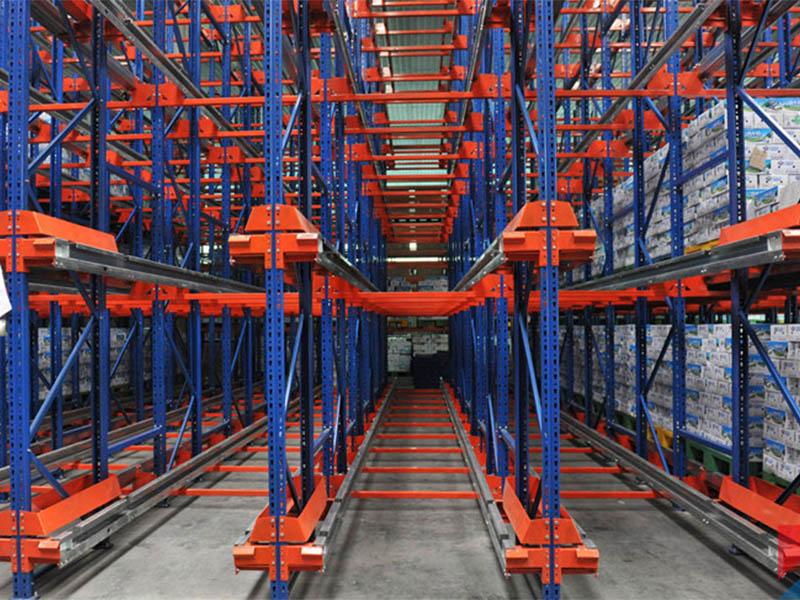
The operational success of a gravity flow system depends on its structural integrity and precision-engineered mechanical parts. Unlike static storage structures, dynamic racking is subjected to continuous kinetic forces as heavy loads travel down inclined lanes. A standard installation consists of several distinct structural modules.
1. Upright Frames and Support Beams
The primary load-bearing framework is constructed from heavy-gauge, cold-rolled or structural steel. Because pallets roll down the lanes and generate dynamic impact forces upon reaching the discharge face, the front uprights are typically reinforced with column protectors or heavy-duty deflector guards. Beam connections are secured with safety locks to resist the upward forces caused by pallet movement and sudden stops.
2. Inclined Roller Lanes and Wheel Beds
The rolling surface is the primary component responsible for inventory transit. Depending on the load profile, engineers specify one of two configurations:
- Full-Width Metal Rollers: Ideal for wooden pallets with irregular bottom surfaces or varying configurations. Steel rollers distribute the load evenly, reducing the risk of a pallet catching or stalling.
- Skate Wheel Beds: Often used for lightweight carton flow applications or high-quality plastic totes with flat, uniform bottom surfaces. Polyethylene wheels offer low rolling resistance and cost-effective maintenance.Regardless of the roller type, the lanes are pitched at a continuous slope, typically ranging between 3.5% and 4% grade. This angle provides sufficient gravitational pull to overcome static friction without allowing the load to accelerate to unsafe velocities.
3. Speed Controllers and Centrifugal Braking Rollers
In deep-lane configurations where pallets travel more than three positions, controlling the velocity of the load is a safety requirement. Centrifugal brake rollers are installed at designated intervals within the track. As a pallet rolls over a brake roller, the internal centrifugal mechanism engages, absorbing kinetic energy and maintaining a steady, controlled speed of approximately 0.25 meters per second.
4. Flow Separation Devices and End Stops
When a forklift operator retrieves the front pallet from the picking face, the force of the remaining pallets in the lane pushes forward. To prevent this cumulative line pressure from pinching the front pallet against the uprights—which makes retrieval difficult and unsafe—mechanical separator devices are integrated into the lane. These systems isolate the second pallet in line, holding back the rest of the queue until the first pallet is completely cleared from the system.
Key Advantages of Implementing Flow Through Racking
Deploying dynamic storage lane systems changes how inventory moves through a facility, replacing manual transport steps with passive gravity-fed movement.
Optimized Space Conservation and Storage Density
Conventional selective racking typically requires up to 60% of total floor space to be dedicated to forklift access aisles. By grouping storage lanes together and utilizing gravity to move pallets from the loading side to the unloading side, flow through racking eliminates intermediate aisles. This consolidation can increase storage density by up to 100% compared to selective layouts, allowing facilities to increase their storage capacity without expanding their physical footprint.
Streamlined Labor Workflows and Decreased Travel Time
In a typical warehouse, forklift travel represents a significant portion of labor costs. By separating loading activities (the replenishment aisle) from picking activities (the retrieval aisle), dynamic racking minimizes travel distances. Forklift operators do not need to navigate deep into racking structures to locate items; instead, inventory constantly presents itself at the dedicated picking face, reducing cycle times and increasing picking productivity.
Strict FIFO Inventory Discipline
For operations dealing with perishables, pharmaceutical products, or components with strict shelf-life limits, FIFO compliance is a crucial requirement. Because pallets are loaded at one end of the lane and retrieved from the other, the oldest stock is always positioned for immediate retrieval. This automated sequence eliminates human error in batch rotation, reducing waste and minimizing product expiration losses.
Technical Design and Engineering Considerations
Designing a dynamic gravity-fed storage layout requires careful evaluation of several environmental and load-specific variables. A minor miscalculation in slope, roller spacing, or structural load rating can lead to operational failures, including hung pallets or structural deflection.
1. Pallet Quality and Bottom Board Orientation
The condition of the pallets is one of the most common points of failure in dynamic flow systems. Broken bottom boards, loose nails, or structural bowing can stop a pallet mid-lane. Bottom runners must run parallel to the direction of flow to ensure consistent contact with the rollers. To mitigate these risks, manufacturers like Guangshun design customized roller systems with split lanes or dual-lane tracks to accommodate varying pallet designs and non-standard loads.
2. Dynamic Deflection and Column Loading
The static load of a fully loaded lane is only one part of the structural equation. When a forklift places a heavy pallet onto the charging end, or when a speed controller engages a rolling load, the racking structure experiences dynamic stress. Frame deflection must be kept within strict tolerances (typically L/240 or stiffer) to prevent the gravity lanes from bending, which could alter the incline angle and stop the flow of goods. Systems manufactured by Guangshun prioritize structural integrity, utilizing heavy-duty steel and reinforced connections to absorb these repetitive dynamic forces over years of continuous operation.
3. Temperature and Environmental Adjustments
The operating environment directly affects the performance of the mechanical rollers and speed controllers. In cold storage or deep-freeze warehouses, lubricants within the rollers can thicken, increasing rolling resistance. To maintain consistent flow speeds, engineers must specify low-temperature lubricants and adjust the lane pitch slightly to compensate for the higher friction coefficient of cold metal and plastic parts.
Industrial Application Profiles
While dynamic flow configurations are highly versatile, they are particularly beneficial in several high-volume industrial environments where inventory turnover is fast and space is expensive.
Food and Beverage Logistics
The food and beverage industry relies on strict rotation cycles to ensure product freshness. Because these operations often manage high volumes of limited SKUs, they are well-suited for deep-lane configurations. Pallet flow systems provide the high density required for bulk storage while maintaining the strict FIFO control necessary to prevent spoilage.
High-Density Cold Storage
Operating cold storage and freezer facilities requires significant energy, making empty space highly expensive. To maximize the efficiency of every cubic meter of chilled air, operators use dynamic flow lanes to pack storage positions tightly together. Reducing the number of access aisles minimizes the total volume that must be refrigerated, directly lowering utility costs.
Manufacturing Buffer and Assembly Line Feeding
In assembly plants, components must be delivered to production zones just-in-time (JIT). Flow tracks are often positioned adjacent to assembly stations, acting as a buffer zone for work-in-progress (WIP) materials. When engineering a custom flow through racking configuration for manufacturing, lanes are often sized for smaller plastic bins or custom parts-totes, allowing workers to easily pull parts from the front of the rack while replenishment teams reload the system from behind.
ROI and Cost-Benefit Analysis
Transitioning from a traditional selective layout to a dynamic gravity flow configuration requires a higher initial capital investment. This cost is due to the inclusion of precision machined rollers, speed controllers, separator devices, and reinforced structural steel. However, the long-term operational savings typically yield a rapid return on investment.
- Reduced Facility Footprint: By packing more storage positions into a smaller area, facilities can delay or avoid expensive warehouse expansions or off-site leasing.
- Labor Savings: Decreasing forklift travel distances and separating loading from picking activities can reduce forklift labor hours by 30% to 40%.
- Lower Equipment Maintenance Costs: Fewer access aisles mean forklifts travel shorter paths, reducing tire wear, battery consumption, and maintenance requirements on the lift truck fleet.
- Minimization of Damage: Controlled-speed flow lanes reduce the risk of forklift masts striking rack structures, a common safety hazard in tight, fast-paced selective racking aisles.
Partnering with Guangshun allows operators to design systems that match their specific SKU profiles and material handling workflows, optimizing both structural safety and long-term return on investment.
As supply chains continue to seek greater efficiency, the implementation of flow through racking remains a practical, time-tested approach to balancing storage density with high-volume throughput. By utilizing gravitational force to automate inventory movement, facilities can reduce labor requirements, enforce strict FIFO rotation, and make the most of their available physical footprint. With proper engineering, quality manufacturing, and regular maintenance, these dynamic systems provide reliable, long-term performance in demanding industrial environments.
Frequently Asked Questions (FAQ)
Q1: What is the maximum lane depth recommended for pallet flow through systems?
A1: While lanes can technically be engineered to hold up to 20 or more pallets, most industrial applications are designed for 5 to 10 pallets deep. Extremely deep lanes require heavy-duty brake rollers and precise level controls to handle the substantial cumulative weight and prevent column deflection.
Q2: Can different pallet sizes and weights be used in the same flow lane?
A2: It is highly recommended to use uniform pallets within a single lane. Variations in pallet width, bottom runner configuration, and weight can affect rolling speeds and lane alignment. If a lane must handle diverse pallet types, full-width steel rollers must be used, and the speed controllers must be calibrated for the lightest and heaviest loads expected.
Q3: What happens if a pallet gets stuck in the middle of a lane?
A3: Most hang-ups can be resolved using a technique called "back-loading." A forklift operator gently loads another pallet into the lane, using the weight of the second unit to push and free the stuck pallet. Workers should never climb into active gravity lanes to manually clear a stuck load due to the risk of sudden movement.
Q4: How do flow separation devices improve warehouse safety?
A4: Separator devices temporarily isolate the front pallet from the rest of the queue. This prevents the combined weight of the rear pallets from pushing against the front pallet, allowing forklift operators to lift and retrieve the front unit without dragging or damaging adjacent stock.
Q5: How does the system perform in dusty or high-debris environments?
A5: High levels of dust, wood shavings, or packaging debris can accumulate in the roller bearings and increase rolling resistance. In such environments, engineers specify sealed bearings for the rollers and schedule periodic cleaning cycles using compressed air to maintain smooth, consistent operations.