Warehouse operators and logistics managers face a constant pressure to maximize storage density while maintaining safety and operational agility. The selection of industrial estanterias de almacenamiento directly influences picking efficiency, inventory turnover, and workplace safety. Yet many procurement decisions are based on superficial metrics—price per pallet position or basic load capacity—without evaluating the full engineering and financial implications. This article provides a framework for evaluating storage rack systems across five technical dimensions: structural integrity, application fit, site-specific compliance, safety protocols, and long-term ownership cost. Each dimension is supported by quantifiable benchmarks and industry standards, enabling facility planners to make data-backed investments.
1. Structural Engineering Fundamentals of Industrial Racking
The mechanical performance of any storage system begins with its structural design. Unlike simple shelving, industrial estanterias de almacenamiento must withstand dynamic forces from forklift traffic, seismic events, and variable load distributions. Engineers rely on finite element analysis (FEA) to model stress points, but procurement teams should focus on three measurable parameters.
Static Load Capacity vs. Dynamic Load Ratings
Static load capacity refers to the maximum weight a rack beam can support when stationary—typically measured in kilograms per pallet position. For standard selective pallet racks, this ranges from 1,000 kg to 4,500 kg per beam level, depending on beam length and profile. Dynamic load ratings, however, account for impact forces during loading and unloading. Forklift collisions, even at low speeds, can produce impact forces 2.5 to 3 times the static load. Industry practice dictates that dynamic safety factors of 1.6 to 2.0 be applied to static ratings for beam and frame design. When specifying estanterias de almacenamiento, always request both static and dynamic load certifications from the manufacturer, validated by third-party testing per EN 15512 or RMI standards.
Steel Grades and Coating Specifications
Structural steel for racking is typically S235JR (yield strength 235 MPa) or S355JR (355 MPa) for high-load applications. The choice affects column thickness and overall frame rigidity. For cold-formed sections, gauge thickness ranges from 1.5 mm to 3.0 mm for beams and 1.8 mm to 4.0 mm for uprights. Corrosion protection is equally critical: epoxy-polyester powder coatings with 60–80 micron thickness provide 15–20 years of protection in ambient warehouse environments. For cold storage or chemical exposure, zinc-aluminum coatings (e.g., Magnelis) offer superior resistance. Guangshun provides detailed coating specifications and salt-spray test reports for all its racking systems, allowing engineers to verify corrosion resistance against ISO 9227 standards.
2. Application-Specific Configurations
No single rack design optimizes every operational scenario. The choice of configuration should align with inventory turnover, pallet type, and storage density requirements. Below are the most common industrial configurations and their performance trade-offs.
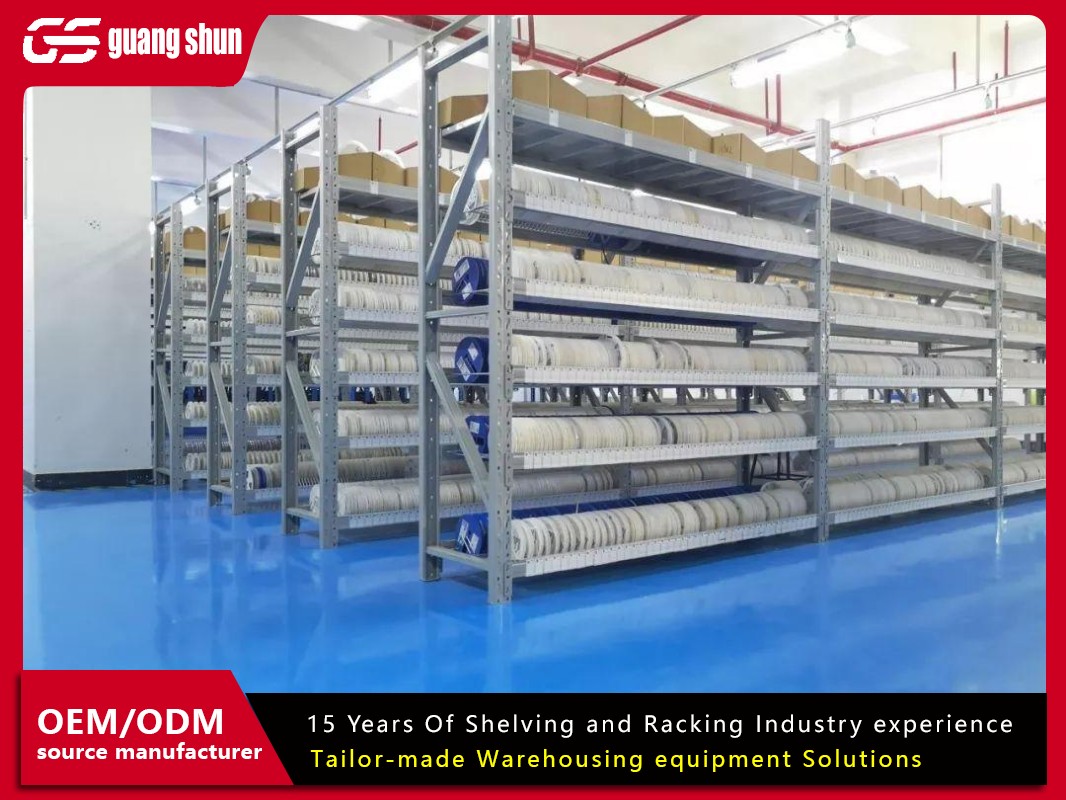
Selective Pallet Racking for High-Turnover Operations
Best for: FIFO (First-In-First-Out) inventory with high SKU variety and rapid turnover.
Accessibility: 100% pallet accessibility—each pallet position can be reached directly.
Density: Moderate, typically 40–50% volume utilization.
Typical dimensions: Beam lengths from 2,300 mm to 3,700 mm, frame heights up to 12 meters.
Cost per position: €80–150 depending on load capacity and height.
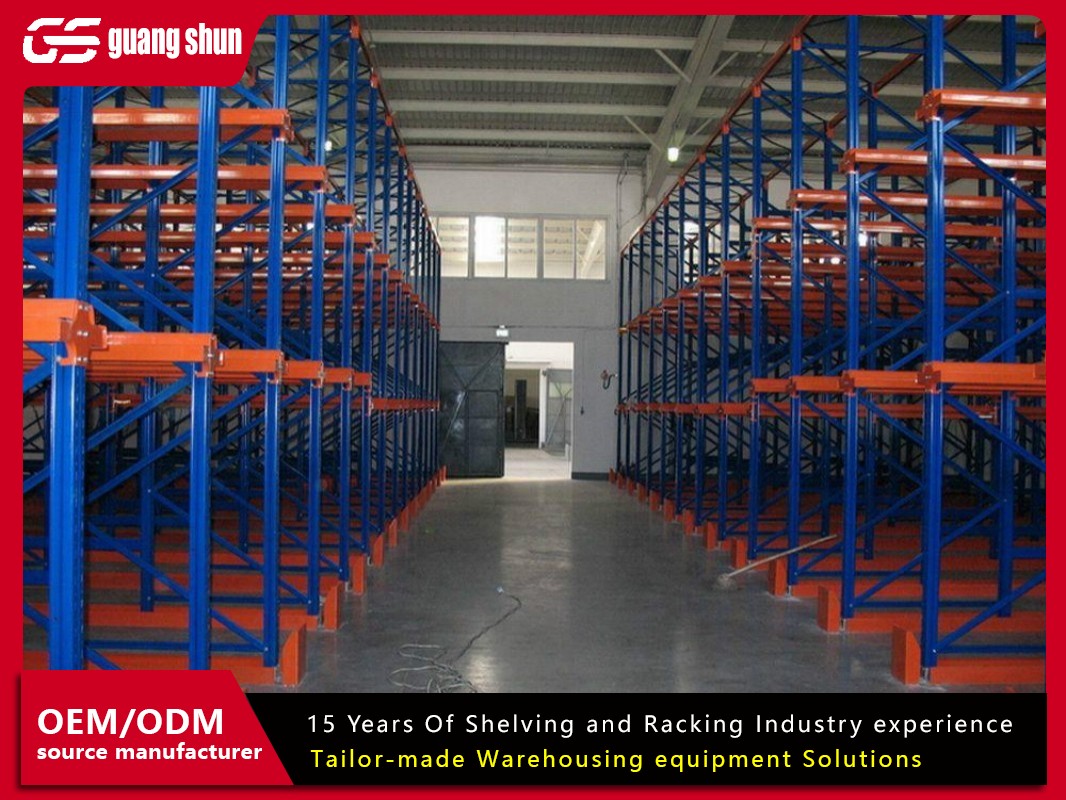
Drive-In and Drive-Through Systems for Dense Storage
Best for: LIFO (Last-In-First-Out) operations with homogeneous products and low SKU count.
Accessibility: Forklift enters the rack structure; only the first pallet at each lane is immediately accessible.
Density: High, up to 75–85% volume utilization.
Critical design factor: Rail thickness and guide clearance must accommodate forklift steering tolerances—typically ±50 mm.
Cost per position: €50–90, but requires higher investment in rack-end protection and rail alignment.
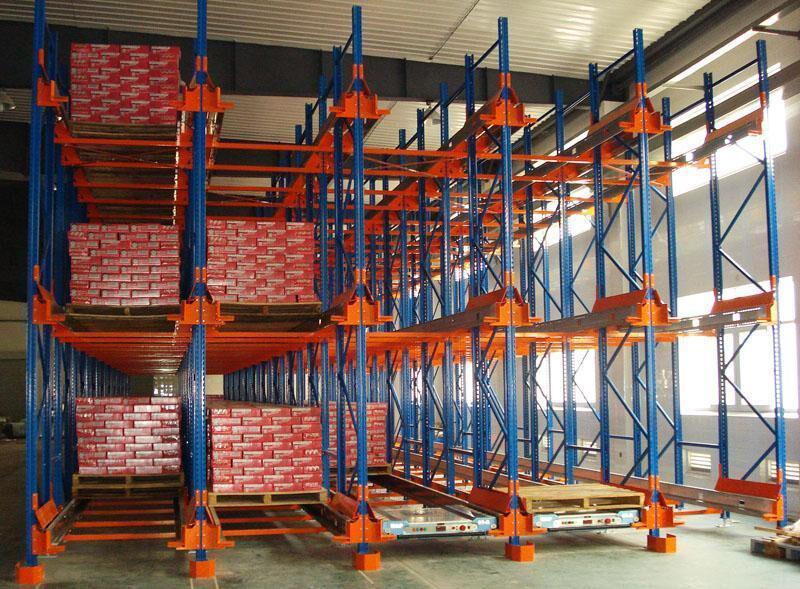
Push-Back and Pallet Flow Racks for FIFO/LIFO Flexibility
Push-Back: LIFO operation with rolling carts on inclined rails. Density up to 65–70%.
Pallet Flow: FIFO operation using gravity rollers with speed controllers. Density up to 70–75%.
Key component: Roller or wheel rail systems must be certified for pallet weight and acceleration forces (typically 0.3–0.5 m/s²).
Maintenance: Requires quarterly inspection of bearings and speed controllers—adds €0.50–1.00 per position annually.
When evaluating configurations, warehouse managers should simulate throughput using discrete-event modeling tools. A 15% increase in storage density through drive-in racking may reduce travel time by 20%, but the loss of direct accessibility can increase retrieval times for partial pallets. Guangshun offers configuration consulting that integrates with WMS data to model these trade-offs before capital commitment.
3. Site-Specific Selection Criteria
Even the best-designed rack system will underperform if site conditions are not properly assessed. Three factors—floor load capacity, seismic zone, and environmental corrosion—must be evaluated during the planning phase.
Floor Load Integration
Industrial estanterias de almacenamiento transmit point loads through column base plates to the concrete slab. A fully loaded upright with four pallets per level (3,000 kg per pallet) can exert over 60 tons on a single column. The floor must have a minimum compressive strength of 25 MPa (C25/30 concrete) with reinforcement spacing no greater than 150 mm. Load spreader plates of 12–16 mm thickness are recommended to reduce bearing pressure. Before installation, conduct a floor flatness test per DIN 15185: deviations exceeding 5 mm over 3 meters require leveling grout or shim packs.
Seismic Zone Compliance
Seismic design is not optional in regions with moderate to high ground acceleration. The International Building Code (IBC) and ASCE 7 define seismic design categories (SDC) from A to F. For SDC C and above, rack structures must incorporate:
Base isolation or dissipative bracing systems to absorb lateral forces.
Column base plates with anchor bolts designed for tension and shear—typically M20–M24 grade 8.8 bolts embedded 150–200 mm into the slab.
Cross-aisle bracing (X-bracing or K-bracing) with yield strength 355 MPa, spaced every 3–4 bays.
Dynamic analysis per EN 16681, including response spectrum analysis for periods up to 2 seconds.
A common oversight is under-specifying anchor bolts. For a typical 10-meter-high rack in SDC D, each column anchor must resist shear forces of 40–60 kN and tension forces of 30–50 kN. Specifying grade 8.8 bolts with embedment depths of 200 mm ensures compliance with ACI 318 Appendix D. Guangshun provides seismic certification packages including anchor pull-out tests and FEA reports for each project, verified by independent structural engineers.
Environmental Corrosion Factors
Warehouses near coastal areas or with chemical storage require elevated corrosion protection. The ISO 12944 classification for corrosivity (C1 to C5) determines coating requirements. For C3 environments (moderate humidity, urban), 60-micron polyester coatings suffice. For C4-C5 (coastal, industrial), 80–100 micron coatings with zinc primer (55% zinc dust) are recommended. In cold storage (−25°C to −10°C), steel embrittlement must be considered—use low-temperature grade S355J2+N with impact testing at −20°C per EN 10025-3.
4. Safety Standards and Inspection Protocols
Regulatory compliance is non-negotiable in industrial racking. Two frameworks dominate global practice: FEM 10.2.02 (European) and RMI (American). Both require documented inspection schedules and load capacity signage.
International Regulatory Frameworks
FEM 10.2.02: Mandates annual structural inspections by certified engineers, with daily visual checks by warehouse staff. Beam connectors must show no plastic deformation—a gap exceeding 2 mm between beam and column indicates overload.
RMI Standard: Similar requirements but with additional emphasis on impact damage. Any upright with a dent deeper than 6 mm or bend exceeding 3 mm over 1 meter must be replaced or reinforced.
EN 15512: Specifies tolerance limits for column straightness (L/300) and beam deflection (L/180 under full load).
Periodic Load Testing and Documentation
Load testing should be performed after installation and every 5 years thereafter. A proof load of 1.25 times the rated capacity is applied using calibrated weights or hydraulic jacks. Deflection and residual deformation are measured with laser displacement sensors. Documentation must include:
As-built drawings with bolt torque values (typically 150–200 Nm for M16 bolts).
Load test certificates with photos of test setup.
Annual inspection logs with damage photos and repair records.
Warehouses that maintain these records reduce insurance premiums by 8–12% and demonstrate due diligence in case of incidents.
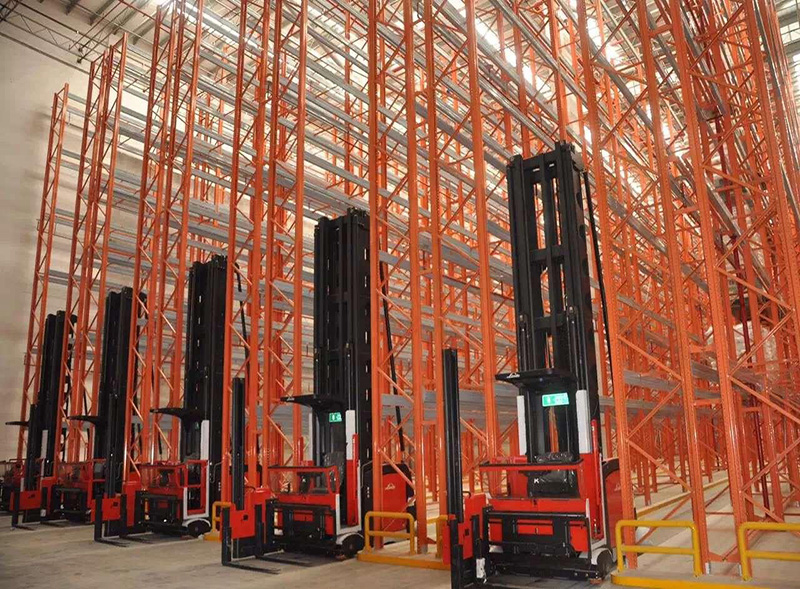
5. Total Cost of Ownership Analysis
Initial capital expenditure (CAPEX) typically accounts for only 30–40% of the total cost over a 15-year service life. Operating expenses (OPEX) include maintenance, repairs, and productivity losses from system limitations.
Capital Expenditure vs. Operational Savings
A selective pallet rack system costs approximately €120–180 per pallet position installed. A drive-in system costs €70–110 per position but may reduce picking productivity by 15–20% due to limited accessibility. For warehouses with high throughput (over 500 pallets moved daily), the productivity loss from drive-in racks can exceed the capital savings within 3 years. Using a discounted cash flow model with a 12% discount rate, the breakeven point for selective vs. drive-in racking occurs at approximately 2,000 pallet movements per month. Below that threshold, drive-in offers lower TCO; above it, selective racking is more economical.
Maintenance Schedules and Service Life
Annual maintenance costs average 2–3% of initial investment for well-protected racks, rising to 5–6% for systems in corrosive environments. Typical service life for industrial estanterias de almacenamiento is 15–20 years with proper maintenance, but seismic zones or high-impact operations may reduce this to 10–12 years. Replacement of damaged beams and uprights should be budgeted at 1.5% of the original investment per year. Guangshun offers life extension programs including retrofitting of bracing systems and impact protection shields, which can add 5–7 years to rack life at 30–40% of replacement cost.
6. Integration with Automated Material Handling
The rise of automated guided vehicles (AGVs) and shuttle systems demands rack designs that accommodate automated interactions. AGV compatibility affects floor-level clearances, beam height tolerances, and navigation aids.
AGV Compatibility
Minimum floor-to-beam clearance of 150 mm for AGV underride.
Alignment tolerances of ±5 mm for AGV docking stations—requires precision-ground floor slabs.
Reflective or magnetic tape paths embedded in the floor, with 50–100 mm clearance from column bases.
Payload sensors at beam levels to provide real-time inventory data to AGV fleet controllers.
Modular Expansion Capabilities
Future-proofing storage infrastructure involves designing for incremental capacity additions. Modular estanterias de almacenamiento with bolt-together frames allow bay additions without dismantling existing sections. Key design features include:
Standardized bay widths (2,700 mm, 3,300 mm, 3,700 mm) for compatibility with future additions.
Pre-drilled column holes at 75 mm or 100 mm pitch for beam height adjustments.
Base plate designs that accommodate future anchor bolt upgrades.
Modular designs add 5–8% to initial CAPEX but reduce expansion costs by 30–50% when capacity increases are needed.
Frequently Asked Questions
Q1: How is the static load capacity of a rack beam calculated, and what safety factor should be applied?
A1: Static load capacity is determined by beam span, profile geometry, and steel grade. The formula M = (W × L²) / (8 × S) (where M = bending moment, W = uniform load, L = span, S = section modulus) is used, with allowable stress limited to 60% of yield strength. A safety factor of 1.6 to 2.0 is then applied for dynamic loads. For example, a 3,300 mm beam with S235JR steel (yield 235 MPa) and section modulus of 120 cm³ has a static capacity of approximately 2,800 kg per beam at 1.6 safety factor. Always verify with the manufacturer's load table, as connector design also affects capacity.
Q2: What are the seismic design requirements for racking in high-risk zones?
A2: For seismic design categories D and above, racks must undergo a response spectrum analysis per EN 16681 or ASCE 7. Requirements include: (1) dissipative bracing with 355 MPa steel, (2) anchor bolts designed for combined tension and shear (typically M24 grade 8.8 with 200 mm embedment), (3) base isolation if ground acceleration exceeds 0.4g, and (4) minimum column cross-section of 100 mm × 100 mm × 3 mm for uprights. Certification by a structural engineer is mandatory, with documentation of anchor pull-out tests.
Q3: How do I choose between selective pallet racking and drive-in racking for my warehouse?
A3: The decision depends on three variables: inventory turnover rate, SKU count, and storage density requirement. Selective racking offers 100% accessibility and is ideal for warehouses with over 500 pallet movements per day and high SKU diversity. Drive-in racking provides 75–85% density but restricts access to the first pallet in each lane—suitable for low-turnover, homogeneous products (e.g., bulk commodities). Perform a throughput simulation: if picking time exceeds 20% of total labor hours, selective racking usually yields better ROI despite higher CAPEX.
Q4: What is the expected service life of industrial storage racks, and how can it be extended?
A4: With proper maintenance, steel racks last 15–20 years in ambient environments. Service life can be extended by: (1) applying protective coatings (epoxy or zinc-aluminum) at 5-year intervals, (2) installing column protectors and end-of-aisle guards to reduce impact damage, (3) conducting annual inspections and replacing damaged components promptly, and (4) retrofitting seismic bracing if seismic codes are updated. In corrosive environments, use stainless steel or hot-dip galvanized components to achieve a 20-year lifespan.
Q5: How often should rack inspections be conducted, and what are the critical checkpoints?
A5: Daily visual inspections by warehouse staff (checking for visible damage, missing pins, and overloaded beams). Formal inspections by a certified engineer are required annually under FEM 10.2.02 and RMI standards. Critical checkpoints include: (1) beam-to-column connector gaps (≤2 mm), (2) column straightness (≤L/300), (3) floor anchor torque (verify with a torque wrench at 80% of specified value), (4) beam deflection under load (≤L/180), and (5) coating integrity—any rust patch exceeding 10 cm² must be repainted.
Q6: Can existing racking systems be modified to accommodate automated storage and retrieval systems (AS/RS)?
A6: Yes, but with constraints. Existing racks can be retrofitted for AGV or shuttle systems if they meet: (a) floor-to-beam clearance of at least 150 mm for AGV navigation, (b) beam height tolerances of ±2 mm over 10 meters, and (c) structural rigidity for dynamic loads from shuttle movements. Typically, 30–50% of existing bays may need reinforcement or replacement. It is more cost-effective to design new sections with AS/RS compatibility than to fully retrofit older racks. Consult with the manufacturer for a feasibility assessment and reinforcement plan.
Selecting industrial estanterias de almacenamiento is a multi-dimensional decision that extends beyond initial price. By applying the five technical metrics outlined in this article—structural integrity, application fit, site compliance, safety protocols, and total cost of ownership—facility planners can align their investment with operational goals and risk management requirements. Engaging a manufacturer that provides comprehensive engineering documentation, seismic certification, and life extension programs, such as Guangshun, ensures that the chosen system performs reliably over its full service life. For warehouses planning expansions or automation upgrades, modular and AGV-ready designs offer the flexibility to adapt without costly overhauls. The data-driven approach presented here transforms rack selection from a commodity purchase into a strategic infrastructure decision with measurable financial and operational outcomes.