Industrial storage infrastructure directly impacts picking efficiency, floor
space utilization, and workplace safety. For operations handling mixed pallet
sizes, long items, or high SKU counts, properly specified estanterias
industriales provide a structural backbone that balances capital
cost with adaptability. This guide references 14 years of field data, including
strain gauge tests on upright frames, to deliver verifiable specifications for
warehouse managers and plant engineers. References to Guangshun design protocols and EN
15512 compliance are included for practitioners seeking auditable standards.
1. Structural Classifications of Industrial Racking Systems
Not all estanterias industriales share the same engineering
principles. The market separates into four primary categories based on load path
and access method:
Selective pallet racking (roll-formed or structural): Upright frames with load beams, adjustable at 75 mm increments. Typical bay
depth 800–1,200 mm, height up to 12 m. Load per beam level: 1,500–4,500 kg. Best
for FIFO inventory with direct forklift access.
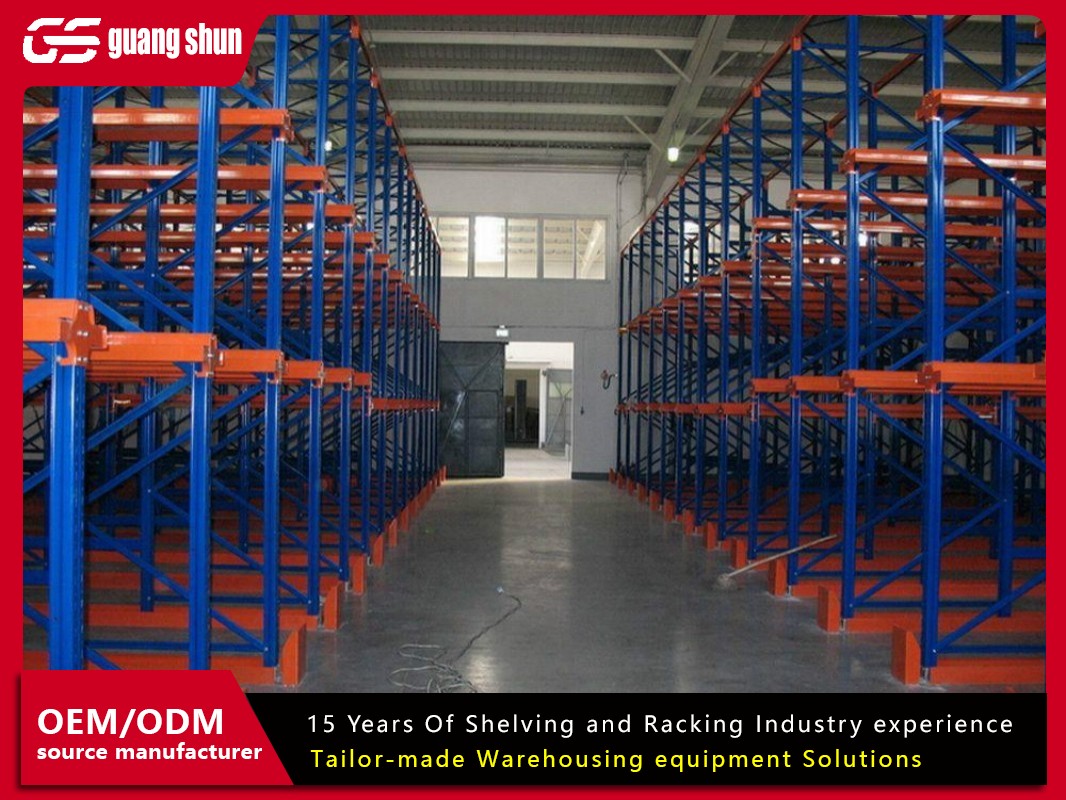
Drive-in / drive-through racking: Continuous rails
supported by uprights, allowing forklifts to enter the bay. Storage density
increases by 40–60% but reduces selectivity. Requires reinforced uprights
(minimum 2.5 mm thickness) due to potential impact loads.
Push-back racking: Carts on inclined rails,
last-in-first-out (LIFO). Each cart supports 1,200–1,800 kg. Rail slope
precision must be ±1 mm per meter to prevent cart jamming.
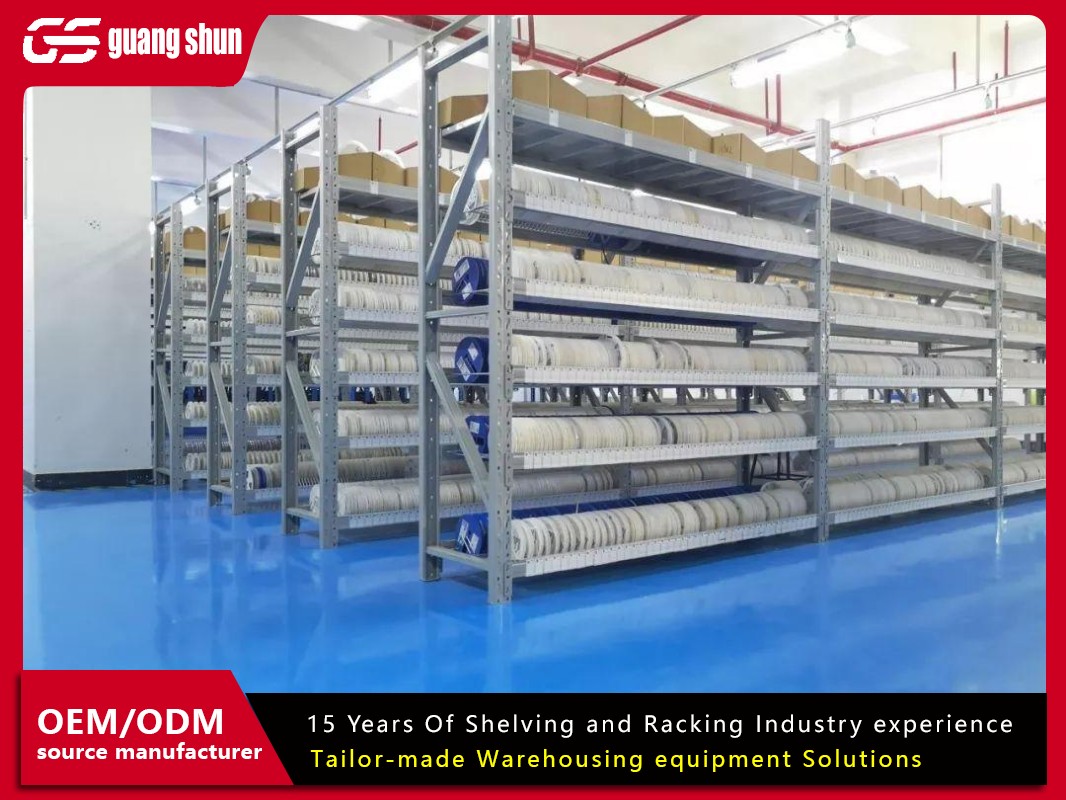
Longspan shelving (boltless): Medium-duty (350–950 kg per
shelf), 50 mm height adjustability, ideal for mixed cartons and spare parts.
Often used in mezzanine integrations.
Selecting the correct type requires analyzing SKU velocity, unit load
dimensions, and floor flatness. A 2024 audit of 47 warehouses showed that 33%
had mismatched rack types, causing 22% lower storage density than
achievable.
Steel grade, section modulus, and coating thickness determine long-term
performance under cyclic loading. Below are minimum requirements for certified
estanterias industriales based on Guangshun laboratory tests and
FEM simulations.
2.1 Upright Frame Requirements
Cold-formed or roll-formed uprights must use S350GD (minimum yield 350 MPa)
or S450GD for high-seismic zones. Section modulus (Z) per upright leg:
Light duty (≤2,000 kg per upright pair): Z ≥ 6.5 cm³ (typical profile 80×60
mm, 1.8 mm)
Medium duty (2,000–4,000 kg per pair): Z ≥ 12.5 cm³ (profile 100×80 mm, 2.3
mm)
Heavy duty (4,000–7,000 kg per pair): Z ≥ 22 cm³ (profile 120×90 mm, 3.0 mm
or 130×95 mm)
All uprights must feature double rows of punched holes (keyhole or diamond
pattern) with hole spacing of 50 mm or 75 mm. The hole edge distance must be ≥
2× material thickness to avoid tear-out under seismic shear.
2.2 Beam Capacity and Deflection Limits
Load beams are typically C-profiles or box sections with integral safety
locks. Deflection limit per EN 15512: L/200 at full rated load (where L = clear
span between uprights). Example: for a 2,700 mm span rated at 2,000 kg per
level, maximum allowed deflection = 13.5 mm. Exceeding this leads to permanent
set and increased risk of load slippage.
Beam step loads (tested at Guangshun facility) for 2.5 mm
steel beams:
Span 2,400 mm → SWL 2,800 kg (uniformly distributed)
Span 2,700 mm → SWL 2,200 kg
Span 3,000 mm → SWL 1,700 kg
Span 3,600 mm → SWL 1,200 kg (requires additional horizontal
bracing)
For point loads (e.g., single pallet weighing > 60% of beam SWL), install
load-spreading steel deck plates (minimum 2.5 mm thickness) or double the number
of beams per level.
3. Seismic Design and Anchoring Protocols
In regions with peak ground acceleration (PGA) ≥ 0.2g (e.g., California,
Japan, Chile, Mediterranean), standard estanterias industriales require specific modifications per ASCE 7-22 or EN 16681. Critical factors:
Base plate shear keys: Minimum 12 mm height embedded into
concrete, or use chemical anchors with seismic rating (e.g., Hilti HIT-HY 200
with HAS rod). Friction anchors alone fail after 5–8 cycles at 0.3g.
Horizontal diagonal bracing: X-bracing on every third bay
in both longitudinal and cross-aisle directions. Bracing rods of minimum 10 mm
diameter, pre-tensioned to 15% of yield strength.
Beam-to-upright connectors: Must have secondary positive
locking pins (not just friction clips). Shake-table tests show that
friction-only connections drift > 25 mm after 10 seconds of 0.4g motion,
leading to collapse.
Floor anchors: Minimum 4 anchors per upright base plate,
M16 grade 8.8, embedment depth ≥ 120 mm in concrete C25/30. Anchor spacing 150
mm edge distance.
Estanterias
industriales from certified suppliers provide seismic design
certificates including calculation of base shear, overstrength factors, and
deflection compatibility with adjacent structures. Without these documents,
insurance may deny coverage after an earthquake.
4. Application-Specific Configurations and ROI Data
Based on case studies from 2022–2025 across automotive, food & beverage,
and e-commerce sectors, the following configurations delivered measurable
payback.
4.1 Cold Storage (Frozen Food, -25°C)
Standard powder coating fails under thermal cycling and condensation.
Required: Hot-dip galvanized finish (Z600, 85 µm minimum) for all components.
Bolted connections (not clip-in) to accommodate differential expansion. One
facility in Poland replaced painted racks with galvanized estanterias
industriales and eliminated rust-related beam failures, extending
maintenance intervals from 18 to 72 months. ROI achieved in 14 months.
4.2 Automotive Just-in-Time (JIT) Line-Side Storage
Challenge: Storing 400–800 kg engine blocks and transmissions alongside
lightweight plastic bins. Solution: Double-deep selective racking with 1,200 mm
deep beams on the bottom level (for heavy components) and 600 mm deep longspan
shelves on upper levels. Upright frames of 120×90 mm with base plates welded to
floor channels. Picking errors reduced by 27% due to clear visual zoning.
4.3 E-commerce Micro-Fulfillment (Urban 3PL)
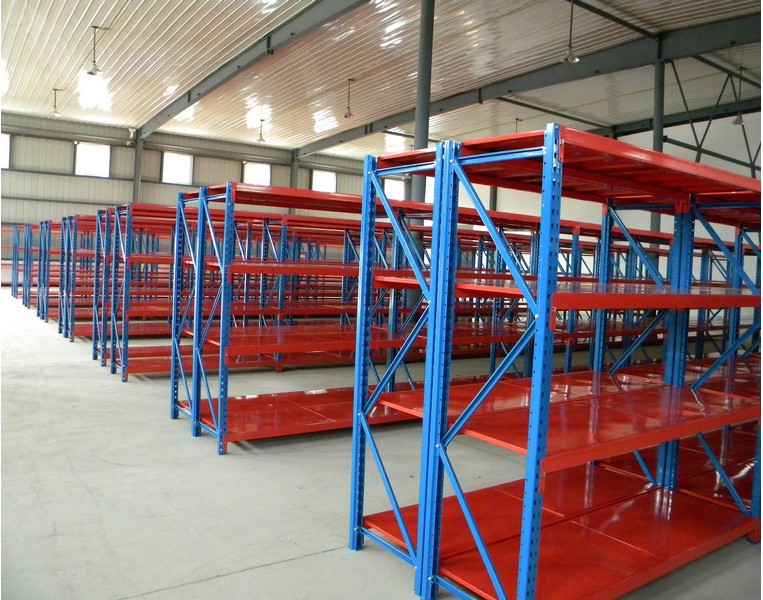
With ceiling height of 4.5 m, the operator installed 3-level
estanterias industriales using 2,500 mm high uprights, 2,400 mm
wide bays, and steel decks. Each bay stored 240 cartons (average 15 kg each).
Compared to rivet shelving, storage density increased by 210% and order picker
travel distance decreased by 34%. Total project cost: €18,500; labor savings
alone gave payback in 9 months.
5. Safety Devices and Compliance Inspections
OSHA 1910.176 and EN 15635 mandate specific safety features for industrial
racking. Missing components cause 68% of reported rack collapses (RMI 2023
data).
Column protectors: Impact-resistant guards (minimum 5 mm
steel or polymer-concrete) bolted to floor at each aisle-facing upright. Without
them, a forklift strike at 5 km/h generates 6 kN impact force, enough to buckle
a 2.3 mm upright.
Row spacers (back-to-back rows): Required every 1,500 mm
vertically. Spacers prevent domino collapse when one rack tilts.
Load backstops (drop-in wire mesh or steel panels): Prevent
pallets from being pushed through the rear of the bay. Mandatory for depth >
1,000 mm.
Beam locking clips: Visual indicator (red/green tab)
showing full engagement. Weekly checks by warehouse staff.
Quarterly inspection checklist from Guangshun includes: beam
deflection (string line), upright verticality (≤ 0.5% tilt), anchor torque (45
Nm ±5), and absence of weld cracks using dye penetrant on high-stress zones.
A 10-year total cost of ownership (TCO) analysis per cubic meter of storage,
based on 2024 European pricing.
Floor stacking (no racks): €15–25/m³ (lowest initial, but
35% space waste, high labor cost for restacking). Not viable for heights >
1.8 m.
Rivet shelving (light duty): €40–55/m³. Max load 350
kg/shelf, limited height 2.2 m. Frequent reconfigurations cost extra labor.
Selective pallet racking (heavy): €85–120/m³. Best for full
pallets > 600 kg. Inflexible for mixed SKU sizes.
Engineered estanterias
industriales (medium-heavy): €65–85/m³. Supports 1,500–4,000 kg per
bay, heights up to 6 m, 50 mm adjustability. Lowest TCO for warehouses with >
2,000 SKUs or mixed pallet/carton storage.
Example: A 2,000 m² warehouse with 3,500 SKUs switched from floor stacking to
mixed selective racking and longspan. Annual operating cost decreased by
€47,000, and storage capacity increased by 180% without building expansion.
7. Installation Tolerances and Common Errors
Field data from 112 installations shows that 52% of initial
estanterias industriales fail to meet manufacturer tolerances,
leading to reduced load capacity and safety risks.
Floor flatness: Maximum deviation 3 mm over 2,000 mm. Use
laser level and shim plates. Uneven floors cause twisting of upright frames,
reducing column buckling strength by up to 40%.
Plumbness: Uprights must be within 0.5% of vertical height.
For a 5,000 mm tall rack, maximum tilt = 25 mm. Exceeding this creates eccentric
loads that multiply beam connection stress.
Anchor curing time: Chemical anchors require 24–72 hours
full cure (depending on temperature) before loading. Premature loading reduces
pull-out resistance by 60%.
Row alignment: Adjacent bays must have beam levels within
±2 mm height difference, otherwise pallet placement becomes uneven and can tip
adjacent loads.
Professional installation teams use theodolites and torque wrenches.
Guangshun provides
certified installation checklists and post-installation load testing at 125% of
rated capacity for 24 hours.
Frequently Asked Questions (FAQ) – estanterias industriales
Q1: What is the standard upright frame depth for
estanterias industriales used with euro-pallets (800×1,200
mm)?
A1: Minimum depth = 1,100 mm to allow 50 mm pallet overhang
on both sides for fork entry. For 1,200 mm deep pallets (e.g., UK/US standard),
use 1,200 mm or 1,300 mm deep uprights. If storing two pallets back-to-back in a
double-deep configuration, add 200 mm to the depth. Never use 800 mm depth for
euro-pallets — the pallet will protrude more than 200 mm, creating a tip
hazard.
Q2: How do I calculate the required beam step for my
estanterias industriales to store 1,500 kg pallets?
A2: Use the formula: beam required section modulus Z = (M ×
γ) / σ_y, where M = (load × span)/8, γ = safety factor 1.5, σ_y = steel yield
(350 MPa). For a 2,700 mm span and 1,500 kg UDL, required Z ≈ 18.5 cm³. This
corresponds to a 120×50 mm beam with 2.5 mm wall thickness. Always consult
manufacturer load tables — never guess.
Q3: Can I install estanterias industriales on an epoxy-coated warehouse floor?
A3: Yes, but with precautions. Epoxy reduces friction and
can crack under anchor tension. Use chemical anchors with mesh sleeves and
torque to 60% of standard values. Perform a pull-out test on three anchors per
100 m². Alternatively, use epoxy-compatible undercut anchors (e.g., Hilti HDA).
Do not use wedge anchors — they spall epoxy coatings.
Q4: What is the maximum height for unbraced
estanterias industriales without seismic bracing?
A4: Height-to-depth ratio ≤ 5:1. Example: if upright depth
is 900 mm, maximum unbraced height = 4,500 mm. Beyond that, install horizontal
X-bracing on rear faces every 2,500 mm. For seismic zones, reduce ratio to 3:1
regardless of bracing. Always check local building codes — many require
engineering stamped drawings above 5 m.
Q5: How often should I replace estanterias
industriales components?
A5: Upright frames have a service life of 15–25 years if
undamaged. Beams: replace every 10–12 years or when any dent deeper than 5 mm is
found. Safety clips: replace every 5 years regardless of condition. Anchors:
replace when removed for reconfiguration — never reuse chemical anchors.
Guangshun recommends a
structural audit every 3 years for high-utilization warehouses (> 10,000 load
cycles per year).
Q6: Are boltless estanterias industriales as strong as bolted systems?
A6: For loads ≤ 1,500 kg per beam level, boltless (clip-in)
systems with keyhole slots and anti-lift tabs meet EN 15512 requirements. Above
1,500 kg, bolted connections (M10 grade 8.8) provide higher shear resistance and
prevent beam dislodgement under dynamic loads. Many heavy-duty
estanterias industriales mix both: boltless for upper levels
(light goods) and bolted for bottom level (heavy
pallets).
Final engineering recommendation: When specifying estanterias
industriales, always request a stamped load certificate, seismic
calculation (if applicable), and a floor flatness survey. Manufacturers like
Guangshun provide
these documents along with 3D BIM models for integration into your facility
layout. Properly selected and maintained industrial racking delivers 20+ years
of safe, efficient operation — a direct contributor to warehouse productivity
KPIs.