For warehouse operations processing uniform, non-perishable SKUs with high
inventory turns, the choice between selective racking and high-density systems
directly impacts throughput and operational cost. Among continuous-run storage
solutions, the rack drive
thru (also known as drive-through pallet racking) offers a distinct
advantage: forklift entry from both aisles, enabling true first-in/first-out
(FIFO) capability while maintaining space utilization above 75%. Unlike drive-in
racks that restrict entry to one side, the drive-thru configuration transforms
deep-lane storage into a flow-through system, reducing load retrieval times by
up to 40% in high-volume distribution centers. This technical brief examines
engineering considerations, application scenarios, and safety protocols for
implementing rack drive
thru structures, with data-backed comparisons and industry-proven
solutions from Guangshun.
1. Definition and Operational Principle of Rack Drive Thru
A rack drive
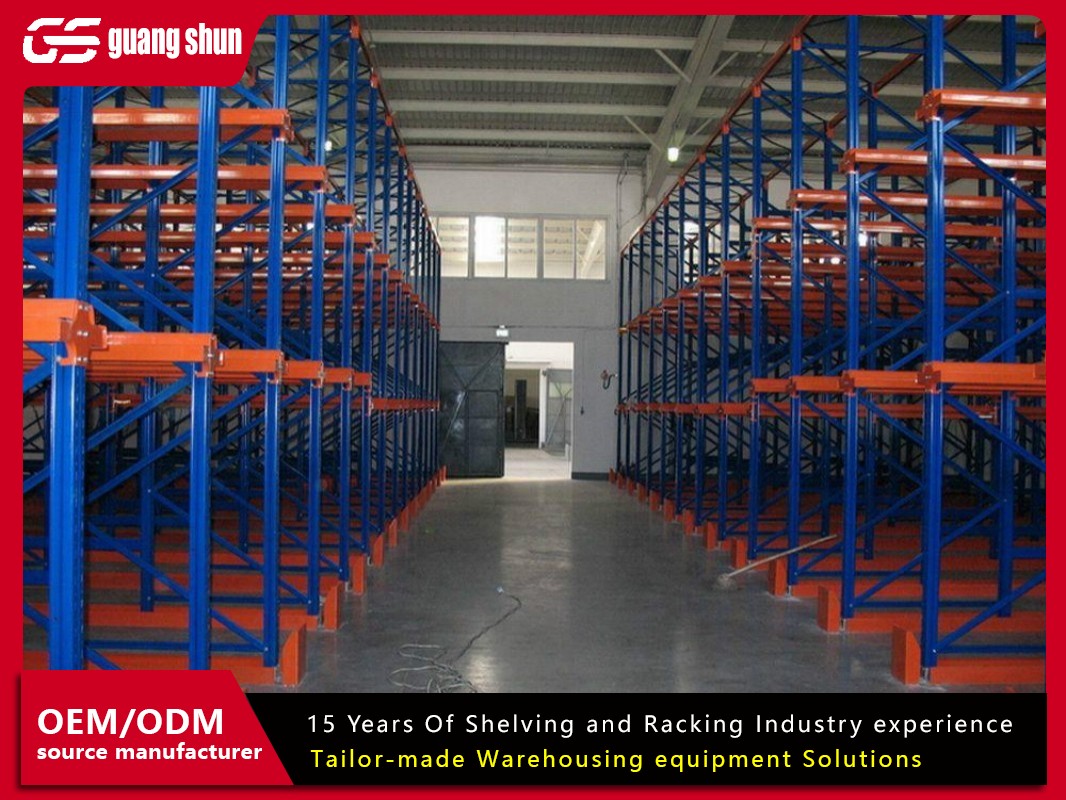
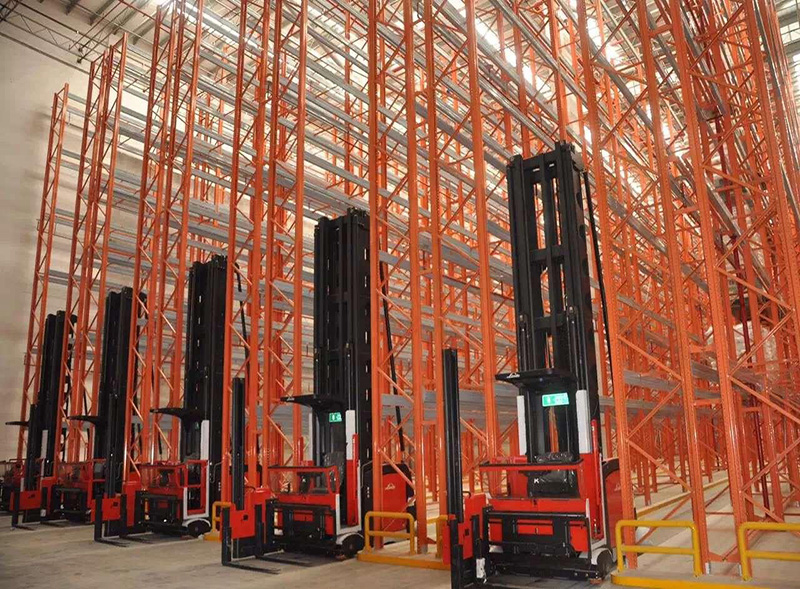
thru is a continuous-pallet rack configuration where upright frames
and horizontal load beams create multiple deep lanes, typically 4 to 12 pallets
deep, with access openings at both ends. Forklifts enter from the front aisle,
deposit pallets onto rails or cantilever arms, drive through the lane, and exit
from the opposite aisle. This bi-directional access differentiates it from
drive-in racks (one entry/exit), enabling FIFO inventory rotation without
repositioning loads. Each lane operates independently, supporting different SKUs
per lane. Key components include:
Upright frames with heavy-gauge steel columns (3-5mm
thickness) and diagonal bracing for lateral stability.
Rail systems – either full-support rails (for block
pallets) or roll-formed cantilever arms (for open-deck loads).
Floor anchor bolts and base plates resisting horizontal
forces during forklift braking (typical load: 2,000–4,000 N per leg).
End-of-aisle safety barriers and column protectors to
withstand impact at entry/exit points.
Industry data from the Warehouse Education & Research Council (WERC)
indicates that converting selective racking to a rack drive
thru layout increases storage density by 55% to 70% for homogeneous
pallet loads, while reducing the number of aisles required by 60%.
2. Technical Design Parameters: Lane Depth, Beam Levels, and Load
Ratings
2.1 Maximum Lane Depth vs. Forklift Reach
Determining optimal lane depth for a rack drive
thru involves balancing storage density against retrieval time.
Standard counterbalance forklifts with 4-5m lift height can handle depths up to
8 pallets (approximately 10 meters). Reach trucks or very narrow aisle (VNA)
forklifts extend depths to 12 pallets (15 meters) but require reinforced floor
flatness (FM1 or better). For depths exceeding 10 pallets, laser-guided
positioning systems become necessary to prevent rack strikes. Guangshun provides dynamic load
simulation reports for each design, verifying column deflection under full-lane
occupancy.
2.2 Beam Level Configuration and Vertical Clearance
Drive-thru racks typically support 3 to 6 beam levels, with vertical spacing
determined by pallet height plus 125mm clearance (minimum for safe forklift mast
insertion). For high-bay warehouses (12m+ ceiling height), double-deep
drive-thru configurations are feasible but require seismic bracing in earthquake
zones (ASCE 7-16 compliance). Load per beam level should not exceed the
manufacturer’s uniform distributed load (UDL) – typical ratings: 2,500 kg per
level for standard duty, up to 5,000 kg for heavy-duty variants.
3. Industry-Specific Applications and ROI Analysis
3.1 Cold Storage & Food Distribution
Frozen food warehouses (-25°C) benefit significantly from rack drive thru
designs because dense storage reduces refrigeration energy costs. A 2022 study
of Midwest cold storage facilities showed that implementing drive-thru
configurations cut cubic space requirements by 38%, translating to annual energy
savings of $47,000 per 10,000 pallet positions. However, low temperatures
require galvanized or zinc-coated steel to prevent brittleness – standard
powder-coated finishes degrade under thermal cycling. Guangshun supplies -30°C rated
systems with certified impact toughness (27J at -20°C per EN 10204).
3.2 Automotive Component Warehousing
Just-in-sequence (JIS) logistics for automotive assembly lines rely on FIFO
inventory discipline. Rack drive thru lanes assigned to individual part families
(e.g., instrument panels, bumpers) allow forklifts to replenish from one end
while picking from the opposite side, ensuring batch traceability. A tier-1
supplier reduced picking errors by 62% after converting from selective racks to
drive-thru, achieving ROI within 14 months.
3.3 Beverage and Packaged Goods
High-turnover SKUs like canned beverages (500+ pallets moved daily)
experience reduced congestion when using drive-thru lanes. Compared to push-back
racks (which require complex carts), the drive-thru mechanism has no moving
parts – maintenance cost per lane averages $120/year versus $890/year for
push-back systems.
4. Critical Safety Standards and Impact Protection
While rack drive
thru systems maximize density, they introduce unique hazards:
forklift overtravel into opposite aisles, pallet misalignment, and accumulated
damage to rails. Mandatory safety features include:
Entry/exit guides – flared rail ends that self-center
pallets, reducing placement errors by 70%.
Column protectors – removable steel sleeves absorbing side
impacts (certified to SEI 2020 standard).
Load backstops – at least 50mm high at the rear of each
beam to prevent pallets from being pushed off during insertion.
Photoelectric sensors on deep lanes (>10 pallets) to
signal when lane is full, avoiding over-pressurization of the rear
pallet.
Regular inspections per ANSI MH16.1-2020 are mandatory: measure rail
deflection under full load (max allowable L/200), check weld integrity at
upright-to-rail connections, and verify anchor torque (minimum 200 Nm).
Guangshun integrates QR-code
based inspection tags into every rack drive thru project, allowing facility
managers to log monthly checks via mobile devices.
5. Comparison with Alternative High-Density Systems
To justify investment in rack drive thru, evaluate against other dense
storage technologies:
| System Type | Density (pallets/m²) | FIFO/LIFO | Cost per position |
|---|
| Selective rack | 0.8–1.2 | FIFO | Baseline |
| Drive-in rack | 2.4–3.1 | LIFO | +15% vs selective |
| Rack drive thru | 2.8–3.5 | FIFO | +22% vs selective |
| Push-back rack (2-4 deep) | 2.2–2.7 | LIFO | +40% vs selective |
| Pallet flow (carton flow) | 2.5–3.2 | FIFO | +80% vs selective |
Rack drive thru delivers the lowest cost per FIFO-compliant pallet position
among automated options, with no conveyor maintenance. For warehouses handling
>2,000 pallet movements daily, the 22% premium over selective racks typically
yields payback in 18–24 months.
6. Installation Guidelines and Floor Requirements
Proper installation of rack drive
thru demands strict adherence to floor flatness and levelness.
According to FEM 10.2.05, drive-thru aisles require:
Floor flatness: Fmin = 90 (FF) and Fmin = 60 (FL) for narrow aisle trucks;
for standard counterbalance, FF 75 minimum.
Concrete compressive strength at least 28 MPa after 28 days.
Anchoring: minimum 4 chemical anchors per upright (M20 grade 8.8) embedded
150mm.
Expansion joints must not bisect any lane – relocate joints to aisle
centerlines to prevent rack displacement.
Pre-installation laser scanning identifies floor deviations; Guangshun provides shim
calculation reports when deviations exceed ±5mm per 3m.
7. Maintenance Protocols and Damage Prevention Programs
Long-term reliability of rack drive thru systems depends on proactive
maintenance. Data from 47 warehouses (surveyed by RMI, 2023) revealed that
drive-thru lanes with quarterly column audits experienced 63% fewer structural
failures than those with annual checks. Recommended schedule:
Monthly: Visual inspection of all rails for bending
(>5mm deflection requires replacement).
Quarterly: Torque check on all anchor bolts and rail splice
connectors.
Biannual: Ultrasonic weld testing on critical joints
(upright to base plate).
Annual: Load test one lane per zone using calibrated
hydraulic jacks (120% of rated capacity).
Digital maintenance logs synced with warehouse management systems (WMS) can
trigger automatic inspection reminders. Operators must be trained to recognize
warning signs: cracked floor coating near uprights, elongated anchor holes, or
visible vertical column tilt (>0.5°).
Frequently Asked Questions (FAQ)
Q1: Can a rack drive thru be
used for mixed SKUs within the same lane?
A1: Technically yes, but only if the SKUs share identical pallet dimensions and
weight. Mixed loads cause uneven rail wear and increase the risk of tip-over
during retrieval. For high-mix operations, designate each lane to a single SKU
family or use selective racking. Some facilities implement lane-dedicated floor
markings to restrict mixing.
Q2: What is the maximum practical
lane depth for a rack drive thru using a standard 3-ton
forklift?
A2: For a counterbalance forklift with a
4m lift height, the maximum safe depth is 8 pallets (approximately 9.6 meters
assuming 1.2m pallet length). Beyond 8 pallets, the operator loses direct
visibility of the rear pallet positions, increasing collision risk. For depths
of 10-12 pallets, integrated laser guidance or camera systems are
required.
Q3: How does rack drive thru handle seismic activity
compared to selective racks?
A3: Drive-thru
structures have lower lateral stiffness due to open faces. In seismic zones (SDC
D or higher), special design is mandatory: add horizontal diagonal braces every
second bay, use base isolators, and increase column section modulus by 30%.
Finite element analysis (FEA) per ASCE 7-16 is recommended. Guangshun offers
seismic-certified drive-thru frames with tested drift limits (max 2% under
design earthquake).
Q4: What fire protection requirements apply
to rack drive thru systems?
A4: NFPA 13 classifies
deep-lane rack drive thru as “high-piled storage.” In-rack sprinklers are
mandatory for lanes exceeding 8 pallets depth or 15ft height. Sprinkler spacing
must follow the rack manufacturer’s obstruction criteria – typically one
sprinkler head per 7 pallet positions. ESFR (early suppression fast response)
heads above the rack may be sufficient for lanes up to 4 pallets deep, but
consult local fire marshal.
Q5: How does the cost of a rack drive
thru system compare to automated storage and retrieval (ASRS) for similar
density?
A5: A typical rack drive thru costs
$150–$220 per pallet position (installed), while a mini-load ASRS system ranges
from $1,200–$2,500 per position. Drive-thru offers lower upfront investment but
requires manual forklift labor. For warehouses with labor costs below $35/hour
and throughput under 250 pallets/hour, drive-thru provides better TCO (total
cost of ownership) over 10 years. ASRS becomes competitive at very high labor
rates (>$50/hour) or 24/7 operation.
Q6: Can existing drive-in
racks be converted to rack drive thru?
A6: Partial
conversion is possible if the existing rack has symmetrical upright frames on
both ends and rear aisle space. You must remove the rear beam connectors and add
entry guides. However, most drive-in racks lack the structural rear columns
needed for safe forklift exit – a full structural assessment is mandatory.
Guangshun provides retrofit kits specifically engineered for drive-in to drive-thru
conversion, including upgraded base plates and impact
barriers.
Q7: What pallet types are compatible with rack drive
thru systems?
A7: Standard GMA pallets (48”x40”)
and Euro pallets (1200x800mm) work directly with full-support rails. For block
pallets (with bottom boards running parallel to the stringers), cantilever arm
rails are required. Avoid using broken or warped pallets – they can get caught
on rail splices, causing lane blockages. Plastic pallets with solid bottoms
require smooth roll-formed rails to reduce friction.
Implementing a rack drive
thru involves significant capital planning but delivers measurable
density improvements for FIFO-critical operations. Consult structural engineers
to validate floor capacity and seismic factors. For project-specific load
calculations and 3D layout simulations, Guangshun offers free preliminary
design audits, ensuring compliance with RMI and FEM standards. Contact their
engineering team via the website to obtain deflection charts and anchor pattern
recommendations tailored to your throughput profile.