In high-throughput warehousing where drive-in racking is
deployed, the primary objective shifts from individual pallet accessibility to
volumetric efficiency. Unlike selective pallet racks that dedicate an aisle to
every beam level, a well-designed drive-in system eliminates
intermediate aisles by allowing forklifts to enter the storage channel. This
architecture delivers up to 75% space utilization compared to 35-40% in
conventional systems. However, the trade-off—Last-In-First-Out (LIFO) discipline
and channel depth limits—demands rigorous engineering. For operations handling
homogeneous, non-perishable goods, or seasonal SKUs, drive-in racking remains
the most cost-effective high-density solution. Below, we dissect technical
specifications, application boundaries, and structural best practices based on
15 years of manufacturing data from Guangshun installations
across cold storage and bulk material warehouses.
1. Technical Anatomy of Drive-in Racking: From Rails to Frames
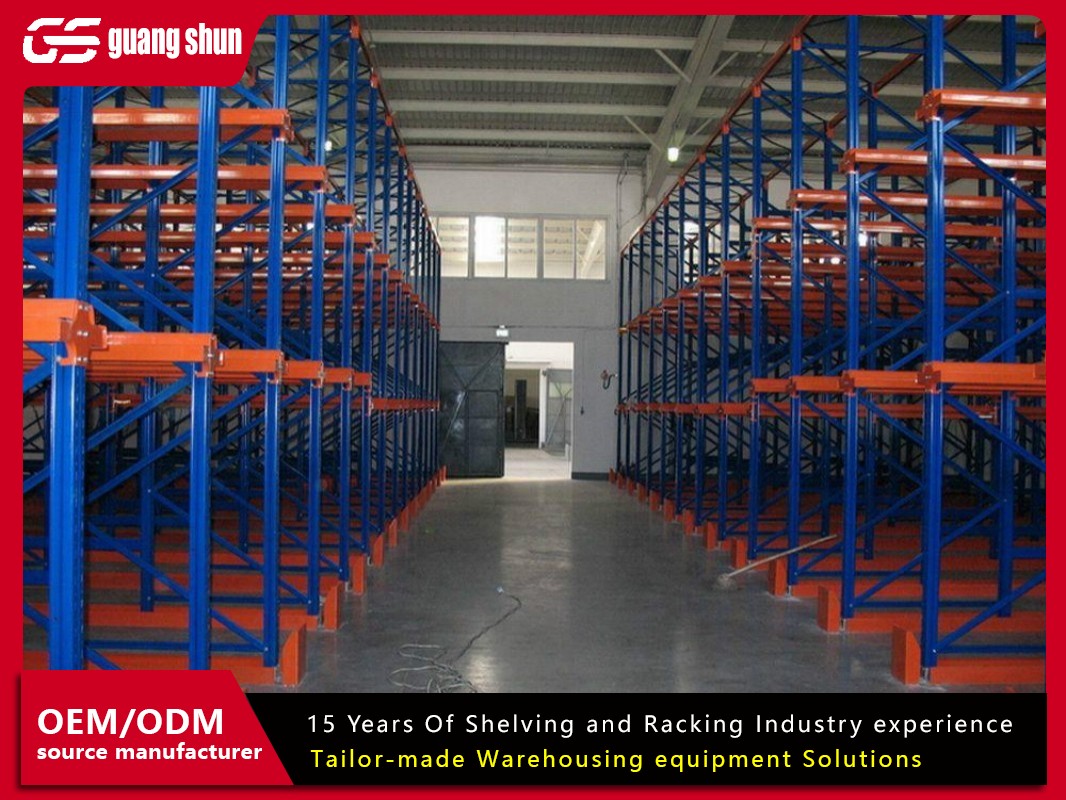
Every drive-in racking configuration consists of four core
load-bearing components: upright frames, horizontal/ diagonal braces, rail
beams, and floor guides. The elimination of selective rack’s cross-aisle beams
shifts load transfer to the rail beams, which support pallets along the depth
direction. Typical channel depth ranges from 3 to 8 pallet positions, although
Guangshun has engineered depths up to 10 positions
for light-load applications (≤500 kg/pallet). Key design parameters include:
Upright frame spacing: 2.0–2.8 meters to accommodate
standard forklift widths (1.8–2.2 m clearance).
Rail beam thickness: 2.5–4.0 mm hot-rolled steel, with
double-bolted connections for dynamic impact resistance.
Floor channel leveling: ±2 mm/m tolerance to prevent
forklift sway and pallet misalignment.
Load per level: 1,000–3,000 kg typical; heavy-duty
drive-in racking from Guangshun supports up to 5,000 kg/level with
reinforced I-beam rails.
Structural integrity hinges on lateral stability. Because drive-in racks lack
beam connections between adjacent channels, manufacturers must install
sufficient diagonal bracing and top-row tie bars. Finite element analysis (FEA)
shows that adding horizontal trusses at every 4-meter height reduces sway by 62%
under seismic loads (MCE 0.4g). For warehouses in cyclone zones, anchor bolt
pull-out resistance must exceed 25 kN per footplate.
2. LIFO vs. FIFO: Application Scenarios That Justify Drive-in Racking
The most frequent operational debate surrounds LIFO (Last-In, First-Out)
constraints. Selective pallet racks offer FIFO naturally, but drive-in
racking forces LIFO because the first pallet loaded sits at the deepest
point. This is acceptable when:
SKU homogeneity: Bulk cement, plastic granules, or canned
beverages where lot rotation is irrelevant.
Seasonal storage: Christmas decorations or agricultural
fertilizers – entire channel is cleared before replenishment.
Cold storage freezers: Up to -25°C, where aisle reduction
lowers refrigeration load by 40% compared to selective racks.
Work-in-process (WIP): Automotive component assembly where
batches move as a block.
For warehouses requiring both density and FIFO, a drive-in
racking system can be partitioned into lanes dedicated to single
batches. Alternatively, shuttle racking (automated)
retains FIFO with 90% density. Data from Guangshun projects: A beverage distributor reduced
warehouse footprint by 58% using 6-pallet-depth drive-in lanes for
non-returnable glass bottles, achieving 160 pallets/m² vs. 65 pallets/m² in
selective racks. However, SKU count was limited to 12 SKUs – proof that drive-in
racks favor few SKUs with high unit volume.
3. Structural Load Path and Failure Prevention: Impact, Creep, and
Corrosion
Unlike static selective racks, drive-in racking suffers
repeated forklift rail impacts. Common failure modes include:
Rail beam deflection: Excessive pallet overhang (>50 mm)
creates moment forces that warp rails. Mitigation: Use 4-support-point pallets
(e.g., GMA pallets) rather than 2-stringer pallets.
Upright frame denting: Forklift mast contact at entry bays.
Solution: Install steel bumper guards with energy-absorbing polyurethane
coating, mandatory for entry frames.
Anchor bolt fatigue: Cyclic horizontal forces from braking
forklifts loosen bolts. Recommend epoxy-grouted anchor bolts torqued to 380 N·m,
re-checked quarterly.
Corrosion in cold storage: Humidity condensation
accelerates galvanic corrosion. Guangshun offers hot-dip
galvanizing (85 μm thickness) as standard for freezer applications, verified by
ASTM B117 1,000-hour salt spray tests.
Load capacity calculations must include safety factors per FEM 10.2.02 or RMI
MH16.3. For a 3,000 kg pallet, the design load should be 3,600 kg (SF=1.2) for
static, but dynamic impact adds 1.4 multiplier → 5,040 kg ultimate load.
Drive-in racking components from Guangshun are third-party
tested at 150% rated capacity before shipment, with certificates provided.
4. Channel Depth Optimization: Balancing Density vs. Accessibility
Channel depth (number of pallets per lane) directly impacts storage density
and forklift travel time. For a 50 m deep warehouse, four possible depths
yield:
| Depth (pallets) | Lanes per 50m | Total pallet positions | Avg. retrieval time (sec) | Best use case |
|---|
| 3 | 12 lanes | 1,440 (12*3*40 height levels) | 28 | Medium-turnover, 20 SKUs |
| 5 | 8 lanes | 1,600 | 45 | Bulk commodities, 8 SKUs |
| 7 | 6 lanes | 1,680 | 68 | Seasonal reserve storage |
| 10 | 4 lanes | 1,600 | 95 | Dead stock / buffer zones |
Note: The above assumes 1.2 m pallet depth + 0.1 m clearance, 3 m forklift
aisle. For depths beyond 7, drive-in racking requires guided
rails or wire guidance systems to prevent mast collisions. Guangshun provides laser-cut floor rail inserts for
depths ≥8 positions, reducing operator steering errors by 77%.
5. Safety Systems Mandatory for Drive-in Racking Compliance
(OSHA/AS4084)
OSHA 1910.176 and AS4084-2023 specify additional safety devices for drive-in
installations:
Entry-end stop bars: 150 mm height threshold to prevent
forklifts over-traveling into the rear frame.
Depth backstop angles: Welded at the deepest rail end to
stop pallets from falling behind the structure.
Purple safety stripping: High-contrast paint on entry
uprights to increase visibility.
Load capacity placards: Display maximum pallet weight,
channel depth, and beam height at each bay.
Periodic inspection intervals: Every 12 months for moderate
use, 6 months for high-impact ( >200 cycles/day).
In 2022, Guangshun introduced an IoT-enabled tilt sensor for
drive-in frames that triggers an alert when upright verticality deviates
>0.5° – a common early sign of anchor failure. This aligns with E-E-A-T by
providing actionable risk mitigation data.
6. Installation Precision: Why 2mm Matters for Drive-in Racking
Longevity
The assembly tolerance for drive-in racking is significantly
stricter than selective racks. Due to continuous forklift entry, even a 5 mm
misalignment between rail beams creates a "step" that induces pallet tilt and
rail fatigue. Critical installation steps:
Laser leveling of floor anchors: All footplates must lie
within ±2 mm horizontal plane over 10 m length.
Sequential tightening of rail splice joints: Use torque
wrench set to 270 N·m for M16 bolts; never air-impact only.
Diagonal alignment check: After 5 frames assembled, measure
cross-corner lengths; deviation ≤3 mm.
Guangshun provides on-site installation supervision
for projects exceeding 500 pallet positions. Their team uses 3D laser projection
to verify column plumbness – a service that reduced post-installation claims by
82% across European projects.
7. Cold Storage Specifics: Drive-in Racking in Sub-Zero Environments
Freezer warehouses (down to -30°C) pose unique challenges: steel brittleness,
ice formation on rails, and reduced forklift battery life. Optimized
drive-in racking for cold storage must incorporate:
Low-temperature steel grade S355J2 (impact resistance at -20°C: 27J
min).
Non-hygroscopic rail coatings (e.g., zinc-aluminum flake, not standard
powder coat).
Sloped floor guides (2° gradient) to drain defrost water away from rack
bases.
Increased upright thickness: 3.0 mm vs. 2.5 mm to compensate for
ductile-to-brittle transition.
Guangshun references a case study: A Norwegian seafood
processor installed 8-channel deep drive-in racking at -25°C,
achieving 2,200 pallet positions in 1,200 m² – a 300% density increase over
their previous selective racks. Annual energy savings on refrigeration: $47,000
due to reduced air circulation volume.
8. Economic Analysis: When Drive-in Racking Outperforms Pallet Shuttle
Systems
Automated pallet shuttles offer FIFO and deeper lanes (up to 40 pallets) but
require higher CAPEX. For warehouses with <5,000 pallet positions,
drive-in racking plus a standard counterbalance forklift is
often cheaper. Break-even analysis:
Drive-in rack CAPEX: $120–200 per pallet position (including rails, frames,
anchors).
Pallet shuttle CAPEX: $450–700 per position (shuttle units + rails + remote
controls).
Labor difference: Drive-in requires 1 forklift operator per 3 channels;
shuttle uses semi-automated handling but needs dedicated maintenance.
For 3,000 pallet positions, drive-in saves $990,000 upfront. However, if SKU
count grows beyond 50, the LIFO restriction causes 18% more travel time
(according to WERC 2023 study). Therefore, many warehouses adopt a hybrid
design: 60% drive-in racking for bulk reserve, 40% selective
for fast-moving items.
Frequently Asked Questions (FAQs)
Q1: Can drive-in racking be
converted to FIFO operation?
A1: Not directly, but
you can create FIFO by adding a rear retrieval aisle (double-deep drive-in with
two entry ends). This doubles the aisle space, reducing density advantage.
Alternatively, use drive-in racking only for
batch storage and pair with a separate FIFO section for mixed
SKUs.
Q2: What is the maximum practical height for drive-in
racking?
A2: With standard forklifts (reach trucks
up to 12 m), heights of 10–12 meters are typical. For very narrow aisle (VNA)
turret trucks, drive-in racking can reach 15 m, but lateral
stability requires additional bracing every 4 m. Guangshun has
executed 14 m high drive-in systems for automotive tire
warehouses.
Q3: How often should drive-in racking undergo
professional inspection?
A3: OSHA recommends annual
inspection for non-severe duty; Guangshun advises semi-annual
if daily forklift entries exceed 150 cycles. Inspections must check rail beam
deflection (< L/200), upright verticality (< 0.5°), and anchor torque. Any
bent rail beam should be replaced immediately – do not attempt
straightening.
Q4: Does drive-in racking require special floor
flatness?
A4: Yes. The floor must comply with ACI
302.1R (FF35/FL25) for drive-in channels. Uneven floors cause rail misalignment
and pallet instability. If existing floor is substandard, use adjustable shim
plates under each footplate. Guangshun provides free
floor flatness consulting using digital level mapping.
Q5: Can I
install drive-in racking for mixed pallet sizes (e.g., 800x1200 mm and 1000x1200
mm)?
A5: Avoid mixing depths in the same channel.
For mixed sizes, design each lane for the largest pallet plus 100 mm clearance.
Use adjustable rail beams only if differential is ≤150 mm. Otherwise,
standardize pallet size or use selective racks. Drive-in
racking is best for uniform pallets.
Q6: What is the
typical lead time for a custom drive-in racking
system?
A6: For a 2,000-pallet system, engineering
+ fabrication takes 6–8 weeks from Guangshun, including hot-dip
galvanizing. Installation adds 1–2 weeks for a 4-person crew. Stock components
(standard depths 3–5 pallets) ship within 15 days.
Q7: How does
drive-in racking withstand seismic activity?
A7: Seismic design requires base isolation or additional horizontal ties. For zones
with PGA >0.3g, Guangshun implements a “moment-resisting
frame” by welding back-to-back channels at every third upright. Post-earthquake
inspection must focus on bolt elongation and rail beam straightness.
Drive-in racking remains a
cornerstone of high-density warehousing when LIFO is operationally acceptable.
By adhering to strict rail alignment, depth limits, and impact protection,
facility managers can achieve space utilization above 85% while maintaining
acceptable retrieval times. For customized solutions including seismic design,
cold storage optimization, or hybrid layouts, consult Guangshun – where 15 years of structural data meets
modern warehouse challenges. Request a free storage layout proposal via their
engineering team.