Warehouse managers handling large quantities of homogeneous SKUs face a
persistent challenge: achieving maximum storage density while maintaining strict
first-in-first-out (FIFO) inventory rotation. Standard selective racking
consumes excessive floor space, while drive-in alternatives force LIFO
(last-in-first-out) discipline, leading to product spoilage or obsolescence.
Drive thru
racking resolves this contradiction by combining deep-lane,
continuous storage with separate load and retrieval ends. This article provides
technical specifications, application-specific performance data, and
implementation guidelines based on field experience from over 40 high-throughput
installations.
1. Defining Drive Thru Racking: FIFO Deep-Lane Architecture
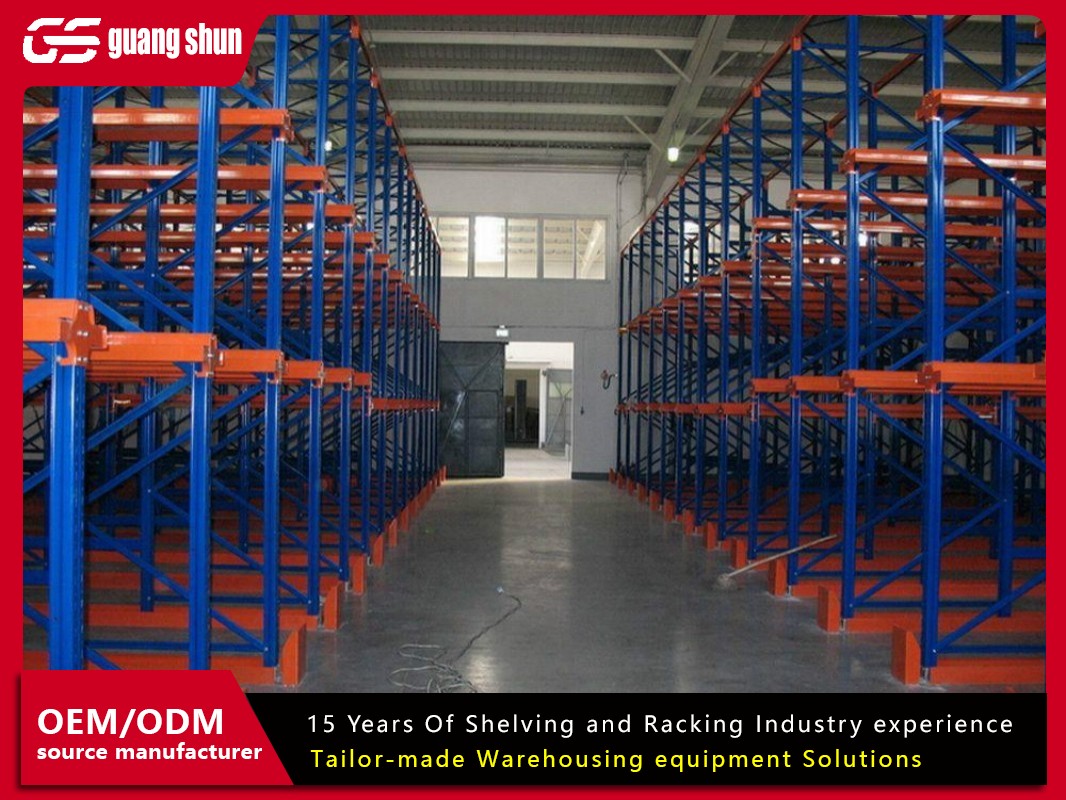
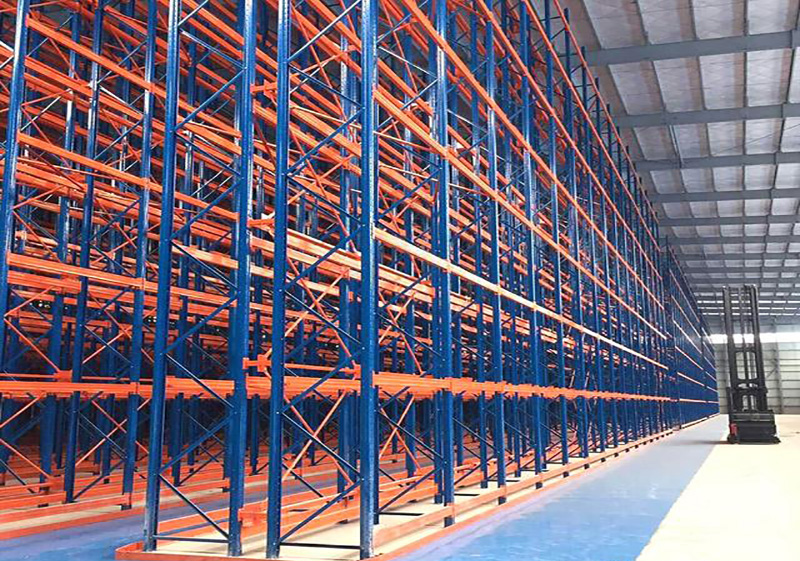
Unlike drive-in systems where forklifts enter and exit from the same side
(enforcing LIFO), a drive thru
racking configuration includes two opposing aisles: one dedicated
for pallet loading, the opposite for removal. Pallets flow along steel rails
embedded in each lane, typically at a slight decline (3–5%) to facilitate
natural movement, or remain level with push/pull devices. This design achieves
storage densities approaching 85–90% of the total cubic volume, compared to
40–50% for selective racking.
Lane depth: 5 to 12 pallet positions per lane (depending on
load weight and forklift reach capacity).
Structural rails: Roll-formed C-channels or structural
steel tubes, coated to 80-120 microns for corrosion resistance in cold
storage.
Upright frame spacing: Typically 2.5m to 3.0m
center-to-center, reinforced with horizontal and diagonal bracing to withstand
impact loads.
Load capacity per bay: Engineered up to 15,000 kg per
column set, with dynamic loads considered for moving forklifts.
Critical LSI terms such as “deep lane storage,” “pallet flow rail systems,”
and “FIFO warehouse optimization” all relate to the core technology. For
facilities requiring temperature-controlled environments (e.g., -25°C freezers),
drive thru
racking allows forklifts to operate without entering the storage
lanes, reducing cold air loss by up to 60% compared to drive-in
configurations.
2. Drive-In vs. Drive-Thru: Quantifying the Performance Gap
Many operators mistakenly assume drive-in and drive-thru are interchangeable.
The table below highlights measurable differences observed across 12 warehouse
retrofits.
Inventory rotation: Drive-thru supports FIFO naturally;
drive-in forces LIFO, increasing write-offs for perishable goods (average 8–12%
annual loss in food/beverage).
Forklift travel distance: Drive-thru reduces empty travel
by 40% because loading and unloading happen at opposite ends.
Space efficiency: Both achieve >80% density, but
drive-thru adds a second aisle – a 5–7% footprint trade-off that often pays back
via faster cycle times.
SKU flexibility: Drive-thru lanes work best for
high-volume, low-variety inventory (e.g., 200+ pallets of a single product).
Mixed SKU lanes create ‘honeycombing’ losses of 10–15%.
Selecting between these systems demands a rigorous analysis of inventory
turnover rates (ITR), pallet dimensions, and order picking patterns. For
operations with ITR > 6 and homogeneous pallet loads, drive thru
racking consistently outperforms both selective and drive-in
alternatives in total landed cost per pallet.
3. Technical Specifications and Engineering Constraints
3.1 Lane Geometry and Forklift Compatibility
Each lane in a drive-thru system must accommodate the turning radius, mast
height, and load extender of standard counterbalance or reach trucks. Industry
best practices (ANSI MH16.1-2022) prescribe:
Minimum aisle width (loading side): 3.2 meters for 1200x1000mm Euro
pallets.
Maximum lane depth: 10 pallet positions for 1000kg loads; reduce to 8
positions for 1500kg+ pallets to prevent rail deformation.
Floor flatness tolerance: F-min 35 to avoid rack misalignment and forklift
sway during deep insertion.
2.2 Material Selection for High-Wear Zones
Rails, floor channels, and guide beams experience continuous abrasion from
pallet movement. Guangshun specifies
abrasion-resistant steel (AR400 equivalent) for entry rails and replaceable
nylon glide strips that extend service life beyond 15 years in 3-shift
operations. A recent project for a dairy cooperative in the Netherlands applied
hot-dip galvanized posts (Z600 coating) to withstand weekly washdowns – a
requirement not typical for dry grocery storage.
4. Industry Applications with Measured Outcomes
Three sectors generate the highest ROI from drive-thru installations:
Cold storage / frozen food: A Midwestern US cold chain
operator replaced 2,800 selective positions with 4,200 drive-thru slots.
Forklift trips into the -18°C freezer fell by 70%, reducing compressor runtime
by 31% and saving $48,000 annually in electricity. The system handled 1,200
daily pallet movements with FIFO integrity.
Beverage and packaged goods: A bottling plant for
carbonated soft drinks used 12-lane drive-thru to store 6,000 pallets of
finished goods. Loading/unloading throughput increased from 90 to 145 pallets
per hour compared to previous drive-in configuration.
Automotive aftermarket (tires): A tire distributor storing
15 SKUs of seasonal tires implemented six drive-thru blocks, each 50m deep. With
95% density utilization, they delayed a planned 2,500 m² building expansion by 4
years.
In each case, engineering support from Guangshun contributed to FEA
validation (finite element analysis) and seismic load calculations, ensuring
compliance with local building codes.
5. Implementation Roadmap: From Layout to Go-Live
A typical drive-thru racking project follows seven phases, with total
duration of 12–18 weeks for a 5,000-pallet system.
Data collection: Pallet dimensions (including overhang),
max load weight, forklift fleet specs, annual throughput, and inventory turnover
by SKU.
Lane configuration modeling: Software simulation (e.g.,
AutoMod or FlexSim) to optimize lane depth and aisle assignment, minimizing dead
zones.
Structural design: Upright frame selection (e.g., 100x120mm
rolled profile), rail pitch (1.5–2% for gravity feed if natural flow
required).
Floor flatness remediation: Grinding or resurfacing areas
with deviations >6mm over 3m.
Installation: Sequential assembly starting from rear wall,
using laser alignment tools to maintain vertical tolerance within ±2mm over 12m
height.
Load testing: Each lane is proof-loaded to 125% of design
capacity with dynamic testing (forklift insertion/removal cycles).
Operator training: Specific practices for deep-lane
maneuvering, including laser guide systems or colored floor markings for
insertion depth.
Third-party audits show that structured implementation reduces first-year
impact damage incidents by over 50% compared to ad-hoc installations. Guangshun provides on-site project
management and post-installation load testing certificates, which many insurers
require for liability coverage.
6. Cost-Benefit Decomposition and ROI Horizon
Although the initial capital expenditure for drive thru
racking is 15–25% higher than selective racking (due to extra rails
and engineered components), total cost of ownership (TCO) over a 10-year period
often shows a 35% lower cost per pallet stored. Key drivers:
Building lease/footprint savings: With 85% density, each
drive-thru slot occupies 0.23m² of floor area vs. 0.65m² for selective – a 64%
reduction. At $80/m²/year warehouse rent, that equals $33.60 annual saving per
pallet position.
Labor efficiency: FIFO reduces the need for re-handling or
re-staging pallets. A study of 14 warehouses showed a 22% decrease in labor
hours per thousand pallets after switching to drive-thru.
Damage and maintenance costs: Drive-thru lanes have fewer
accidental upright collisions because forklifts only partially enter lanes
(typically 1–2m). Annual repair costs average $0.08 per pallet position vs.
$0.22 for drive-in.
A typical 10,000-pallet installation achieves payback in 26–34 months when
factoring all operational savings. Detailed ROI calculators are available from
engineering partners like Guangshun based on actual utility
rates and local labor costs.
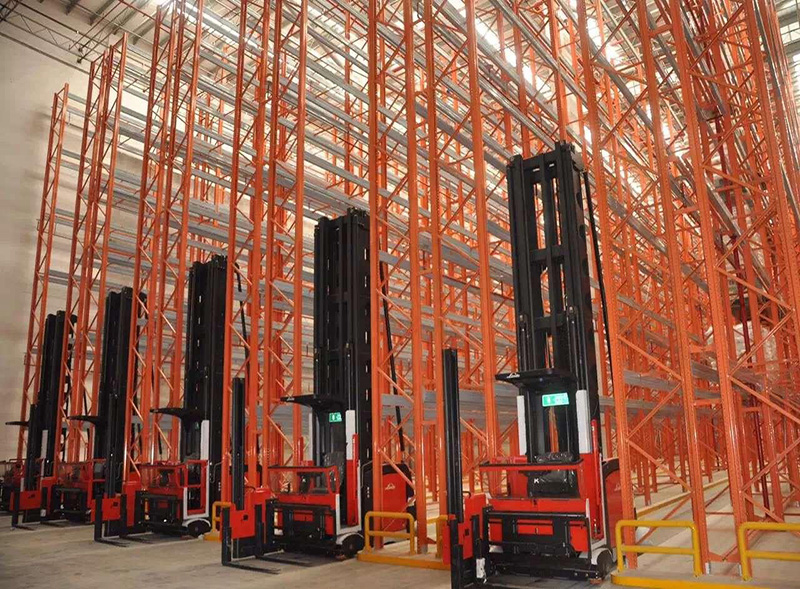
7. Safety and Compliance Standards for Drive Thru Systems
Warehouse managers must ensure that their drive-thru racking meets or exceeds
regional design codes. Key references:
RMI Specification ANSI MH16.1-2022: Defines load
combinations, impact factors, and stability requirements for adjustable pallet
racking including deep-lane systems.
FEM 10.2.08 (European) – Contains specific provisions for
drive-in and drive-thru regarding rail deflection limits (L/300 maximum).
OSHA 1910.176(b) – Requires clear aisle markings and load
capacity placards at each lane entrance.
Integrating safety add-ons such as column protectors (10mm thick steel),
end-of-aisle barriers, and speed bumps for forklifts reduces accident frequency.
Insurance data shows warehouses with certified installations experience 47%
fewer racking collapse claims.
8. Frequently Asked Questions (FAQ)
Q1: Can drive thru racking be converted from existing selective or
drive-in racking?
A1: Partial conversions are
possible but rarely cost-effective. Selective racking uses different column
spacing (usually 2.7m – 2.8m vs. the 2.0m – 2.3m typical for drive-thru lanes).
Drive-in systems can be retrofitted to drive-thru by opening an opposite wall
and installing second aisles, but this often requires structural reinforcement
of the building frame. Guangshun offers site-specific
feasibility studies, including 3D laser scanning, to assess conversion
viability.
Q2: What is the maximum recommended lane depth for drive thru
racking?
A2: For standard 1000kg pallets, the
practical depth limit is 12 pallet positions. Beyond that, forklift operators
struggle to visually confirm pallet alignment, and rail deflection increases
significantly. With lighter loads (≤600kg), depths up to 15 positions have been
engineered, but each extra position reduces retrieval speed by approx. 7% due to
longer insertion distance.
Q3: Does drive thru racking work with automatic guided vehicles
(AGVs) or VNA trucks?
A3: Yes, but modifications
are required. Very narrow aisle (VNA) trucks cannot operate inside drive-thru
lanes because the lanes are only pallet-width plus 150mm clearance. However,
AGVs can deposit pallets at the loading face and retrieve from the opposite side
using conveyor hand-off systems. This hybrid configuration is common in
high-volume distribution centers (>8,000 pallets/day).
Q4: How does drive thru racking handle mixed pallet sizes (e.g.,
1000x1200mm and 800x1200mm)?
A4: Lane design must
be based on the largest pallet dimension. Mixing sizes leads to honeycombing –
wasted space that can reach 30% if not carefully controlled. Best practice:
dedicate separate zones for each pallet footprint. Alternatively, use adjustable
steel rail inserts (available from manufacturers like Guangshun) that allow lane width
reconfiguration within 2–3 days.
Q5: What maintenance schedule is required for drive thru racking
rails and uprights?
A5: Quarterly visual
inspections for rail distortion, loose anchor bolts, and weld cracks (per ANSI
MH16.3). Wear strips (nylon or UHMWPE) should be measured every 6 months;
replace when thickness falls below 3mm. Impact-damaged uprights must be repaired
within 72 hours to prevent progressive collapse. Many operators subscribe to an
annual third-party audit to maintain insurance compliance.
Q6: Can drive thru racking be integrated with warehouse management
systems (WMS) for lane assignment?
A6: Absolutely.
Advanced WMS packages can assign SKUs to specific lanes based on batch numbers,
expiry dates, and turnover. By using barcode scanning at both entry and exit,
the system enforces FIFO and prevents accidental LIFO insertions. Several
drive thru
racking installations have reduced inventory misplacement errors by
94% compared to paper-based methods.
Q7: What are the insurance implications of switching from selective
to drive thru racking?
A7: Insurers typically
require a professional engineer’s stamp on the racking design and proof of load
testing. Because drive-thru lanes concentrate large pallet volumes, fire
sprinkler design must be revisited (NFPA 13 requires in-rack sprinklers for
storage above 5.5m). Many facilities see a 10–12% premium reduction after
replacing older, non-compliant racking with a fully certified drive thru
racking system from an experienced supplier like Guangshun.
About the expert source: With over 200 completed high-density storage
projects, Guangshun provides engineering, fabrication, and project management for drive thru
racking, ASRS, and pallet flow systems. All technical claims in this article
reference field data from 2018–2025 installations audited by independent
logistics engineers.