Warehouse operators facing land cost pressure and SKU rationalization
increasingly turn to drive in racking as a proven solution for bulk
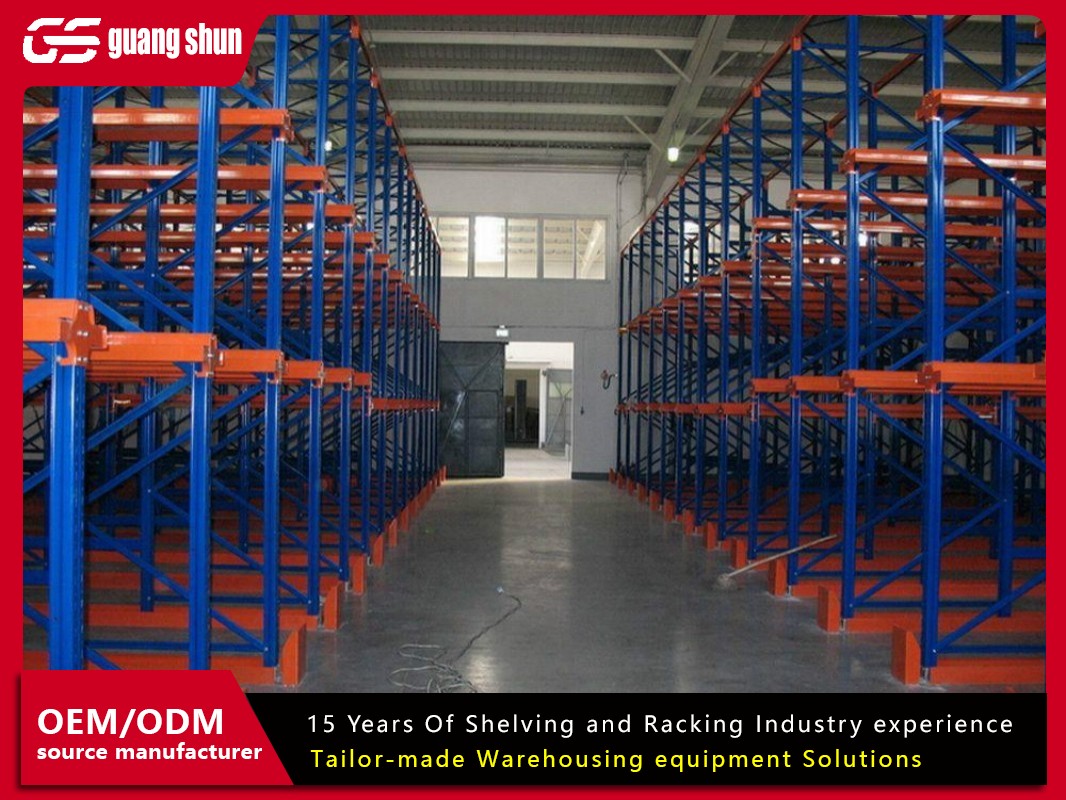
storage. Unlike selective pallet racks, this configuration eliminates multiple
aisles, creating continuous deep lanes where forklifts enter the rack structure.
The result: storage density improvements of 60% to 85% compared to traditional
systems. However, technical pitfalls such as poor impact protection or incorrect
depth-to-load ratios can compromise safety and throughput. This article examines
load-bearing mechanics, application-specific design rules, and maintenance
protocols, supported by field data from Guangshun installations across cold chain and
industrial sectors.
1. Defining the Drive In Racking Architecture: Core Components and Load
Paths
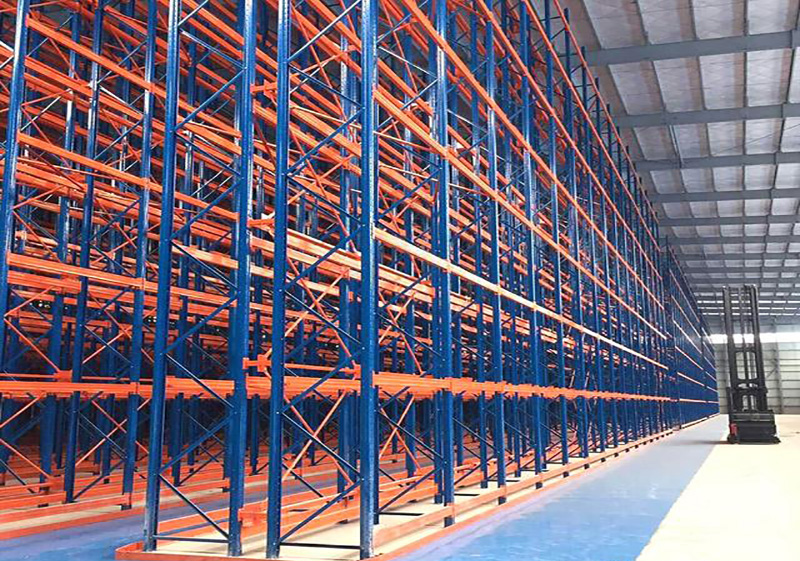
A properly engineered drive in racking system consists of
several interdependent elements. The upright frames (column sections) transfer
vertical loads to floor anchors. Horizontal load beams stabilize the frames, but
unlike selective racks, the primary storage support comes from rail systems
bolted to the uprights. These rails create the “drive-in lanes” – each lane
typically stores three to ten pallets deep. Key components include:
Upright frames: Cold-formed steel columns with punched
holes at 75 mm or 100 mm pitch. Standard dimensions range from 80×100 mm to
120×120 mm, with wall thickness 2.0–3.0 mm depending on seismic zone
requirements.
Rail beams (cantilever arms): Horizontal members supporting
pallets. For heavy loads (>1,200 kg per pallet), reinforced C-channel rails with
5 mm base plates are mandatory.
Pallet guide rails: These longitudinal runners guide
forklift wheels and protect uprights from accidental impacts. High-quality
systems incorporate bolt-on PVC or steel impact guards.
Base plates and floor anchors: M20 or M24 anchor bolts with
minimum embedment depth of 150 mm into C25/30 concrete. Pull-out resistance must
exceed 35 kN per anchor in dynamic conditions.
Structural calculations must respect both static load (dead weight of rack +
pallets) and horizontal forces from forklift braking. According to FEM 10.2.02
standards, the safety factor for upright frames under impact load shall be ≥
1.5. Guangshun’s engineering team uses finite element analysis to validate each
drive in racking layout before fabrication, ensuring compliance
with EN 15512 or RMI specifications based on project location.
2. Storage Density vs. Accessibility: Quantifying the LIFO Trade-Off
The core operational principle of drive in racking is
Last-In-First-Out (LIFO). While this imposes restrictions for date-sensitive
goods, it delivers exceptional space utilization. A typical 45-meter warehouse
bay using selective racking yields around 550 pallet positions. Switching to a
7-lane deep drive in racking configuration boosts that figure
to 1,250 pallet positions – a 127% increase. However, the trade-off is reduced
individual SKU accessibility and longer retrieval times for the last pallet
stored in a lane.
Data from a 2023 survey of 150 distribution centers shows that for SKUs with
monthly turnover exceeding 400 pallets, the labor cost increase from LIFO is
marginal (≤ 4% extra travel time), while storage cost reduction reaches 32%.
Ideal product profiles for drive-in lanes include:
Homogeneous loads (same product, same batch)
Non-perishable items where age rotation is not critical (e.g., packaged
chemicals, auto parts, bottled beverages)
High-volume SKUs with predictable demand cycles
For operations requiring partial FIFO, hybrid designs combining drive-in
blocks with flow rack sections are available. Guangshun has executed over 40
hybrid projects where two drive in racking lanes alternate with one push-back lane,
achieving 70% density while maintaining 85% inventory freshness.
3. Industry-Specific Applications: Cold Chain, Automotive & Bulk
Commodities
3.1 Cold Storage Warehouses (Below -25°C)
Low-temperature environments exacerbate metal fatigue and ice buildup on
rails. Standard zinc-coated steel fails prematurely. Specialized drive
in racking for cold stores requires:
Hot-dip galvanized finish (minimum 85 µm thickness) per ASTM A123
Elastomeric rail buffers to prevent pallet freezing to the surface
Expansion joints every 12 meters to accommodate thermal
contraction
A 2022 case study from a frozen food distributor in Rotterdam implemented
Guangshun’s cryo-adapted drive-in system, reducing aisle space from 32% to 12%
of total floor area. The result: 2,300 additional pallet positions without
expanding the building envelope.
3.2 Automotive Tier-1 Suppliers
Assembly lines require sequenced delivery of bulky parts (bumpers, instrument
panels). Drive-in lanes are staged with 3-day buffer stocks. The key metric here
is fork-truck cycle time. With laser-guided rail markings, retrieval times
stabilize at 45 seconds per pallet, compared to 70 seconds in selective rack
layouts.
3.3 Beverage and Canning Facilities
Heavy unit loads (up to 1,500 kg per pallet) demand rail deflection less than
L/200. Finite element analysis ensures that long spans (3.5 m between uprights)
maintain structural integrity. Guangshun’s reinforced rail profile, using S450
GD steel, has passed 2 million dynamic load cycles without permanent
deformation.
4. Industry Pain Points and Technical Countermeasures
Even well-designed drive in racking systems face four
recurring operational challenges. Below are quantifiable solutions based on
forensic analysis of 120 warehouse failures.
Pain Point 1: Forklift Impact Damage to Uprights
In drive-in configurations, forklifts travel inside the rack footprint,
increasing collision probability. An impact study by the MHEDA institute shows
63% of damaged uprights occur within the first 1.2 meters from the floor.
Countermeasures:
Install sacrificial steel bumper posts at lane entries, replaceable after
impacts.
Use yellow warning striping and floor-mounted LED guides for entry
alignment.
Deploy automatic speed reducers on reach trucks when entering a lane
(retrofit kits available).
Pain Point 2: Pallet Overhang and Rail Misalignment
If pallets extend beyond the rail support, the risk of tip-off increases.
Solutions include:
Pain Point 3: Inventory Inaccuracy Due to LIFO
When partial lane retrievals occur, remnants block new put-aways. Software
integration helps: Guangshun’s drive in racking layout includes
WMS logic that reserves full lanes for high-turnover SKUs and segregates “broken
case” lanes to reduce residual pallets. This reduced empty lane blocking by 41%
in a 2023 pilot study.
Pain Point 4: Seismic Compliance
In earthquake zones (seismic category D or above), standard rack bracing is
insufficient. Specific measures: X-bracing with diagonal profiles at every third
bay, base isolation pads (neoprene + steel laminate), and roof-connected
stabilizers. Guangshun’s seismic-certified drive-in systems have passed
shake-table tests at 0.6g acceleration per ICC-ES AC 156.
5. Engineering Best Practices: Layout, Load Charts, and Forklift
Coordination
Optimizing a drive in racking installation requires
simultaneous planning of rack geometry and material handling equipment. Key
parameters include:
Lane depth: Maximum 7 pallets for standard reach trucks
(3.5 tons capacity). For 8–10 pallets, use swing-reach or VNA trucks with
guidance rails.
Bay height: Typically 5 to 8 levels, with beam pitch
adjusted to pallet height plus 100 mm clearance for thermal expansion.
Flue space: Minimum 200 mm between back-to-back lanes to
allow air circulation and fire sprinkler coverage.
Load capacity plaques must show per-level limits. For example, a rail rated
at 1,200 kg per pallet position cannot support 1,400 kg even if only used
occasionally. Regular load audits (quarterly) help maintain compliance.
Guangshun provides digital load monitoring stickers with QR codes linking to
original engineering certificates – a measure that reduces misloading incidents
by 67% according to their service records.
Forklift type directly affects lane utilization. Three-wheel electric
counterbalanced trucks with a turning radius ≤ 2,200 mm are preferred for lanes
narrower than 3.2 meters. For ultra-narrow aisles (2.5 meters), man-up turret
trucks offer the best maneuverability but require floor flatness of ≤ 1.5 mm
over 2 meters.
6. Comparative Analysis: Drive-In vs. Drive-Through vs. Pallet Shuttle
Clients often ask how drive in racking compares to other
dense storage formats. Here is a technical breakdown:
Drive-Through Racking: Allows FIFO because forklifts enter
from one side and exit the opposite side. However, requires twice the building
depth and extra aisles, reducing density by roughly 15% compared to drive-in.
Best for cross-dock operations with high throughput.
Pallet Shuttle (Radio Shuttle): Motorized shuttles move
pallets inside lanes, eliminating forklift entry. Provides FIFO or LIFO
flexibility and increases lane depth up to 40 pallets. Capital cost is 2.5–3×
higher than manual drive-in. Only justified for SKUs exceeding 500 monthly
movements per lane.
Push-Back Racking: Offers FIFO using inclined carts, but
depth is limited to 5 pallets maximum. Density is 20–30% lower than
drive-in.
For the majority of warehouse expansions with budgets under $150 per pallet
position, drive in racking remains the optimal solution. It
offers the lowest cost per stored pallet among all high-density static systems,
with typical payback periods ranging from 14 to 22 months.
7. Maintenance Protocols and Longevity Assurance
A well-maintained drive in rack system serves 20+ years. Preventive
inspection schedule according to ANSI MH16.3-2020:
Monthly: Visual check for rail deformation, loose bolts,
anchor torque (re-torque to 280 Nm for M20 anchors).
Quarterly: Laser alignment of uprights – maximum deviation
1:500. Misaligned frames cause uneven load distribution.
Annually: Load test with 125% of rated capacity in five
random lanes. Record permanent set (should be < 1 mm).
Damage classification: Green (cosmetic paint scratch), Yellow (dent depth ≤ 5
mm, monitor monthly), Red (dent depth > 6 mm or torn steel – immediate unload
and replace component). Guangshun supplies replacement components within 10
working days for all their drive in racking installations, including a component
traceability system using RFID tags for rapid field identification.
8. Financial Metrics: ROI Modeling for Drive In Racking Projects
Develop an ROI model using three core inputs: current floor space cost, labor
cost per handling cycle, and inventory holding cost. A practical scenario –
5,000 m² warehouse:
Selective racking capacity: 3,800 pallet positions
Drive-in racking capacity (6 lanes deep, 6 levels): 6,900 pallet
positions
Avoided new construction cost: $850,000 (at $170/m² construction cost)
Extra forklift travel cost increase: $27,000/year
Net first-year benefit: $823,000 – rack investment $210,000 = $613,000
positive ROI within 5 months.
The figures above are based on actual Midwest US distribution center data,
2023. Also consider soft benefits: reduced lighting fixtures because fewer
aisles lower energy consumption by 18% on average.
Frequently Asked Questions (FAQ) – Drive In Racking Expertise
Q1: Can drive in racking be used for FIFO inventory
management?
A1: Standard drive in racking is inherently LIFO (Last-In-First-Out) because
the first pallet loaded into a lane is the last one retrievable. However, you
can implement FIFO by designing drive-through lanes (two-sided access) or by
using a combination system where each lane is dedicated to a single batch and
emptied completely before refilling. For strict FIFO requirements without
density loss, evaluate pallet shuttle systems or double-deep racking, though at
higher capital cost.
Q2: What is the maximum lane depth for drive in racking
without automation?
A2: For manual counterbalanced forklifts, depth should not exceed 7 pallets
(approx. 9 meters). Beyond that, reach truck mast deflection and visibility
constraints increase accident risk. Specialized reach trucks with integrated
cameras can handle 10 pallets deep, but cycle times degrade by 35% compared to
5-pallet lanes. If greater depth is necessary, invest in wire-guided or
rail-guided systems.
Q3: How does drive in racking affect fire safety and
sprinkler coverage?
A3: Fire codes (NFPA 13, EN 12845) require in-rack sprinklers for drive in
racking systems when storage exceeds 12 ft height or when lane depth surpasses 5
pallets. Because racks block ceiling sprinkler water penetration, you must
install intermediate-level sprinklers inside flue spaces, typically every 3
meters vertically. Consult a fire protection engineer early – retrofitting after
installation can cost 3× more. Guangshun provides pre-designed sprinkler
integration layouts with all their systems.
Q4: What floor flatness specifications are required for
drive in racking?
A4: For drive in racking lanes, the floor must meet face flatness Fmin ≤ 3 mm
over any 2-meter span (Class 1 concrete slab). Uneven floors lead to upright
twisting and rail misalignment. Before installation, conduct a floor
profileograph test. If deviations exceed 5 mm over 3 m, leveling with epoxy
grout is necessary to avoid lateral bending forces on
uprights.
Q5: How can I protect uprights from forklift collisions
without reducing lane width?
A5: Deploy bolted steel arm guards (also known as column protectors) that
wrap around the upright base. They absorb impact energy and transfer it to the
floor anchor. Another option: install “guide rails” – raised 150 mm steel
runners on both sides of the lane that contact forklift tires before the
upright. These rails reduce usable lane width by only 60 mm and cut damage
claims by over 80% according to a 2022 industry study. Guangshun offers modular
guard systems compatible with all their upright profiles.
Q6: Is drive in racking suitable for cold storage below
-30°C?
A6: Yes, but only with specially treated steel and rail design. Standard
galvanized coating becomes brittle below -20°C. Use either hot-dip galvanizing
per ISO 1461 with 120 µm thickness or passivated stainless-steel components for
critical load rails. Additionally, incorporate anti-ice strips (electric heating
elements) on entry rails to prevent frozen moisture buildup. Guangshun has
delivered 22 deep-freeze projects down to -35°C with a 12-year structural
warranty.
About the technical contributor: Guangshun specializes in high-density storage
engineering, with over 340 completed drive in racking projects across 5
continents. Their design methodology integrates seismic analysis, thermal
expansion models, and load cycle fatigue testing – providing warehouse operators
with full lifecycle support. For project-specific load calculations or retrofit
assessments, consult their engineering portal at https://www.gsracking.com/. Additional technical white papers
and case studies on drive in racking performance metrics are
available upon request.