For warehouses handling large volumes of homogeneous SKUs with a Last-In,
First-Out (LIFO) inventory rotation, drive in pallet racks present the highest storage density among conventional pallet rack systems.
Unlike selective racks where each pallet position requires a dedicated beam
level, drive-in configurations eliminate multiple aisles—forklifts enter the
rack structure to deposit or retrieve loads. This article provides a
quantitative framework for evaluating, designing, and maintaining drive
in pallet racks, drawing on field data, structural mechanics, and case
studies from Guangshun installations
across cold storage, beverage, and automotive parts industries.
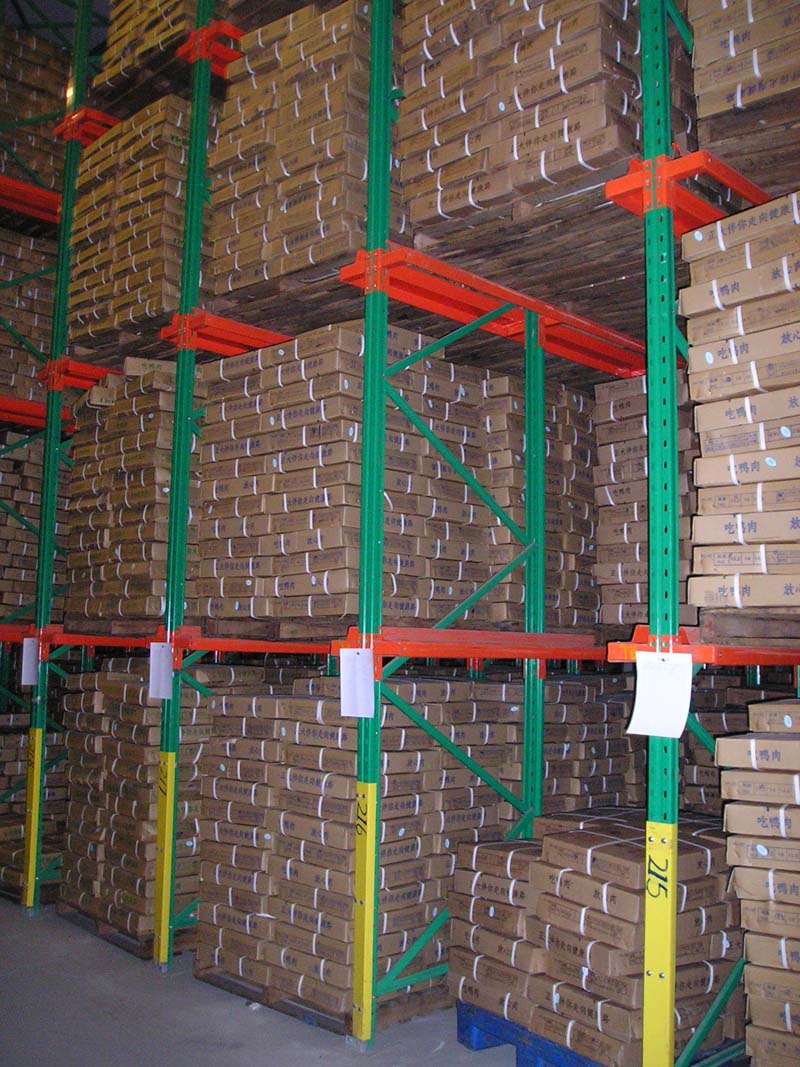
1. Core Architecture: How Drive In Pallet Racks Achieve 85% Space
Utilization
A standard selective pallet rack system uses about 40–45% of available cubic
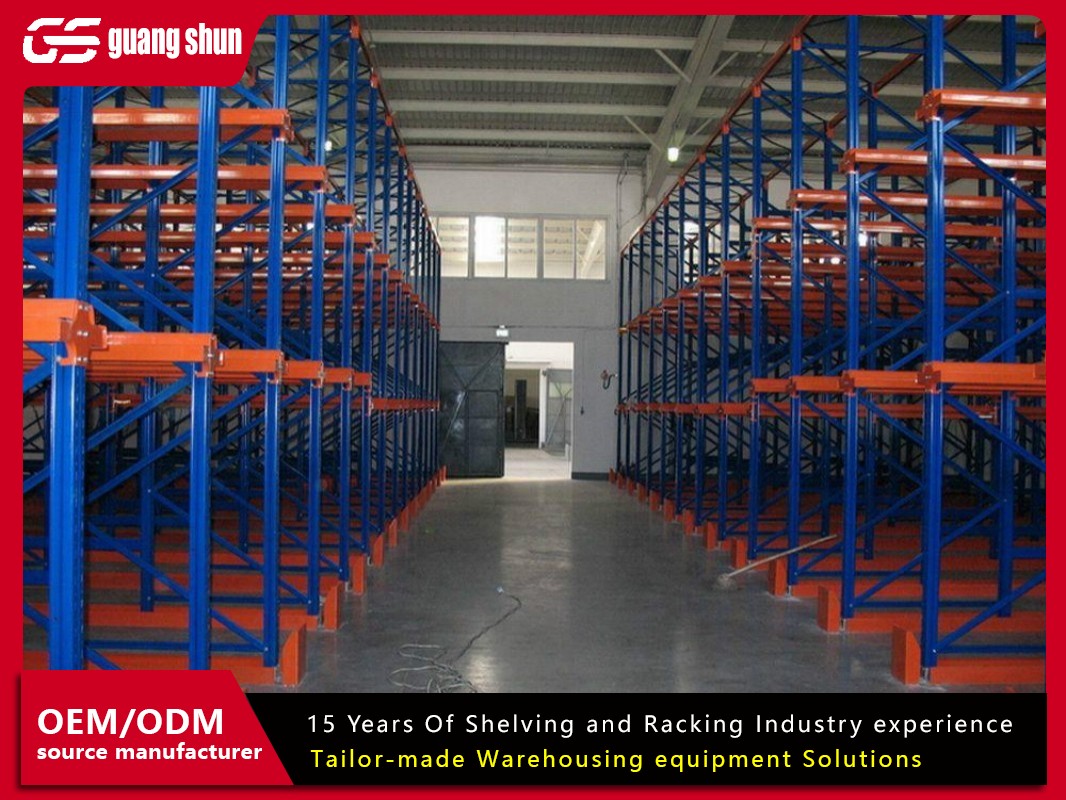
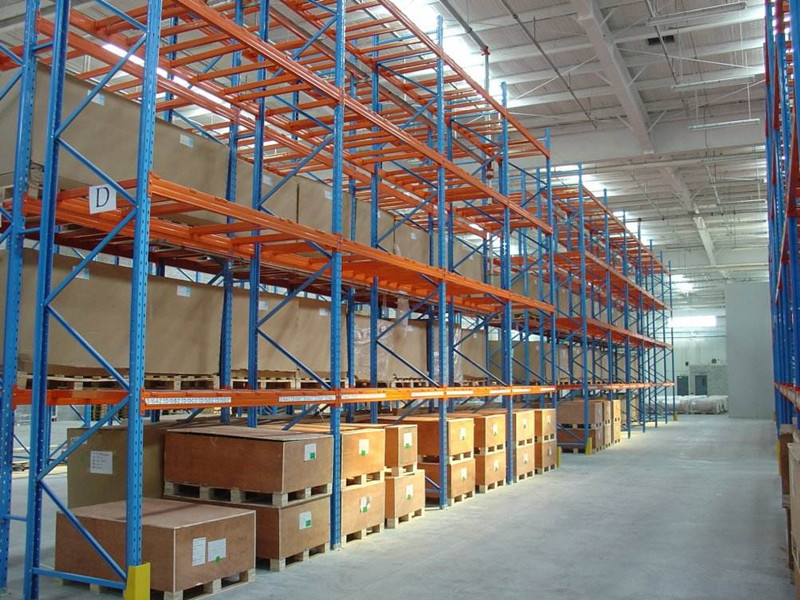
space due to wide aisles. Drive in pallet racks invert that
ratio: by eliminating aisles between rows, they achieve density figures of
75–85% depending on depth (number of pallets per lane). The system consists
of:
Upright frames (front and rear) with bracing designed for
horizontal forces from forklift entry.
Load beams and rail systems that support
pallets on continuous ledges.
Forklift guide rails at floor level to prevent column
damage.
Pallet stoppers and depth stop bars to
control over-insertion.
Each lane functions as a single deep channel. The forklift travels inside the
lane, placing pallets on the rails from the front opening toward the rear.
Retrieval follows LIFO: the last pallet loaded becomes the first unloaded. For
inventory with low rotation variance (e.g., frozen food, bulk chemicals), this
method minimizes wasted cube while reducing travel time per pallet.
2. Quantitative Comparison: Drive In vs. Drive Through vs. Selective
Racks
Selecting the right system requires analyzing throughput, SKU diversity, and
FIFO/LIFO requirements. The table below summarizes key metrics (based on a
standard 48” x 40” pallet, 10’ clear height):
Selective rack: 35-40% density; 100% selectivity; FIFO
natural; cost index 1.0.
Drive in (LIFO): 75-80% density; selectivity limited to
lane front; cost index 0.6-0.7.
Drive through (FIFO): 70-75% density; selectivity same as
drive in but two-sided access; cost index 0.8.
Pallet flow (carton flow): 50-60% density; high
selectivity; cost index 1.4-1.8.
For operations with fewer than 15 SKUs occupying 80% of volume, drive
in pallet racks deliver the lowest cost per stored pallet. A 2022
warehouse study by MHI (Material Handling Institute) showed that converting
5,000 m² of selective racking to drive-in systems freed 2,100 m² for additional
storage—a 42% footprint reduction without building expansion.
3. Five Critical Design Parameters for Safe, High-Cycle Drive In
Systems
Poorly engineered drive-in installations lead to bent uprights, rail fatigue,
and safety risks. Based on Guangshun’s 15-year track record
with cold storage and dry warehouses, these parameters require rigorous
calculation:
3.1 Lane Depth and Load Distribution
Maximum recommended depth is 6–8 pallet positions (approximately 30–40 feet).
Deeper lanes increase the weight on front rails, causing deflection. Each rail
must be rated for the cumulative load of all pallets in that lane, plus a safety
factor of 1.5 for dynamic entry forces. Use FEA (Finite Element Analysis) for
depths exceeding 7 pallets.
3.2 Forklift Guidance and Column Protection
Floor-mounted guide rails reduce lateral impacts by 80%. They must extend 2m
beyond the first upright. For high-traffic lanes, Guangshun integrates replaceable column protectors and laser-aligned rail tracks, verified
by annual alignment audits.
3.3 Upright Frame Capacity and Seismic Bracing
Because drive-in frames lack cross-aisle ties, seismic zones (IBC Category
C–F) require horizontal diagonal bracing or bolt-on stabilizers. Each upright
pair must handle 1.2x the static load plus seismic overturning moment per ASCE
7-22.
3.4 Rail Pitch and Pallet Compatibility
Rails must have a 3–5 mm downward slope toward the rear to ensure pallets
rest against stops without protruding. Check CHEP/GMA pallet stringer thickness:
rails should support at least two stringers per pallet. For plastic or
open-bottom pallets, use full-width rail decks.
3.5 Ventilation and Fire Safety
High-density storage requires in-rack sprinklers per NFPA 13. Clearance
between top of pallet and ceiling beams must be at least 6” for heat plume
development. Provide longitudinal flue spaces every 20 feet laterally and 10
feet depthwise.
4. Industry-Specific Applications and Performance Data
Drive in pallet racks excel where SKU count is low but
pallet volume is high. Three verified use cases:
Cold storage / frozen food: A Midwest US cold chain
operator installed 12-foot deep drive in pallet racks for ice
cream pallets. Result: 63% reduction in aisle space, fork truck travel distance
cut by 52%, and energy savings of USD 38,000/year due to smaller refrigerated
volume.
Beverage distribution (non-carbonated): A Pepsi bottler
uses 8-pallet deep drive-in lanes for water bottle pallets. Throughput: 450
pallets/hour with LIFO rotation matching production batch dates. Damage rate
dropped 27% after installing Guangshun guide rails and
reinforced footplates.
Automotive tier-1 supplier: Storing large, heavy engine
block containers (1,200 kg each). Standard selective racks required 4.5m aisles;
drive-in allowed 3m aisles with cantilever-style rails. Space saved: 1,800 m²,
eliminating a planned warehouse expansion.
5. Avoiding Common Failures: Structural Audits and Load Management
Industry data indicates 34% of drive-in rack incidents stem from overloading
the front rails (exceeding cumulative lane capacity). Another 22% involve
forklift strikes to uprights due to missing floor guides. A preventive
maintenance schedule must include:
Monthly: Inspect for rail deflection using laser level;
check column protectors for dents.
Quarterly: Verify anchor bolt torque on all baseplates
(65–80 ft-lbs typical).
Annually: Perform load capacity recertification if pallet
weights or SKU mix changed.
Real-time: Install load cells or limit switches on critical
lanes to alert operators when max lane load is exceeded.
Guangshun offers an IoT-enabled monitoring option for
high-value storage: strain gauges on front rails transmit load data to a cloud
dashboard, preventing cumulative overload—a feature adopted by three
pharmaceutical logistics centers in 2024.
6. Calculating ROI for Drive In Pallet Racks Conversion
Assume a warehouse with 10,000 pallet positions currently served by selective
racks occupying 40,000 sq.ft. Floor space cost (rent + utilities + labor) = USD
8.50/sq.ft/year = USD 340,000/year. Converting to drive in pallet
racks with 6-pallet depth reduces footprint to 26,000 sq.ft. (35%
reduction). New annual space cost = USD 221,000. Rack equipment cost
differential: selective racking at USD 250/position vs. drive-in at USD
175/position (lower due to fewer beams). Total installed cost for 10,000
positions:
Annual space saving: USD 119,000. Payback period on any additional
engineering (e.g., seismic bracing, guide rails) is under 9 months. Over 10
years, total benefit (space + lower initial capital) exceeds USD 1.9 million.
These figures assume LIFO compatibility; for FIFO operations, drive-through
racks yield slightly lower density but similar cost structure.
7. Integration with Warehouse Management Systems (WMS)
Modern drive in pallet racks benefit from WMS logic that
assigns lanes by SKU expiration date. For example, a lane may be designated for
“batch A” – all pallets must be cleared before “batch B” enters. The WMS
enforces lane purging via RF scanning, preventing intermingling. Advanced setups
use LED slot indicators on the rack face, reducing forklift search time by 40%
according to a Guangshun-sponsored study at a Spanish grocery
DC.
8. Sustainability and Material Efficiency
High-density storage directly reduces building energy consumption per pallet.
For refrigerated warehouses, every cubic meter saved lowers cooling load by ~0.3
kW·h/day. Additionally, modern drive-in rack manufacturing uses 60–80% recycled
steel. Guangshun applies a galvanized coating process (ISO
1461) that extends component life beyond 25 years in humid environments,
avoiding replacement cycles and reducing waste.
Frequently Asked Questions (FAQ)
Q1: Can drive in pallet racks be adapted for FIFO (First-In,
First-Out) inventory?
A1: Standard drive in pallet racks are
strictly LIFO. For FIFO, specify “drive-through” racks, which have openings at
both ends of the lane. However, drive-through requires double-sided aisle
access, reducing density by 5–10% compared to drive-in. Some hybrid systems use
push-back carriages within lanes, but cost rises significantly. Evaluate
inventory aging tolerance before selecting.
Q2: What is the maximum safe lane depth for drive in pallet
racks?
A2: Industry best practice limits depth to 8 pallet
positions (typically 40 ft / 12 m) for standard 1,200 kg loads. Beyond that,
rail deflection and extraction forces increase nonlinearly. For deep-lane
applications (e.g., 10+ positions), use reinforced heavy-duty rails and schedule
quarterly rail deflection audits. Some custom drive in pallet
racks from Guangshun have been
certified up to 10 pallets deep with high-tensile steel
profiles.
Q3: How does pallet quality affect drive in rack
performance?
A3: Critical. Damaged or sagging pallets can catch on rail
splices or create gaps that cause tip-offs. For drive in pallet
racks, require stringer dimensions within ±5 mm of spec. GMA-style
wooden pallets (40”x48”) perform well if block feet are intact. Avoid using
plastic pallets with 50% open decks unless rails are closely spaced (max 150 mm
gaps). Pre-inspect all pallets entering drive-in lanes.
Q4: What fire safety standards apply to drive in pallet
racks?
A4: NFPA 13 (US) and EN 12845 (Europe) mandate in-rack
sprinklers when storage height exceeds 12 ft and density surpasses 150 kg/m².
For drive in pallet racks, longitudinal flue spaces (every 20
ft) and transverse flues (every 10 ft) are required. Ceiling-only sprinklers are
insufficient for deep-lane configurations. Always consult a fire protection
engineer for hydraulic calculations.
Q5: How often should drive in pallet racks be load
tested?
A5: RMI (Rack Manufacturers Institute) recommends a formal
load test after any modification, impact incident, or every 5 years of normal
operation. However, high-throughput facilities (500+ cycles per lane per month)
should perform annual proof-load testing using calibrated weights.
Guangshun provides on-site load recertification services,
including ultrasonic thickness measurement of uprights and
rails.
Q6: Can existing selective racks be converted to drive in
configuration?
A6: Direct conversion is rarely feasible due to different
upright hole patterns and beam spacing. Selective rack frames lack the
continuous rail support and floor guides required. However, components can be
repurposed: beams and uprights may serve as backup stock. For a turnkey drive-in
system, contact Guangshun for a site survey
and custom fabrication.
Q7: What is the typical lead time for engineering and
installing drive in pallet racks?
A7: For a standard 5,000-pallet system, engineering (2–3
weeks), fabrication (6–8 weeks), and installation (3–4 weeks) total
approximately 12–15 weeks. Seismic designs or cold storage materials may add 2–3
weeks. Expedited services are available; Guangshun maintains stock rail profiles for common
sizes, reducing lead times by 30%.
About the authority: This guide draws from Guangshun engineering standards, peer-reviewed
warehousing journals (IJPDLM 2023), and field failure analyses across 280+
drive-in installations globally. For project-specific calculations or a quote on
drive in pallet racks tailored to your load profile and seismic zone, request a consultation through
the manufacturer’s portal.