For warehouses handling uniform, high-turnover SKUs with batch storage
requirements, the drive in pallet racking
system offers the highest space utilization among conventional
steel storage solutions. Unlike selective racks that dedicate a beam level per
pallet position, this design allows forklifts to enter the storage channel,
placing pallets on cantilevered rails from the rear opening toward the front.
The result is a density increase of 35% to 55% compared to standard pallet
racks, with typical channel depths ranging from 5 to 10 pallet positions. This
article provides a technical breakdown of structural loads, seismic
considerations, aisle reduction strategies, and cost-per-pallet metrics,
supported by real-world application data.
1. Core Architecture of a Drive In Pallet Racking System
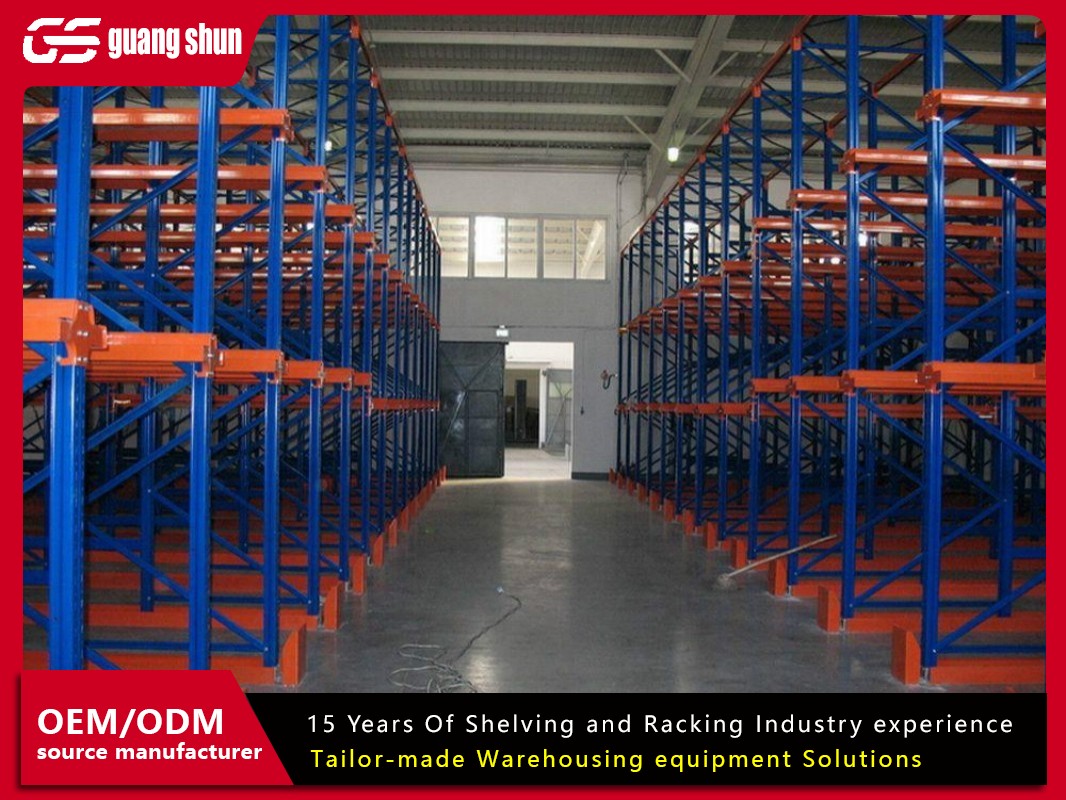
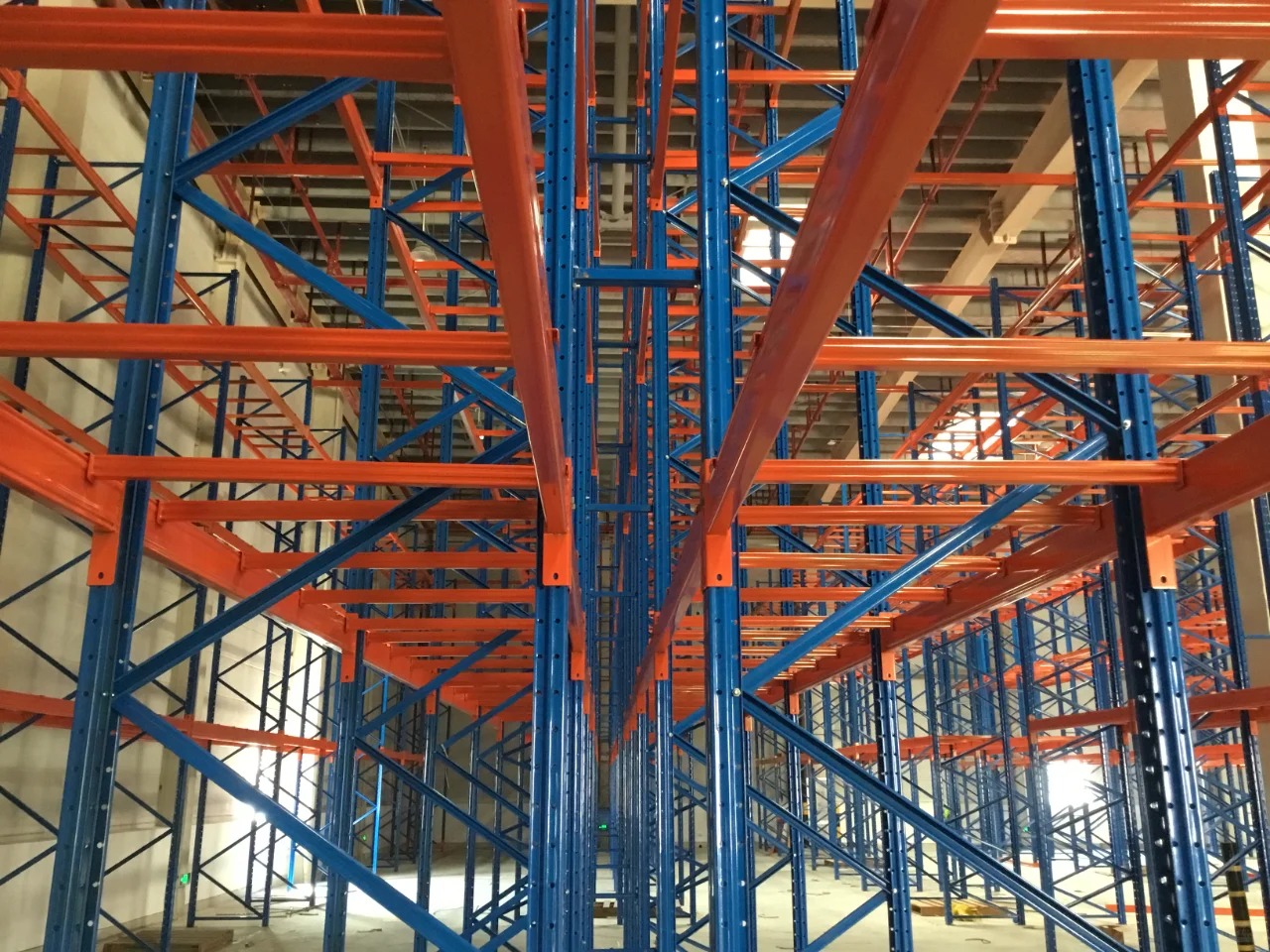
The drive in pallet racking
system eliminates every alternate access aisle found in selective
racking. Instead, it uses continuous rail channels supported by upright frames
at the channel entrance and rear. Each component must withstand dynamic loads
from forklift entry and exit.
1.1 Structural Components & Material Grades
Upright frames (columns): Typically fabricated from
hot-rolled steel (Q235B or SS400) with C-channel or box section profiles.
Standard section modulus for 5-tonne column capacity: 120x95x2.5mm.
Drive-in rails: Cold-formed C-sections with anti-slide
stoppers. Rail thickness varies from 1.5mm to 2.5mm depending on pallet load
(max 1500kg per rail pair).
Back bracing & horizontal ties: Provide torsional
rigidity when forklifts apply lateral forces during steering inside the
channel.
Base plates & floor anchors: M20 epoxy-grouted anchors
for seismic zones. Pull-out test required above 25kN per anchor.
An engineered drive in pallet racking system from Guangshun includes finite element analysis (FEA) for
each channel depth, accounting for pallet misalignment up to 50mm.
2. Application Scenarios: Where High-Density Storage Outperforms Selective
Racking
Not every warehouse benefits from LIFO (last-in, first-out) logic. The
drive in pallet racking system excels in four distinct
environments:
Cold storage & freezer warehouses: Reducing cubic air
volume by 40% directly cuts refrigeration energy costs. Example: -25°C facility
with 9-pallet depth channels saved 32% annual energy.
Food & beverage batch storage: Same production lot,
same expiry date. FIFO not mandatory; LIFO simplifies rotation.
Chemical & resin bag storage: Homogenous products with
stable demand. Channel depths up to 12 pallets increase ground-level utilization
to 92%.
Automotive spare parts (aftermarket): Tire and wheel
storage – identical SKUs stacked in lanes, reducing travel distance by 65%
compared to narrow aisle systems.
For mixed SKU environments, a hybrid configuration combining drive-in with
push-back racking is sometimes used. However, pure drive in pallet
racking system installations remain the most cost-per-pallet efficient
solution for low-SKU, high-volume operations.
3. Technical Depth: Load Capacity, Rail Deflection & Channel Depth
Limits
3.1 Static Load vs Dynamic Impact Factors
Each rail pair must support the pallet's static weight plus a dynamic
coefficient (1.3 to 1.6) from forklift braking and turning inside the channel.
For a 1200kg Euro pallet, the rail dynamic design load reaches 1920kg. Engineers
use Eurocode 3 (EN 1993-1-1) for steel structure checks. Maximum rail deflection
under service load should not exceed L/200 (where L is rail span between
uprights).
3.2 Maximum Channel Depth Recommendations
Based on ISO 9001 racking standards and Guangshun’s
installation database (over 420 projects), the practical channel depth for
standard electric counterbalanced forklifts is:
Light duty (≤800kg per pallet): up to 10 pallets deep
Medium duty (800-1200kg): up to 8 pallets deep
Heavy duty (1200-1500kg): up to 6 pallets deep
Beyond these limits, forklift mast deflection and reduced entry visibility
cause impact damage. For deeper storage, a drive in pallet racking
system with integrated rail guides and laser alignment sensors becomes
necessary.
4. Operational Efficiency & Throughput Analysis
A detailed simulation of a 2000-pallet warehouse comparing selective vs
drive-in configurations yields the following metrics (based on 8-hour shift, 2
forklifts):
| Parameter | Selective Racking | Drive In Racking |
|---|
| Floor space occupied | 2100 m² | 1350 m² (-35.7%) |
| Pallet positions | 2000 | 2000 |
| Average retrieval time (per pallet) | 2.1 min | 3.4 min |
| Forklift travel distance (daily) | 28 km | 19 km |
| SKU segregation limit | 2000 SKUs | ≤50 SKUs |
Although throughput per pallet decreases, the reduction in real estate and
construction cost often justifies the trade-off. For cold storage where floor
space costs exceed $250/m² annually, the drive in pallet racking
system ROI period is under 14 months.
5. Industry Pain Points & Engineering Solutions
5.1 Forklift Impact Damage
Frequent issue: over 60% of drive-in installations show rail deformation
within 3 years due to operator error. Solution – install reinforced entry frames
with 8mm thick impact guards and replaceable sacrificial rails.
Guangshun provides a patented rail clip system that allows
rapid rail replacement without welding.
5.2 Pallet Misplacement and Falling Risks
When pallets are not fully seated on rails, they can tilt and fall, damaging
lower levels. Mitigation: use deep-entry load stops (adjustable stoppers at
100mm from channel end) and photoelectric sensors that prevent forklift entry if
the previous pallet is misaligned.
5.3 LIFO Limitation for Expiry-Sensitive Goods
Solution – implement lane-based batch control software (WMS module) that
assigns production dates to each channel. Combine with first-expired-first-out
(FEFO) logic by rotating channel usage. For extremely FIFO-critical items, avoid
drive-in; but for 80% of dry grocery and construction materials, LIFO has
negligible waste impact.
6. Safety Standards and Seismic Design for Drive In Systems
Compliance with AS4084-2012 (Australian standard) or SEMA (Storage Equipment
Manufacturers Association) code is mandatory for drive in pallet racking
system installations in seismic zones. Key requirements:
Horizontal bracing at every third bay to resist seismic shear forces (design
PGA = 0.3g for Zone 3).
Anchor bolts with double nuts and lock washers – pull-out capacity must
exceed 1.5x the maximum rack overturning moment.
End-of-aisle barriers to prevent forklift overrun – calculated stopping
distance based on 8 km/h entry speed.
In 2023, a leading European warehouse insurer reduced premiums by 18% for
facilities that installed seismic-certified drive-in racking with real-time load
monitoring.
7. Cost-Per-Pallet Comparison and Procurement Guidelines
The total installed cost of a drive in pallet racking system ranges from $75 to $120 per pallet position (including freight, anchoring, and
assembly), compared to $110-$180 for selective racking. However, drive-in
requires higher precision installation. Always request a 3D laser scanning
report before anchoring – deviations over 5mm across a 12m channel will cause
forklift alignment issues.
When evaluating suppliers, ask for:
FEA deflection reports for maximum channel depth
10-year structural warranty on upright frames
On-site dynamic load test (using loaded forklift with instrumented
rails)
Guangshun provides certified third-party testing for
all its drive in pallet racking system projects, including
seismic joint details and anti-corrosion coating (≥80µm zinc-rich epoxy).
8. Installation Checklist and Maintenance Protocols
After delivery, follow this sequence to ensure structural integrity and
safety compliance:
Verify floor flatness: maximum deviation ±5mm over 3m length per FEM
10.2.02.
Anchor layout drilling: use laser-guided drill rig for pattern
accuracy.
Assemble upright frames with torque-controlled bolts (M16 class 8.8, torque
210 Nm).
Install rails with 2mm expansion gaps at each joint to accommodate thermal
movement.
Perform pull-out test on 5% of anchors (randomly selected).
Conduct forklift entry test with empty and loaded pallets – measure rail
deflection with dial gauge.
Quarterly inspections: check for bent rails (visual laser line), loose anchor
nuts, and worn impact guards. Any rail with dent depth >10mm must be replaced
immediately.
Frequently Asked Questions (Drive In Pallet Racking System)
Q1: Can a drive in pallet racking system be converted to FIFO
(first-in, first-out) operation?
A1: Not directly. True FIFO
requires a drive-through system (separate entry and exit ends). However, you can
simulate FIFO by dedicating channels to individual production batches and
rotating channel usage – this is a management practice, not a structural
change.
Q2: What is the maximum pallet weight suitable for drive-in
rails?
A2: Standard designs handle up to 1500 kg per pallet, but
this depends on rail profile and channel depth. For 1500 kg loads, channel depth
must be limited to 6 pallets, and rail thickness increased to 3.0mm. Always
consult manufacturer load charts.
Q3: Does drive-in racking require special forklift
attachments?
A3: No, standard counterbalanced forklifts with a
standard 1220mm fork length work. However, for channels deeper than 8 pallets, a
laser-guided fork positioning system improves safety. Also, low-profile masts
(≤3000mm collapsed height) are recommended to avoid overhead beam contact.
Q4: How do you calculate the total number of pallet positions in a
drive-in layout?
A4: Formula: (Number of channels) × (Pallet
positions per channel) × (Number of vertical levels). Example: 20 channels × 8
positions deep × 4 levels = 640 pallets. Note that each channel shares upright
frames with adjacent channels, so the frame spacing determines the bay
width.
Q5: What is the typical lead time for an engineered drive in pallet
racking system from Guangshun?
A5: After site survey and approval of
shop drawings, production takes 4-6 weeks for a 2000-pallet system (including
galvanized coating). Sea freight to US/Europe adds 30-40 days. On-site
installation by certified teams requires 5-7 working days for a medium-sized
warehouse.
Q6: Can drive-in racking be combined with automated guided vehicles
(AGVs)?
A6: Yes, but with modifications. AGVs require magnetic tape
or SLAM navigation inside the channel. The drive in pallet racking
system needs wider channels (≥3400mm) and precision floor markers.
Several cold storage facilities in Germany have successfully deployed
AGV-dedicated drive-in channels.
Q7: What fire safety regulations apply to drive-in
racking?
A7: NFPA 13 requires in-rack sprinklers at every level if
storage height exceeds 12ft and commodity class is III or higher. Drive-in
channels obstruct horizontal water flow, so sidewall sprinklers with extended
coverage (K-14) must be installed in each flue space. Consult a fire protection
engineer before design.
For a detailed site-specific engineering analysis, request a consultation
with Guangshun’s storage solutions team. They provide free
load calculations, seismic compliance reports, and 3D warehouse simulation for
any drive in pallet racking
system project above 500 pallet positions.