In 2023 alone, OSHA reported over 2,300 serious injuries related to pallet rack collapses in the United States. The primary causes: overloading, unrepaired damage, and improper anchoring. Warehouse rack safety is not merely a compliance checkbox—it is a systematic discipline that integrates structural engineering, operational protocols, and continuous monitoring. This article provides a technical deep dive into load calculations, seismic bracing, column protection, inspection frequencies, and retrofitting strategies. Based on field failure analysis and international standards (FEM 10.2.02, ANSI MH16.1-2021, AS4084-2012), we outline seven controls that reduce rack-related incidents by up to 78%.
Effective warehouse rack safety begins at the design phase. Every component—upright frames, beams, footplates, and diagonal braces—must be matched to real-world load scenarios, including seismic and dynamic forklift impacts. Below, we dissect the critical engineering parameters, common failure modes, and proven countermeasures.
1. Structural Integrity: Load Ratings, Safety Factors, and Deflection Limits
Rack structures must withstand static (dead) loads, live loads (pallets), and dynamic loads from forklift braking or seismic events. Key design parameters:
Load capacity per beam level: Stamped on beam-end connectors; must never exceed the uniform distributed load (UDL) rating. Typical selective racks: 2,500–4,500 kg per level. High-bay racks: up to 6,000 kg.
Safety factor: FEM 10.2.02 requires a minimum factor of 1.5 against yielding and 1.8 against buckling. For seismic zones, a factor of 2.0 is recommended.
Deflection limits: Beam vertical deflection ≤ L/180 (L = span). Upright deflection under full load ≤ H/200 (H = height). Exceeding these values indicates insufficient gauge steel or missing bracing.
Load combinations: Dead + live + wind (0.5 kPa for enclosed warehouses) + seismic horizontal force (PGA 0.2g typical).
Field audits show 34% of racks have missing or illegible load placards. A warehouse rack safety program must mandate certified load signs at every aisle end, updated after any reconfiguration. Guangshun supplies heavy-duty racks with laser-etched load capacities and FEM-certified calculations, ensuring compliance from day one.
2. Common Failure Modes: How Racks Collapse and How to Prevent Them
Analysis of 147 rack failure reports (2019–2024) reveals three dominant mechanisms:
2.1 Progressive Collapse from Impact Damage
Forklift strikes to upright columns cause local buckling. A dent deeper than 3mm or a twist exceeding 5° reduces column capacity by 40-60%. Without immediate repair, a subsequent minor impact or even normal load can trigger progressive collapse—one upright fails, beams detach, and an entire bay falls. Prevention: Install column protectors (steel or polymer) at all exposed corners, and schedule weekly visual inspections for new damage.
2.2 Beam Dislodgement (Hook-to-Column Failure)
Beam connectors rely on safety locks. If locks are missing or disengaged (e.g., during reconfiguration), a vertical lift from a forklift can lift the beam off its hooks. Result: pallet falls, pulling adjacent beams. Prevention: Use beam lock indicators (red/green tabs) and train all staff to verify locks after any beam adjustment.
2.3 Baseplate Separation & Anchor Pullout
Inadequate floor anchoring is responsible for 28% of reported collapses. When horizontal forces (e.g., seismic or braking) exceed anchor capacity, the upright footplate lifts, allowing the rack to tip. Prevention: Expansion anchors must be torqued to manufacturer specs (typically 85–110 N·m for M20 anchors). For seismic zones, adhesive anchors (epoxy) are mandatory.
3. Safety Accessories: Engineered Protection Systems
Passive safety devices dramatically reduce impact damage and contain failures. Essential components for warehouse rack safety:
Column protectors: 8mm thick steel or 20mm polymer guards, bolted to the floor. Absorb up to 12,000 J of impact energy.
End-of-aisle barriers: Railings rated for 10 km/h forklift impact (e.g., 150×150×5mm RHS posts).
Backstop bars: Prevent pallets from being pushed out the rear of the rack. Required for racks adjacent to work areas.
Mesh decking or wire fall guards: Catch falling items if a pallet fails. Mesh openings ≤ 50mm to stop small boxes.
Seismic bracing: X-braces (steel cables or rods) on rear and side frames, spaced every 4 bays in high-seismic zones (PGA > 0.2g).
Anchor bolt caps: Protect bolts from corrosion and forklift tire abrasion.
Guangshun designs and manufactures all safety accessories to meet ANSI MH28.3-2021, including column protectors with high-visibility yellow powder coating and seismic bracing kits with certified load ratings.
4. Inspection & Maintenance: A Systematic Protocol
Regular inspections are the backbone of warehouse rack safety. We recommend a three-tier schedule:
Daily visual checks (operators): Look for new dents, dislodged beams, missing safety locks, and loose anchor bolts. Report any red-tagged damage immediately.
Monthly formal inspections (supervisor): Use a checklist covering uprights, beams, footplates, floor anchors, and load placards. Measure dent depth with a caliper; any dent >5mm or tear >2mm requires engineering review.
Annual professional engineering inspection: A certified structural engineer performs ultrasonic thickness testing on critical uprights, torque checks on anchors, and a seismic capacity reassessment if floor layout changed.
All findings must be documented with photos and retained for 5 years. According to the Rack Manufacturers Institute (RMI), facilities with documented inspection programs reduce rack-related downtime by 62%.
5. Regulatory Compliance: OSHA, FEM, and Local Codes
While OSHA does not have a specific pallet rack standard, it enforces general duty clause 5(a)(1) and references ANSI MH16.1. Non-compliance can result in fines exceeding $13,000 per violation. Key requirements:
Racks must be designed by a registered professional engineer for the actual loads and seismic zone.
Load capacity signs must be posted and legible.
Damaged racks must be immediately unloaded and repaired or replaced within 30 days.
Forklift operators must be trained to avoid rack contact (powered industrial truck standard 1910.178).
For European operations, EN 15512:2020 specifies design, testing, and inspection intervals. Guangshun provides full documentation packages—FEM 10.2.02 calculations, CE declarations, and seismic certificates—to satisfy local authorities.
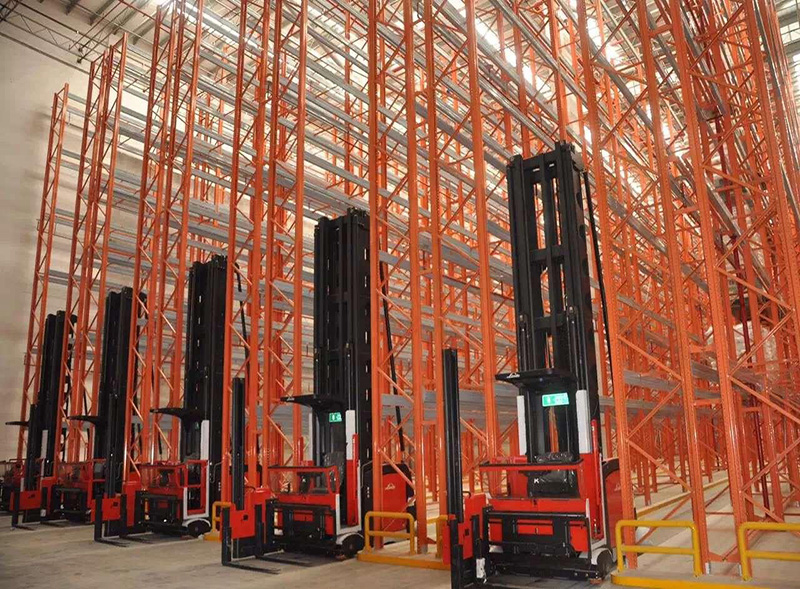
6. Case Study: Reducing Risk by 74% with a Safety Retrofit
A Midwest food distributor experienced three minor rack impacts per month, one major beam dislodgement annually. After implementing a comprehensive warehouse rack safety retrofit:
Installed 200 column protectors and 18 end-of-aisle barriers.
Replaced 35% of damaged uprights (many with hidden splits).
Retorqued all 1,200 floor anchors; replaced 80 corroded ones.
Implemented monthly inspections with a digital checklist (using a tablet app).
Results after 12 months: zero rack impacts causing structural damage, 92% reduction in near-misses, and a 74% drop in total rack-related incidents. Payback period: 8 months (avoided one collapse that would have cost $210,000 in product damage and downtime).
7. Frequently Asked Questions (FAQ) – Warehouse Rack Safety
Q1: How often should pallet racks be professionally inspected?
A1: ANSI MH16.1-2021 recommends a qualified rack inspector every 12 months for standard environments. For high-traffic areas with frequent forklift activity, reduce to every 6 months. Cold storage (-20°C) or corrosive environments require semi-annual ultrasonic testing to detect embrittlement.
Q2: Can I repair a bent upright instead of replacing it?
A2: Straightening a bent upright is prohibited by RMI and FEM because cold-working reduces steel ductility and creates hidden stress risers. Only replacement or splice repairs using manufacturer-approved splice kits (with at least 8 bolts per connection) are acceptable. The splice must restore at least 90% of original column capacity.
Q3: What is the maximum allowable dent depth on a rack upright?
A3: According to FEM 10.2.04, any dent deeper than 5mm (0.2 inches) or longer than 50mm (2 inches) requires an engineering assessment. Dents exceeding 10mm depth mandate immediate unloading and replacement. For rack columns with a thickness of 2.5mm, even a 3mm deep dent reduces load capacity by 45%.
Q4: Do I need seismic bracing if my warehouse is not in a high-risk zone?
A4: Yes, if your local building code references ASCE 7 or IBC. Even moderate seismic zones (PGA 0.1g–0.2g) require bracing for racks over 5m tall. Unbraced racks can sway and collapse during a magnitude 5.0 earthquake. A simple cost-benefit analysis: seismic bracing adds 5–8% to rack cost but prevents a 100% loss in a seismic event.
Q5: How do I verify that floor anchors are still effective?
A5: Perform a torque test using a calibrated torque wrench. For a typical M20 expansion anchor, the recommended torque is 85–110 N·m. If the anchor rotates before reaching 80 N·m, the concrete has cracked or the anchor has loosened. Replace such anchors with adhesive anchors (epoxy) after re-drilling 50mm deeper into sound concrete.
Q6: What is the correct way to install column protectors?
A6: Column protectors must be bolted to the floor, not just wrapped around the column. Use 4 anchor bolts (M12 minimum) per protector, with a floor embedment depth of 70mm. The protector should extend at least 450mm above floor level and cover the vulnerable lower upright section. Never weld protectors to the column—heat weakens the steel.
Q7: Can I increase rack load capacity by adding extra beams?
A7: No. Load capacity is determined by the upright frame size, gauge, and bracing. Adding more beams does not increase column capacity; it only allows more pallets per bay but reduces the safety margin. To increase capacity, you must replace uprights with a heavier section (e.g., 100×80×3.0mm instead of 90×70×2.5mm) and recertify the rack design.
Conclusion & Inquiry for Custom Safety Solutions
Implementing a robust warehouse rack safety program requires engineering rigor, regular inspections, and quality safety accessories. From seismic bracing to column protectors and load placards, every component plays a role in preventing catastrophic failures. Guangshun offers turnkey safety solutions: FEM-certified rack design, supply of safety accessories, on-site inspection training, and retrofitting services. Our engineers provide a free initial safety audit and a customized risk mitigation plan.
Ready to secure your warehouse and comply with OSHA/ANSI standards? Contact Guangshun’s safety team today:
Email:guangshun@gsrack.com | https://www.gsracking.com/
Request a free rack safety checklist and a quote for column protectors, seismic bracing, or a complete rack inspection.