When warehouse operators move beyond conventional pallet racks, the logical
progression leads to automated racking systems.
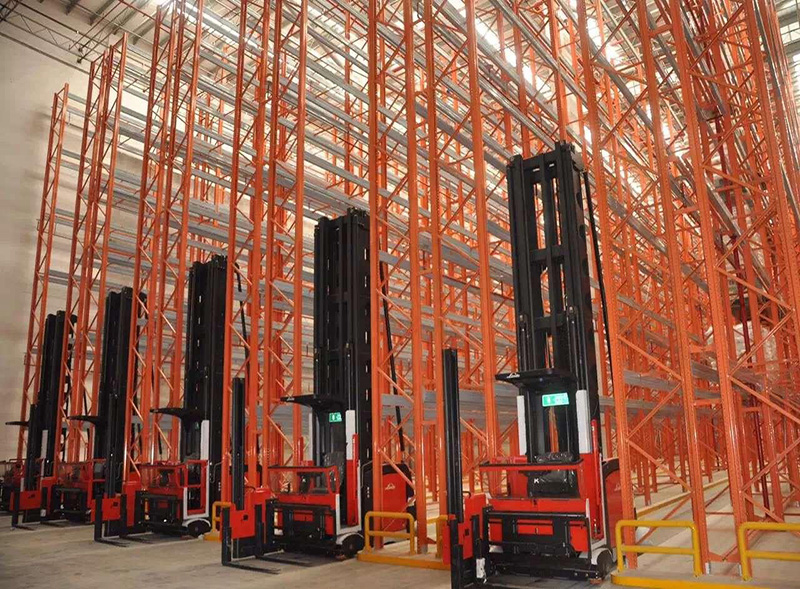
These structures combine high-density steel frameworks with motorized handling
equipment – stacker cranes, shuttle carts, or robotic shuttles – all
orchestrated by a warehouse control system (WCS). Unlike static racks, an
automated racking system is a mechatronic asset where
structural tolerances directly impact machine cycle times and uptime. Based on
over 150,000 m² of deployed AS/RS projects, Guangshun has compiled key performance
differentiators: aisle widths shrink from 3.2 m (forklift) to 1.2 m (stacker
crane), floor flatness requirements tighten to FF 50/FL 35, and structural
deflection limits drop from L/180 to L/240. Below we dissect the engineering
choices, operational models, and financial thresholds that justify
automated racking systems.
1. Core Components of Automated Racking Systems: Stacker Cranes vs.
Shuttle-Based Designs
Every automated racking system is built upon a steel
structure, but the material handling mechanism defines its throughput profile.
Two dominant configurations exist:
Mini-load ASRS (stacker crane): A single mast crane travels
horizontally down an aisle while a vertically moving platform retrieves totes or
cartons. Typical speed: 240 m/min horizontal, 60 m/min vertical. Best for
high-SKU, low-weight (≤500 kg) environments.
Pallet shuttle system: Battery-powered shuttles ride on
dedicated rails inside each rack channel, transferring pallets to/from an end
lift. Shuttles achieve 0.8–1.2 m/s, allowing depths up to 40 pallets. Ideal for
homogeneous, high-volume flows.
Unit-load ASRS (crane + pallet): Heavy-duty stacker cranes
handle pallet loads up to 2,000 kg, with heights exceeding 30 m. automated racking systems of this class require seismic-rated columns and precision-ground rail alignment
(deviation ≤1 mm over 10 m).
Selection criteria revolve around SKU velocity and storage depth. For a
10,000-pallet facility with 800 picks/day, a mini-load ASRS provides 200
cycles/hour. However, if the same facility stores 40% reserve stock (low turns),
a shuttle-based automated racking system reduces capital cost
by 30% because fewer motors and controllers are needed. Guangshun engineers perform cycle time simulations
using discrete event modeling – a mandatory step before structural design.
2. Structural Tolerances for Automated Racking Systems: Beyond RMI/FEM
Standards
Traditional selective racks follow RMI MH16.3 or FEM 10.2.02 with deflection
limits of L/180 for beams. Automated racking systems demand
stricter criteria because crane rails and shuttle guides are attached directly
to the structure. Key parameters:
Column verticality: ≤0.5° (vs. 1° for manual racks).
Rail beam deflection under live load: L/400 or 5 mm
maximum, whichever is smaller.
Floor flatness: FF 50 / FL 35 (ACI 302.1R) for unit-load
ASRS; shuttle systems require FF 35 / FL 30 but with additional local leveling
plates.
Dynamic amplification factor: 1.5 for crane
acceleration/deceleration forces applied to the rack frame.
In 2023, Guangshun implemented a 22 m high unit-load ASRS
for a pharmaceutical distributor. Post-installation laser scanning revealed
maximum column tilt of 0.2° – well within tolerance. The key was using
pre-cambered uprights and torque-controlled base plates with epoxy grout. Any
deviation beyond 0.5° causes crane rail misalignment, leading to wheel wear 6x
faster and eventual rail buckling.
3. Throughput Engineering: Calculating Required Cycle Times for Automated
Racking
The business case for automated racking systems rests on
dual command cycles (DCC) – a single crane performs both a store and a retrieve
in one trip. Theoretical DCC time = 2 × (travel time to the farthest location) +
pickup/deposit time. For a 150 m long aisle with a crane traveling at 2.5 m/s,
single command cycle (SCC) time averages 120 seconds. DCC can achieve 150–180
seconds, boosting throughput by 40–50%.
Real-world factors reduce ideal numbers:
Transaction interleaving: Only possible with WCS sequencing.
Load profiling: Mixed pallet weights affect acceleration (de-rate by 10% for
>80% of max load).
Blockage delays: If a shuttle fails, the entire aisle stalls – hence
redundant shuttles are recommended for channels >20 deep.
For a distribution center requiring 120 pallet retrievals per hour, a single
crane with 80-second SCC would need 3 cranes. But by optimizing rack layout –
placing fast-moving SKUs in the middle of the aisle (minimum travel distance) –
a two-crane automated racking system can achieve 150
picks/hour. Guangshun provides ABC
analysis integration with their layout software, automatically positioning
high-velocity SKUs near the I/O point.
4. Application-Specific Engineering: Cold Storage, Cleanrooms, and Explosive
Atmospheres
Automated racking systems excel in environments where human
access is limited. Three demanding use cases illustrate engineering
adaptations:
Cold storage (≤ -25°C): Steel becomes brittle; use S355J2+N
grade with Charpy V-notch 27J at -30°C. Crane motors require heated windings and
low-temperature lubricants (Mobil SHC 600 series). Guangshun installed a 12-aisle automated system for a frozen food company, achieving 98.5%
uptime at -28°C over 18 months.
Cleanrooms (ISO 7-8): Rack surfaces must be electropolished
stainless steel or epoxy-coated to prevent particle generation. Sealed shuttle
batteries (LiFePO4) eliminate outgassing. Aisle widths shrink to 1.0 m to reduce
air turbulence.
Explosive atmospheres (ATEX Zone 2/22): All electrical
components (motors, sensors, control cabinets) require ATEX certification.
Mechanical spark prevention via brass-coated guide rollers and grounding straps
on every rack bay.
In each scenario, the structural design must incorporate sacrificial anodes
(for cold storage condensation) or non-sparking rail materials (copper-beryllium
alloys). Standard powder coating is replaced by zinc-nickel plating with 15 μm
thickness.
5. Economic Analysis: ROI of Automated Racking Systems vs. Traditional + VNA
Forklifts
Comparing automated racking systems to very narrow aisle
(VNA) turret trucks over a 10-year horizon reveals three cost drivers: labor,
space, and maintenance. Base assumptions: 20,000 pallet positions, 2 shifts/day,
250 days/year.
| Metric | VNA Turret Trucks (Manual) | Unit-Load ASRS (Automated) | Shuttle System (Semi-Automated) |
|---|
| Initial CAPEX (USD) | $2.8M (racks + 6 trucks) | $6.5M (racks + 4 cranes) | $4.2M (racks + 20 shuttles + lifts) |
| Annual labor (operators + maintenance) | $420,000 (8 operators) | $85,000 (2 technicians) | $160,000 (3 technicians + 1 supervisor) |
| Annual energy cost | $36,000 (battery charging) | $58,000 (cranes + conveyors) | $41,000 (shuttle batteries + lifts) |
| Floor space saved (m²) | 0% baseline | 42% (aisles 1.2m vs 1.8m) | 28% (aisles 1.5m but depth 30+) |
| 10-year total cost of ownership | $8.5M | $7.9M | $7.1M |
The shuttle system yields lowest TCO due to moderate automation without
expensive cranes. However, for facilities with land costs exceeding $300/m², the
space savings from a full ASRS (42% less area) often tilt the decision.
Guangshun offers a free ROI calculator that
incorporates local real estate prices, labor rates, and throughput
requirements.
6. Integration with WMS/WCS: Protocols, Redundancy, and Data Integrity
An automated racking system without robust software is just
inert steel. The control architecture typically layers:
WMS (Warehouse Management System): Manages inventory,
orders, and SKU allocation. Sends tasks to WCS via API (REST or MQTT).
WCS (Warehouse Control System): Real-time traffic
management, crane/shuttle dispatching, collision avoidance.
PLC layer: Direct motor controls, safety circuits (light
curtains, emergency stops).
Common integration pitfalls include:
Latency >200 ms between WMS and WCS causing missed interleaving
opportunities. Solution: Edge server collocated with WCS.
Single point of failure: Without a redundant WCS server, a crash stops all
movements. Recommended: hot-standby with <30 second failover.
Barcode/QR misreads: Use 2D cameras with error correction (Reed-Solomon)
rather than laser scanners.
In a recent automated racking system deployment for an
e-grocery DC, Guangshun integrated a WCS
that reduced crane idle time by 37% through dynamic task reassignment when one
crane experienced a slowdown.
7. Maintenance Protocols for Automated Racking Systems: Predictive vs.
Preventive
Maintenance costs for automated racking systems typically
run 3–5% of initial CAPEX annually. However, reactive maintenance can spike to
12% if rail alignment drifts. Recommended protocols:
Monthly: Check rail straightness with laser tracker; adjust
shims if deviation >0.5 mm per 10 m.
Quarterly: Torque verification on column anchor bolts (380
N·m for M20 grade 10.9). Inspect shuttle wheel wear – replace when tread depth
<2 mm.
Semi-annual: Lubricate crane mast rails with low-odor
grease (for food-grade warehouses). Verify emergency stop response time (<0.5
seconds).
Annual: Third-party structural audit per FEM 10.2.08 –
includes load testing at 125% of rated capacity.
Predictive maintenance using vibration sensors on crane motors (FFT analysis)
can detect bearing failures 3 months in advance. Guangshun provides an IoT condition monitoring package for all ASRS installations, with
cloud-based alerts when vibration exceeds 4.5 mm/s RMS.
Frequently Asked Questions (FAQs)
Q1: What is the minimum
throughput to justify automated racking systems over selective
racks?
A1: Based on cost models, a facility needs
at least 200 pallet transactions per hour or 50,000 annual picks to break even
on a mini-load ASRS. Below that, VNA turret trucks are more economical. However,
if land constraints force vertical expansion beyond 15 m, automation becomes
necessary regardless of throughput because forklifts cannot reach that height
safely.
Q2: Can automated racking systems handle multiple SKUs
per lane?
A2: Yes, but only if using mixed-case
shuttle systems (e.g., AutoStore or OPEX). Traditional pallet-based
automated racking systems assign one SKU per lane due to LIFO
constraints. For multi-SKU lanes, you need a shuttle that can rearrange totes –
which increases cost by 40–60%. A practical hybrid: reserve lanes for bulk
single SKUs, and use a separate mini-load zone for fast-moving mixed
items.
Q3: How does seismic activity affect the design of
automated racking systems?
A3: In seismic zones
(PGA >0.2g), the rack structure must incorporate base isolators or
energy-dissipating braces. Additionally, shuttle rails require flexible
couplings that allow ±10 mm movement without derailing. Guangshun designs to ASCE 7-16 requirements, with
shake table testing for systems above 12 m. Post-earthquake, automated systems
must undergo a full rail alignment survey before restarting.
Q4:
What is the typical lifespan of an automated racking system, and can it be
refurbished?
A4: Structural steel: 25–30 years with
proper coating. Mechanical components (cranes, shuttles): 10–15 years. At
mid-life (year 12), a refurbishment costing 20% of original CAPEX can replace
motors, controllers, and rails, extending service to 20+ years. Many operators
choose to replace only the WCS software at year 8 to gain modern optimization
algorithms.
Q5: How do automated racking systems perform in cold
storage freezers (-30°C)?
A5: Specialized
components are mandatory: low-temperature steel (S355J2+N), heated crane rail
covers to prevent ice buildup, and sealed lead-acid batteries (Li-ion cannot
charge below -20°C). Cycle times increase by 15–20% due to lubricant viscosity.
Guangshun has delivered 18
freezer-compatible ASRS systems, with documented uptime >97% at
-28°C.
Q6: What fire protection standards apply to automated
racking systems?
A6: NFPA 13 requires in-rack
sprinklers for racks over 8 m high. However, automated systems often have
reduced access for manual firefighting. Therefore, early suppression fast
response (ESFR) sprinklers at every level are recommended, with water flow
monitored by the WCS – triggering automatic crane movement to a safe zone. Some
insurers demand a 30-minute fire rating for structural columns (achieved with
intumescent coating).
Q7: How long does it take to design,
manufacture, and install a custom automated racking
system?
A7: Typical timeline: engineering (8–12
weeks), fabrication (12–16 weeks for steel, plus 6 weeks for motors/controls),
site installation (8–10 weeks), and software integration (4–6 weeks). Total:
9–12 months. Expedited projects (using modular components) can be delivered in 6
months but with limited customization. Guangshun maintains a
stock of standard uprights and rails for shuttle systems, reducing lead time to
14 weeks for systems under 5,000 pallet positions.
Implementing automated racking systems is a capital-intensive but operationally transformative decision. Success hinges
on matching the mechanism (crane vs. shuttle) to throughput profiles,
maintaining sub-millimeter structural tolerances, and integrating a resilient
WCS. With over 15 years of AS/RS engineering, Guangshun provides end-to-end services from floor
flatness analysis to post-installation performance contracting. Request a
feasibility study and cycle time simulation through their engineering
portal.