For warehouse operations handling large volumes of homogeneous,
time-sensitive products, maximizing storage density while maintaining rotational
integrity is a critical challenge. Standard selective racking, with its
dedicated aisles for each row, often falls short when the priority is bulk
storage rather than immediate access to every SKU. Drive through
racking systems offer a specialized solution, engineered to transform
storage economics for industries ranging from cold chain logistics to food and
beverage distribution. This analysis provides a deep technical dive into the
design principles, operational dynamics, and financial justification of these
high-density systems.
1. The Core Engineering: How Drive Through Racking Achieves High
Density
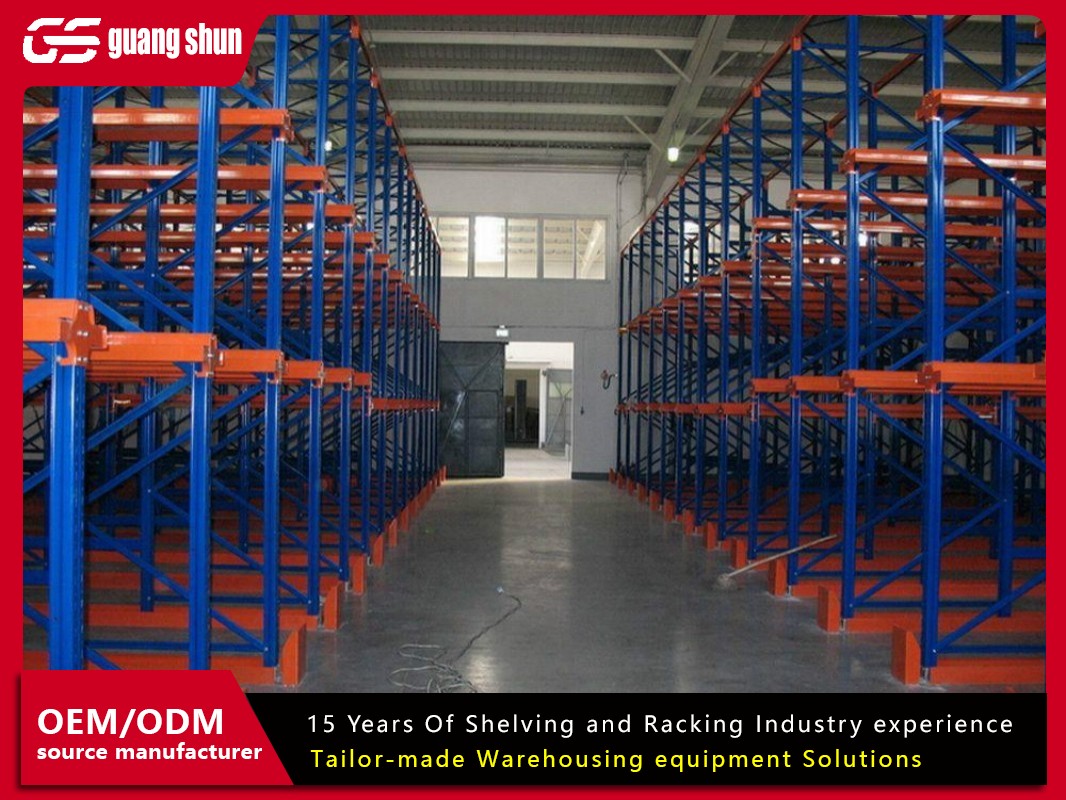
The fundamental architecture of drive through racking eliminates multiple access aisles by allowing forklifts to drive directly into
the storage structure itself. This is achieved through continuous, welded frames
and horizontal/vertical bracing that create a stable tunnel. Unlike drive through
racking, which has an entry and exit at opposite ends, a drive-in system
typically uses a single entry point (Last-In, First-Out). Understanding this
structural nuance is key to proper application.
1.1 Structural Components and Load Paths
A robust drive through racking configuration relies on
several engineered components working in concert:
Upright Frames: Fabricated from high-tensile steel (yield
strength often exceeding 350 MPa), with profiles designed to resist both
vertical loads and the horizontal forces from forklift entry.
Rail Guidance Systems: Floor-mounted or rail-guided systems
are critical. They protect the bottom of the uprights from impact and ensure
precise forklift maneuvering within narrow lanes, often reducing required lane
width by 150-200mm.
Pallet Support Rails: These continuous rails along the
length of the lane support the pallets. Their spacing must precisely match the
pallet dimensions and forklift pocket locations to prevent tipping or
instability.
Top Ties and Cross Bracing: These components tie multiple
bays together longitudinally, distributing loads and providing essential rack
rigidity against seismic or wind forces.
2. Quantifying Space Efficiency and Storage Density
The primary economic driver for selecting drive through
racking is the dramatic improvement in floor space utilization. By
converting access aisles into storage lanes, facilities can often double their
pallet capacity within the same footprint. Consider a comparative analysis for a
facility storing 1,000 pallets of a single SKU:
| System Type | Aisle Space Required | Total Floor Area (Approx.) | Pallets per m² | Selectivity |
|---|
| Selective Racking | ~3.5m per aisle (multiple aisles) | ~1,500 m² | ~0.67 | 100% (each pallet accessible) |
| Drive Through Racking | ~3.5m shared lanes (only 2 main aisles) | ~850 m² | ~1.18 | ~40% (FIFO rotation limited to lane depth) |
This 40-50% reduction in floor space requirement translates directly to lower
leasing costs, reduced energy consumption (especially critical in -25°C freezer
environments), and shorter travel distances for forklifts.
2.2 FIFO vs. LIFO Configurations
It is a common misconception that all deep-lane systems are LIFO.
Drive through racking is specifically designed for First-In,
First-Out (FIFO) inventory rotation. This is achieved by loading pallets from
one end of the lane (the "input" aisle) and retrieving them from the opposite
end (the "output" aisle). This makes the system ideal for time-sensitive goods.
In contrast, drive-in racking, where loading and retrieval occur from the same
aisle, is strictly LIFO and better suited for bulk storage of non-perishable
items. When specifying a system, engineers must verify the intended flow to
ensure the correct rail and guide configuration is supplied.
3. Sector-Specific Applications and Engineering Considerations
The technical demands on drive through racking vary
significantly by industry. Engineers from leading manufacturers like Guangshun routinely customize
solutions based on these specific operational environments.
3.1 Cold Storage and Freezer Applications
In low-temperature environments, steel becomes more brittle and contraction
occurs. Engineering solutions include:
Thermally-Processed Steel: Specifying steel grades with
guaranteed impact toughness at low temperatures (e.g., -20°C to -30°C).
Shimmed Baseplates: Allowing for contraction and expansion
of the concrete slab without transferring stress to the uprights.
Galvanized Finishes: Providing superior corrosion
resistance compared to standard paint in high-humidity, defrost-cycle
environments.
3.2 High-Throughput Food and Beverage Warehouses
Facilities handling soft drinks, bottled water, or canned goods require
racking that can withstand frequent, high-speed forklift traffic. Key features
include:
Full-Height Column Guards: Heavy-duty impact protection at
the entry points of every lane.
Rail Guidance Systems: Mechanically guiding the forklift to
prevent lateral contact with the rack structure.
Reinforced Rail Sections: Using thicker steel for the
load-bearing support rails to handle the repeated dynamic loading of pallet
placement and retrieval.
4. Safety Protocols and Operational Best Practices
Operating a drive through racking system requires rigorous
discipline. Because the forklift operates inside the storage structure, the
margin for error is smaller than in open aisles. Compliance with safety
standards (such as AS4084 in Australia or EN 15512 in Europe) is
non-negotiable.
4.1 Forklift Type and Operator Training
Only specific forklifts are suitable for deep-lane operations. Reach trucks
or counterbalance trucks with a side-shifter and a precise mast are standard.
Operators must be trained not only in driving but also in "reading" the racking
for damage. Common protocols mandate that any visible damage to uprights, rail
connections, or floor anchors be reported immediately and the lane taken out of
service until inspected by a qualified engineer.
4.2 Load Containment and Pallet Quality
The stability of stored goods is paramount. Pallet overhang is strictly
prohibited as it can snag on the rack structure during retrieval, dislodging
other pallets. Pallets must be in good repair—no broken stringers or deck
boards—and the load must be unitized (e.g., with stretch wrap) to prevent
individual cases from falling into the lane and creating a trip hazard or
obstruction.
5. Total Cost of Ownership and ROI Analysis
When evaluating drive through racking, the initial
investment per pallet position is typically lower than for selective systems due
to the higher density. However, the true financial picture involves analyzing
operational costs over a 10-15 year lifecycle. Factors include:
Space Cost Savings: As quantified above, reduced square
meterage provides the most immediate and significant ROI.
Maintenance Costs: High-density systems are more
susceptible to impact damage. Investing in higher-grade steel and robust
guidance systems from the outset reduces long-term repair and replacement
expenses. Guangshun's engineering data
suggests that systems with integrated rail guidance can reduce lane-edge impacts
by over 70%.
Productivity: While retrieval times for a specific pallet
can be longer than in selective racking (due to lane depth), the overall travel
time between storage locations is drastically reduced because the warehouse
footprint is smaller.
Frequently Asked Questions (FAQ)
Q1: What is the maximum lane depth achievable with drive through
racking?
A1: Lane depth is determined by forklift type and the
required reach. Typically, depths range from 5 to 12 pallets deep. For very deep
lanes (e.g., 10+ pallets), very narrow aisle (VNA) trucks with rail guidance are
often required to maintain stability and precision. Deeper lanes increase
density but reduce selectivity, as you may have to move multiple pallets to
access a specific one at the back.
Q2: Can drive through racking be used for mixed SKUs in the same
lane?
A2: Technically yes, but it is highly inefficient for FIFO
rotation. If different SKUs are stored in the same lane, you may have to unload
and reload many pallets to access a specific SKU at the far end. The system is
optimized for homogeneous products where the entire lane contains the same SKU
or batch, ensuring that retrieval from the output end always yields the required
item.
Q3: How do I calculate the required spacing between support rails for
my pallets?
A3: The spacing is critical for safety. It must be wider
than the width of the forklift's outriggers or legs but narrower than the
pallet's depth, ensuring the pallet is fully supported. Engineers use the exact
pallet dimensions, including allowable overhang and the position of the bottom
deck boards, to determine the optimal rail spacing, typically ranging from 750mm
to 1100mm apart.
Q4: What are the key differences between drive through and drive-in
racking?
A4: The fundamental difference is inventory rotation.
Drive through racking has an entry aisle at one end and a
separate exit aisle at the other, enabling First-In, First-Out (FIFO) flow.
Drive-in racking has only one access aisle, so the last pallet stored is the
first one retrieved (LIFO). Your choice depends entirely on whether your goods
are time-sensitive (FIFO) or can be stored in bulk without rotation concerns
(LIFO).
Q5: What maintenance is required for a drive through racking
system?
A5: A structured inspection regime is essential. This
includes weekly visual checks by warehouse staff for obvious damage like bent
uprights or dislodged rail clips, and an annual detailed inspection by a
qualified racking engineer. The engineer will check anchor torque, plumbness of
frames, and the integrity of all welds and connections. Any damaged components
must be replaced immediately using parts from the original manufacturer.
Q6: Is seismic bracing available for drive through racking
systems?
A6: Yes, absolutely. High-density systems in seismic zones
require specialized engineering. Solutions include adding longitudinal and
transverse bracing throughout the structure, using larger baseplates with more
anchors, and sometimes incorporating energy-absorbing connections. A structural
engineer must perform a site-specific seismic analysis, and the rack supplier
must provide components certified for those calculated loads. Drive through
racking from reputable manufacturers like Guangshun can be engineered to
meet stringent seismic standards.