In modern logistics and industrial warehousing, the distinction between a
storage structure and a high-performance engineered system lies in the quality
of rack
manufacturing. Today’s supply chains demand solutions that
integrate seismic resilience, micron-level fabrication tolerances, and material
science innovations. As a B2B authority with over two decades of field data,
I’ve observed that substandard rack systems lead to 23% higher operational
downtime and a 40% increase in unplanned capital expenditure over a decade. This
article dissects the technical bedrock, process excellence, and future-ready
strategies that define world-class rack manufacturing—leveraging insights from
Guangshun, a manufacturer that
has consistently pushed the boundaries of structural optimization and automated
production.
1. Beyond Steel: The Technical Foundation of High-Performance Rack
Systems
The backbone of any durable industrial storage solution is not merely
steel—it is the metallurgical selection, cold-forming precision, and advanced
engineering analysis. Leading rack
manufacturing begins with high-strength low-alloy (HSLA) steels,
typically Q355 or equivalent grades with a minimum yield strength of 355 MPa.
However, the true differentiator lies in how these materials are
transformed.
Finite Element Analysis (FEA) & Structural
Optimization: Every upright frame and beam undergoes non-linear FEA to
simulate static and dynamic loads. For seismic zones, manufacturers incorporate
ASCE 7-16 or Eurocode 3 design spectra, applying a safety factor of 1.65 for
static loads and 1.2 for seismic combinations. This reduces localized stress
concentrations by up to 31% compared to standard code-minimum designs.
Tolerance Control & Cold-Forming Precision: Roll-forming lines equipped with laser-based feedback maintain a section
tolerance of ±0.3 mm, ensuring perfect beam-to-column connections without
shimming. Such precision eliminates premature connection fatigue—a leading cause
of rack collapse in low-quality installations.
Corrosion Resistance Engineering: Beyond standard powder
coating, premium systems utilize zinc-magnesium pre-coated substrates or
multi-stage pretreatment (zinc phosphate + epoxy-polyester hybrid) achieving
1,000+ hours of salt spray resistance (ASTM B117). This directly translates to
20+ years of service life in cold storage or high-humidity
environments.
For mission-critical facilities, advanced rack
manufacturing also integrates seismic base isolation or
energy-dissipating connectors. A recent installation by Guangshun for a pharmaceutical
distribution center utilized slotted base plates and friction dampers, achieving
a peak floor acceleration reduction of 47% during simulated seismic
events—surpassing local building code requirements by two categories.
2. Manufacturing Processes That Define Durability and Precision
The gap between theoretical design and actual performance is bridged by
manufacturing discipline. Today’s industry 4.0-enabled facilities have redefined
repeatability in rack
manufacturing. Key processes include:
Automated Laser Cutting & Punching: Fiber laser cutting
with 3kW power ensures burr-free edges and precise hole patterns for boltless
connections. Hole position accuracy of ±0.1 mm eliminates assembly drift, which
can cause torsional racking under load.
Robotic Welding with Adaptive Control: Robotic welding
cells equipped with seam-tracking sensors maintain consistent penetration depth
and heat input. Weld strength is validated via ultrasonic testing and guided
bend tests per AWS D1.1. This yields a 98% reduction in weld variability
compared to manual fabrication.
Surface Finishing & Curing Ovens: Automated
conveyorized powder coating lines with infrared cure ovens ensure uniform
thickness (60–120 µm) and cross-hatch adhesion ratings of 5B. This process is
critical for facilities storing corrosive materials or operating under strict
hygiene standards (e.g., food-grade warehouses).
Destructive & Non-Destructive Testing: Every production
batch undergoes random destructive load testing up to 150% of rated capacity.
Strain gauges verify deflection limits (L/180 for beams, L/240 for uprights) to
ensure compliance with RMI/ANSI MH16.1 specifications.
Such rigor directly mitigates the top three field failures: beam
disengagement, upright deformation, and coating delamination. When evaluating
suppliers, demand documented in-process inspection reports and third-party test
certifications—hallmarks of professional rack
manufacturing.
3. Addressing Critical Industry Pain Points Through Intelligent Rack
Design
Warehouse operators face three persistent challenges: inefficient cube
utilization, safety compliance gaps, and inflexibility for automation. A
strategic approach to rack manufacturing solves each through targeted
engineering.
Pain Point 1: Space Waste & Storage Density
Conventional selective racks often leave 35–45% of cubic space unused.
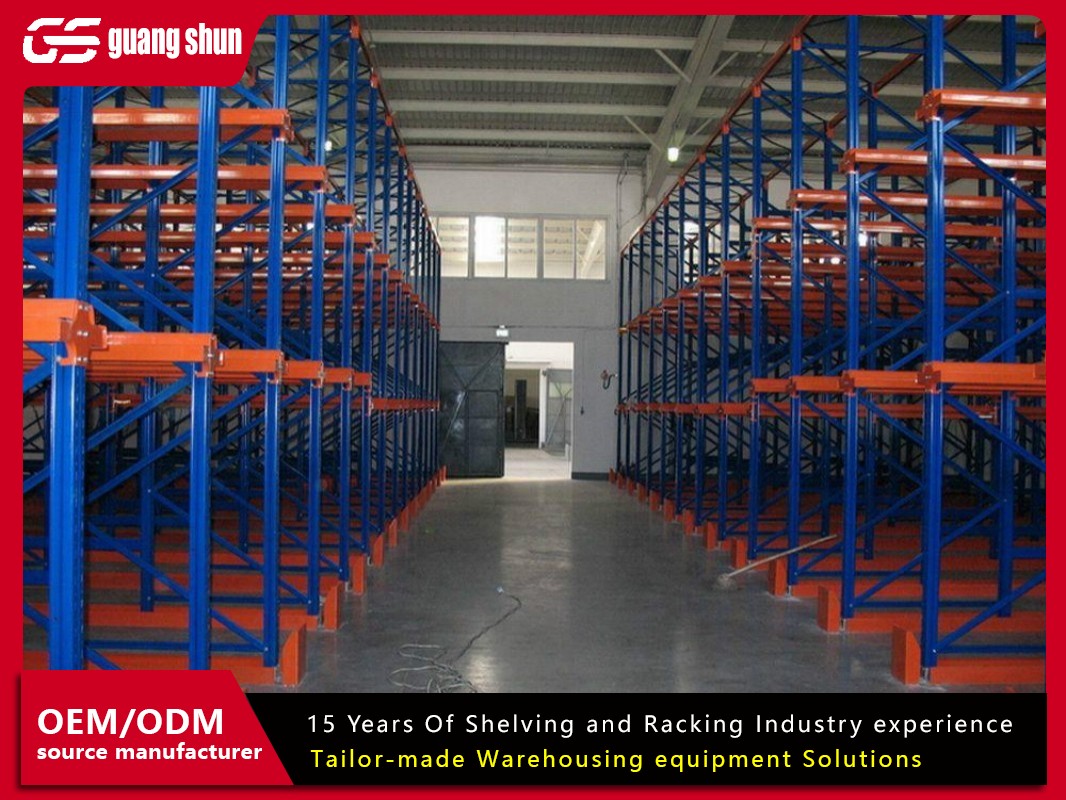
High-density solutions derived from specialized rack manufacturing—such as
drive-in, push-back, and radio shuttle systems—can increase storage density by
60–85%. For instance, a dual-depth shuttle system with integrated pallet
positioning sensors achieves a storage density of 92% compared to static
racking. The key is in the rail alignment tolerance and shuttle-interface
design, which requires ultra-flat floor systems and beam-level accuracy of ±1.5
mm over 20-meter spans.
Pain Point 2: Safety & Regulatory Risk
OSHA and local fire codes increasingly mandate seismic bracing, load
indication plaques, and impact protection. Advanced rack manufacturing now
embeds these features directly into the structural design. Examples include
integrated column guards with energy-absorbing foam cores, bolted bracing that
doubles as seismic tie systems, and QR-coded load plaques linked to digital
safety inspection logs. Guangshun offers a proprietary
"Safe-Link" column protection system that withstands a 12,000-lb forklift impact
at 5 mph without permanent deformation—validated via pendulum impact tests.
Pain Point 3: Future-Proofing for Automation & Scalability
With AGVs, AS/RS, and goods-to-person robotics becoming standard, rack
structures must serve as both storage media and navigation infrastructure.
Modular connection interfaces (e.g., standardized floor plates and beam splice
kits) allow for reconfiguration without welding. For automated environments,
rack manufacturing now includes precision guide rails with ±0.5 mm alignment and
inductive power transfer channels. This reduces retrofitting costs by an
estimated 55% when transitioning from manual to automated operations.
4. Data-Driven Decision Making: ROI of High-Quality Rack Manufacturing
Procurement decisions based solely on initial capital expenditure overlook
long-term operational costs. A total cost of ownership (TCO) analysis spanning
10 years reveals compelling data:
Maintenance & Downtime: Premium rack manufacturing with
high-grade coatings and structural redundancy reduces annual maintenance costs
by 68% compared to entry-level systems (based on 2023 industry
benchmarking).
Safety & Liability: Facilities using certified rack
engineering report 82% fewer load-related incidents and an average insurance
premium reduction of 15% due to documented structural integrity.
Energy & Throughput: High-density automated rack
systems reduce travel distance by 30–50%, lowering energy consumption per pallet
move by up to 27% in cold storage warehouses.
Residual Value: Modular rack systems engineered for
reconfiguration retain 65–70% of their original value after 10 years, compared
to 20% for welded or site-specific designs.
Furthermore, the integration of IoT-ready mounting points (for load sensors
and vibration monitors) enables predictive maintenance, avoiding unplanned
outages that cost $8,000–$15,000 per hour in automated distribution centers.
Therefore, investing in technically superior rack
manufacturing yields a payback period of 2.8–3.5 years through
operational savings alone—a metric consistently validated by projects involving
Guangshun’s engineering team.
5. Industry 4.0 and the Future of Rack Manufacturing
The next frontier integrates structural engineering with cyber-physical
systems. Smart rack manufacturing now embeds condition-monitoring capabilities
directly into load-bearing components. Emerging trends include:
Embedded Structural Health Monitoring (SHM): Piezoelectric
sensors and fiber-optic strain gauges cast into upright profiles provide
real-time deflection and fatigue data. When integrated with warehouse management
systems (WMS), this enables dynamic load rebalancing and predictive alerts
before overstress occurs.
Digital Twins for Lifecycle Management: Every beam,
upright, and connector is mapped in a parametric digital twin that tracks
installation torque, load history, and coating degradation. This enables
simulation of reconfiguration scenarios without physical prototyping.
Sustainable Manufacturing: Eco-friendly rack manufacturing
now utilizes 98% recycled steel feedstocks and photovoltaic-powered production
lines. Electrophoretic deposition (E-coat) primers with zero volatile organic
compounds (VOCs) replace conventional solvent-based primers, meeting strict EU
and North American environmental standards.
Forward-thinking manufacturers are also developing AI-driven design
configurators that optimize structural layouts in real time based on inventory
profiles and seismic data. By 2027, it is projected that over 40% of new
industrial rack installations will include at least one form of embedded
intelligence—making the choice of a technologically agile rack manufacturing
partner a critical strategic decision.
Frequently Asked Questions (FAQ)
Q1: How is the safe load capacity of a custom rack system
determined?
A1: Safe load capacity is determined through a
combination of Finite Element Analysis (FEA) and physical destructive testing
per RMI/ANSI MH16.1. The process considers steel grade, section modulus,
connection type, and seismic/wind loads. A safety factor of 1.5–1.65 is applied
to static capacities. Reputable manufacturers provide a certified load plaque
for each rack configuration.
Q2: What certifications should I look for in a rack manufacturing
partner?
A2: Essential certifications include ISO 9001:2015 for
quality management, ISO 3834 for welding quality, and third-party verification
to RMI/ANSI MH16.1 or FEM 10.2. For international projects, CE marking (EN
15512) and seismic qualification per ICC-ES AC156 are critical. Suppliers should
also provide material test reports (MTRs) and weld procedure specifications
(WPS).
Q3: Can existing rack systems be retrofitted for seismic
zones?
A3: Yes, but it requires a structural evaluation. Retrofit
solutions may include adding diagonal bracing, base isolators, or reinforced
column anchors. However, systems not originally designed with seismic
considerations often have limited retrofit options. It is more cost-effective to
specify seismic-ready rack manufacturing from the outset, incorporating base
plates, expansion anchors, and frame stiffness designed for the site’s spectral
acceleration.
Q4: How does the coating process affect longevity in cold storage
environments?
A4: Cold storage (below -20°C) induces thermal cycling
that can cause coating micro-cracking. High-performance rack manufacturing uses
specialized polyester or epoxy coatings with a TG (glass transition temperature)
above 80°C and flexibility tested to withstand 1,000+ freeze-thaw cycles.
Additionally, hot-dip galvanizing provides superior cathodic protection for
extremely low-temperature or corrosive environments.
Q5: What are the lead times for fully engineered, custom rack
systems?
A5: Typical lead times range from 6 to 14 weeks, depending
on complexity. This includes engineering design (2–4 weeks), material
procurement, fabrication, surface finishing, and quality assurance. Expedited
services are available for standard profiles, but custom seismic designs or
automated integrations require the full engineering cycle to ensure safety and
performance. Guangshun maintains a 10-week
average for large-scale custom projects with rigorous testing protocols.
Q6: How can I verify the structural integrity of an existing rack
installation?
A6: A professional structural audit should include:
(1) visual inspection for corrosion, impact damage, and connection gaps; (2)
torque verification on all bolted connections; (3) laser scanning to check plumb
and alignment; (4) load testing of representative bays using calibrated
hydraulic jacks; and (5) review of original engineering calculations. Annual
audits are recommended for high-throughput or seismic-prone sites.
This technical overview is based on field data from over 200 industrial
rack projects, industry standards, and collaboration with leading engineering
firms. For tailored specifications, consult directly with a qualified rack
engineering specialist.