Industrial Racking Systems: Engineering Configurations, Load Analysis, and Safety StandardsWarehouse efficiency hinges on the proper selection and engineering of industrial racking systems. These structures are not mere shelves; they are precision-engineered frameworks that must withstand dynamic loads, seismic events, and decades of forklift traffic. This article provides a deep technical examination of the major industrial racking systems—from selective pallet rack to high-density configurations—detailing their design parameters, material specifications, and application-specific engineering. Drawing on industry standards (RMI, FEM, AS4084) and the manufacturing expertise of Guangshun, we aim to equip warehouse professionals with the knowledge to specify, audit, and maintain systems that deliver both safety and return on investment.
1. Classification and Technical Specifications of Industrial Racking Systems
industrial racking systems are categorized by their configuration, access method, and load path. Each type has distinct engineering requirements and is suited for specific inventory profiles.
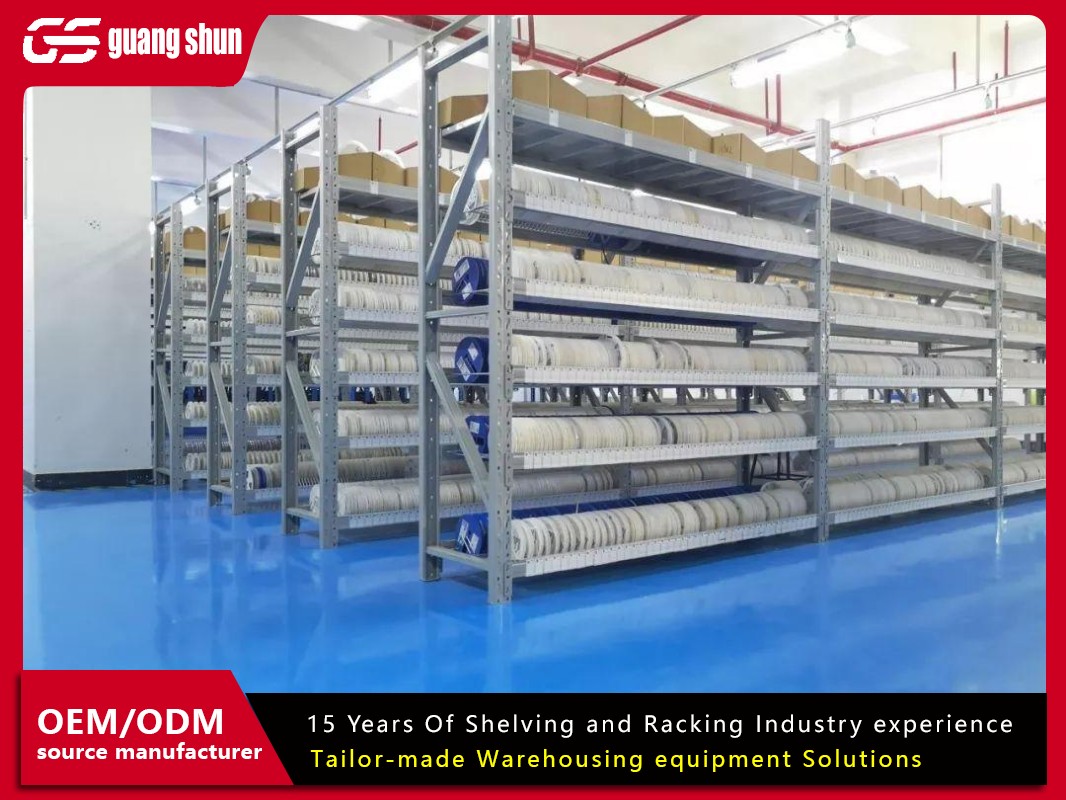
1.1 Selective Pallet Racking
Selective racking is the most common configuration, offering 100% accessibility to each pallet. Frames are typically fabricated from roll-formed steel (yield strength 350–550 MPa) with boltless beam connections. Key engineering parameters include:
Beam capacity: Determined by section modulus and steel grade. Typical beams (100–150 mm deep) support 2,000–5,000 lbs per pair with deflection limited to L/180.
Frame stability: Diagonal bracing (X or K pattern) resists longitudinal forces. Upright columns are often perforated for beam adjustments.
Seismic considerations: In high-risk zones, base plates and anchors must resist overturning moments calculated per ASCE 7. Guangshun offers seismic-rated selective systems with tested connections.
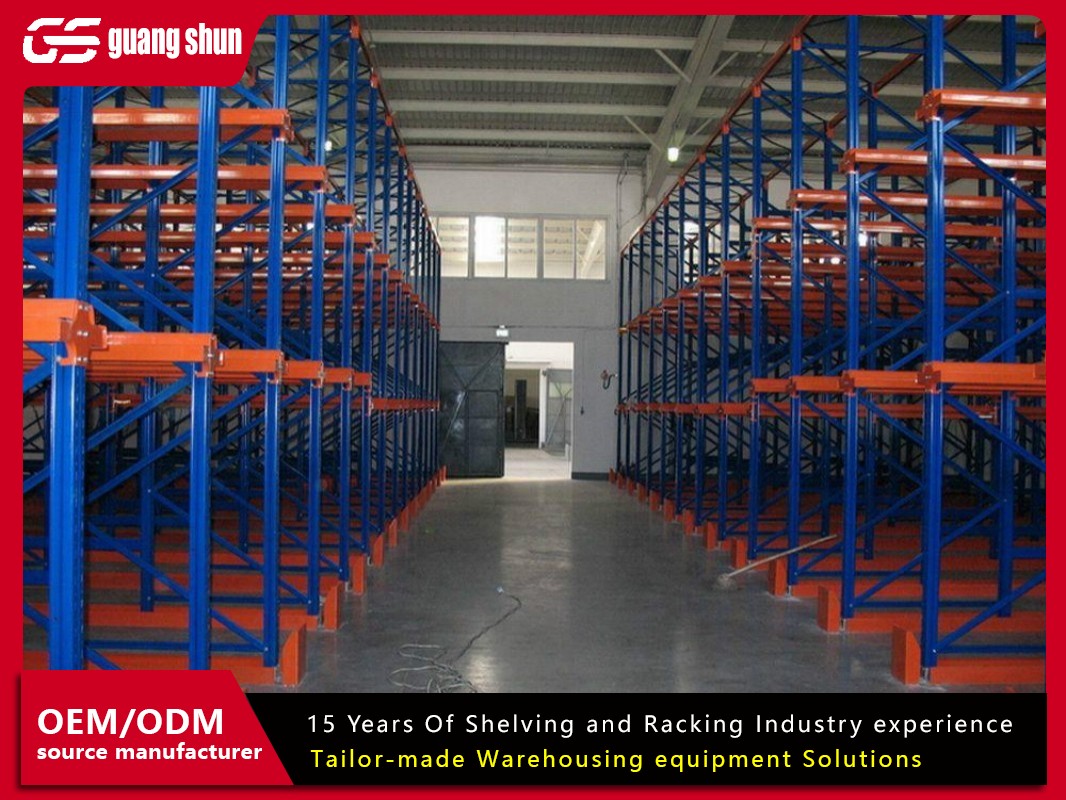
1.2 Drive-In and Drive-Through Racking
For high-density storage of homogeneous products, drive-in racking allows forklifts to enter the structure. This system is LIFO (last-in, first-out) while drive-through enables FIFO with entry from both ends. Engineering focus areas:
Rail guidance: Floor rails guide forklifts to prevent column strikes. Rails are typically 10 mm thick hardened steel.
Frame bracing: Due to the absence of beams on the entry side, frames require robust horizontal and diagonal bracing to resist racking.
Load capacity: Uprights must support cantilevered loads from multiple pallet depths. Finite element analysis optimizes steel thickness (2.5–4.0 mm) based on pallet weights and bay sizes.
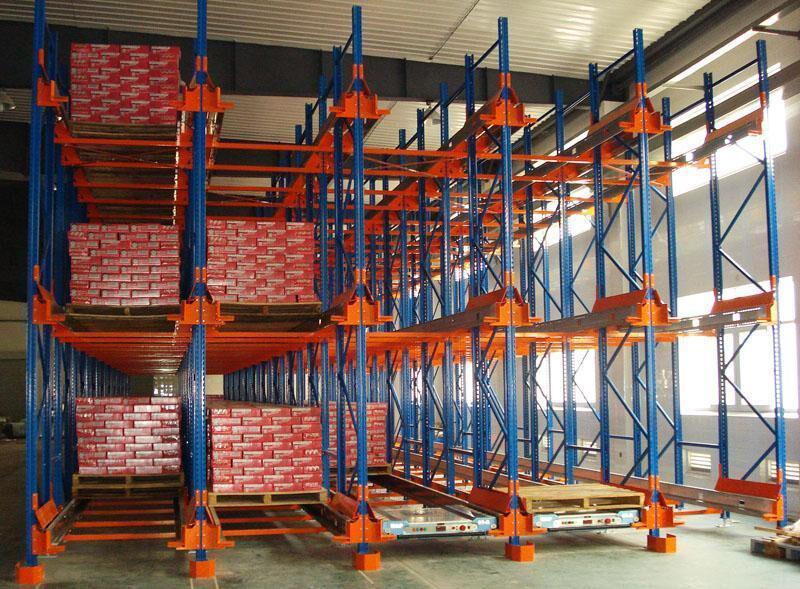
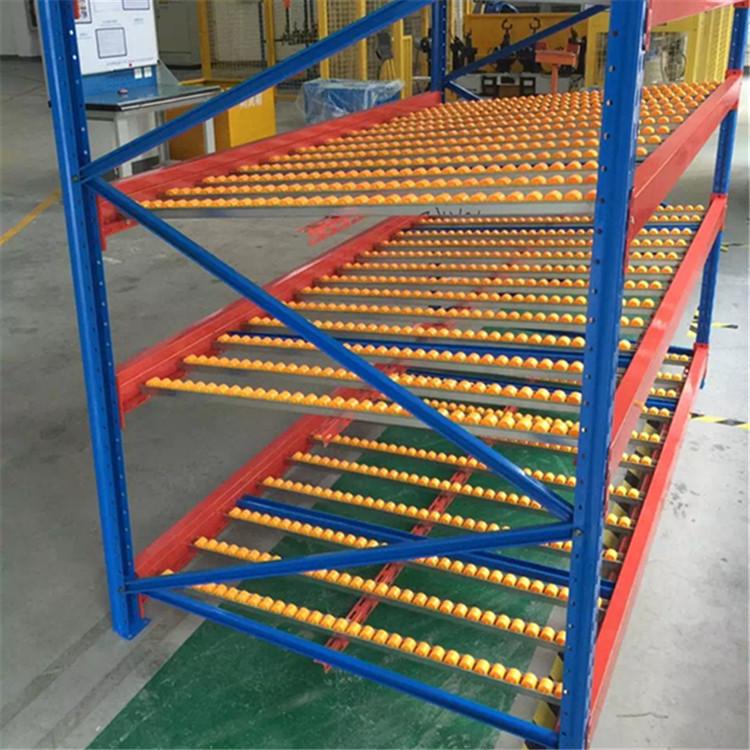
1.3 Push-Back and Pallet Flow Racking
These systems use gravity or push-back mechanisms to store pallets 2–4 deep. Push-back racking employs nested carts on inclined rails; pallet flow uses rollers. Engineering challenges include:
Dynamic load transfer: Carts and rollers must withstand repeated impact and rolling loads. Rails are often 5–8 mm thick with precision alignment to ±2 mm.
Speed control: Pallet flow requires brake rollers to control descent speed (typically 0.3–0.5 m/s).
Compatibility: Pallet condition (no broken boards) is critical. Guangshun supplies systems with adjustable flow rates to accommodate various pallet types.
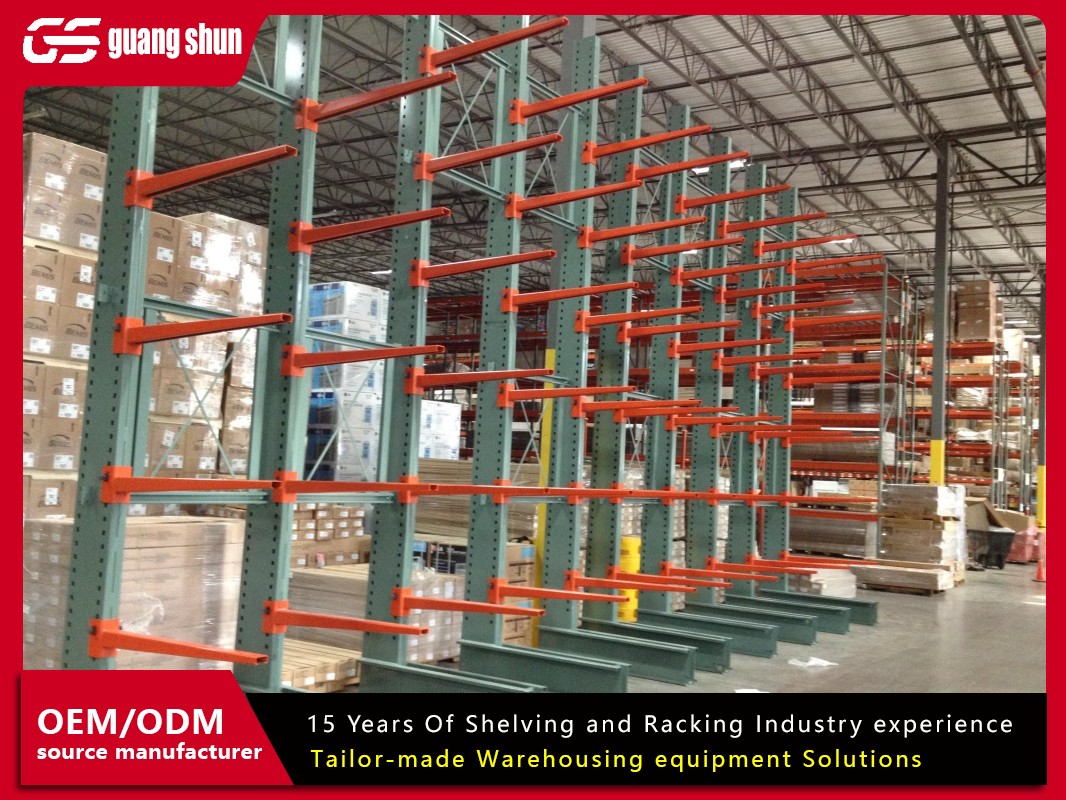
1.4 Cantilever Racking
Designed for long goods (lumber, pipes, steel bars), cantilever racking consists of vertical columns with horizontal arms. Engineering parameters:
Column design: Single- or double-sided columns with deep bases to resist overturning. Arm capacities range from 500–3,000 kg.
Bracing: Tension rods or structural steel bracing connects columns for longitudinal stability.
Material: Hot-rolled structural steel (e.g., IPE or HE sections) is common for heavy loads.
2. Engineering Design and Safety Compliance
All industrial racking systems must be engineered to withstand specified loads and environmental conditions. Key factors include material selection, load combinations, and safety accessories.
2.1 Material Grades and Corrosion Protection
Structural steel for racking typically conforms to ASTM A1011 (Grade 55) or EN 10025 (S355). Yield strength directly affects capacity; higher grades allow thinner sections but require careful welding procedures. Corrosion protection options:
Hot-dip galvanizing: Provides sacrificial protection for outdoor or cold storage environments.
Powder coating: Applied over pre-galvanized steel for indoor use; must meet scratch and impact resistance standards (e.g., ISO 2409).
Stainless steel: Used in food or pharmaceutical areas requiring washdowns.
2.2 Load Calculations and Safety Factors
Engineers calculate loads per applicable codes (RMI MH16.1, FEM 10.2.02, AS 4084). Design includes:
Dead loads: Self-weight of rack structure.
Live loads: Pallet weights (uniformly distributed or concentrated).
Impact loads: 25–40% of live load applied horizontally to account for forklift contact.
Seismic loads: Based on site-specific spectral acceleration (SDS). Systems in seismic zones require ductile connections and anchorage capable of 0.5g or higher.
Safety factors of 1.5–2.0 against yielding are standard.
2.3 Safety Accessories and Inspection Protocols
To protect personnel and inventory, industrial racking systems must include:
Column guards: Steel or polymer protectors at aisle corners.
Mesh decking or back panels: Prevent items from falling through.
Safety pins/locks: Secure beams to frames against accidental dislodgement.
Inspection: Formal annual inspections per OSHA or local regulations. Guangshun provides training and checklists.
3. Industry Applications and Case Studies
Different sectors require tailored configurations of industrial racking systems. Below are examples of engineering adaptations.
3.1 Cold Storage and Food Logistics
Freezer warehouses (-25°C) demand special attention to steel brittleness and condensation. Guangshun supplies galvanized systems with low-temperature impact-tested steel (Charpy V-notch at -30°C). Aisles are minimized using double-deep or drive-in configurations to reduce refrigeration loss.
3.2 Automotive Parts Distribution
Automotive warehouses handle heavy components (engines, transmissions) and irregularly shaped items. Heavy-duty selective racking with reinforced beams and cantilever arms for long parts is common. Guangshun implemented a system for a Tier-1 supplier with 8-meter tall frames and integrated barcode scanning.
3.3 E-Commerce Fulfillment Centers
High-speed picking requires multi-level systems with mezzanines and conveyor integration. Light-to-medium duty shelving and carton flow racks are combined with structural steel platforms. Engineering focuses on floor loading (typically 25 kN/m²) and seismic compatibility.
4. ROI and Selection Criteria
Choosing among industrial racking systems involves balancing space utilization, equipment costs, and operational throughput.
4.1 Space Utilization Metrics
Selective racking achieves 30–40% space utilization (pallet positions per floor area). Drive-in can reach 70–80% but with LIFO constraints. Double-deep offers 50–60% with good selectivity. A cost-benefit analysis must include:
Cost of building expansion vs. high-density racking.
Forklift type and aisle width requirements (reach trucks for double-deep, turret trucks for VNA).
Inventory turnover rates (fast movers in selective, slow in drive-in).
4.2 Lifecycle Cost and Maintenance
Initial rack cost is only part of the equation. Maintenance of moving parts (push-back carts, flow rollers) adds expense. Structural steel racking may have lower maintenance but higher initial cost. Guangshun offers lifecycle cost analysis based on 20-year projections.
Frequently Asked Questions (FAQ)
Q1: What is the maximum height for industrial racking systems?
A1: Height depends on the rack type and handling equipment. Selective racking can reach 15–18 meters with very narrow aisle (VNA) turret trucks. Drive-in systems are typically limited to 10–12 meters due to forklift mast constraints. Guangshun designs systems up to 16 meters with appropriate seismic bracing.
Q2: How do I determine the required beam capacity for my pallets?
A2: Calculate the maximum weight per pallet position, including pallet weight. Add a safety factor of 1.2–1.5 for dynamic loads. Consult the manufacturer's load table—each beam pair has a rated capacity based on span and deflection limit. Never exceed the rated capacity.
Q3: What are the seismic requirements for racking in earthquake-prone areas?
A3: Seismic design per RMI or ASCE 7 requires that racks resist lateral forces calculated from site-specific spectral acceleration. Anchorage must resist uplift and shear. Special ductile connections and pallet retention (e.g., wire mesh, back panels) are often required. Guangshun provides certified seismic solutions with shake-table test reports.
Q4: Can I mix racking components from different manufacturers?
A4: Mixing is not recommended without engineering review. Beam end connectors are often proprietary, and tolerances may vary. Mismatched components can lead to connection failure. If necessary, consult both manufacturers and perform physical tests.
Q5: How often should industrial racking be inspected?
A5: At minimum, conduct a formal annual inspection by a qualified person (e.g., a professional engineer). Additionally, weekly visual checks by warehouse staff should look for bent uprights, missing safety pins, or damaged beams. After any forklift impact, inspect immediately.
Q6: What is the difference between roll-formed and structural steel racking?
A6: Roll-formed racking is made by cold-forming steel coils into C or Z sections; it is lighter, more economical, and adjustable. Structural steel racking uses hot-rolled beams and columns (e.g., I-beams) which are heavier and more impact-resistant. The choice depends on load requirements, budget, and environment.
Q7: How do I protect racking from forklift damage?
A7: Install column guards (steel or polymer) at aisle ends and corners. Use reflective markings or guide rails. Train operators and enforce speed limits. Consider reinforced base sections (heavier gauge steel) for high-traffic areas.
Specifying Industrial Racking Systems for Long-Term Value
industrial racking systems are foundational assets that directly impact warehouse safety and productivity. By understanding the engineering principles—from steel grades and load paths to seismic design and safety accessories—facility managers can make informed decisions that balance density, accessibility, and cost. Partnering with experienced manufacturers like Guangshun ensures compliance with international standards and long-term durability. For a detailed site assessment and system design, contact our engineering team.
For technical downloads and case studies, visit Guangshun’s resource library.