Industrial
storage racking forms the structural skeleton of high-throughput
warehouses and distribution centers. Unlike generic shelving, these engineered
systems must withstand continuous dynamic loads, seismic events, and accidental
impacts while maintaining dimensional stability over decades. This article
examines the mechanical behavior, failure modes, and specification criteria for
industrial storage racking systems, referencing FEM and RMI
standards. Guangshun has supplied racking for cold
storage, automotive, and chemical sectors, and the following analysis reflects
field data from those installations.
1. Structural Mechanics of Industrial Storage Racking
All industrial storage racking systems must satisfy limit
states design principles: yielding, buckling, and serviceability (deflection).
Engineers calculate load combinations including dead loads (self-weight), live
loads (pallet weights), impact loads (forklift collisions), and seismic
forces.
1.1 Beam-to-Column Connections
Connections determine overall frame rigidity. Common types include:
Tab-and-slot (boltless): Punched columns with integral
tabs; fast assembly but lower moment resistance.
Bolted end-plate: High rigidity; used in seismic zones
(requires pre-tensioned bolts).
Clip-in safety locks: Prevent beam dislodgement during
impact; mandatory in all modern systems.
Moment-rotation curves for each connection type are input into FEA models.
For industrial storage racking exceeding 8 m height, semi-rigid
connections are often modeled explicitly to predict sway deflections.
1.2 Column Buckling and Bracing
Upright columns are typically perforated (for beam adjustment), which reduces
their buckling capacity. The effective length factor (K) depends on bracing
intervals—horizontal and diagonal braces convert long columns into shorter
segments. Torsional buckling is critical for open sections; closed tubular
sections (80x60x3 mm) offer higher torsional resistance. Guangshun’s Guangshun columns undergo stub-column tests to validate perforation effects per AISI
S100.
2. Material Specifications and Environmental Factors
Steel grade selection impacts both cost and performance. Most
industrial storage racking utilizes S235JR or S275JR (European)
or ASTM A36 (US). For cold environments (below -20°C), notch-tough steels (e.g.,
S355NL) prevent brittle fracture.
2.1 Corrosion Protection
Galvanized (HDG): 50–80 μm coating; ideal for food
warehouses or chemical exposure.
Powder coating: Polyester or epoxy; color-coded for visual
management but requires scratch repair.
Pre-painted: Factory-applied; consistent finish but
vulnerable at cut edges.
Accelerated salt spray tests (ASTM B117) verify coating durability. In
coastal facilities, Guangshun specifies hot-dip galvanized industrial
storage racking with additional zinc-rich primer.
3. Seismic Design and Energy Dissipation
In seismic zones, industrial storage racking must resist
horizontal accelerations without collapse. Codes (ASCE 7, IBC) assign seismic
design categories (SDC A–F) based on risk. Strategies include:
Baseplate anchors: Ductile expansion or epoxy anchors;
embedment depths calculated for tension pull-out.
Cross-aisle bracing: Rods or angles in the vertical plane;
pre-tensioned to limit drift.
Down-aisle ductility: Frame action (moment-resisting
connections) or added energy absorbers.
Non-linear time-history analysis using scaled earthquake records is now
standard for critical facilities. Guangshun provides seismic compliance
documentation including anchor reaction forces and inter-story drift ratios.
4. Dynamic Loading: Forklift Impact and Fatigue
Impact from forklifts is the leading cause of rack damage. Industrial storage
racking can be designed to sacrifice components (replaceable column sections) or
resist impacts through high-strength steel. Recent research from the Rack
Manufacturers Institute suggests that baseplate guards and wrap-around
protectors reduce repair costs by 65%.
4.1 Fatigue Considerations
High-frequency access (e.g., e-commerce fulfillment) introduces cyclic
stresses. Beam-to-column connections may experience millions of minor load
cycles. While most racking is not fatigue-prone (stresses below endurance
limit), thin-walled sections can crack if notched. Guangshun uses punched holes
with rounded corners to reduce stress concentration factors (Kt < 2.5).
5. System Configurations and Application Matching
The term industrial storage racking encompasses several
sub-types, each suited to specific operational profiles.
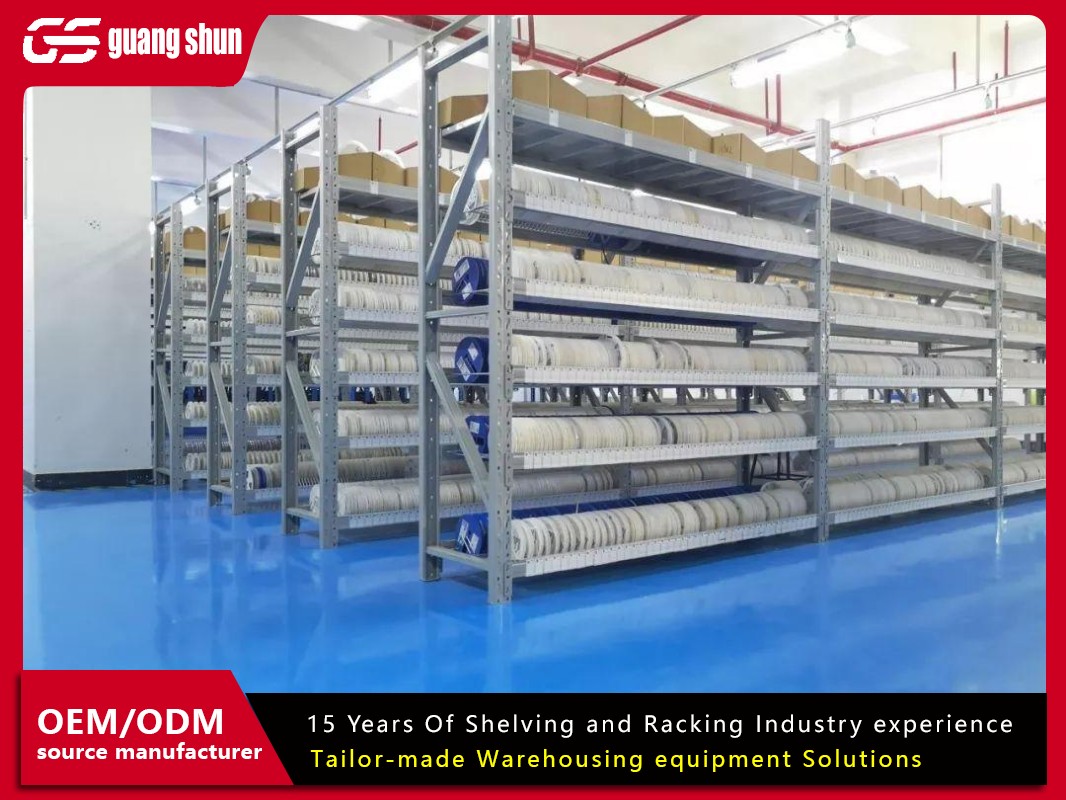
5.1 Selective Pallet Racking
Universal access, simple design. Beam loads up to 5,000 kg per level. Ideal
for high-SKU environments. However, aisle space reduces density—typically 40–50%
of floor area is aisles.
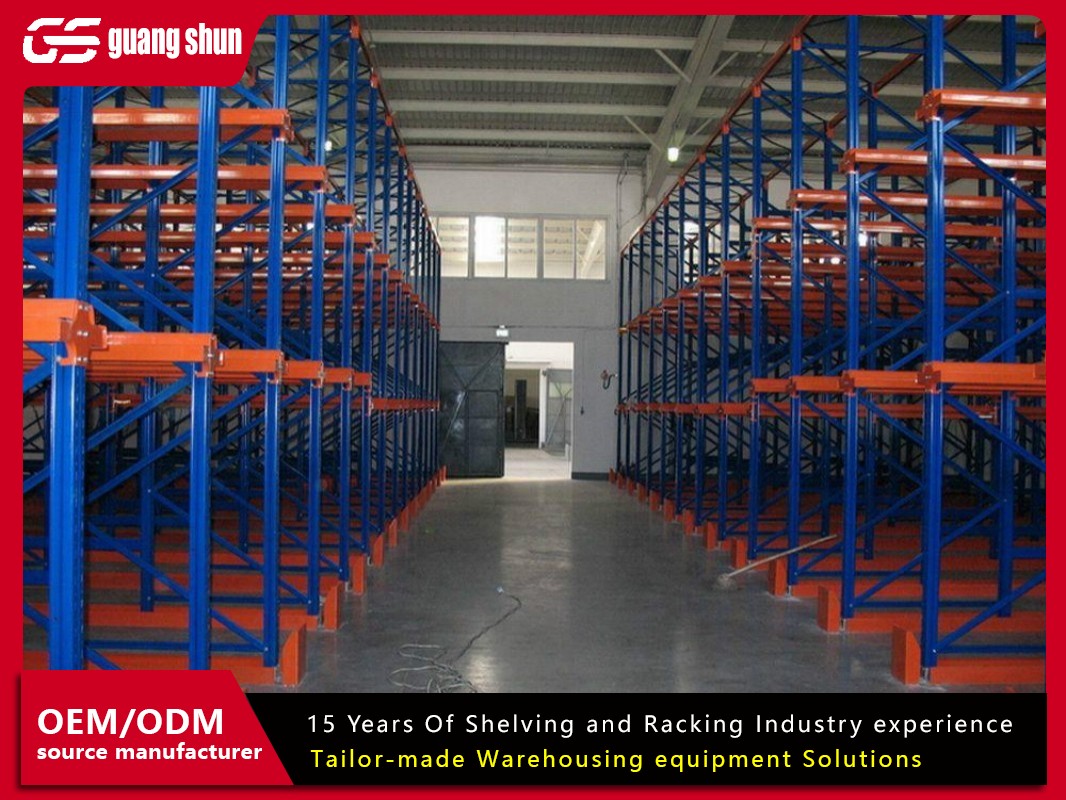
5.2 Drive-In Racking (LIFO)
Forklifts enter the structure; pallets stored on rails. Density increases by
60% versus selective, but throughput drops. Best for homogeneous bulk goods
(e.g., paper rolls, plastic pellets). Column protection essential—full-height
impact guards.
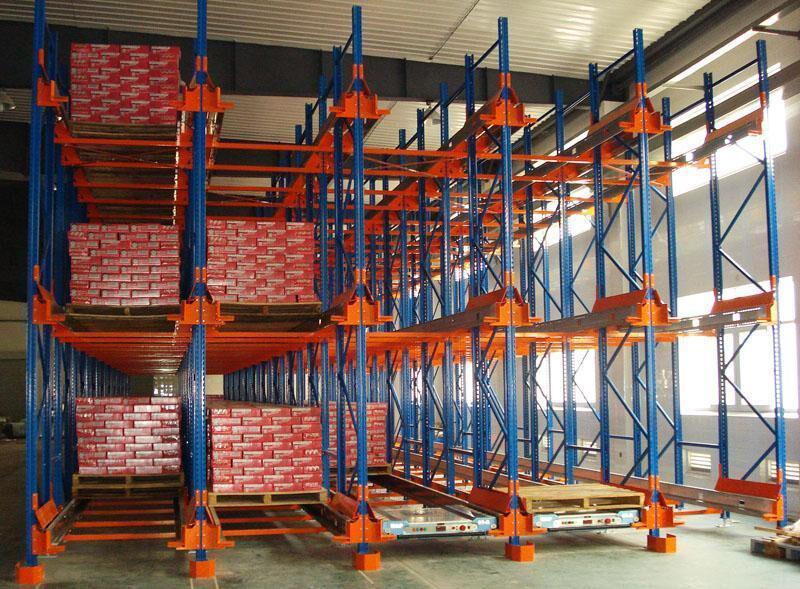
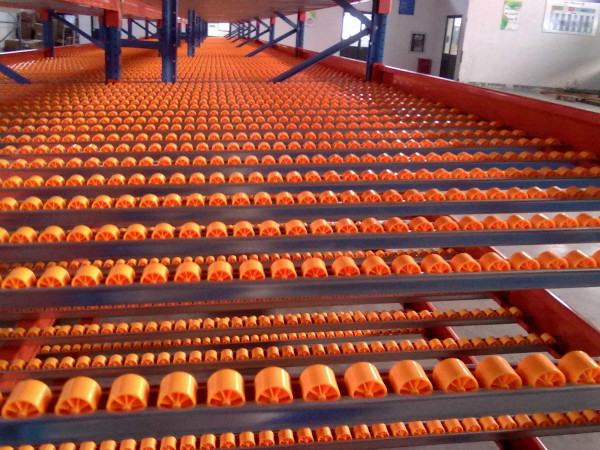
5.3 Push-Back and Pallet Flow
Push-back uses nested carts; pallet flow uses gravity rollers. Both offer
high density with better selectivity than drive-in. Pallet flow is true FIFO,
critical for perishables. Speed controllers must be adjusted for pallet
weight—typically 3–5 m/min descent.
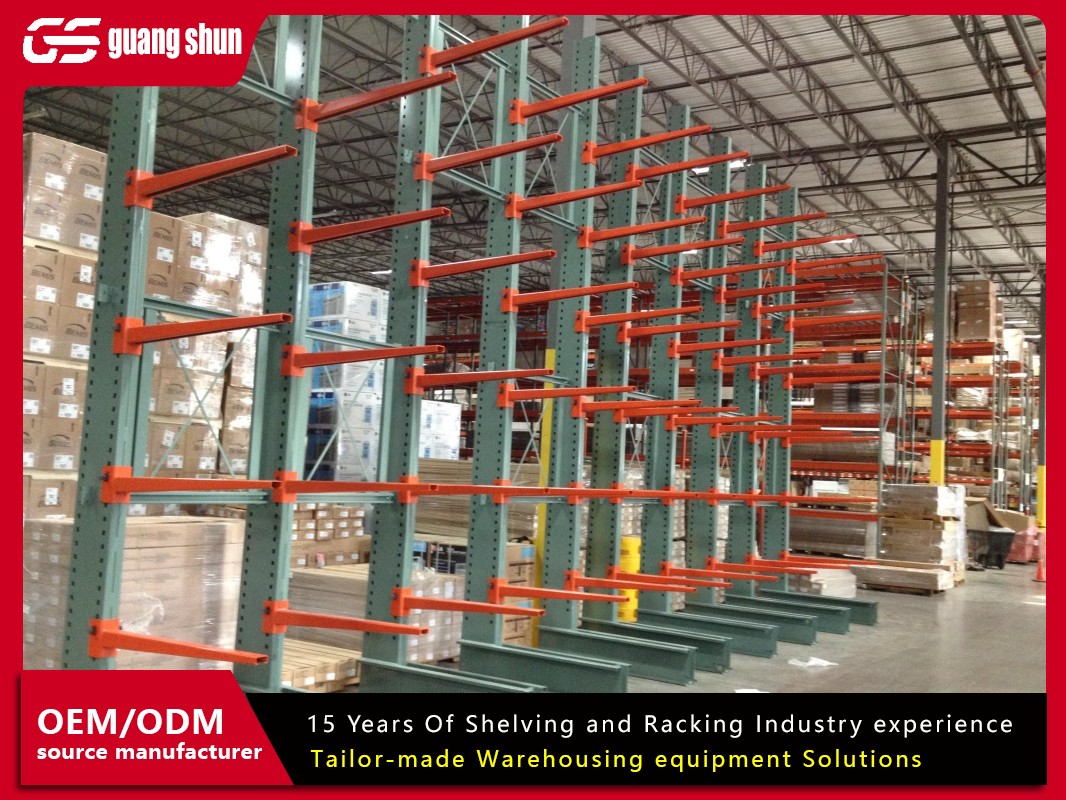
5.4 Cantilever Racking
For long loads (steel bars, timber, pipes). Arms adjustable vertically; load
capacities per arm up to 4,000 kg. Deflection limit L/180 governs arm design.
Guangshun’s cantilever systems use tapered arms to shed weight while maintaining
stiffness.
5.5 Very Narrow Aisle (VNA) Systems
Wire-guided or rail-guided trucks operate in aisles as narrow as 1.6 m.
Racking heights exceed 15 m. Floor flatness tolerances are critical (FM2 or
better). These industrial storage racking systems maximize cube
utilization but require precision installation and maintenance.
6. Installation Tolerances and Quality Control
Field installation directly affects structural performance. Key parameters
per FEM 10.2.02:
Plumbness: ≤ 2 mm per 3 m of height.
Baseplate level: Shimmed with steel plates (no wood).
Anchor torque: Verified with a torque wrench; typically
150–250 N·m for M16 anchors.
Beam level: Within 5 mm across bay length.
Industrial
storage racking installed outside these tolerances may experience unexpected
load redistribution and premature failure. Guangshun provides on-site survey and
laser alignment as part of turnkey projects.
7. Safety Inspections and Repair Protocols
Regular inspections per ANSI MH16.3 identify damage. Common damage
classes:
Class 1 (minor): Paint scratches; monitor only.
Class 2 (moderate): Bent uprights < 5 mm sweep; monitor
quarterly or reinforce.
Class 3 (severe): Bent uprights > 5 mm or torn sections;
immediate replacement required.
Repair techniques include cold straightening (limited to one cycle) or
splicing in new sections. Welding on load-bearing members is generally
prohibited unless specifically approved by a structural engineer.
8. Total Cost of Ownership (TCO) Analysis
When specifying industrial storage racking, initial material
cost is only one factor. TCO includes:
Maintenance: Impact damage repairs, anchor retorquing,
coating touch-up.
Downtime: Rack failure stops operations; cost can exceed
$10,000/hour in large DCs.
Insurance premiums: Certified racks may reduce rates.
Modifiability: Systems that allow beam repositioning (50 mm
centers) adapt to changing loads.
Guangshun’s modular designs enable reconfiguration without drilling or
welding, reducing future modification costs.
Conclusion
Industrial storage racking is a long-term capital investment
that demands rigorous engineering analysis. From material selection and
connection design to seismic detailing and installation tolerances, each
decision influences safety and productivity. By applying limit states design
principles and adhering to international codes, facilities can achieve storage
densities exceeding 90% while maintaining full accessibility. Guangshun supports clients with structural calculations, on-site surveys, and
post-installation audits to ensure that industrial storage
racking systems perform as specified for 20+ years.
Frequently Asked Questions (FAQ)
Q1: What is the difference between light-duty shelving and
industrial storage racking?
A1: Light-duty shelving (typically <500 kg per level)
uses thinner steel (1.0–1.5 mm) and is designed for hand-loaded items.
Industrial
storage racking is engineered for forklift-loaded pallets, with
beam capacities of 1,000–10,000 kg, thicker steel (2.5–4.0 mm), and full
compliance with structural codes like RMI or FEM.
Q2: How do I determine the required beam capacity for my
pallets?
A2: Calculate the maximum gross weight per pallet, then
multiply by the number of pallets per beam level. Add a safety factor (typically
1.2 for dynamic loads). Also consider beam span—longer spans require deeper
beams to meet deflection limits (L/180). Guangshun’s load tables provide
capacities for each beam size and span combination.
Q3: Can industrial storage racking be anchored to any
concrete floor?
A3: Concrete must have minimum compressive strength
(typically 25 MPa at 28 days) and thickness sufficient for anchor embedment
(usually 100–150 mm). Cracks near anchor points reduce capacity; post-tensioned
slabs require special embedded anchors. A pull-out test on site verifies anchor
capacity before full installation.
Q4: What are the seismic requirements for racking in
California?
A4: In California, industrial storage
racking must comply with CBC (California Building Code) based on IBC
with amendments. Seismic design includes calculating base shear, providing
cross-aisle bracing, and verifying anchor ductility. A licensed structural
engineer must seal the calculations. Guangshun offers seismic-engineered systems
with full PE stamping.
Q5: How often should industrial racking be inspected?
A5: ANSI/RMI standards recommend a formal inspection at
least annually, with monthly visual checks by warehouse staff. After any
significant impact or seismic event, an immediate inspection is required.
Inspections should document damaged uprights, loose anchors, and missing safety
clips.
Q6: What is the typical lifespan of industrial storage
racking?
A6: With proper maintenance and no major impacts,
industrial storage racking can last 20–30 years. Galvanized
systems in controlled environments have exceeded 40 years. However, cumulative
damage from forklifts often dictates replacement earlier. Regular inspection and
prompt repair extend service life significantly.
---
For structural load charts or seismic design assistance, visit Guangshun’s
industrial racking page or request an engineering consultation.