Double Deep Racking Systems: Engineering Density and Throughput for Modern WarehousesWarehouse managers often face a fundamental trade-off: maximizing storage capacity versus maintaining fast access to every pallet. Standard selective racking offers immediate accessibility but consumes floor space with multiple aisles. Drive-in systems maximize density but impose LIFO (last-in, first-out) constraints and slower cycle times. double deep racking occupies the middle ground—it stores pallets two-deep on either side of an aisle, doubling the depth compared to selective racking while retaining forklift access via reach trucks with telescopic forks. This article provides a technical deep dive into the engineering, operational nuances, and financial justification of double deep racking, drawing on industry data and the manufacturing expertise of Guangshun.
1. Technical Configuration of Double Deep Racking Systems
double deep racking consists of standard selective rack frames modified to accommodate two pallet positions in depth. This requires specific beam placements and clearances to allow the reach truck's pantograph mechanism to extend and retrieve the second pallet.
1.1 Frame Geometry and Beam Spacing
Upright frames for double deep racking are typically deeper (e.g., 1100 mm vs. 900 mm for selective) to provide stability for the two pallet loads. Beam levels must be aligned so that the rear pallet rests on the same pair of beams as the front pallet, but with sufficient clearance for fork entry. Standard beam depths range from 100 mm to 150 mm, with load capacities per beam pair engineered for the combined weight of two pallets (often up to 2 x 1200 kg). Guangshun uses roll-formed high-tensile steel to minimize beam deflection, which is critical to prevent trapping of the second pallet.
1.2 Reach Truck Compatibility and Aisle Widths
Unlike counterbalance trucks, reach trucks equipped with triple-stage masts and pantograph mechanisms can extend forks into the second position. The required aisle width for double deep racking typically ranges from 2.8 m to 3.2 m, depending on truck model and pallet size. This is narrower than selective racking (approx. 3.5 m for counterbalance) but wider than very narrow aisle (VNA) systems. The pantograph reach must be precise; some installations incorporate laser guidance to assist operators.
1.3 Pallet Overhang and Clearances
Standard pallets (e.g., 1200 x 1000 mm) must overhang the beams by at least 25 mm on each side to ensure stable support. In double deep racking, the rear pallet's position must be verified: if the front pallet is slightly forward, the rear pallet may become inaccessible. Thus, load stop bars or pallet supports are often installed on beams to prevent load shift during seismic events or forklift impacts.
2. Operational Dynamics: Handling Two-Deep Storage
Double deep systems introduce specific workflow considerations. Understanding these helps in designing warehouse processes that maximize throughput without compromising safety.
2.1 Storage and Retrieval Logic (LIFO by Lane)
Each lane (two pallets deep) inherently operates as LIFO for the rear position: the front pallet must be removed before accessing the rear pallet. This makes double deep racking suitable for SKUs with medium turnover where some batch storage is acceptable. Warehouse management systems (WMS) can be programmed to assign incoming goods to lanes with matching SKUs to minimize reshuffling. For high-velocity SKUs, front positions can be dedicated to fast movers, while rear positions hold reserve stock.
2.2 Forklift Training and Productivity Metrics
Operators must be skilled in using the pantograph to engage the rear pallet without damaging the front pallet or rack components. Cycle times for double deep are generally 15–20% longer than selective racking due to the extra reach movement. However, the reduction in travel distance (fewer aisles) often compensates. Studies by logistics institutes show that overall pallet moves per hour can be similar to selective racking when lane depth is optimized (two-deep) and SKU allocation is smart.
2.3 Integration with WMS and Automation
Modern double deep racking installations often integrate with RF scanning and put-to-light systems. The WMS directs operators to specific lanes and can sequence retrievals to minimize shuffling. Some facilities use semi-automated reach trucks with wire guidance to ensure precise fork positioning in the rear cells.
3. Comparative Analysis: Double Deep vs. Other Racking Types
Choosing between selective, double deep, and drive-in racking requires evaluating trade-offs in density, accessibility, and cost.
3.1 Storage Density Metrics
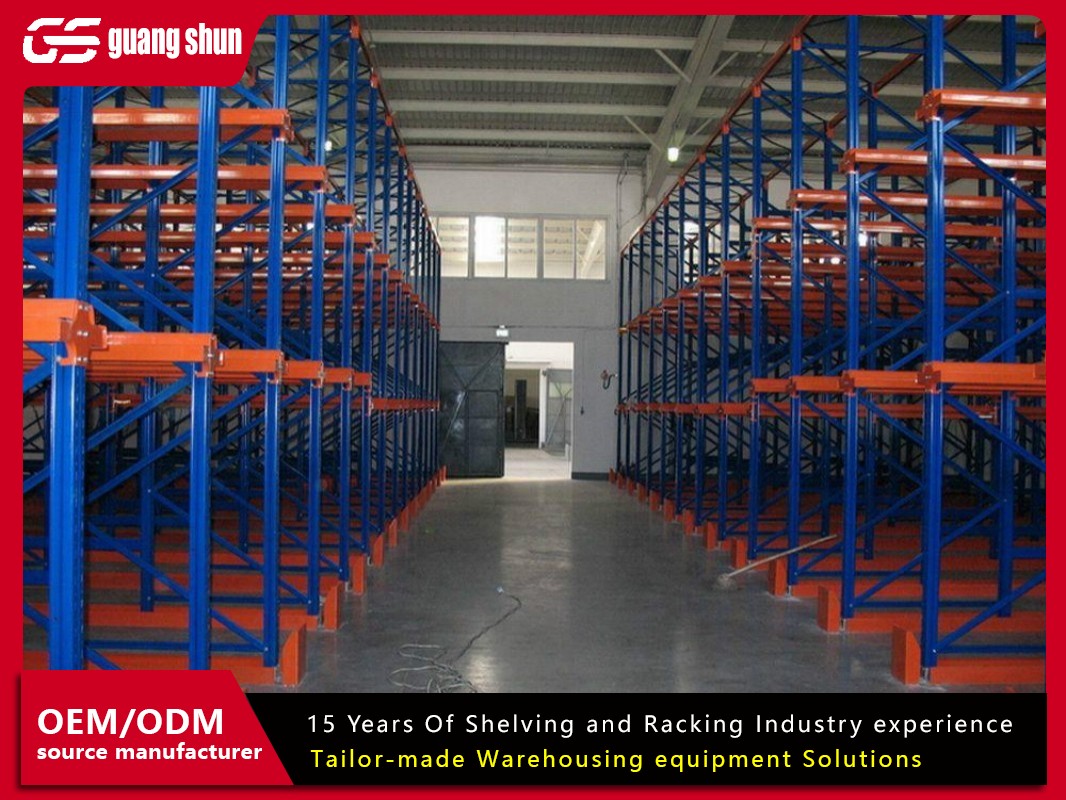
Selective racking uses one aisle for every two rows. double deep racking uses one aisle for four rows (two deep on each side), reducing aisle count by 50% compared to selective. This increases pallet positions per square meter by 30–50% depending on pallet size. Drive-in racking can achieve even higher density but sacrifices immediate access to all pallets (LIFO by lane, multiple deep). Double deep offers a compromise: two-deep LIFO, but every pallet is reachable with the right equipment.
3.2 Capital and Operational Cost Comparison
The rack structure for double deep is slightly more expensive per pallet position than selective due to deeper frames and additional beams. However, the reduced number of aisles means fewer forklifts and operators may be needed for the same throughput. A 10,000-pallet warehouse using double deep racking typically requires 3–4 fewer aisles than selective, saving floor space worth $200,000–$500,000 in construction costs. Guangshun provides ROI calculators that factor in these variables.
3.3 Throughput and SKU Segmentation
For facilities with a mix of fast, medium, and slow movers, a hybrid approach is common: selective racking for fast movers, double deep for medium movers, and drive-in or push-back for slow movers. This maximizes both density and throughput. Double deep is particularly effective in e-commerce fulfillment where inventory depth per SKU is moderate (2–4 pallets).
4. Engineering Considerations for Safe Installation
Structural integrity in double deep racking requires attention to floor conditions, seismic design, and impact protection.
4.1 Floor Flatness and Anchor Design
Because reach trucks operate in narrower aisles, floor flatness tolerances are tighter than for selective racking. FM Global or DIN 18202 standards recommend a maximum deviation of ±3 mm over 2 m. Anchor bolts must resist both shear and uplift from potential seismic events or accidental truck impacts. Guangshun specifies M16 or M20 anchors with embedment depths calculated per ACI 318.
4.2 Seismic Bracing and Load Distribution
In seismic zones, double deep frames require additional cross-aisle bracing due to the increased depth and mass. Diagonal steel sections or rod bracing must be sized to resist horizontal forces (typically 0.2g to 0.5g). The rear pallet can impose eccentric loads if not centered, so load distribution beams or pallet supports are essential. Shake-table tests have validated designs for up to Zone 4.
4.3 Impact Protection and Maintenance
The exposed corner posts at aisle entries are vulnerable to forklift strikes. Column guards (steel or energy-absorbing polymer) should be installed. Regular inspections must check for bent uprights or damaged beams, especially on the lower levels where impacts are most frequent. Replacement parts must match original specifications—never mix components from different manufacturers.
5. Industry Applications and ROI Analysis
double deep racking is widely adopted in food and beverage, pharmaceutical, and general merchandise distribution centers where inventory depth per SKU is moderate and space is at a premium.
5.1 Cold Storage and Food Logistics
In freezer warehouses, minimizing air exchange is critical. Double deep reduces the number of aisles, cutting refrigeration loss by up to 15%. Guangshun has supplied galvanized double deep systems for major cold chain operators, with special low-temperature lubricants for reach trucks and corrosion-resistant coatings.
5.2 Automotive Parts and Aftermarket
Automotive warehouses often store large quantities of identical parts (e.g., tires, batteries). Double deep provides dense storage while allowing some selectivity. With proper WMS zoning, picking efficiency can remain high.
5.3 ROI Calculation Example
Assume a 20,000 m² warehouse currently using selective racking for 15,000 pallets. Converting half the area to double deep racking could increase capacity to 21,000 pallets without new construction. With land and building costs at $1,500/m², this avoids $3 million in expansion. The additional rack cost (approx. $100,000) and reach truck investment ($50,000) pay back in under one year. Operational savings from reduced travel also contribute.
Frequently Asked Questions (FAQ)
Q1: What is the maximum number of pallets deep in double deep racking?
A1: By definition, double deep racking stores pallets two-deep on each side of an aisle. This is the limit for reach trucks with standard pantographs. For deeper storage (three or more), drive-in or push-back systems are required.
Q2: Can double deep racking be used with automated guided vehicles (AGVs)?
A2: Yes, specialized reach truck AGVs can handle double deep. They require precise navigation (laser or magnetic tape) and sensors to detect pallet positions. Guangshun works with automation integrators to provide racking compatible with AGV clearances.
Q3: What is the typical aisle width for double deep racking?
A3: Aisle widths typically range from 2.8 m to 3.2 m, depending on the reach truck model, pallet size, and operator skill. Some narrow-aisle reach trucks can operate in 2.6 m aisles. Consult the truck manufacturer's specifications.
Q4: How does double deep racking handle fire sprinkler requirements?
A4: Fire protection must account for the two-deep storage. In-rack sprinklers may be required if the depth exceeds certain thresholds (e.g., NFPA 13). Guangshun provides racks with pre-drilled holes for sprinkler pipes and clearance for deflectors. Always consult a fire protection engineer.
Q5: Can double deep racking be used for FIFO (first-in, first-out)?
A5: Standard double deep is LIFO per lane. For FIFO, you would need to access from both ends (e.g., drive-through configuration) or use specialized systems like push-back or pallet flow. However, with proper WMS slotting, you can assign lanes to ensure older stock is retrieved first (e.g., by using front positions for older pallets and rear for newer).
Q6: What maintenance is required for double deep racking?
A6: Regular inspections should focus on: beam locking clips, upright alignment, anchor integrity, and damage from forklifts. Any bent components must be replaced immediately. Lubrication of reach truck rails is separate. Guangshun offers inspection services and replacement parts.
Conclusion: Specifying Double Deep Racking for Optimal Density
double deep racking provides a proven solution for warehouses needing higher density than selective racking without the complexity of drive-in systems. By carefully engineering the rack structure, selecting appropriate reach trucks, and integrating with WMS, facilities can achieve significant space savings while maintaining reasonable throughput. Partnering with experienced manufacturers like Guangshun ensures compliance with safety standards and long-term durability. For a detailed site assessment and ROI projection, contact our engineering team.
For more technical resources, visit Guangshun’s knowledge base.