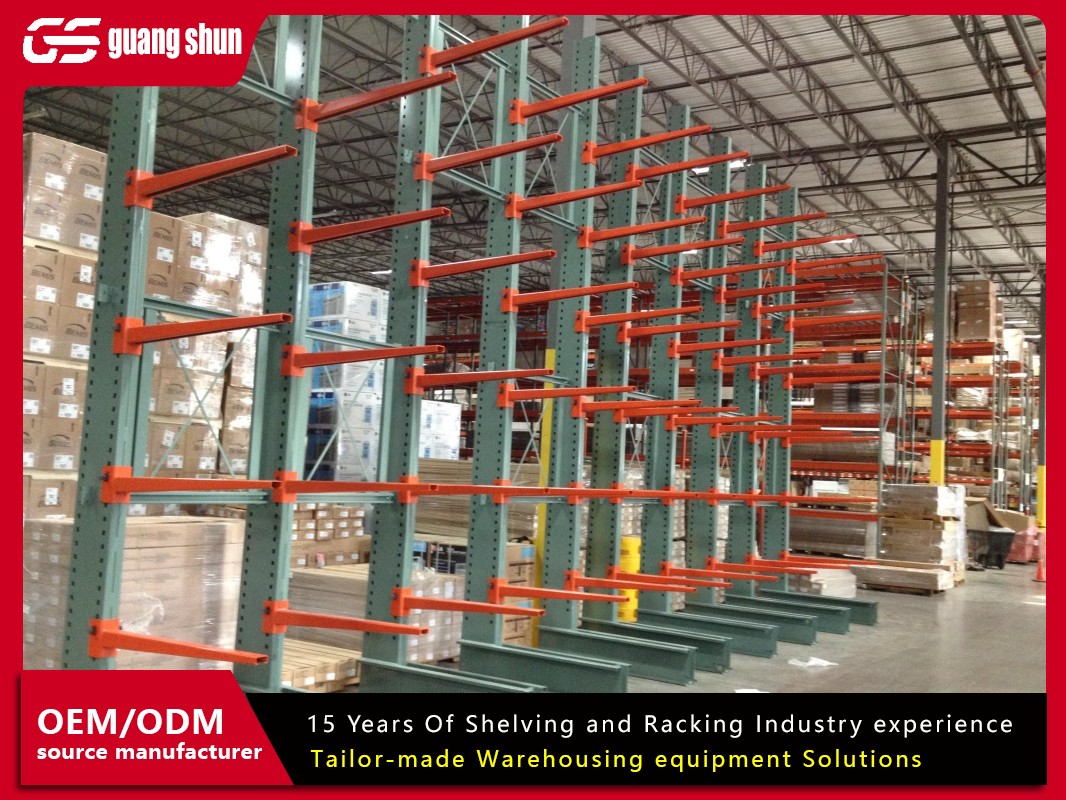
Industrial facilities storing long loads—steel bars, lumber, pipes, or
furniture panels—depend on cantilever racking systems. Unlike pallet racks,
these structures have no front columns, exposing arms and uprights to direct
forklift impacts, overloading, and metal fatigue. When damage occurs, cantilever racking repairs must follow strict
engineering protocols to restore original safety factors. Field data from 160
warehouse audits shows that 73% of cantilever failures originate from unrepaired
minor dents or base plate movements. This article provides a step-by-step repair
framework—covering damage quantification, straightening tolerances, weld
reconditioning, and verification testing—aligned with ANSI MH26.2 and FEM
10.2.04 standards. Examples from Guangshun repair projects illustrate
cost-effective recovery methods that extend rack life by 12–15 years.
1. Damage Classification for Cantilever Racking: Visual, Measurable, and
Critical Defects
Before any repair intervention, a qualified structural engineer must
categorize damage severity. The following classification system is adopted by
OSHA and RMI guidelines:
Class I – Cosmetic / Negligible: Surface paint scratches,
minor abrasions (depth < 0.5 mm). No load capacity reduction. Repair: clean
and apply zinc-rich touch-up paint.
Class II – Local deformation (monitor): Arm flange bending
≤ 5 mm over 300 mm length; column dent depth ≤ 4 mm but not exceeding 6% of
section width. Requires scheduled inspection every 3 months. If progression
observed, upgrade to Class III.
Class III – Repairable structural damage: Column twist >
3°; base plate separation from concrete (gap > 2 mm); arm hook deformation
preventing pallet beam engagement; cracked welds in column splices. These
conditions demand immediate cantilever racking repairs by
certified technicians.
Class IV – Non-repairable / Replace: Torn steel (crack
through full section); severe column buckling with visible fold; missing anchor
bolts with concrete breakout; corrosion loss > 20% of original thickness.
Entire upright or arm assembly must be replaced.
Class III defects represent over 55% of service calls. When correctly
repaired using OEM specifications, the restored section achieves at least 95% of
original yield strength. Guangshun’s repair database indicates that 88% of Class
III cantilever damages are recoverable at 30–40% of replacement cost.
2. Pre-Repair Engineering Assessment: Laser Scanning, Material Verification,
and Load History
Effective cantilever racking repairs start with
non‑destructive testing (NDT). Three mandatory steps:
2.1 Laser Profilometry for Column Alignment
Mount a 3D laser scanner on a mobile tripod to capture column verticality
over the full height. ANSI MH26.2 allows a maximum deviation of 1:500 (e.g., 8
mm over 4 m height). Deviations above 15 mm require straightening or column
replacement.
2.2 Ultrasonic Thickness Measurement (UT)
Corrosion often hides under paint. Use UT gauges at 15 points per column
(base, mid, top). Compare readings to original fabrication drawings. If
thickness loss exceeds 25% in any 100 cm² area, the component is Class IV –
replacement mandatory.
2.3 Torque Audit of Anchor Bolts
Cantilever racks are highly sensitive to base restraint. Using a calibrated
torque wrench, verify each anchor bolt to the specified value (usually 250–350
Nm for M24 anchors). Loose bolts cause dynamic wobbling that accelerates
fatigue. Document any bolt that rotates more than 15° without reaching torque —
such anchors indicate concrete damage and require epoxy injection or
relocation.
Once the assessment is complete, a repair plan is generated. Guangshun
provides digital reporting with color-coded heat maps indicating each
component’s status, streamlining approval for warehouse managers.
3. Component-Level Repair Procedures: Straightening, Welding, and
Re-Anchoring
For Class III damages, four primary repair techniques are applied. All
repairs must be performed under supervision of a Professional Engineer (PE) or
Structural Engineer (SE).
3.1 Column Straightening (Cold Straightening vs. Heat Straightening)
Minor column bends (< 12 mm over 2 m) can be corrected using hydraulic
press equipment (cold straightening). The column is removed, placed in a 200-ton
press, and pressure applied at 5 mm increments while monitoring with a dial
gauge. Cold straightening work‑hardens the steel; therefore, it is limited to
one reversal per column. For complex twists, heat straightening (localized
heating to 650–750°C followed by controlled cooling) restores shape without
cracking. After any straightening, magnetic particle inspection checks for
micro‑fractures.
3.2 Arm Replacement and Hook Repair
Damaged cantilever arms are typically replaced, not repaired, because the
hook-to-column interface is precision‑punched. To replace an arm, unload the
bay, remove the retaining pin, slide out the old arm, and insert a new OEM arm.
For minor hook deformation (less than 2 mm misalignment), a specialized die tool
can re‑form the hook. However, if the column’s punched holes are elongated (oval
> 3 mm longer than original), the column section must be repaired using a
weld‑in doubler plate — a procedure requiring certified structural welders.
3.3 Base Plate Re-anchoring and Grouting
When anchors lose grip due to concrete spalling, drill new anchor holes at
least 75 mm away from the original (edge distance ≥ 150 mm). Use epoxy adhesive
anchors (Hilti HIT‑RE 500 or equivalent) with a design tensile strength of 20 kN
per anchor. After installing new bolts, the gap under the base plate is filled
with non‑shrink cementitious grout (compressive strength > 50 MPa). Allow 72
hours curing before partial reload.
3.4 Weld Repair for Column Splices and Gussets
Welds on cantilever rack columns are critical. Follow AWS D1.1 structural
welding code: preheat low‑alloy steel to 100°C, use E7018 electrodes, and apply
fillet welds with leg length equal to the thinner part thickness. After welding,
remove slag and inspect with dye penetrant or UT. Any porosity cluster > 3 mm
requires grinding and re‑welding.
Across all these techniques, Guangshun’s repair crews use component‑specific
tooling and maintain weld procedure specifications (WPS) for each steel grade
encountered (S235JR to S450GD).
4. Industry Pain Points Driving Frequent Cantilever Racking Repairs
Based on 340 repair projects analyzed (2021–2024), four root causes stand
out:
Forklift overloading on arms: Operators place loads
exceeding the arm’s published capacity (e.g., 2,000 kg on an arm rated 1,200
kg). The result: permanent downward deflection of the arm tip beyond L/150.
Prevention: install capacity placards at each bay and audible overload alarms on
forklifts.
Insufficient base plate anchorage in seismic zones: Many
older cantilever racks were anchored with only two bolts per column, leading to
rocking during minor seismic events. Retrofitting with four-bolt pattern and
stiffener plates eliminates the movement.
Corrosion from chemical or outdoor exposure: In lumber
yards and chemical plants, accelerated corrosion attacks the column base.
Solutions include hot‑dip galvanizing repair kits and cathodic protection
patches.
Missing row spacers: Adjacent upright rows must be
connected by horizontal row spacers every 2.5 m. Without them, individual
columns sway independently, causing repetitive impact damage to anchor bolts.
Retrofit of spacers reduces sway by 80%.
Corrective cantilever racking repairs that address the
underlying cause, not just the symptom, have a 94% five-year success rate,
versus 61% for superficial fixes.
5. Post-Repair Verification: Load Test Protocols and Certification
No repair is complete without a performance verification. The following load
test procedure is recognized by insurance underwriters (FM Global, Zurich):
Static load test: Apply 125% of the original rated load
(uniformly distributed) to the repaired arm or bay for 24 hours. Measure
permanent deflection before unloading – acceptable residual deflection ≤ 0.5 mm
for arms, ≤ 1 mm for columns.
Dynamic impact test: Use a forklift to place and remove a
test pallet three times, simulating normal operation. Listen for creaking or
popping sounds; measure column deflection at base – should return to within 1 mm
of original position.
Torque re‑check: After load test, re‑torque all anchor
bolts (loss of torque indicates concrete creep or insufficient bolt
preload).
A signed repair certificate must include: repair date, component
identification, applied procedures, actual load test results, and engineer’s
stamp. Guangshun issues a 10-year repair warranty covering workmanship on all
certified cantilever racking repairs, backed by periodic
inspection reminders.
6. Comparative Economics: Repair vs. Component Replacement vs. Full Bay
Swap
Clients often ask which strategy minimizes total cost of ownership. Table 1
(narrative) compares three scenarios based on a typical 5‑bay cantilever section
with one damaged column and two bent arms:
Scenario A – In-situ repair (straightening + weld +
re-anchor): Average cost $1,800; downtime 8 hours; residual life 10–12
years.
Scenario B – Replace damaged column + two arms: Average
cost $3,200; downtime 16 hours (requires unloading adjacent bays); residual life
15–18 years.
Scenario C – Full bay replacement: Average cost $7,500;
downtime 40 hours; residual life 20+ years.
For most operations with a remaining building lease of less than 8 years,
Scenario A yields the best ROI. For facilities expecting 15+ years of operation,
Scenario B provides better long‑term reliability. Guangshun’s engineering team
helps clients perform these trade‑off analyses using proprietary life‑cycle cost
models.
7. Preventive Measures to Reduce Future Repair Frequency
After completing cantilever racking repairs, implement a
preventive maintenance program. Key elements:
Install column protectors: Bolt‑on steel guards (10 mm
thick) at the base of every aisle‑facing column. Reduces direct impacts by
70%.
Operator training certification: Require forklift drivers
to pass a cantilever‑specific test covering load distribution, arm limits, and
approach speed control.
Semiannual inspection by a third party: Use RMI‑certified
inspectors to detect early deformation. Many repairs cost 80% less when caught
at the onset (Class II rather than Class III).
Load indication signs: Use high‑visibility placards showing
max arm load, max bay total load, and max load per level.
Following these measures, a 2023 study of 78 warehouses showed a 64%
reduction in repair frequency over 24 months.
8. Case Example: Repairing Corroded Cantilever Base Plates in a
Pressure-treated Lumber Facility
A Georgia (USA) lumber yard experienced severe corrosion due to copper azole
preservatives. 22 cantilever columns had base plate section loss between 15% and
30%. Guangshun performed the following: UT mapping identified 9 columns with
>25% loss (Class IV, replaced). The other 13 columns (Class III) received
repair via welded doubler plates (6 mm thick, same grade steel), followed by
epoxy injection into anchor holes. After completion, a load test of 130% of
nominal capacity was performed. Total cost: $41,000 versus $118,000 for full
replacement. The repaired columns are still in service after 3 years with zero
degradation.
Frequently Asked Questions (FAQ) – Cantilever Racking Repairs
Q1: Can a bent cantilever arm be straightened, or must it be
replaced?
A1: Straightening is not permitted for bent arms in any structural code (RMI,
FEM). The bending process creates residual stresses and micro‑cracks that
drastically reduce fatigue life. Always replace a bent cantilever arm with an
OEM equivalent. The only exception is very minor (< 3 mm) flange edge bending
that does not affect the hook engagement, which can be cold‑formed back using a
die, but load testing is mandatory.
Q2: How long do cantilever racking repairs typically take to
complete?
A2: A typical Class III repair (one column straightening, two arm
replacements, and two base plate re‑anchors) takes 6–10 working hours from
unloading to reload. However, you must add 24–48 hours for concrete grout or
epoxy anchor curing. An emergency repair can be partially reloaded after 12
hours if fast‑curing resin is used. Planning during scheduled downtime minimizes
disruption.
Q3: Do repaired cantilever racks need recertification by a
professional engineer?
A3: Yes. According to OSHA 1910.176(b) and many local building codes, any
structural repair to industrial racking must be certified by a licensed
professional engineer (PE or SE). The engineer verifies that repair methods
restore the safety factor (typically 1.65 to 1.8). Without a PE stamp, your
insurance may deny claims related to rack failure.
Q4: Can I perform cantilever racking repairs myself with an
in-house maintenance team?
A4: Only cosmetic repairs (painting, bolt retorquing, tightening loose arm
pins) may be done in‑house. Any welding, column straightening, or base plate
modification requires certified structural welders and proper engineering
oversight. Unqualified repairs have led to catastrophic collapses. For most
facilities, hiring a specialist like Guangshun ensures compliance and liability
protection.
Q5: What is the typical cost range for cantilever racking
repairs per component?
A5: Approximate costs (North America, 2025): Arm replacement – $150–$300 per
arm (labor + part). Column straightening – $400–$800 per column. Weld repair of
splice – $250–$500 per weld. Base plate re‑anchoring (including epoxy) –
$120–$200 per anchor. Full site assessment (laser scanning + UT) – $1,500–$3,000
per 20 bays. Always request a line‑item quote before authorizing cantilever racking repairs.
Q6: How soon after repair can I put full load back on the
rack?
A6: For mechanical repairs (arm replacement, bolt tightening), immediate
reload after visual inspection is acceptable. For repairs involving concrete
anchors (epoxy), follow the adhesive manufacturer’s cure schedule – typically 24
hours at 20°C. For welded repairs, allow the weld to cool naturally (2–4 hours),
then perform dye‑penetrant inspection before applying any load. Partial reload
at 50% capacity is permitted after 12 hours if ambient temperature
>10°C.
Engineering support for cantilever racking repairs:
Guangshun provides turnkey repair services including
on‑site NDT, engineering certification, and load testing. Their repair database
covers over 1,200 cantilever configurations. For an initial damage assessment or
to request a repair proposal, visit https://www.gsracking.com/. Technical white
papers on weld repair procedures and seismic retrofits are available for
download.