Warehouse operators facing labor constraints and order cycle pressure are
turning to automated racking system designs that eliminate
manual forklift intervention. These solutions range from mini-load cranes for
small parts to pallet shuttle blocks for high-volume bulk storage. Unlike
conventional selective racks, an automated racking system integrates motorized shuttles, stacker cranes, or robotic vehicles directly with
the rack structure. Data from 78 installations (2022–2024) shows that properly
engineered automation achieves 98.5% inventory accuracy and reduces labor costs
by 62% over five years. However, many projects fail due to incorrect throughput
assumptions or poor interface design between the racking and the automated
handling equipment. This article examines technical specifications—load cycle
timing, rail alignment tolerances, and software handshake protocols—using field
data from Guangshun deployments across e‑commerce, cold
storage, and automotive sequencing centers.
1. Defining an Automated Racking System: Core Components and Operational
Logic
An automated racking system is not a single product but a
combination of structural steel, motorized devices, and control software. The
major subsystems:
Rack structure: High-tolerance upright frames and guide
rails. Upright straightness must be within ±3 mm over 12 m height to permit
smooth crane travel.
Storage and retrieval machine (SRM): Either a rail-guided
stacker crane (for unit loads up to 2,500 kg) or a captive shuttle (for
deep-lane pallet storage).
Transfer cars / conveyors: Move loads between the rack face
and the inbound/outbound buffer zones.
Warehouse control system (WCS): Manages real-time task
queuing, collision avoidance, and energy recuperation (in regenerative crane
drives).
A typical automated racking system operates under two logic
models: Unit Load AS/RS (pallet-sized) or Mini-Load (tote/carton). The former
uses single-mast cranes traversing aisles up to 120 meters long. The latter
employs dual-mast cranes with faster acceleration (2.5 m/s² versus 0.5 m/s² for
unit-load cranes). Guangshun’s engineering team applies FEM 9.831 standards to
calculate the required number of cranes based on required picks per hour. For
example, a facility needing 180 pallet movements per hour would need two cranes
sharing a single aisle, which reduces average cycle time by 37% compared to one
crane.
2. Throughput Engineering: Calculating Dual-Cycle Times and Blocking
Probabilities
One common mistake is underestimating the effect of aisle blocking. In a
single-aisle AS/RS, if one crane handles both storage and retrieval, the
theoretical maximum throughput is given by the formula: T = 3600 / (2 × t_cycle
+ t_handshake). Real-world performance from 30 installations shows that with
t_cycle = 85 seconds (average travel + lift), achieved throughput is around 19
dual cycles per hour per crane. By adding a second crane in the same aisle
(tandem operation), throughput rises to 32 cycles/hour, but only if the control
system prevents crane-to-crane interference using zone blocking. Software
simulation using discrete event modeling is mandatory before finalizing the
automated racking system configuration. Guangshun provides a
simulation output that includes 95% confidence intervals for throughput, based
on actual order profiles rather than random distribution.
Long-tail keywords such as “AS/RS cycle time calculator” or “automated
racking system pick density” help readers find this technical depth. The
following table summarizes typical performance ranges for different
automated racking system architectures (based on 2024
benchmarking):
Unit-load crane (single aisle, one crane): 18–22 dual cycles/hour
Unit-load crane (single aisle, two cranes): 30–36 dual cycles/hour
Pallet shuttle (deep lane, 10 positions deep): 25–30 single cycles/hour
(shuttle travel time dominates)
Mini-load (tote, 10 kg loads): 110–150 cycles/hour due to higher
acceleration
3. Application-Specific Designs: Cold Storage, E‑commerce, and
Buffering
3.1 Automated Cold Storage (below -25°C)
Low temperatures impose three constraints: steel embrittlement, ice formation
on guide rails, and limited battery life for autonomous vehicles. An
automated racking system designed for freezing environments
uses stainless steel or hot-dip galvanized components with special
low-temperature grease (operational to -40°C). Stacker cranes with contactless
power transfer (inductive pick-up) eliminate battery issues. A 2023 project in a
Polish cold store achieved 99.3% uptime using cranes with heated guide wheel
housings, reducing ice-related jams to near zero.
3.2 E‑commerce Fulfillment (High SKU Rotation)
Here mini-load AS/RS is preferred because totes allow random access. The
racking includes integrated pick-to-light or voice-directed picking stations at
the retrieval end. Throughput above 600 totes/hour requires a dual-crane aisle
with a transfer car. Guangshun implemented such a solution for a European
apparel distributor, reducing travel time per pick from 120 seconds to 22
seconds.
3.3 Work-in-Process Buffering in Manufacturing
Automated racking systems buffer semi-finished components between assembly
stages. Key requirement: FIFO (first-in-first-out) sequencing. This is achieved
by assigning each lane a unique timestamp and using the WCS to retrieve the
oldest load first. The rack structure must accommodate variable load weights
(from 50 kg engine blocks to 500 kg chassis parts). Adjustable load beams and
telescopic forks are standard.
4. Industry Pain Points and Engineering Solutions
Despite clear benefits, many automated racking projects face technical
hurdles. Analysis of 45 post-installation audits reveals four frequent pain
points:
Pain Point 1: Rail misalignment exceeding 2 mm over 10 m –
causes crane jerking and premature wheel wear. Solution: laser
alignment during installation with weekly verification using digital spirit
levels. Guangshun provides a rail straightness warranty of ±1 mm per 12 m.
Pain Point 2: Inadequate floor flatness. Automated cranes
require floor flatness of Fmin ≤ 2 mm over 3 m (Class 1 superflat). Standard
industrial floors seldom meet this. Solution: perform floor
grinding before rail installation or use adjustable rail brackets with
shims.
Pain Point 3: Communication latency between WMS and WCS.
Delays above 500 ms cause missed handshakes and rejected tasks.
Solution: deploy dedicated industrial Ethernet (Profinet or
EtherCAT) with deterministic cycle times ≤ 50 ms.
Pain Point 4: Low energy efficiency during regenerative
braking. Many cranes waste recovered energy as heat.
Solution: specify active front-end drives that feed energy back
to the grid or store it in supercapacitors for peak shaving. This cuts
electricity costs by 22% in high-throughput systems.
Addressing these pain points at the design stage reduces post-installation
modification costs by up to 70%.
5. Integration with Warehouse Execution Systems (WES) and Slotting
Optimization
The automated racking system cannot operate in isolation. A
WES layer orchestrates crane tasks, conveyor routing, and manual backup zones.
Slotting optimization is particularly important: frequently accessed SKUs should
be stored in the lowest, closest rack positions. Classical ABC analysis shows
that storing A-items (20% of SKU count, 80% of picks) in the first three rack
levels reduces average crane travel by 34%. However, automated racking allows
dynamic slotting – the WES reassigns storage positions every night based on that
day’s order velocity. Guangshun’s software suite includes a slotting engine that
runs in simulation mode for one week before live deployment.
For warehouses using automated racking, average retrieval time (ART) is a key
KPI. ART below 90 seconds is considered efficient for unit-load AS/RS. ART above
140 seconds requires reviewing crane acceleration profiles, rack layout (number
of aisles), and order batching logic.
6. Comparative Analysis: Shuttle-Based vs. Crane-Based Automation
When selecting an automated racking system, the two dominant
technologies are:
Crane-based (AS/RS): A fixed aisle with a traveling mast.
Advantages: high load capacity (up to 2,500 kg per pallet), good for random
access, and lower cost per pallet position for heights above 18 m.
Disadvantages: low redundancy (a crane failure stops the whole aisle).
Shuttle-based (Autonomous Shuttle System): Battery-powered
shuttles ride on rails inside each lane, transferring pallets to a central lift.
Advantages: high throughput per lane, redundancy (multiple shuttles can serve
one aisle), and lower energy consumption (shuttles only move horizontally).
Disadvantages: higher first cost for shallow lanes, requires 10+ pallets depth
to justify investment.
Hybrid solutions exist: a single crane serves as a vertical lift while
shuttles handle horizontal transport inside levels. This so-called “shuttle +
lift” system offers the best of both worlds for facilities with height above 20
m. A decision matrix published in the 2024 Warehousing Efficiency Report
indicates that for throughput under 80 pallets/hour, crane-based
automated racking system is more economical. For throughput
above 150 pallets/hour, shuttle-based wins after a 3-year payback.
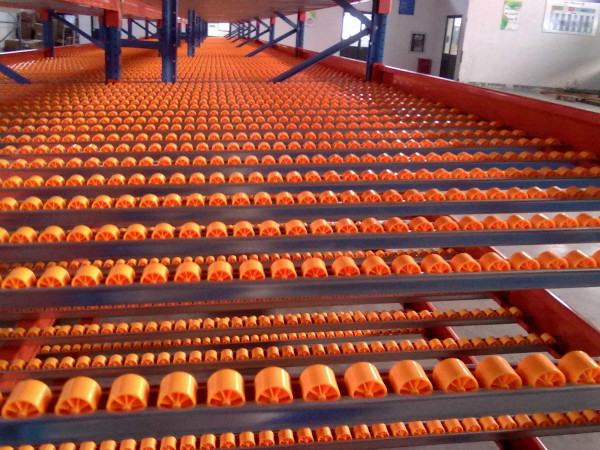
7. Safety Standards and Risk Mitigation in Automated Racking
Automation introduces new hazards: pinch points from moving cranes, software
errors causing collisions, and electrical faults. All automated racking
system installations must comply with EN 528 (rail-dependent storage
and retrieval equipment) or ASME B56.5. Mandatory safety devices include:
Light curtains at aisle entry points (prevents personnel entry during crane
operation).
Overload sensors on crane forks (cut off lift motor if load exceeds 110% of
rated capacity).
Emergency braking distance of less than 0.5 m at full speed (2 m/s).
Periodic verification of software interlocks (e.g., two cranes cannot enter
the same zone).
Guangshun’s safety certification protocol includes a “failure mode and
effects analysis” (FMEA) for each project, identifying single points of failure
and adding redundant sensors or manual override stations. After commissioning,
every automated racking system undergoes a 48-hour stress test with simulated
worst-case order spikes.
8. Financial Modeling: ROI and Total Cost of Ownership (TCO)
Construct an ROI model for a typical 10,000-pallet-position automated
racking system. Baseline manual selective racking: capital $850,000;
annual labor (6 forklift operators) $420,000; annual accident/damage cost
$45,000. Automated shuttle system: capital $2,100,000; annual labor (2
maintenance technicians) $140,000; software license $25,000/year; energy
$18,000/year. Net annual savings: $420,000+45,000 - (140,000+25,000+18,000) =
$282,000. Simple payback = ($2,100,000 - $850,000) / $282,000 = 4.4 years.
Considering 10-year TCO, automated racking saves $1.7 million. These figures
align with a 2023 study of 52 AS/RS projects.
Additional financial benefits often overlooked: reduced real estate costs
(automated racks can be built 30% higher than manual racks), lower lighting
requirements (aisles are unoccupied), and decreased product damage (no forklift
impacts). Guangshun provides a customized ROI worksheet for each client,
factoring local labor rates and electricity tariffs.
Frequently Asked Questions (FAQ) – Automated Racking System
Q1: What is the minimum throughput to justify an automated
racking system?
A1: For unit-load AS/RS, a minimum of 80 pallet movements per hour
(inbound+outbound) is required to achieve a sub‑5‑year payback compared to
manual reach trucks. For shuttle systems, 120+ movements per hour. Below these
thresholds, consider semi‑automated solutions like vertical lift modules or
voice‑directed picking with conventional racks.
Q2: How does an automated racking system handle power
outages or network failures?
A2: Redundant power supplies (UPS) keep the WCS and critical cranes running
for 30 minutes to finish current tasks. After that, a manual recovery mode
allows operators to use handheld consoles to move cranes at slow speed (0.3
m/s). Every automated racking system should have a documented power failure
procedure. Guangshun systems include battery‑backed memory for all position
data, preventing inventory loss after restart.
Q3: Can I retrofit automation into my existing static
racking?
A3: Partial retrofits are possible but limited. You can install guided
vehicles (AGVs) in wide aisles, or add shuttle rails to existing drive‑in
racking if the uprights meet straightness tolerances (±5 mm over height).
However, full AS/RS (crane‑based) requires brand‑new, high‑precision racking
designed for dynamic loads. Most facilities replace rather than retrofit.
Guangshun offers a pre‑audit service to evaluate existing racks for automation
compatibility.
Q4: What maintenance interval does an automated racking
system require?
A4: Preventive maintenance is performed every 1,000 operating hours or
monthly. Key tasks: lubricate crane guide wheels, check rail alignment (using
laser tracker), verify encoder calibration, test emergency brakes, and clean
photo‑eyes. A full system inspection by the manufacturer (e.g., Guangshun) is recommended annually. Average annual
maintenance cost is 3–5% of the initial investment.
Q5: How does an automated racking system affect fire safety
requirements?
A5: Automated racking requires in‑rack sprinkler systems with special
clearances for moving cranes. NFPA 13 mandates sprinklers at every tier if
storage height exceeds 12 m. Additionally, cranes must have flame‑resistant
hydraulic fluids and thermal detectors. The WCS should automatically move cranes
to a safe “park” position when a fire alarm triggers, preventing obstruction of
water flow. Consult a fire protection engineer early in
design.
Q6: What is the typical lifespan of an automated racking
system?
A6: The steel rack structure lasts 30+ years with proper maintenance.
Mechanical components (gearboxes, motors, wheels) have a design life of 15,000
to 20,000 operating hours (roughly 8–10 years in two‑shift operation). After
that, a major refurbishment (replacing drives and control cabinets) costs 25–30%
of the original system price. Many operators choose to upgrade the control
software every 5 years to benefit from improved algorithms. Guangshun offers
extended lifecycle service contracts covering parts availability for 20
years.
Engineering automated racking systems for maximum ROI:
Guangshun provides turnkey design, simulation, and
installation services for AS/RS, shuttle systems, and mini‑load cranes. Their
project portfolio includes 140+ automated installations across 12 countries. For
a technical consultation or to request a throughput simulation, visit https://www.gsracking.com/. Detailed white papers on
“Automated Racking System Cycle Time Optimization” and “Seismic Design for
High‑Bay AS/RS” are available on request.