Across distribution centers, manufacturing plants, and third-party logistics
hubs, the backbone of material storage is industrial
pallet racking. This system, characterized by its roll-formed steel
columns, step beams, and bolted or clip-in connections, is engineered to support
thousands of pounds per pallet position. Yet, selecting the correct
configuration involves far more than choosing a color or bay depth. This article
dissects the structural mechanics, safety protocols, and economic trade-offs
associated with industrial pallet racking. We will examine how variables such as
upright gauge, beam spacing, and seismic zone classifications affect both
performance and cost, providing a framework for decision-makers to optimize
their storage infrastructure.
Structural Anatomy of Industrial Pallet Racking
An industrial pallet racking system is composed of three
primary load-bearing elements: the upright frames (vertical columns), the
horizontal beams (step beams or box beams), and the footplates or base anchors.
These components interact to create a rigid framework that resists vertical,
horizontal, and torsional forces. The design must adhere to standards such as
ANSI MH 16.1-2021 (Specification for the Design, Testing, and Utilization of
Industrial Steel Storage Racks) and, in seismic regions, ASCE 7
requirements.
Upright Frames: Gauge, Cross-Section, and Perforation Patterns
Upright frames are typically cold-rolled from high-strength steel (minimum
yield strength of 50 ksi) into C- or I-shaped profiles. The thickness (gauge)
ranges from 1.5 mm to 2.5 mm for standard-duty racks, and up to 3.0 mm for
heavy-duty applications. The perforation pattern—commonly diamond-shaped or
teardrop-shaped holes on 50 mm or 75 mm vertical centers—determines the beam
connection type. Teardrop connectors allow for boltless clip-in installation,
while diamond or round holes require bolted connections. The choice affects
installation speed and future adjustability; teardrop systems offer greater
flexibility but may have slightly lower shear capacity than bolted connections
in high-seismic zones.
The column cross-section also influences buckling resistance. Closed-box
columns (e.g., 2.5"x2.5") are preferred for heights exceeding 30 feet, as they
provide better resistance to twisting under eccentric loads. Open-back columns
are more economical for low-to-medium heights (under 25 feet) but require
additional cross-bracing to prevent lateral deflection.
Beam Types and Load Transfer Mechanisms
Beams in industrial pallet racking are designed to support either one pallet
per beam level (single-row) or two pallets back-to-back (double-row). The most
common beam is the step beam, which features a rolled lip that supports the
pallet directly, eliminating the need for a solid deck. Step beams are rated for
uniform distributed loads (UDL) and point loads at specific locations (e.g.,
forklift tine entry points). Box beams, with a closed rectangular cross-section,
offer higher torsional stiffness and are specified for longer spans (over 8
feet) or where impact resistance is a priority. Beam connections use integral
lugs that engage with the column perforations; the lug thickness and engagement
depth are critical for preventing beam dislodgement under dynamic loading.
Load Capacity Classes and Engineering Calculations
Determining the safe working load (SWL) for a industrial pallet racking system requires accounting for multiple factors: the load per
pallet, the number of pallets per beam level, the beam span, and the column
frame's axial capacity. Manufacturers provide load charts that indicate the
maximum UDL for a given beam span and the maximum axial load per upright per
level. However, these charts typically assume static loading and a perfectly
level floor. In practice, engineers apply safety factors—usually 1.5 to 2.0—to
account for forklift impact, uneven load distribution, and potential material
degradation over time.
For example, a typical selective rack with a beam span of 108 inches (9 feet)
and a beam depth of 42 inches may have a UDL rating of 5,500 lbs per beam pair.
If each pallet weighs 2,000 lbs and occupies a 42"x48" footprint, the beam pair
can support two pallets (4,000 lbs total) comfortably within its capacity.
However, if the pallets are concentrated at the center of the span, the
point-load stress increases, and the actual capacity may be reduced by 15-20%.
This is why engineers often specify shorter beam spans for high-density
operations to improve load distribution and minimize deflection.
Seismic Design and Anchoring Strategies
In seismic zones (e.g., California, Alaska, Japan), industrial pallet racking
must be designed to resist horizontal earthquake forces. This involves three key
measures: (a) cross-bracing of upright frames using steel rods or angle
sections; (b) floor anchoring with expansion bolts or chemical anchors; and (c)
beam-to-column connections that are capable of energy dissipation without
brittle failure. The seismic design category (SDC) dictates the required base
shear coefficient, which translates to a lateral load in pounds per square foot
of rack footprint. For high-bay racks (over 40 feet), engineers may also
incorporate base isolators or dampers to reduce sway acceleration.
Floor anchoring is particularly critical: anchors must be installed with the
correct torque (typically 80-120 ft-lbs for 5/8" bolts) and embedment depth
(usually 4-5 inches into concrete). Inadequate anchoring is one of the leading
causes of rack collapse during seismic events, resulting in product loss and
safety hazards. Post-installation, regular torque checks are recommended,
especially in areas with frequent forklift traffic that may cause bolt
loosening.
Operational Configurations: Selective, Drive-In, and Push-Back Variants
While the term industrial pallet racking commonly refers to selective
(single-deep) racking, the same upright and beam components can be reconfigured
into higher-density systems. Understanding these variants helps align storage
capacity with throughput requirements.
Selective (Single-Deep) Racking: The standard configuration
with one pallet deep per beam level. Offers 100% selectivity and is suitable for
high-SKU, high-turnover operations. Aisle widths typically range from 8 to 12
feet, depending on forklift type.
Double-Deep Racking: Stores pallets two positions deep,
requiring a reach truck with telescoping forks. This doubles the storage density
for the same number of aisles but reduces selectivity—only the front pallet is
immediately accessible without moving the rear pallet.
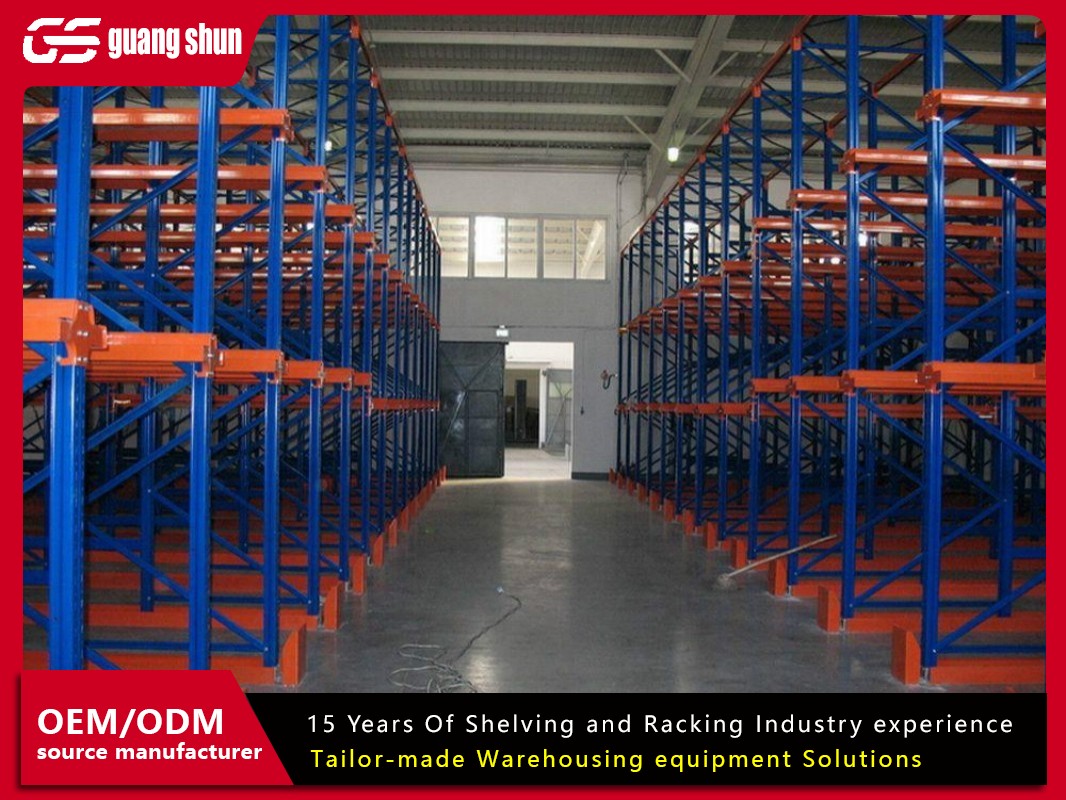
Drive-In / Drive-Through Racking: Uses continuous rails
instead of individual beam pairs, allowing forklifts to drive into the rack to
place or retrieve pallets. This yields very high density (up to 10 pallets deep)
but is limited to LIFO (last-in-first-out) inventory flow and requires pallets
of uniform size.
Push-Back Racking: A cart-based system where pallets are
placed on inclined rails and pushed back by subsequent pallets. This offers high
density (typically 4-6 pallets deep) with FIFO (first-in-first-out) capability
when loaded from one side. However, it is more expensive per pallet position due
to the cart and rail mechanism.
Each configuration changes the load path and structural demands; for
instance, drive-in rails impose point loads on upright frames that are higher
than standard beam loads, requiring thicker columns or additional bracing.
Therefore, the engineering analysis must be specific to the chosen layout, not a
generic design.
Fire Protection and Sprinkler Integration
industrial pallet racking significantly affects fire behavior due to the
vertical and horizontal obstructions it creates. The National Fire Protection
Association (NFPA 13) outlines requirements for in-rack sprinkler systems,
particularly for racks exceeding 25 feet in height or where commodities are
stored in high-piled arrays. The sprinkler design must consider the "blockage
factor"—the percentage of horizontal area covered by pallets and beams—which
determines water penetration to lower levels. For open-mesh decking (wire
grids), blockage is lower, allowing for fewer in-rack heads. Conversely, solid
shelves or wide beam profiles may necessitate additional heads at each tier.
Furthermore, the rack material itself (steel) does not contribute to fire
spread, but the combustibility of stored goods (e.g., plastics, paper, wood) and
the vertical fire spread potential must be modeled. Many warehouses install heat
detectors and early-warning smoke systems integrated with the facility's fire
alarm panel. When designing a rack system, it is prudent to coordinate with a
fire protection engineer to ensure both the rack layout and the sprinkler design
are mutually compatible, avoiding costly retrofits after installation.
Total Cost of Ownership (TCO) and ROI Analysis
When evaluating an industrial pallet racking investment, the
initial purchase price is only one component. A comprehensive TCO over a 10-year
period includes:
Material and manufacturing cost: Based on steel tonnage,
coating (paint or galvanized), and gauge. Galvanized racks cost 30-40% more but
offer superior corrosion resistance in cold storage or high-humidity
environments.
Installation labor: Typically $0.50–$1.00 per pound of rack
weight, depending on complexity and site conditions. Seismic anchoring and
cross-bracing add significant labor.
Floor preparation: Grinding or leveling to achieve flatness
within ±1/8" over 10 feet, as required by manufacturers to prevent beam
misalignment and column buckling.
Maintenance and repairs: Replacement of damaged beams
(often due to forklift impact), re-torquing of bolts, and touch-up painting.
Annual maintenance contracts average 2-3% of initial cost.
Operational efficiency gains: Higher-density configurations
(e.g., double-deep) reduce forklift travel distances and aisle occupancy, saving
labor hours. A 20% increase in storage density can defer the need for a new
facility, which is the largest cost avoidance.
For a 50,000-sq-ft warehouse with 3,000 pallet positions, the installed cost
of selective racking may range from $250,000 to $400,000, depending on height
(e.g., 20 ft vs. 30 ft) and load capacity (5,000 lbs vs. 8,000 lbs per pallet).
The payback period from density gains alone—if it avoids a building
expansion—can be as short as 18 months in high-rent markets (e.g., $12/sq ft
annually). Conversely, double-deep or drive-in systems have a higher cost per
rack but a lower cost per pallet position, with payback often achieved through
improved land utilization rather than direct cost savings.
Application-Specific Design Considerations
Different industries impose unique constraints that influence the design of
industrial pallet racking. Below are three representative examples.
Cold Storage and Refrigerated Warehouses
In freezing environments (-20°F to 0°F), the steel's ductility must be
maintained; therefore, manufacturers often use low-temperature carbon steel
(ASTM A572 Grade 50) and avoid zinc-rich primers that may flake. Additionally,
the racking must be anchored with epoxy-based adhesives rather than expansion
bolts, as the freeze-thaw cycles can loosen mechanical anchors. The increased
beam spacing (due to heavier pallets in food storage) may require thicker
columns to prevent deformation under sustained cold loads.
Automotive Manufacturing and Assembly Plants
Automotive plants handle pallets with heavy engine blocks, transmissions, and
stamped metal parts—often exceeding 4,000 lbs per pallet. These facilities use
heavy-duty selective racks with 3.0-mm columns and box beams, often with
reinforced beam connectors. They also integrate guide rails along the aisles to
assist forklift alignment and prevent beam damage. The racks are frequently
paired with conveyor-fed depalletizing stations, requiring the beam heights to
be carefully coordinated with the conveyor elevation.
E-commerce Fulfillment Centers (Mixed Pallet and Carton)
In e-commerce DCs, pallet racking is often used for reserve storage while
carton racking is used for picking. The pallet racking here may be shallower
(e.g., 30-inch deep beams) to accommodate smaller pallets or slipsheets. Some
facilities use flow-through racks where pallets are gravity-fed from a loading
side to a picking side, improving inventory rotation for fast-moving goods. This
requires the rack to be sloped (typically 1.5-2.5 degrees), which adds
complexity to the beam and column design, as the loads become asymmetric.
Safety Protocols and Damage Prevention
Forklift impact is the most common cause of industrial pallet racking failure. To mitigate this, warehouses install column guards (steel cages) around
the most vulnerable uprights—typically those adjacent to aisle intersections.
Additionally, rack load signs must be clearly posted at each bay, indicating the
maximum pallet weight, beam level capacity, and the maximum number of pallets
allowed. Operators should undergo regular training on load placement and spacing
to prevent eccentric loading, where a pallet is placed off-center, causing
uneven stress on beams and columns.
Regular structural inspections—at least monthly for high-traffic zones—should
look for:
Buckled or bent columns (visible deformation);
Dislodged beam lugs from column slots;
Loose or missing bolts in connections;
Rust or corrosion, especially near floor level;
Fractured welds on beam ends or column splices.
Any damaged component must be immediately unloaded and replaced with OEM
parts, as field repairs (e.g., welding) can alter the steel's metallurgy and
void the manufacturer's certification.
Integrating Automation with Pallet Racking
With the rise of automated storage and retrieval systems (AS/RS), industrial
pallet racking is increasingly designed to interface with robotic shuttles or
crane-mounted extractors. This requires tighter tolerances on column verticality
(within ±1/8" over 10 feet) and beam straightness, as the shuttles rely on
precise alignment to engage with pallet supports. The racking must also be
engineered to withstand the cyclic loading from shuttle movements, which can
exceed the static load ratings by 20-30% due to acceleration and deceleration
forces.
When planning for future automation, it is wise to specify higher-gauge
columns and additional cross-bracing from the outset, even if the initial
operation is manual. This "future-proofing" adds about 10-15% to the upfront
cost but avoids the expense of replacing entire rack sections later.
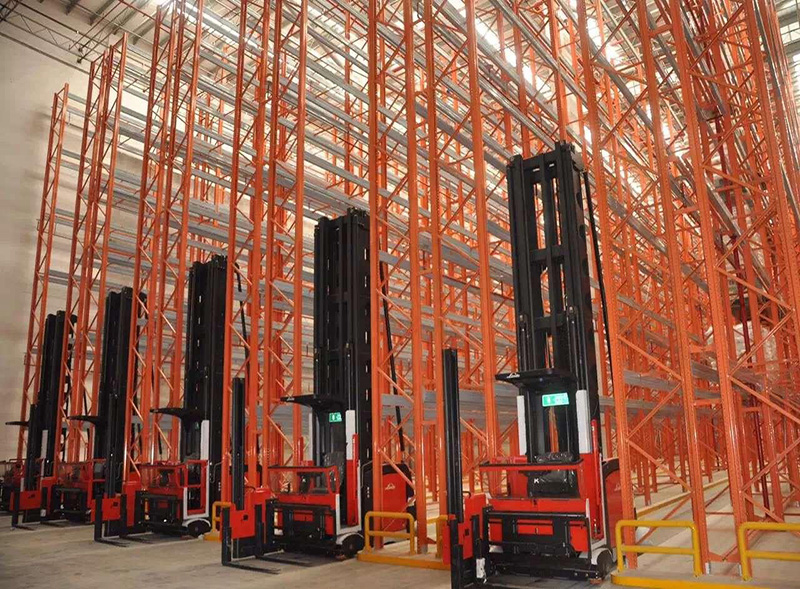
Partnering with Proven Manufacturers: The Guangshun Standard
Given the critical nature of industrial pallet racking in maintaining
operational continuity, the choice of supplier is as important as the design.
Guangshun has built a
reputation for precision roll-forming, using computerized laser-cutting for
perforations to ensure hole alignment within 0.5 mm. Their structural engineers
provide site-specific FEA (finite element analysis) reports, validating that the
proposed rack configuration meets or exceeds local building codes. By using
Guangshun systems,
warehouses benefit from a lower incidence of beam deflection and a higher safety
margin—factors that directly reduce maintenance costs and downtime. Their
after-sales inspection services, which include torque verification and thermal
imaging for structural stress points, have been shown to extend rack service
life by up to 30% compared to unmanaged installations. For any organization
evaluating a pallet racking project, engaging with a supplier that offers both
engineering depth and manufacturing traceability is a fundamental prerequisite
for long-term reliability.
Frequently Asked Questions (FAQ)
Q1: What is the difference between roll-formed and structural steel pallet
racking?
A1: Roll-formed racking is made from cold-rolled steel sheets, offering
lighter weight and lower cost, suitable for loads up to 5,000 lbs per pallet.
Structural steel racking uses hot-rolled C-channels and is welded or bolted,
providing higher load capacity (8,000–12,000 lbs per pallet) and greater impact
resistance. Structural racks are often specified for automotive or heavy
machinery storage, while roll-formed is common in general distribution.
A2: The RMI recommends a formal inspection by a qualified professional at
least once a year. However, for high-traffic warehouses, a "visual" inspection
by supervisors should be done weekly, and a detailed inspection (checking
torques and measuring beam deflections) should be performed quarterly. Any
damaged component must be replaced immediately, regardless of the scheduled
timeline.
Q3: Can I mix different brands of beams and uprights in the same rack
system?
A3: Mixing brands is generally not advised, as each manufacturer uses
proprietary perforation patterns and connection designs. Interchanging
components may result in improper locking or reduced shear capacity. If you need
to add beams to an existing system, always source from the original manufacturer
to ensure compatibility and maintain load ratings.
Q4: What is the typical height limit for an industrial pallet racking
system?
A4: There is no fixed maximum, but practical limits are driven by forklift
reach and building height. Selective racks are commonly installed up to 40 feet,
with some reaching 60 feet in high-bay warehouses. Beyond 40 feet, the column
gauge must be increased, and additional bracing is required. The height is also
constrained by the seismic design category; in Zone 4, heights over 30 feet may
require a special engineering peer review.
Q5: How does pallet weight affect beam span selection?
A5: Heavier pallets require shorter beam spans to limit deflection and
prevent beam sagging, which can cause pallets to slip. For loads over 3,000 lbs,
engineers often limit the span to 96 inches (8 feet) and specify box beams for
added rigidity. For lighter loads (under 1,500 lbs), spans up to 120 inches (10
feet) are feasible. Always consult the manufacturer's span-load chart before
finalizing the layout.
Q6: What are the fire safety requirements for industrial pallet racking in a
40-ft-high warehouse?
A6: NFPA 13 requires in-rack sprinklers at every tier for racks over 25 feet
tall, with a maximum horizontal spacing of 10 feet between sprinklers. The water
demand is typically higher than for low-bay storage, often requiring a fire pump
upgrade. Additionally, the rack design must include open-mesh decking or allow
for sprinkler drop-down pipes. Coordination with the local fire marshal and an
approved sprinkler designer is mandatory before installation.
This technical and economic evaluation provides a thorough basis for
evaluating industrial pallet racking projects. Since each warehouse presents
unique structural and operational constraints, we strongly recommend engaging
licensed structural engineers and certified racking suppliers to develop
site-specific solutions.