The structural integrity and configurability of industrial rack
systems form the backbone of modern supply chain infrastructure. As
warehouses face pressure to increase pallet positions without expanding
footprints, the selection of appropriate storage rack configurations has
transitioned from a simple purchasing decision to a complex engineering
challenge. This analysis examines the mechanical properties, load dynamics, and
automation compatibility of various rack
systems, providing operations directors and logistics engineers
with data-driven criteria for specification.
1. Classification and Load-Bearing Mechanics of Steel Rack Structures
All rack
systems are governed by fundamental principles of structural
engineering, yet their performance varies significantly based on connection
types and steel grades. Understanding these mechanics is essential for
preventing catastrophic failure and optimizing material handling flow.
1.1 Beam-to-Upright Connections and Moment Resistance
The interface between horizontal beams and vertical uprights determines the
overall rigidity of the structure. Standard roll-formed connections utilize
integral tabs that lock into perforations on the upright. For high-seismic
zones, however, bolted end-plate connections are specified to provide greater
moment resistance. Testing per RMI (Rack Manufacturers Institute) standards
indicates that bolted connections can withstand 30% more lateral force than
standard tab connections before deflection exceeds acceptable limits. When
specifying Guangshun frames, the
company provides finite element analysis (FEA) certification, verifying that
beam deflection under rated load does not exceed L/180 (span divided by 180),
which is the industry threshold for safe automatic guided vehicle (AGV)
interface.
1.2 Upright Column Profiles and Torsional Stability
Open-back versus closed-back column profiles present trade-offs in strength
versus flexibility. Closed-back sections (tubes) offer superior torsional
resistance—critical for cantilevered loads—but complicate beam insertion.
Open-back sections, typically 3-4 inches deep, allow for rapid reconfiguration.
For drive-in rack systems, where uprights are subjected to impact from
forklifts, thicker steel (minimum 10-gauge, or 3.4 mm) is mandatory. Impact
tests show that 10-gauge steel withstands 5,000 lbs of force at 4 mph without
permanent deformation, whereas 12-gauge suffers buckling.
2. Comparative Evaluation of Pallet Rack Topologies
Selecting the appropriate rack configuration requires matching inventory
profiles—SKU velocity, pallet uniformity, and throughput requirements—to the
mechanical characteristics of each system type.
Selective Pallet Racking: Offers 100% accessibility to each
pallet. Beam levels are adjustable in 2-inch increments. Ideal for mixed SKU
environments with high turnover. However, aisle space consumes approximately 60%
of floor area, limiting density to roughly one pallet per 30-35 sq ft.
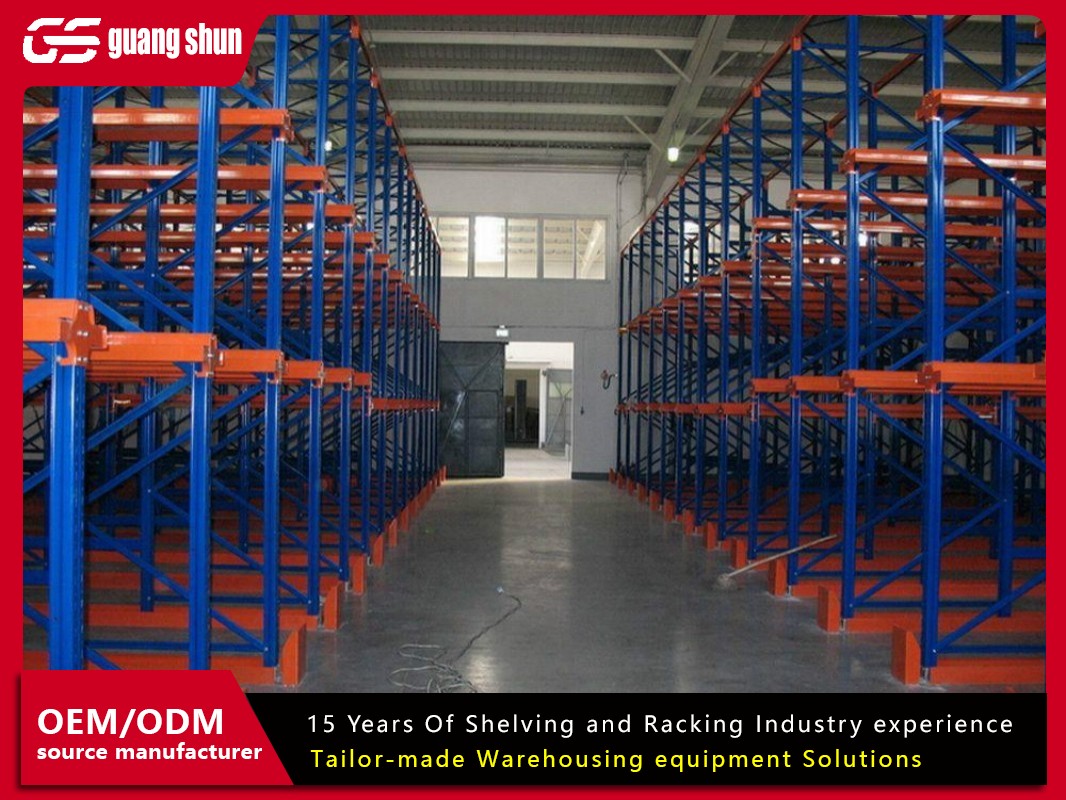
Drive-In/Drive-Thru Racking: Utilizes continuous rails (not
beams) to support pallets, allowing forklifts to enter the structure. Density
increases to 85% space utilization, but throughput drops due to the
"honeycombing" effect—empty positions cannot be easily reused without
reshuffling. Typical application: uniform, bulk storage of non-perishable
goods.
Push-Back Racking: Employs nested carts on inclined rails.
LIFO (Last-In, First-Out) configuration yields 2-4 pallet depth. Throughput of
10-12 pallets per hour per lane is achievable, bridging the gap between
selective and drive-in.
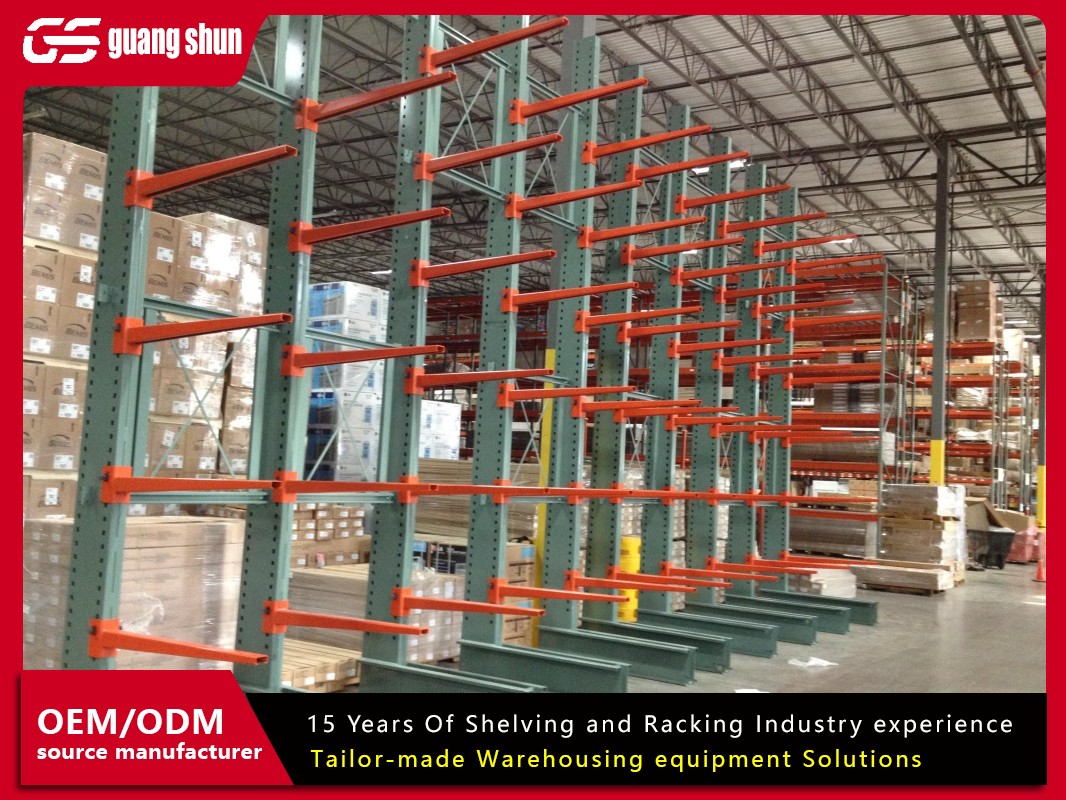
Cantilever Racking: Designed for long, irregular loads such
as lumber, pipes, or furniture. Arms adjust vertically, and load capacity per
arm ranges from 1,000 to 5,000 lbs, depending on arm length (up to 8
feet).
3. Seismic Design and Base Plate Anchoring Specifications
In regions prone to seismic activity, the interaction between the rack system
and the concrete slab is the most critical engineering parameter. Base plates
distribute vertical loads, but shear forces during an earthquake must be
transferred through anchor bolts.
3.1 Anchor Bolt Embedment and Edge Distance
Post-installed mechanical anchors (wedge-type) or epoxy anchors are specified
based on pullout tests per ACI 318. Minimum embedment for a 5/8-inch anchor in
4,000 psi concrete is 3.5 inches. Edge distance—the space from the anchor center
to the slab edge—must be at least six times the anchor diameter to prevent
concrete spalling. Guangshun seismic
calculations incorporate Sds (short-period spectral acceleration) values from
local building codes, adjusting row-spacer widths to accommodate sway without
collision.
3.2 Frame Bracing and Diagonal Stiffeners
Longitudinal stability relies on diagonal and horizontal bracing. For systems
exceeding 20 feet in height, back-to-back horizontal ties are mandatory at each
beam level. Seismic tests on unbraced frames show a 50% reduction in load
capacity during 0.5g ground acceleration compared to braced frames. Welded wire
mesh or channel bracing must be rated for the anticipated tributary load,
typically calculated as 5% of the total dead load per seismic design
categories.
4. Integration with Automated Material Handling Equipment
As facilities adopt semi-automated and fully automated picking, the interface
between rack systems and machinery demands micron-level precision. Traditional
rack tolerances of ± 1/2 inch may be acceptable for manual reach trucks but are
inadequate for automated storage and retrieval systems (AS/RS).
AS/RS Interface Tolerances: Rack systems serving mini-load
cranes require vertical alignment of rail inserts to within ± 3 mm over 10
meters. This necessitates laser-based installation verification and shimmed base
plates.
Shuttle-Compatible Rails: When integrating pallet shuttles,
the rack incorporates continuous C-channel rails. These rails must be spliced
with precision-ground joints to prevent shuttle wheel impact. A misalignment of
just 2 mm can reduce wheel bearing life by 50%.
Conveyor Handshake: At the input/output (I/O) points, rack
systems must be designed with cantilevered extensions to allow conveyor to pass
beneath. Photocell brackets and flag sensors are integrated into the rack
uprights, requiring pre-punched mounting slots to avoid field welding.
5. Material Specifications and Surface Treatments
Corrosion resistance and surface finish directly impact the longevity of rack
systems, particularly in cold storage or outdoor applications. Hot-dip
galvanizing remains the gold standard for environmental resistance, providing
50+ years of protection in controlled indoor environments. The galvanizing
process (ASTM A123) applies a 3.5 mil zinc coating, which sacrificially protects
the steel even if scratched.
For food-grade or pharmaceutical warehouses, epoxy powder coating over
zinc-rich primer is specified to prevent flaking and contamination. Salt spray
tests per ASTM B117 show that epoxy-coated samples withstand 1,000 hours without
red rust, compared to 150 hours for standard painted finishes.
6. Load Deflection and Dynamic Impact Factors
Engineers must account for both static and dynamic loads. Static loads
include the weight of pallets and the rack itself. Dynamic loads arise from
forklift impacts or seismic events. The International Building Code (IBC)
requires that rack systems withstand a minimum lateral force equal to 5% of the
stored product weight, applied at the beam level. However, high-throughput
facilities with fast forklift traffic (exceeding 8 mph) should specify impact
lugs at aisle intersections. These lugs, welded to the base plate, protect the
upright by absorbing energy during accidental collisions.
7. Lifecycle Cost Analysis and Depreciation Models
When presenting capital expenditure requests for rack systems, it is prudent
to include a total cost of ownership (TCO) model. Steel prices fluctuate;
however, the depreciation of racking is typically linear over 15-20 years.
Maintenance costs for powder-coated systems average $0.02 per pallet position
annually, primarily for touch-up paint and bolt torque checks. Conversely,
galvanized systems require virtually no maintenance but carry a 20-25% higher
initial material cost. The break-even point for galvanizing occurs at year 12 in
non-corrosive environments.
8. Future-Proofing: Modularity and Reconfiguration
The ability to reconfigure rack systems in response to changing SKU profiles
is a key economic consideration. Systems utilizing teardrop or keyhole
connections allow beam relocation without tools. However, repeated beam changes
can elongate the holes, reducing connection stiffness. For facilities
anticipating quarterly reslotting, bolted connections with replaceable inserts
are recommended. Guangshun offers a hybrid
system with hardened steel inserts rated for 25 beam insertion cycles without
wear—exceeding industry average of 15 cycles.
Frequently Asked Questions (FAQ) on Industrial Rack Systems
Q1: What is the standard seismic compliance requirement for
rack systems in North America?
A1: In North America, rack systems must
comply with the seismic provisions of the International Building Code (IBC) and
the RMI (Rack Manufacturers Institute) specification ANSI MH16.1: "Specification
for the Design, Testing and Utilization of Industrial Steel Storage Racks." This
includes site-specific seismic design categories (SDC) determined by geographic
location, requiring engineered calculations for base shear and overturning
moments.
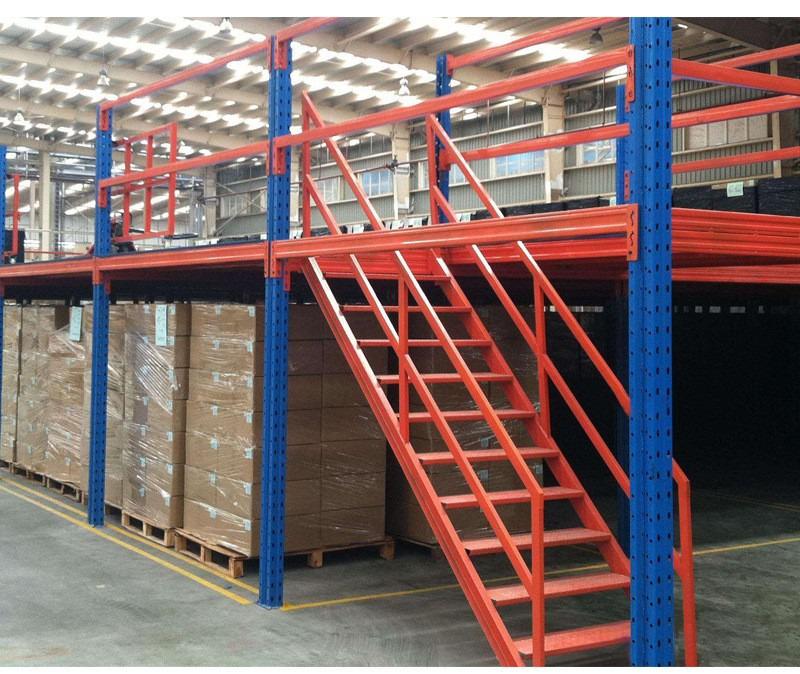
Q2: Can rack systems be installed on mezzanine floors, and
what are the load limitations?
A2: Yes, rack systems can be installed on
structural mezzanines, but the mezzanine deck must be engineered to support both
the concentrated point loads from the rack uprights and the uniform live load of
stored materials. Upright base plates often require load-spreading pads to
prevent deck puncture. The mezzanine structure must also accommodate the rack's
lateral bracing without interfering with ceiling heights.
Q3: What is the difference between roll-formed and
structural steel rack systems?
A3: Roll-formed rack is fabricated from
sheet steel (typically 12-14 gauge) that is cold-rolled into C or Z shapes. It
is lighter and more cost-effective. Structural steel rack uses hot-rolled
angles, channels, or I-beams (typically 8-10 gauge or heavier). Structural rack
offers higher impact resistance and is preferred for heavy loads or environments
with frequent forklift traffic. Structural connections are almost always bolted,
whereas roll-formed often uses clip-in connections.
Q4: How often should rack systems undergo professional
safety inspection?
A4: OSHA and RMI guidelines recommend that
rack systems receive a formal inspection by a qualified professional annually,
or immediately after any known impact incident. Daily visual checks by warehouse
staff for bent uprights, dislodged safety clips, or damaged footplates are also
required. Facilities with high forklift traffic (over 50 cycles per hour) may
require semi-annual inspections.
Q5: What are the maximum allowable beam deflection limits
for pallet rack systems?
A5: Industry standards (RMI and FEM)
typically limit beam deflection under rated load to between L/180 and L/150,
where L is the beam span length. For example, a 108-inch beam should not deflect
more than 0.6 inches at center under full load. Exceeding this deflection can
cause pallets to become trapped between beams or interfere with automated
retrieval equipment.
Q6: How does pallet overhang affect rack system safety?
A6: Pallet overhang—when a pallet extends
beyond the front or rear beam—reduces the effective load capacity and creates a
snagging hazard. Overhang of more than 2 inches per side can reduce beam
capacity by up to 20% due to eccentric loading. It also narrows the aisle
clearance, increasing the risk of forklift collisions with adjacent
rack.