In modern logistics, the pressure to maximize storage density while
maintaining high throughput rates has driven the evolution of automated storage
solutions. The shuttle
rack system stands out as a critical engineering response to this
challenge. Unlike traditional static shelving or even standard drive-in racking,
a shuttle rack integrates a motorized platform—the shuttle—that travels within
the rack structure on dedicated rails. This design transforms deep-lane storage
from a LIFO (Last-In, First-Out) limitation into a flexible, FIFO (First-In,
First-Out) or LIFO capable high-density asset. For operations managers and
supply chain directors evaluating capital investments, understanding the
technical nuances, from rail tolerances to battery recovery protocols, is
essential for projecting accurate ROI.
1. Technical Anatomy of a Modern Shuttle Rack Installation
The efficacy of a shuttle
rack extends far beyond the shuttle vehicle itself. It is a
symphony of precision-engineered steel, control logic, and interface design. To
evaluate a system, one must dissect its core components.
1.1 Rail Systems and Dynamic Load Distribution
The foundation of any shuttle system is the rack structure. The rails must
maintain absolute parallelism over spans of 20 to 40 meters to prevent shuttle
binding or wheel wear. Grade 80 steel is commonly specified for wear strips. The
dynamic load capacity—how the weight transfers as the shuttle moves with a 1,500
kg pallet—requires finite element analysis to prevent beam deflection. Guangshun engineering
protocols, for instance, specify a safety factor of 1.8 for dynamic loads in
seismic zones, ensuring that the interface between the shuttle wheel and the
rail maintains contact integrity even during high-speed traversal.
2.2 Shuttle Propulsion and Energy Recovery
Modern shuttles are not merely carts; they are IoT-enabled devices.
Lithium-ion batteries have largely replaced lead-acid due to opportunity
charging capabilities. During regenerative braking—when the shuttle decelerates
approaching a stop—the motor acts as a generator, feeding current back into the
battery. This extends operational cycles in cold storage environments, where
battery efficiency typically drops by up to 30%. The control systems utilize
LiDAR or laser distance sensors for positioning accuracy to within ±3 mm, which
is critical for the fork clearance when depositing or retrieving pallets.
2. Comparative Analysis: Shuttle Rack vs. AS/RS vs. Reach Trucks
When selecting a storage methodology, the decision matrix often weighs CapEx
against throughput. A shuttle
rack occupies a specific niche between manual reach trucks and full
Automated Storage and Retrieval Systems (AS/RS).
Throughput Metrics: A single shuttle operating in a
deep-lane channel can achieve 20-25 cycles per hour. When integrated with a lift
at the end of the aisle to move shuttles between levels, system throughput can
exceed 120 pallets per hour, rivaling mini-load AS/RS at a lower capital cost
per pallet position.
Density Calculations: Compared to selective racking,
shuttle systems eliminate the need for multiple aisles. A facility requiring
5,000 pallet positions might occupy 40% less floor space with a multi-deep
shuttle configuration. This consolidation reduces lighting, HVAC, and land
costs.
SKU Segmentation: For high-velocity SKUs (movers), a
"first-in" lane depth of 10-15 pallets is common. For slow movers, depths can
extend to 30 pallets deep. This velocity-based zoning is difficult to manage
with standard drive-in rack due to the honeycombing loss, but shuttle racks
mitigate this by allowing the shuttle to bypass empty positions.
3. Solving Industry Pain Points: Cold Chain and Throughput Bottlenecks
The true value of a shuttle rack system is realized when applied to specific
operational friction points.
3.1 Cold Storage Efficiency
In freezer environments (-25°C), human efficiency drops, and equipment
failure rates rise. Standard VNA (Very Narrow Aisle) trucks require operators to
enter the frozen zone. A shuttle rack system, particularly one engineered by Guangshun for arctic
conditions, allows pallets to be staged at a single interface point at the dock.
The shuttles, equipped with cold-resistant lubricants and sealed electronics,
perform the deep-lane storage autonomously. This reduces the number of personnel
required in the cold zone by up to 70%, lowering energy costs associated with
air exchange and improving workplace safety.
3.2 Mitigating SKU Proliferation
As e-commerce and diverse product lines grow, warehouses face the challenge
of handling non-uniform loads. Advanced shuttle racks now accommodate mixed
pallet sizes. By utilizing telescopic fork shuttles, the system can handle Euro
pallets, block pallets, and plastic pallets interchangeably. The control
software automatically adjusts the shuttle's fork spread based on a barcode read
at the entry point, ensuring compatibility without manual intervention.
4. Integration with Warehouse Control Systems (WCS)
A standalone shuttle is merely a mechanized sled. Its power is unlocked
through deep integration with the WCS. The shuttle
rack acts as the physical execution layer for the digital inventory
map.
Dynamic Slotting: The WCS analyzes inbound SKU velocity and
assigns lanes dynamically. A fast-moving SKU might be placed in a shallow lane
close to the input/output point, while a slow-moving SKU is relegated to a deep
lane. This "hot slotting" adjusts in real-time based on seasonal demand
shifts.
Interfacing with Automation: Shuttle systems typically
interface with conveyor belts or AGVs at the front of the rack. The handshaking
protocol here is critical. Photocells verify pallet overhang before the shuttle
accepts the load; if a pallet is overhanging by more than 5 cm, it could strike
the rack uprights during transit, causing a system stoppage.
Predictive Maintenance: Vibration sensors on the shuttle
wheel assemblies can predict bearing failure. By monitoring current draw on the
motor, the system can detect if a rail has developed a high-friction spot,
triggering a maintenance request before a catastrophic failure occurs.
5. Structural Integrity and Seismic Considerations
One of the primary concerns with high-density storage is seismic stability.
Because shuttle racks are often deeper and heavier than selective racks, the
engineering standards applied are stringent.
RMI (Rack Manufacturers Institute) and FEM (Fédération Européenne de la
Manutention) standards dictate specific bracing requirements for shuttle
systems. The continuous welding of rail splices is mandatory to prevent
separation during an earthquake. Furthermore, the interface between the shuttle
and the rack must be designed to prevent the shuttle from becoming a projectile
during seismic activity. Safety pins or auto-locking mechanisms engage when the
shuttle is parked in its home position. Guangshun incorporates
seismic dampeners in regions with high tectonic activity, which absorb kinetic
energy and distribute it through the base plates, protecting the building
foundation.
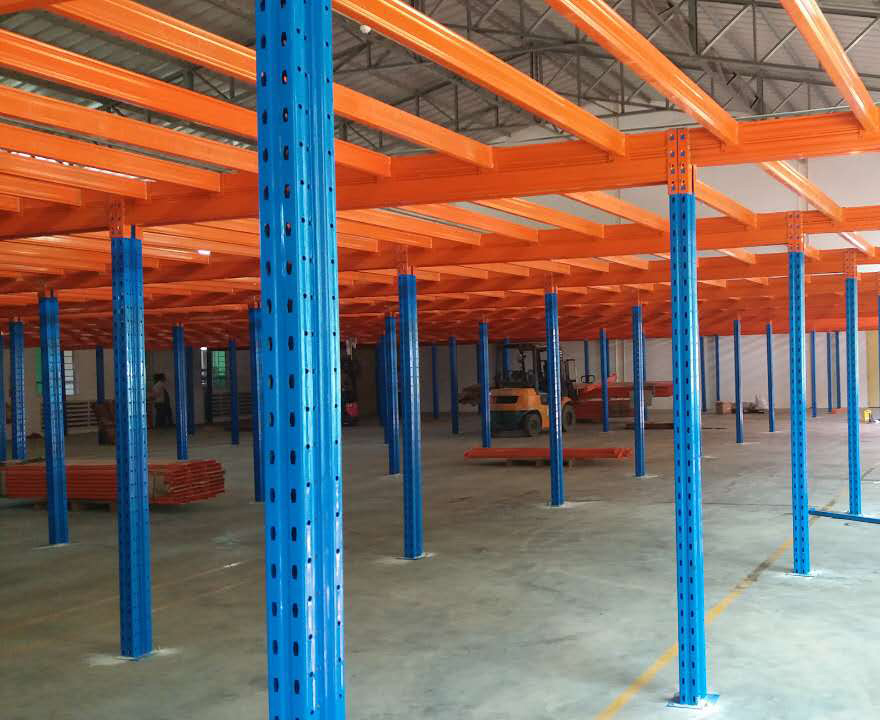
The Economic Rationale for Shuttle Rack Adoption
The decision to implement a shuttle rack system is a strategic move towards
Industry 4.0 readiness. By analyzing the total cost of ownership—including
reduced labor costs, increased storage density, and lower product damage
rates—the payback period for a shuttle system typically ranges from 18 to 36
months. As SKU complexity and labor shortages continue to pressure supply
chains, the precision and density offered by modern shuttle racks will
transition from a competitive advantage to an operational necessity.
Frequently Asked Questions (FAQ) on Shuttle Rack Systems
Q1: What is the maximum pallet weight a standard shuttle
rack can handle?
A1: Standard shuttle systems are typically
engineered to handle dynamic loads between 1,000 kg and 1,500 kg (2,200 lbs to
3,300 lbs). However, heavy-duty variants, often utilizing reinforced rail
profiles and high-torque motors, can manage pallets up to 2,000 kg or more. It
is critical to verify the "beam capacity" and "rail point load" with the
manufacturer, as these factors determine the long-term structural integrity of
the rack.
Q2: Can shuttle racks handle FIFO (First-In, First-Out)
inventory management?
A2: Yes, absolutely. Shuttle racks are
designed to support both LIFO and FIFO. For FIFO operations, the rack is
configured as a "through" system. Pallets are loaded from one end of the lane
(the input side) and retrieved from the opposite end (the output side). The
shuttle travels the entire length of the lane to place and retrieve pallets,
ensuring that the oldest inventory is always retrieved first, which is essential
for perishable goods or time-sensitive stock.
Q3: How does the battery life of the shuttle affect
uptime?
A3: Modern shuttles utilize lithium-ion
batteries with opportunity charging. This means during idle periods—even as
short as 30 seconds—the shuttle automatically connects to a charging rail or
busbar at the front of the rack. This "top-up" approach ensures the battery
typically remains between 40% and 80% charge, eliminating the need for manual
battery swaps and enabling 24/7 operation with near 100% uptime, provided the
system is not over-cycled beyond its design specifications.
Q4: What are the maintenance costs associated with shuttle
rack systems?
A4: Maintenance costs are generally lower
than for reach trucks or VNA equipment because the moving parts are limited to
the shuttle itself, not the entire fleet of vehicles. Annual maintenance
typically involves cleaning the rails, checking wheel wear, and updating
software. Predictive analytics can reduce costs further by alerting managers to
potential motor or bearing failures. Budgeting approximately 2-3% of the initial
capital cost per year for preventive maintenance is a standard industry
benchmark.
Q5: Can a shuttle rack be retrofitted into an existing
warehouse with standard racking?
A5: While it is possible, it is rarely a
simple "drop-in" replacement. Existing selective or drive-in racking is not
engineered to the precise tolerances required for shuttle rail systems.
Typically, a full decommissioning of the old rack is required to install new
floor anchors that meet the stricter flatness tolerances (often requiring FM2 or
better floor flatness). However, the existing building footprint and column
spacing can often be utilized, making the civil engineering work feasible and
cost-effective compared to new construction.