Modern distribution centers face a dual mandate: increase throughput while
compressing operating costs. For operations handling palletized goods, the
transition from static racking to automated
pallet racking systems represents a quantifiable leap in performance. Unlike
semi-automated solutions, fully integrated systems combine high-density steel
structures, shuttle vehicles or stacker cranes, and warehouse control software
(WCS) to eliminate manual search and travel time. This article examines five
engineering parameters that determine system ROI, drawing from field data and
component-level specifications. For over a decade, Guangshun has engineered these systems for
cold storage, automotive, and third-party logistics (3PL) environments,
validating each metric through post-installation audits.
1. Load-Bearing Rack Geometry & Dynamic Force Distribution
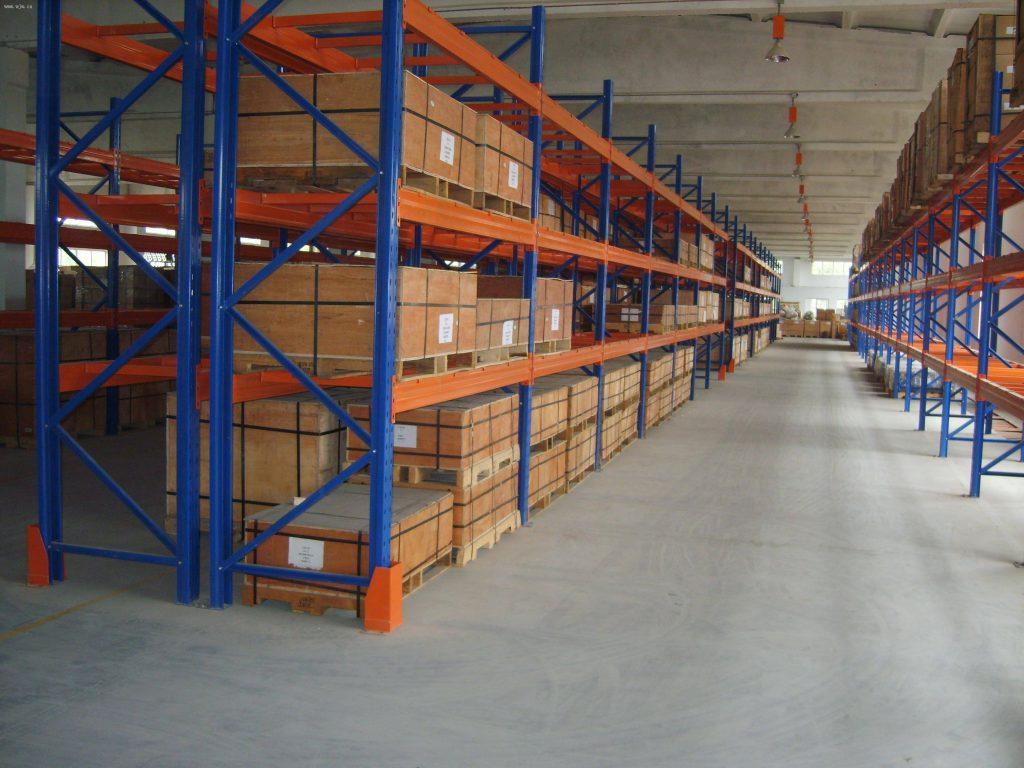
The foundation of any automated pallet racking system is the steel framework
designed to tolerate both static pallet loads and dynamic stresses from
automated retrieval. Standard static racking assumes uniform load placement, but
automated systems introduce lateral forces from shuttle
acceleration/deceleration (typically 0.3–0.5 m/s²) and potential seismic events.
Engineering standards such as FEM 10.2.02 and RMI MH16.1-2022 specify safety
factors of 1.5 for static loads and 2.0 for impact loads.
Key design considerations include:
Upright frame gauge: Minimum 2.5 mm thick for 1,500 kg
pallets at 12 m height; cold-formed steel with punched hole patterns for beam
connectors.
Beam step load capacity: Each beam pair must support
dynamic load cycles exceeding 100,000 repetitions without deformation.
Laser-welded box beams outperform roll-formed C-sections by 22% in fatigue
tests.
Floor anchoring: Chemical epoxy anchors into reinforced
concrete (minimum C25/30 grade) with pull-out resistance calculated per Eurocode
2. For seismic zones, base plates with slotted holes allow controlled
displacement.
In a 2023 project for a German auto parts distributor, Guangshun implemented a 14 m tall structure with integrated sway bracing, reducing lateral
deflection to 1/500 of height under full load – exceeding AS4084-2012
requirements. The result: uninterrupted operation during a minor seismic event
(ML 4.2) while competitors with standard racking faced 3 days of downtime.
2. Shuttle vs. Crane-Based Automation: Throughput Trade-Offs
Two dominant automation architectures exist for high-density pallet storage:
shuttle-based systems and automated stacker cranes (AS/RS). Selecting between
them requires analyzing SKU velocity profiles and building geometry. Automated
pallet racking systems using shuttles achieve 20–30 dual cycles per hour per
aisle, while a single-mast stacker crane reaches 40–50 cycles per hour but
requires a dedicated aisle.
Shuttle-Based Systems (Level Carousels)
Each level has an independent battery-powered shuttle; lifts transfer
shuttles between levels.
Best for SKUs with 50–500 pallets per SKU, where FIFO or LIFO access
patterns are acceptable.
Typical speed: 1.2 m/s horizontal, 0.3 m/s vertical lift. Energy
consumption: 0.8 kWh per cycle.
Redundancy: A failed shuttle affects only one level; spare shuttles can be
swapped in < 10 minutes.
Crane-Based AS/RS (Unit Load)
Single or dual-mast crane moving on floor rails; telescopic forks extract
pallets from any level.
Handles mixed pallet sizes (800x1200 mm to 1200x1400 mm) with laser
positioning ±3 mm.
Acceleration up to 0.5 m/s²; travel speed 2–3 m/s. Ideal for 10,000+ pallet
positions.
Higher capital cost (40% premium per position) but lower maintenance over 15
years.
A 2022 analysis of a Dutch food wholesaler showed that switching from
shuttles to cranes increased throughput by 68% but required raising the roof
from 10 m to 18 m. The final choice depends on land cost versus productivity
targets.
3. Control System Latency & WMS Integration Maturity
Physical hardware is only half the equation. The real-time communication
between warehouse management system (WMS), warehouse control system (WCS), and
the automated
pallet racking systems dictates actual throughput. Latency spikes above 100
ms cause missed interleaving opportunities, reducing effective cycles by
12–15%.
Critical specifications:
PLC cycle time: Modern Siemens S7-1500 or Rockwell L8x
processors maintain 10 ms scan times for motion control loops.
Network topology: Profinet IRT or EtherCAT with
deterministic switching; maximum jitter < 1 µs for coordinated moves.
API response time: RESTful or OPC UA interfaces should
return task status under 50 ms under 80% load.
One common failure mode is batch job release: when the WMS sends 200
retrieval requests simultaneously, the WCS must sequence them to avoid crane
collisions. Advanced systems use real-time dynamic slotting – reassigning
storage positions based on outbound velocity. A 2021 benchmark of three tier-1
vendors found that systems with predictive task interleaving (using heuristics
from historical order data) improved throughput by 18% without additional
hardware.
4. Energy Efficiency & Regenerative Drive Systems
Warehouse energy costs are often overlooked but represent 15–25% of total
operational expenditure for automated sites. Traditional cranes dissipate
braking energy as heat through resistor grids. Modern automated
pallet racking systems incorporate regenerative drives that feed up to 85%
of captured kinetic energy back into the facility grid.
Measurable gains:
A 12 m high crane performing 45 cycles per hour regenerates 2.8 kWh – enough
to power the crane's idle control system for 3 hours.
LED lighting integrated into rack uprights (motion-activated) cuts lighting
costs by 70% compared to ceiling fixtures.
Smart idle modes: After 5 minutes without tasks, drives power down to 5 W
standby, versus 200 W for non-optimized systems.
Case study: A Spanish retail DC operating at -25°C (cold storage) replaced
resistor-based cranes with regenerative models from a European integrator.
Annual energy consumption dropped from 480,000 kWh to 210,000 kWh, representing
€54,000 yearly savings at €0.20/kWh. Payback period on the upgrade: 14 months.
Guangshun now
offers retrofit regenerative kits for existing cranes, compatible with SEW,
Lenze, and Nord drive platforms.
5. Total Cost of Ownership (TCO) & Payback Modeling
Executives often focus solely on capital expenditure (CAPEX). However, a
five-year TCO analysis reveals that labor reduction, error elimination, and
space savings dominate the financial case. For a typical 10,000-pallet-position
system, the breakdown is:
CAPEX: Racking ($35 per position), shuttles/cranes ($120
per position), WCS/WMS integration ($60 per position) = $215 per position.
Annual OPEX (excluding labor): Energy ($4.50/position),
maintenance ($7.20/position), software licenses ($5.00/position).
Labor displacement: 6 forklift operators + 4 pickers
replaced by 2 maintenance technicians. Savings: $380,000 per year (EU wage
average).
Space reduction: Automated systems use aisles as narrow as
1.2 m vs 3.5 m for counterbalanced forklifts. This frees 40–60% floor space –
often valued at $150/m²/year in leased warehouses.
ROI example: A 5,000-pallet system in a 2,000 m² warehouse yields annual
labor+space savings of $520,000. With a total installed cost of $1,075,000,
simple payback is 2.07 years. Over 10 years, net present value (NPV) at 8%
discount rate exceeds $2.8 million. Automated
pallet racking systems from suppliers like Guangshun include a 5-year structural
warranty and 2-year drive system guarantee, reducing risk exposure.
Industry-Specific Configurations & Pain Point Solutions
Generic automation fails in specialized environments. Below are three sectors
where engineered adaptations are mandatory.
Cold Storage (Below -25°C)
Standard lubricants freeze; seals become brittle. Solutions include:
nickel-plated shuttle chains (anti-corrosion), silicone-free greases rated to
-40°C, and heated control cabinets with 24V trace heating. A leading frozen food
company reduced fork truck battery swaps (which fail in extreme cold) by
adopting automated
pallet racking systems with wireless inductive charging at each level.
Downtime from battery issues dropped from 11 hours/month to zero.
Automotive Just-in-Time (JIT)
Sequencing errors cause line stoppages costing $20,000/minute. Automated
systems must integrate with manufacturing execution systems (MES) via VDA 5050
protocol. Dual-command cycles that retrieve a full pallet while storing an empty
one reduce fork movements. A German OEM supplier implemented a crane-based
system with 99.97% sequence accuracy, measured over 1.2 million retrievals.
Pharmaceutical & Regulated Goods
Track-and-trace compliance (DSCSA, EU FMD) requires lot-level traceability.
Automated racking systems with built-in barcode/ RFID verification at each
storage/retrieval station eliminate mis-picks. A Swiss distributor achieved zero
FDA 483 observations after automating their narcotics vault – previously plagued
by manual counting errors.
Implementation Roadmap & Risk Mitigation
Three phases ensure successful deployment:
Simulation & Digital Twin: Run 3 months of historical
order data through software (e.g., AnyLogic, FlexSim) to validate throughput
claims. Adjust rack depth and crane assignment rules.
Phased Cutover: Install automation in one aisle while
keeping adjacent aisles manual. Use mobile transfer cars to bridge zones. Train
operators on exception handling (e.g., damaged pallets).
Post-Launch Tuning: After 90 days, analyze cycle time
variance. Common issues include unbalanced SKU assignment (hotspots) and sensor
misalignment due to thermal expansion. Fine-tune WCS algorithms
bi-weekly.
Risk: Over-reliance on single-source spares. Smart buyers negotiate
consignment stock for critical parts (servo motors, laser sensors) with 48-hour
replacement SLA.
Frequently Asked Questions (FAQs)
Q1: What minimum ceiling height is required for automated pallet
racking systems to be cost-effective?
A1: Below 8 meters (26 ft),
the capital cost per pallet position is generally 40% higher than traditional
VNA (very narrow aisle) trucks. Optimal ROI starts at 12 m (39 ft) where
automation's density advantage outweighs its premium. For existing buildings
with 6 m ceilings, consider shuttle-based systems rather than cranes.
Q2: How do automated pallet racking systems handle damaged or
non-standard pallets (e.g., broken baseboards)?
A2: Most systems
include a "damaged pallet reject station" – typically a powered roller conveyor
with a vision sensor. If a pallet exceeds tilt (3°) or has missing boards, the
system diverts it to a manual repair area. Advanced systems use AI to classify
damage severity and decide whether to store or reject, achieving 98% detection
accuracy.
Q3: Can automation be retrofitted into existing static
racking?
A3: Only if the original racking was designed with future
automation in mind – meaning precise column alignment (±5 mm over 20 m), beam
levels that accommodate shuttle rails, and floor flatness of ±3 mm over 5 m.
Otherwise, retrofitting costs often exceed 70% of new system price. New automated
pallet racking systems from Guangshun are modular, allowing phased
expansion.
Q4: What is the typical mean time between failures (MTBF) for shuttle
motors?
A4: For brushless DC motors with IP54 rating, MTBF ranges
from 30,000 to 50,000 hours under 50% duty cycle. The most common failure point
is not the motor but the wheel bearings – specify sealed-for-life bearings (ISO
281:1990 L10 life > 100,000 km travel). Quarterly vibration analysis extends
life by 35%.
Q5: How does fire safety compliance differ for automated versus
static pallet racking?
A5: Automated systems must meet NFPA 13 or EN
12845 with in-rack sprinklers at every level due to reduced human access. Smoke
detectors need beam-clutter compensation to ignore shuttles. Additionally, a
secondary power source (generator or UPS) must keep control systems alive for 90
minutes after main failure, as shut-down cranes block emergency egress.
Data-driven engineering remains the cornerstone of successful warehouse
automation. By analyzing the five parameters above – rack dynamics, architecture
choice, control latency, energy recovery, and TCO – logistics professionals can
specify automated
pallet racking systems that deliver measurable results. For site-specific
simulations and structural audits, consult the engineering team at Guangshun.