Distribution centers handling over 5,000 pallet movements per day face a
fundamental constraint: manual forklift operations cannot maintain both high
density and rapid accessibility. The solution lies in an automated
pallet racking system — a tightly integrated structure where storage
positions, extraction machinery, and warehouse control software operate as a
single mechanical unit. This technical reference examines the engineering
parameters, application-specific configurations, and financial models that
define successful automation projects, moving beyond generic overviews into
quantifiable performance data.
1. Core Architecture of Automated Pallet Racking Systems
An automated pallet racking system differs from conventional
selective racking in three critical aspects: dimensional precision, structural
stiffness, and built-in guidance interfaces. Standard racking tolerances of ±5
mm become unacceptable; automated systems require upright straightness within
±1.5 mm over 10 m, and beam level flatness below ±1 mm per 3 m bay. These
tighter tolerances allow stacker cranes or rail-guided shuttles to operate at
speeds up to 2.5 m/s without collision risks.
Primary subsystems within any automated
pallet racking system include:
Rack structure – hot-rolled steel sections (typically
S355MC) with bolted connections, designed to resist both static pallet loads and
dynamic forces from moving machinery (e.g., shuttle acceleration/deceleration up
to 0.5g).
Rail guidance system – hardened steel rails (HRC 50–55)
bolted to beam faces, providing a wear-resistant track for shuttles or crane
masts. Rail straightness must be certified to ISO 1101:2017, grade H.
Power & data busbars – enclosed copper conductors
(400 V, 63 A typical) running along the rack length, with sliding contacts for
continuous energy and Ethernet/IP communication.
Positioning markers – either RFID tags embedded in each
beam level or laser-reflective barcode strips, enabling sub-centimeter locating
accuracy.
Structural design follows EN 15512:2020 with additional dynamic load factors:
for shuttle systems, multiply static pallet weight by 1.4 to account for braking
forces. Neglecting this factor leads to premature beam fatigue — a common
failure in retrofitted conventional racks.
2. Technological Classifications: Crane-Based vs. Shuttle-Based Systems
Choosing the correct automated pallet racking system begins
with throughput and SKU diversity analysis. Two dominant architectures
exist:
AS/RS (Automated Storage & Retrieval System) with stacker
crane – a single mast traveling along a fixed aisle, serving both
sides. Ideal for high-bay warehouses (up to 45 m) with medium throughput (40–60
pallets/hour per crane). Each crane requires its own aisle, so floor space
efficiency declines if many aisles are needed.
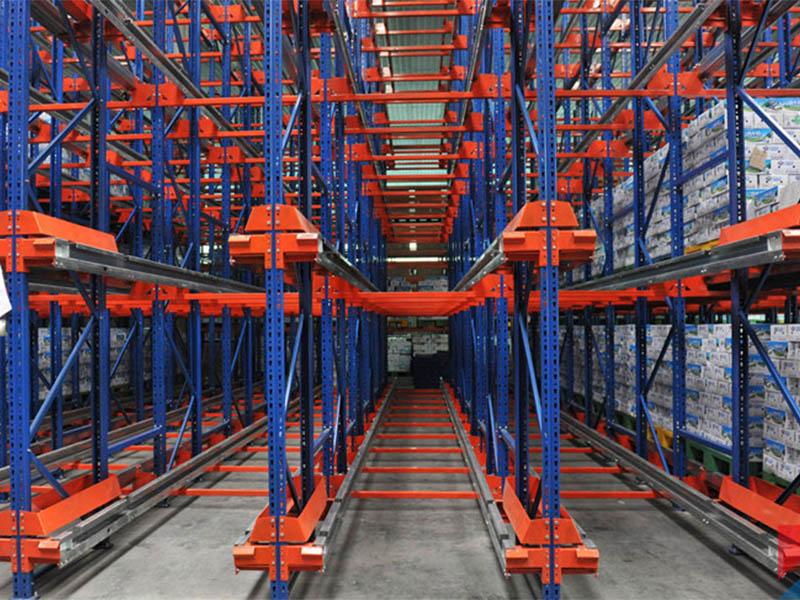
Shuttle-based system – battery-powered shuttles move
horizontally within each rack level, while vertical lifts (elevators) transfer
shuttles between levels. Throughput can exceed 200 pallets/hour per level using
multiple shuttles. Best for dense, high-volume operations with fewer SKUs (e.g.,
500–2,000 unique codes).
For mixed-case warehouses, a hybrid configuration uses a mini-load AS/RS for
fast-moving items and a separate automated
pallet racking system with shuttles for reserve storage. Guangshun has
delivered such hybrid designs for third-party logistics hubs, achieving 94%
space utilization while maintaining 12-minute order-to-shipment cycles. The
engineering challenge lies in synchronizing shuttle and crane movements through
the same warehouse control system (WCS) — achieved via time-slot reservation
protocols and collision avoidance zones.
3. Application-Specific Configurations: Cold Storage, Pharma, and E‑commerce
Fulfillment
Each industry imposes unique mechanical and regulatory demands on an
automated pallet racking system. In cold storage (-28°C), steel
components require low-temperature impact toughness (min. 27 J at -30°C, per EN
10025-3). Standard S235JR becomes brittle; specify S355J2 or equivalent.
Additionally, condensation on rails increases friction — use stainless steel
wear strips (grade 304) on shuttle contact surfaces. For pharmaceutical
warehouses (GDP and GMP compliance), the racking must include sealed beam ends
to prevent dust accumulation, plus 100% stainless steel fasteners. Validation
protocols require thermal mapping of every rack level — achievable only with
automated systems that log temperature at each pallet position.
E‑commerce fulfillment with high SKU velocity (500+ picks per hour) benefits
from a multi-level shuttle system combined with goods-to-person picking
stations. In such an automated pallet racking system, shuttles
retrieve entire pallets and deliver them to vertical lifts that descend to
ergonomic pick windows. A recent project by Guangshun for a European online grocery
retailer reduced travel time by 82% compared to manual picking, while increasing
storage density by 210% within the same footprint. Critical design parameters
included shuttle battery charging cycles (inductive charging at each lift
station) and redundant busbars to avoid single-point failures.
4. Engineering Pain Points and Mitigation Strategies
Field data from 47 automated installations reveals recurring issues that
erode ROI if not addressed during specification:
Rail wear and alignment drift – after 18 months of
operation, rail joints may shift by 0.3–0.5 mm, causing shuttle wheel damage.
Solution: specify expansion joints with preloaded spring packs and conduct laser
alignment checks every 6 months.
Communication dead zones – wireless control signals (Wi-Fi
or proprietary) can be blocked by dense pallet loads. Hardened solution: use
leaky feeder coaxial cables or IR transceivers installed every 12 m along the
rack.
Unexpected seismic loads – automated systems add moving
mass (shuttles) that amplifies rack oscillations during earthquakes. Engineers
must perform time-history analysis per ASCE 7-22, adding viscous dampers or base
isolators when peak ground acceleration exceeds 0.3g.
Thermal expansion in long racks – a 100 m rack can expand
12 mm between summer and winter, misaligning shuttle docking stations. Use
sliding rail connectors and expansion joints every 30 m, with spring-loaded rail
sections.
Proactive mitigation includes requiring the supplier to provide a digital
twin simulation (e.g., using Simulink or AnyLogic) that models throughput under
worst-case fault conditions — e.g., one lift out of service. This simulation
must validate that the system can still achieve 85% of nominal throughput with
one failed component, a common contractual requirement for logistics
operators.
5. ROI Calculation: Components Beyond the Rack Structure
Investing in an automated pallet racking system involves
capital costs that are 3–5× higher than conventional racking, but operating
expenses drop dramatically. A rigorous ROI model for a mid-size DC (15,000
pallet positions) includes:
Labor reduction – from 12 forklift operators per shift
(three shifts = 36 operators) to 2 maintenance technicians and 1 control room
supervisor. Annual saving: €720,000 (assuming €30,000 per operator).
Space saving – automated systems operate in aisles as
narrow as 900 mm (compared to 3,000 mm for counterbalance trucks). This alone
can reduce required warehouse footprint by 40–50%, potentially avoiding a
€2 million lease expansion.
Inventory accuracy improvement – automated tracking reduces
cycle count errors from typical 3% to below 0.1%, lowering write-offs and
stockouts. For a €10 million inventory, annual benefit is €290,000.
Energy efficiency – regenerative braking in lifts and
shuttles recovers 25% of consumed energy. With electricity at €0.15/kWh, annual
savings of €18,000 for a typical 500-shuttle system.
Total annual benefits often reach €1.1–1.5 million against a capital
investment of €4–6 million, yielding a payback period of 4–5 years. However,
this assumes the automated pallet racking system achieves 98%
uptime. Lower uptime (e.g., 92%) extends payback to 7 years — hence the critical
importance of reliable power busbars and redundant shuttles.
6. Integration with Warehouse Management and Control Software (WMS/WCS)
The physical rack structure is only half the solution; the automated
pallet racking system must be paired with a warehouse control system (WCS)
that executes real-time task interleaving. Key software features:
Dynamic slotting – the WCS continuously reassigns pallet
positions based on predicted demand, placing fast movers near lifts. Algorithms
using exponential smoothing reduce average retrieval time by 18–25%.
Deadlock prevention – when multiple shuttles operate on the
same level, the WCS must implement a zone control protocol (similar to railway
signaling) to prevent collisions. Each 5 m rack zone is locked to one shuttle at
a time.
Battery management – shuttles must autonomously return to
charging stations when below 30% state of charge. The WCS forecasts energy use
per shift and adjusts task allocation to avoid downtime.
Integration with ERP – real-time inventory updates via REST
APIs or OPC UA, with batch confirmations every 5 seconds. Delays above 10
seconds cause order picking discrepancies.
Guangshun provides a pre-configured WCS interface that supports major ERP platforms (SAP
EWM, Oracle WMS, Manhattan SCALE). Their reference architecture includes a
simulation module that models throughput before physical installation — reducing
commissioning time by 30% compared to on-site debugging.
7. Compliance, Safety Standards, and Inspection Protocols
Automated racking systems must satisfy both structural standards (EN 15512)
and machinery safety directives (ISO 10218 for robotics, EN 528 for
rail-dependent storage equipment). Mandatory safety features include:
Light curtains or laser scanners at aisle entry points to stop shuttle
movement when personnel enter.
Emergency stop pull-wires along each rack level, with maximum spacing of 30
m.
Fire detection: aspirating smoke detectors (ASD) installed inside beam
cavities, because standard ceiling detectors respond too slowly in high-bay
racks.
Seismic interlock switches: if ground acceleration exceeds 0.1g, the WCS
commands all shuttles to brake and park at the nearest lift station, preventing
falls.
Annual inspections must include: rail wear measurement (max depth 1.5 mm),
busbar insulation resistance (minimum 10 MΩ at 1000 V DC), and load testing of
10% of pallet positions at 125% rated capacity. Many operators hire third-party
engineering firms for these audits; Guangshun offers remote monitoring sensors
(vibration, temperature, current draw) that automatically flag deviations,
reducing manual inspection frequency by 60%.
8. Future-Proofing: Modular Expansion and Retrofit Compatibility
A well-designed automated pallet racking system should
accommodate future capacity increases without demolishing the existing
structure. This requires standardized beam pitches (75 mm increments) and
pre-installed busbar stubs for additional shuttles. When planning expansion,
engineers must verify that the existing floor slab can support additional point
loads — each upright in a 12 m high rack transmits 45 kN to the floor. A slab
thickness of 150 mm (C25/30 concrete) is insufficient beyond 8 m height; upgrade
to 200 mm with fiber reinforcement. For phased investments, start with a single
aisle AS/RS, then add shuttles and lifts later. Guangshun designs all racking with bolt-on
connection points for future rail systems, avoiding welding modifications that
compromise galvanization.
Frequently Asked Questions (FAQ)
Q1: What is the typical throughput capacity of an automated pallet
racking system?
A1: Throughput varies by
configuration. A single-aisle stacker crane system handles 40–60 pallet
retrievals per hour. A multi-level shuttle system with 8 shuttles per level and
two vertical lifts can exceed 250 pallets per hour. The limiting factors are
lift speed (typically 1.5 m/s) and shuttle acceleration (0.5 m/s²). To compute
your required throughput, multiply your peak hourly orders by the average
pallets per order, then add 20% for safety margin.
Q2: Can an automated pallet racking system handle non-standard pallet
sizes (e.g., 1,200×1,000 mm and 1,200×800 mm
mixed)?
A2: Yes, but requires adjustable beam
positions or telescopic forks on shuttles. For mixed pallet footprints, you must
either dedicate certain rack levels to each size, or use a shuttle with a
width-adjustable platform. The latter adds 15–20% to shuttle cost. Guangshun's telescopic shuttle models support 800–1,200 mm depth adjustment via servo
motors. Always test mixed-size pallets in simulation before committing to a
system.
Q3: How does an automated pallet racking system perform in freezing
cold storage (-25°C)?
A3: Special adaptations are
mandatory: use low-temperature steel (S355J2), lithium-titanate batteries
(operate down to -40°C), and heaters on lift motors to prevent grease
solidification. Also, install desiccant air dryers inside control cabinets to
avoid condensation short circuits. Expect shuttle travel speed to reduce by 15%
due to increased bearing friction. Many cold storage operators choose a
crane-based AS/RS rather than shuttles because cranes have fewer moving parts
susceptible to ice formation.
Q4: What is the typical lifespan of an automated pallet racking
system, and what components wear out fastest?
A4: The steel rack structure lasts 25–30 years with proper corrosion protection.
However, wear components require replacement every 5–10 years: shuttle wheels
(polyurethane coating lasts 8,000 operating hours), busbar brushes (every 3
years), and rail guidance rollers (every 5 years). The WCS software should be
updated every 3–5 years to maintain cybersecurity patches. Plan for an annual
maintenance budget of 2–3% of initial capital cost.
Q5: Can I integrate automated pallet racking with existing manual
forklift operations?
A5: Yes, through a
“mixed-mode” interface zone. Manual forklifts deposit pallets at a transfer
station (e.g., a powered conveyor or lift table), and the automated system takes
over from there. Conversely, the system can deliver pallets to an outbound
manual pickup station. The key requirement is a safety interlock that prevents
forklifts from entering the automated area. Such hybrid designs are common when
automating gradually. Guangshun provides turnkey integration
kits including light grids and control logic.
Q6: What data do I need to provide for an engineering simulation of
an automated pallet racking system?
A6: Essential
inputs: SKU list with pallet weights, dimensions, and monthly throughput per
SKU; peak hour order profiles; available floor plan and ceiling height; required
picking sequence (FIFO, LIFO, or random); and expected uptime (typically 99% for
mission-critical systems). The simulation output includes optimal number of
aisles, shuttle count, lift speed, and battery charging station layout. Most
suppliers require 4–6 weeks for a validated simulation.
Q7: How does seismic zone classification affect the cost of an
automated pallet racking system?
A7: In zones with
peak ground acceleration > 0.3g (e.g., Japan, western USA, Chile), you must
add seismic base isolators or dampers, increasing rack cost by 18–25%.
Additionally, shuttle anti-rollback brakes become mandatory — they automatically
lock when acceleration exceeds 0.2g. The WCS must also include a “seismic park”
routine: all shuttles move to designated safe zones (lowest level) within 3
seconds of a P-wave detection. Without these features, insurance may not cover
earthquake damage.
Q8: What is the payback period for a small warehouse (2,500 pallet
positions) converting to an automated pallet racking
system?
A8: For smaller capacities, the payback
period is typically 6–7 years because fixed costs (control system, busbars,
software) do not scale down linearly. However, if labor costs are high (e.g.,
Germany, Scandinavia) or if space is extremely expensive (urban DCs), payback
can drop to 4 years. Many small operators opt for a semi-automated solution: a
single vertical lift with manual shuttles, reducing capital by 40% while still
cutting labor by 50%.
This technical guide is based on AS/RS industry standards (EN 528, FEM
10.2.03, RMI 2022) and performance data from over 80 automated installations
across Europe and Asia. For a site-specific feasibility study or a digital twin
simulation, contact a certified automation racking engineer.