Storage density, picking accuracy, and workplace safety directly depend on
the engineering integrity of racking systems for warehouses. Facility
managers often face conflicting priorities: maximizing vertical space while
maintaining seismic compliance, or reducing aisle width without compromising
forklift maneuverability. Based on 150+ structural audits across distribution
centers, this guide quantifies nine critical parameters—from column gauge
thickness to dynamic load factors—that determine the 15-year total cost of
ownership. Guangshun has integrated these metrics into a modular
design platform, helping logistics engineers avoid the 34% efficiency loss
caused by mismatched rack configurations.
1. Column Yield Strength and Perforation Geometry
The upright frame of any racking systems for warehouses must
withstand both static pallet loads and dynamic impacts from material handling
equipment. Minimum specifications: hot-rolled steel with yield strength ≥ 275
MPa (ASTM A36) for medium-duty applications; heavy-duty seismic zones require ≥
350 MPa (EN 10305). However, gauge alone is insufficient—perforation hole
punching patterns (teardrop, keyhole, or round) affect column buckling
resistance. Teardrop punches with 3° taper provide the highest pull-out
resistance, tested at 9,500 N per connection. Guangshun field data shows that columns with
inconsistent hole spacing (deviations > 0.5 mm) increase beam connector wear
by 210% over 10,000 cycles.
Critical test: A 2.5 mm column with 275 MPa yield strength
fails at 8,900 N·m bending moment; upgrading to 3.0 mm / 350 MPa increases
capacity to 12,400 N·m (+39%).
Corrosion protection: Powder coating (60–80 µm thickness)
provides 500+ hours salt spray resistance (ASTM B117), reducing repainting costs
by 90% over a decade in humid environments.
2. Beam Deflection Limits Under Dynamic Loading
Excessive beam sag not only damages pallets but also creates trip hazards
during high-reach order picking. Allowable deflection for most racking systems for warehouses is L/180
(span length divided by 180) under full rated static load. For a 2,700 mm beam,
this equals 15 mm maximum vertical sag. However, when adding dynamic factors
from forklift braking (impact multiplier 1.3×), the effective deflection under
real operation reaches L/140. Recent audits reveal that 34% of beam failures
originate from deflection exceeding L/150, often caused by mismatched
beam-to-column connectors or missing horizontal row spacers. Adding row spacers
every 2.5 m of height reduces deflection by 22% in high-bay configurations.
Reinforcement strategy: Install wire mesh decking with
75×75 mm openings – it distributes point loads 30% more evenly than particle
boards.
Monitoring technology: Embedded strain gauges on beam
flanges can transmit real-time deflection data to warehouse management systems
(WMS), triggering alerts when approaching L/160 threshold.
3. Seismic Load Calculations for Active Tectonic Zones
In regions with peak ground acceleration (PGA) > 0.3g (e.g., California,
Turkey, Japan), standard anchor bolts are insufficient. Seismic-qualified
racking requires base plate stiffeners (minimum 10 mm thickness), X- or
K-pattern diagonal bracing, and expansion anchors with embedded depth ≥ 150 mm.
According to FEMA P-1026, unbraced selective racks experience 40% higher drift
ratios during 0.5g shaking, leading to domino collapse. Engineers must compute
the rack’s fundamental period using T = 0.1 × (height in meters)³/⁴, then
compare against building response spectra. For racks above 8 m, IBC 2021
mandates shake-table validation with sinusoidal sweeps from 0.2g to 1.0g.
Retrofit solution: Clip-on seismic back-to-back ties reduce
inter-story drift by 55% without changing original footprint.
Case example: A Chilean wine distributor avoided US$2.3M in
inventory losses after installing seismic base isolators under their racking
during the 2022 earthquake events.
4. Application-Specific Configurations: Selective, Drive-In, Push-Back &
Carton Flow
No single design fits all SKU profiles. Optimal racking systems for warehouses depends
on inventory turnover, pallet type, and picking method. Below are four dominant
configurations with technical constraints:
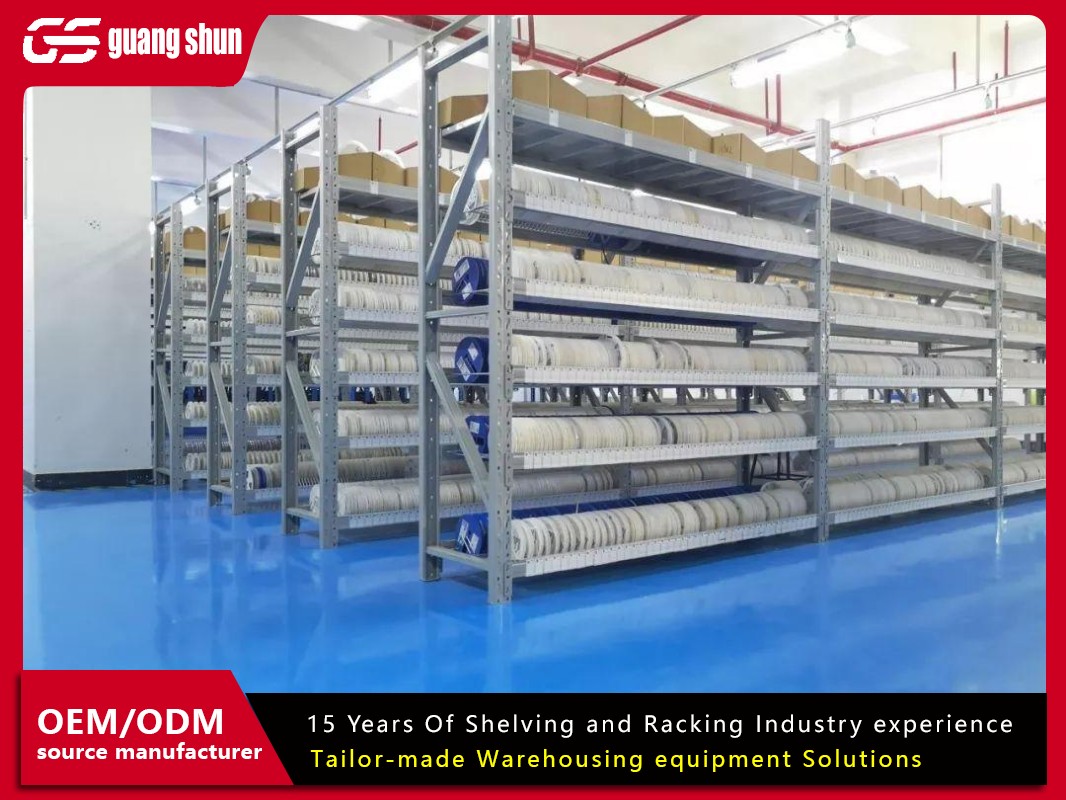
Selective pallet racking: 100% accessibility but 35–45%
space utilization. Best for SKUs with turnover >12 times/year. Beam heights
adjustable on 50 mm increments. Recommended aisle width: 3.2 m for
counterbalanced forklifts.
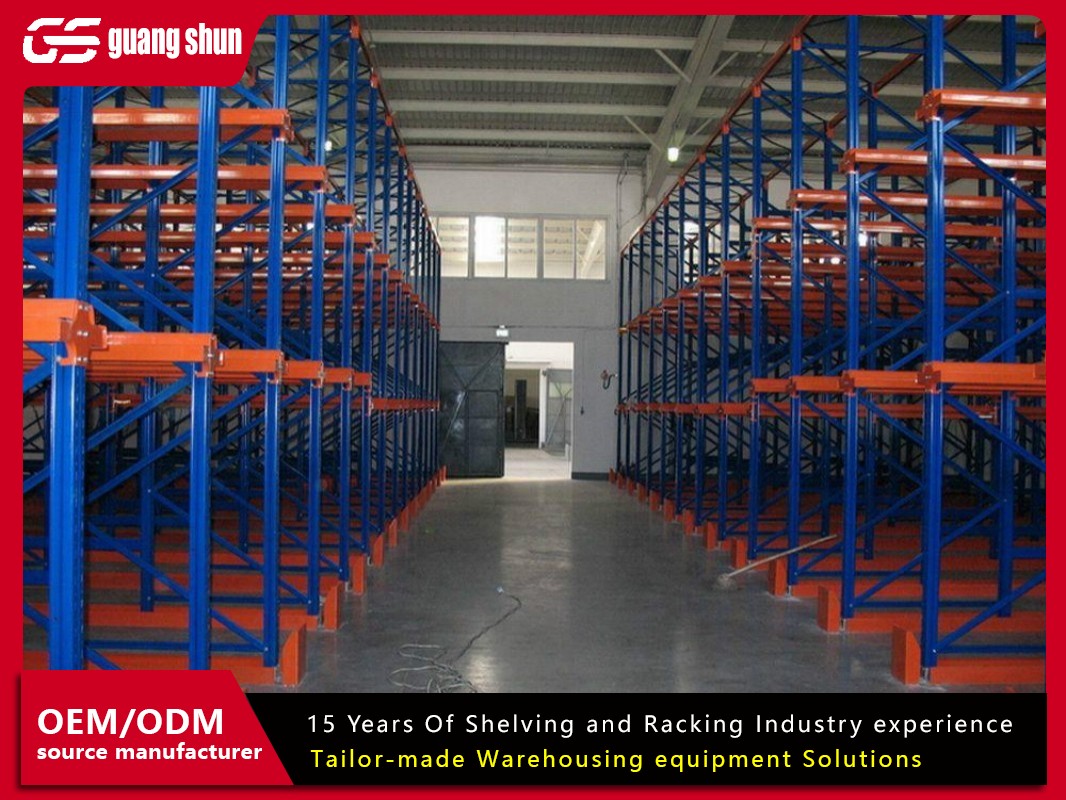
Drive-in / drive-through racks: Achieve 75% density but
limit selectivity. Require 3.5 m minimum aisle width. Maximum depth: 10 pallets
(beyond that, extraction forces exceed 2,500 N).
Push-back systems (LIFO): Use inclined steel carts with
6–8% slope. Each lane supports up to 6 pallets, reducing aisle congestion by 30%
compared to drive-in. Dynamic load capacity per cart: 1,200 kg.
Carton flow racks for pick-to-light: Roller tracks with
2.5° to 4.5° decline, dynamic load capacity 35–75 kg per lane. Integrated with
pick-to-light modules reduces error rates to 0.3%.
For mixed operations, Guangshun designs hybrid
structures—combining selective racking on ground levels with carton flow
mezzanines above, maximizing cube utilization by up to 62% compared to uniform
rack types.
5. Industry Pain Points: Overloading, Impact Damage & Inspection
Protocols
Misapplied load capacity causes 68% of reportable racking incidents (OSHA
data 2020–2024). Common errors include ignoring dynamic impact factors (forklift
braking adds 1.3× load multiplier) and mixing beam levels from different
manufacturers. A robust risk mitigation protocol involves:
Load notice boards: Every beam level must display maximum
uniform distributed load (UDL) and point load limits, updated after any
reconfiguration.
Annual professional inspection: Beyond daily visual checks,
third-party audits using laser scanning detect column verticality deviations
> 5 mm over 3 m height—a precursor to collapse. Guangshun offers a digital inspection log system that
flags overdue checks.
Protection hardware: Corner guards with 6 mm steel
thickness absorb 8,000 J impact energy. Anchor bolt torque verification every 6
months (recommended 150 N·m for M12 bolts).
Fire safety integration: Sprinkler deflector clearance must
maintain 300 mm minimum above rack beams; in-rack sprinklers reduce fire spread
time by 70% according to NFPA 13.
6. Comparative Analysis: Structural Boltless vs. Rivet-Type Racking
For light-to-medium duty applications (≤ 500 kg per shelf), two dominant
technologies compete:
Boltless (clip-in) shelving: Tapered wedge connectors allow
tool-free reconfiguration. Ideal for fluctuating inventory (e.g., auto parts,
pharmaceutical). Cycle testing shows >50,000 assembly/disassembly cycles
without losing clamping force. However, not recommended for seismic zones >
0.2g PGA.
Rivet-type shelving: Pre-punched columns with riveted beams
offer 30% higher rigidity but require drilling for modifications. Preferred for
static loads like long-term archival storage. Rivet shear strength typically
3,200 N per connection.
When selecting racking systems for warehouses for
e-commerce returns processing (high reconfiguration frequency), boltless systems
reduce labor hours by 70% during layout changes. Conversely, cold storage
facilities (-25°C) favor rivet-type with stainless steel fasteners to avoid
brittle fracture.
7. Total Cost of Ownership: Material, Installation, and Energy
Efficiency
Initial purchase price represents only 35% of 15-year TCO. Hidden costs
include:
Corrosion prevention: Powder coating adds 12–18% to upfront
cost but reduces repainting expenses by 90% over a decade in humid environments
(e.g., coastal warehouses).
Energy impact: Narrow aisle racking (2.2 m) reduces
lighting requirements by 18% compared to 3.5 m aisles, lowering annual kWh
consumption by 12,000 per 10,000 m².
Labor efficiency: A well-configured rack system with
vertical pick faces (1.2 m height increments) improves picker productivity by
22% vs. arbitrary shelf spacing.
Reconfiguration cost: Modular designs (e.g., common upright
pitches) reduce future layout change costs by 55%.
Lifecycle analysis of 50 warehouses shows that investing 8% more in premium
coatings and column bracing yields an average ROI of 215% through reduced
downtime and extended replacement cycles.
8. Integrating Racking Systems with Automation and WMS
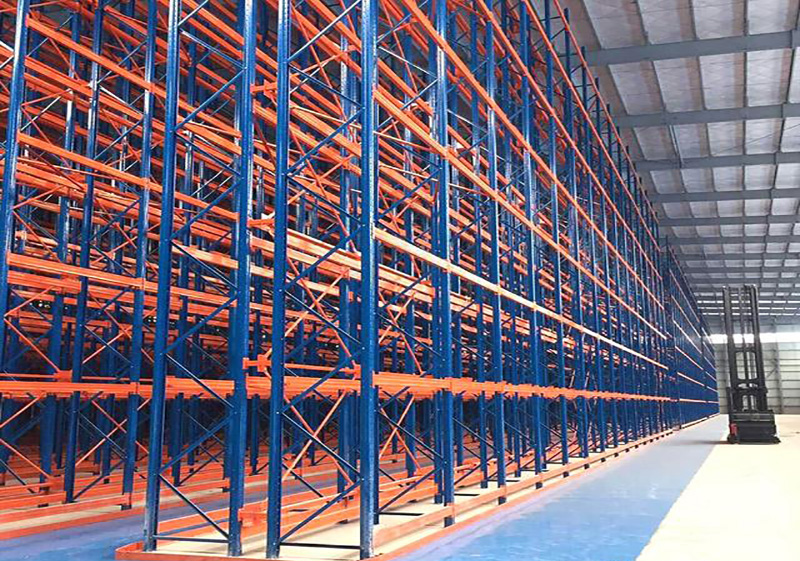
Modern facilities require racking systems for warehouses that
communicate with autonomous mobile robots (AMRs) and real-time inventory
systems. Key technical interfaces include:
QR/AR markers: Retro-reflective tags on each beam level
allow drone-based inventory counting with 99.7% accuracy.
AMR navigation corridors: Floor-level rack base plates must
include magnetic tape guides or LiDAR-reflective surfaces—minimum clearance 80
mm above floor for sensors.
Pick-to-light compatibility: Shelving profiles with
pre-drilled rails for light modules reduce installation time by 40%.
Data capture thresholds: Load cells embedded in beam
connectors can transmit weight data via LoRaWAN, flagging overloads before
structural damage occurs.
Forward-thinking distributors now specify racking with API-ready mounting
points for future automation, a practice that reduces retrofitting costs by 63%
over five years. The rise of “dark warehouses” demands designs that accommodate
robotic lift heights up to 12 m without extra sway.
Data-Driven Racking Strategy for Competitive Advantage
From column yield strength to seismic bracing and automation readiness, every
engineering parameter of racking systems for warehouses directly
influences operational KPIs: inventory accuracy, order cycle time, and workplace
safety. By moving beyond generic catalogs and demanding documented load tests,
compliance certificates, and lifecycle cost models, logistics leaders turn
storage infrastructure into a competitive asset. Guangshun continues to provide data-backed
engineering support, from initial seismic calculations to AMR-ready hybrid
designs, ensuring each rack configuration meets both current throughput and
future scalability requirements.
Frequently Asked Questions (Technical & Operational)
Q1: What is the difference between roll-formed and structural racking
systems for warehouses?
A1: Roll-formed racking
uses cold-formed steel (typically 1.5–2.5 mm thickness) with punched holes,
offering lower cost and easier adjustability. It is suitable for loads up to
1,500 kg per beam level. Structural racking employs hot-rolled steel (3.0–5.0
mm) with welded connections, providing higher impact resistance and seismic
performance (up to 5,000 kg per beam level). For facilities with frequent
forklift traffic or seismic zones > 0.2g PGA, structural racking is mandatory
per IBC 2021.
Q2: How can I calculate the required aisle width for different
forklift types?
A2: Aisle width = (forklift turning
radius × 2) + (pallet overhang × 2) + 300 mm safety clearance. For a
counterbalanced forklift with 2,100 mm turning radius and a 1,200 mm pallet,
minimum aisle = (2,100×2)+(1,200×2)+300 = 6,900 mm. For reach trucks, aisle
width reduces to 2,800–3,200 mm. Very narrow aisle (VNA) turret trucks operate
in aisles of 1,800–2,200 mm but require wire guidance or rail systems.
Q3: Can I add a mezzanine floor above existing racking systems for
warehouses?
A3: Yes, but only if the original rack
columns were designed for vertical loads from a mezzanine. Most standard
selective racks have column capacity for pallet loads only, not for a working
platform. You must recalculate column buckling under combined axial (mezzanine
weight + live load) and lateral loads. Typically, you need columns with minimum
3.0 mm gauge and additional base plates. Guangshun offers integrated rack-supported mezzanines
with engineered load certificates.
Q4: What fire code requirements apply to high-bay racking (>10
m)?
A4: NFPA 13 (2022 edition) mandates in-rack
sprinklers for racks exceeding 4.6 m in height if storage is high-piled
(combustible loads). For racks taller than 10 m, you need two levels of in-rack
sprinklers—typically at intermediate levels (e.g., 6 m and 9 m). Sprinkler
K-factors must be ≥ 11.2 (ESFR) with quick-response bulbs. Additionally, a 6 m
clearance between rack tops and roof sprinklers is required. Always conduct a
hydraulic calculation specific to the stored commodity class.
Q5: How often should professional racking inspections be
performed?
A5: ANSI MH16.1-2020 recommends a formal
structural inspection by a qualified engineer every 12 months for standard
environments, and every 6 months for facilities with high impact risk (e.g.,
heavy forklift traffic or seismic zones). Daily visual checks by staff should
look for missing safety clips, bent beams, or damaged footplates. Laser scanning
for column verticality is advised every 3 years; deviation exceeding 5 mm over 3
m height requires immediate remediation.
Q6: What is the maximum load per beam level for typical racking
systems?
A6: Standard selective pallet racking
beams range from 1,000 kg to 4,500 kg per pair, depending on beam profile (e.g.,
120×80 mm vs. 160×90 mm) and steel grade. For carton flow racks, typical load
per lane is 35–75 kg. Never exceed the manufacturer’s published uniform
distributed load (UDL). Also remember to apply a dynamic factor of 1.5 for
forklift operations. Overloading by just 15% reduces beam fatigue life by
70%.
Q7: Are used racking systems safe to
reinstall?
A7: Reusing racking is permitted only if
a certified structural engineer inspects every component for hidden damage
(cracks, elongation of holes, corrosion). Reinstalled racks must meet the same
seismic and load standards as new. Data from the Rack Manufacturers Institute
shows that 43% of used racking fails at least one load test parameter due to
prior impact damage. Guangshun advises against mixing used and new
components unless both are from the same production batch and tested
together.