Meta Description: Technical specifications for medium duty cantilever racking
– column hole patterns, arm capacity at 600mm pitch, and seismic anchoring.
Real-world load tests for steel, lumber and PVC storage.
For warehouses storing pipes, lumber, sheet metal, or furniture components,
medium duty cantilever racking offers a clear
advantage over selective pallet racks: no front columns, allowing any length of
product. This analysis provides engineering data on arm deflection, base sizing,
and layout patterns. Drawing from RMI (Rack Manufacturers Institute) and FEM
10.2.03 standards, we examine load cases and structural failures specific to
cantilever systems rated for 500–1,500 kg per arm set.
1. Structural Anatomy of Medium Duty Cantilever Racking
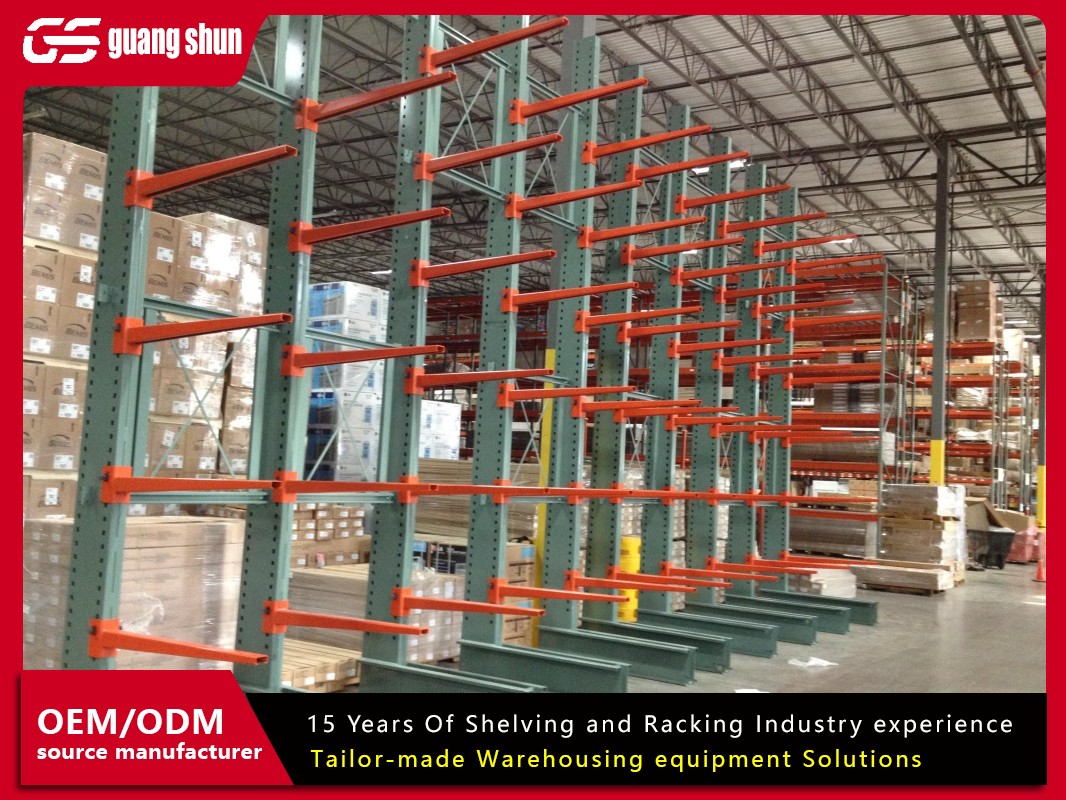
A properly designed medium duty cantilever racking system
consists of vertical columns, tapered arms, and horizontal bracing. Unlike
heavy-duty versions (arm capacity >2,500 kg), medium duty uses thinner column
gauges (2.0–2.5 mm vs 3.0 mm) and smaller base plates. Key parameters:
Column profile: C-channel or I-section, typically 100–120
mm depth with hole punching at 100 mm vertical increments.
Arm length: 600 mm, 900 mm, 1,200 mm – each has specific
load de-rating curves. A 1,200 mm arm holds only 60% of the capacity of a 600 mm
arm from same column.
Arm tilt: Factory set at 4–6° upward to compensate for
creep under sustained loads. After loading, deflection brings arm to
horizontal.
Base width: For single-sided racks, base width = arm length
× 0.6 + 150 mm. For double-sided, minimum 800 mm for 1,200 mm arms.
One common field mistake: using a medium duty cantilever
racking frame with arms overloaded at the tip. Manufacturers provide
capacity charts based on uniform load distribution. Point loads near the tip
reduce safe working load (SWL) by up to 50%. Guangshun provides
stamped load labels on every arm showing SWL at 300 mm and 600 mm from
column.
2. Application-Specific Load Cases for Medium Duty Cantilever Systems
2.1 Steel Service Centers – Bar and Tube Storage
For 6-meter steel bars (diameter 20–50 mm), a double-sided medium
duty cantilever racking layout with 900 mm arms and 1,800 mm column
spacing works efficiently. Each arm set (two arms per level) can hold 800 kg
uniformly distributed over 1,200 mm length. To prevent bar roll-off, install
wire decking or wooden planks with 50 mm edge stops.
2.2 Lumber and Building Materials
Pressure-treated timber (2x4 to 4x6) has variable moisture content. Use
galvanized arms with 2.5 mm thickness to resist corrosion from wet lumber. For
4.8 m boards, three uprights with 2.4 m spacing prevent sagging. A
medium duty cantilever racking system with 1,200 mm arms and
2,000 mm height can store 15 layers of 2x4 lumber (approx. 1,200 board
feet).
2.3 Furniture and Panel Storage
Particle boards and MDF panels need flat, uninterrupted support. Use
continuous plywood decking over arms to distribute load. Medium duty cantilever
arms (600 mm length, 500 kg per arm) accommodate 4x8 ft sheets. The absence of
front columns allows forklift side-loading, reducing damage by 40% compared to
standard racking.
3. Six Engineering Pitfalls in Medium Duty Cantilever Racking
Installations
Insufficient column anchoring: For racks over 2.5 m height,
chemical anchors (M12) are required instead of expansion anchors. Pull-out tests
show chemical anchors withstand 28 kN vs 15 kN for expansion bolts in cracked
concrete.
Ignoring horizontal bracing: Back-to-back columns without
horizontal ties sway under uneven loads. For every 3 m of height, install
X-bracing (30x3 mm flat bar) to reduce sway angle below 1:150.
Arm pin loosening: Vibration from overhead cranes or
forklifts causes locking pins to back out. Use spring-loaded pins or secondary
screws. Annual torque check: 35 Nm for M10 pins.
Under-specified base plates: Many medium duty racks use 5
mm base plates for 2.5 m height. For seismic zone 2, upgrade to 8 mm plates with
four anchors per column. Guangshun provides a seismic load calculator with each
layout.
No load zoning signs: Operators often store heavier items
on higher arms, increasing moment on column. Implement color-coded arm labels
(green for <400 kg, yellow for 400–700 kg).
Inadequate arm step taper: Arms must have progressive step
thickness – 3 mm at column, tapering to 1.5 mm at tip. Fixed-thickness arms
(constant 2 mm) bend at the weld zone after 18 months of cyclic
loading.
Routine inspection per AS4084-2012 requires checking arm tip deflection under
full load – maximum L/150 (e.g., 8 mm for 1,200 mm arm). Replace any arm
exceeding this after unloading.
4. Layout Density vs. Accessibility: How to Optimize Medium Duty Cantilever
Aisle Width
Calculating optimal aisle width for medium duty cantilever
racking depends on material length and handling equipment. For 6 m
bars, the aisle must allow 90° turning of a counterbalance forklift with 2 m
long load. Formula: Aisle width = (forklift turning radius + load overhang) ×
1.2.
For 3-ton forklift (turning radius 2,400 mm) carrying 6 m pipes: recommended
aisle = (2,400 + 600) × 1.2 = 3,600 mm.
For narrow aisle reach truck (turning radius 1,800 mm) with same load: aisle
= (1,800 + 600) × 1.2 = 2,880 mm – saves 20% floor space.
Double-sided racks with 1,200 mm arms on each side require a total width of
(arm length × 2 + column width + aisle). For a 3,600 mm aisle: total bay width =
1,200 + 150 + 1,200 + 3,600 = 6,150 mm. This configuration holds 60 linear
meters of storage per 10 m rack length.
High-density alternative: Use mobile cantilever rack bases on rails,
eliminating all but one moving aisle. This increases storage density by 70% but
reduces pick speed. Suitable for low-velocity items like spare steel coils.
5. Safety Compliance and Structural Integrity Checks for Cantilever
Racking
Any medium duty cantilever racking installation must meet EN
15512 or RMI specification. Three mandatory safety features:
Column end caps: Prevent water ingress and corrosion inside
hollow sections. Stainless steel caps with rubber gaskets reduce internal rust
by 90%.
Arm locking clips: Secondary retention devices (spring
steel clips) prevent arm dislodging if main pin fails. Required for arms above
1,500 mm height.
Floor shims: For uneven floors, use stainless steel shims
under base plates. Do not use plywood or plastic – they compress over time,
loosening anchors. Maximum shim stack 12 mm.
Third-party load testing: Randomly select 5% of arm positions, load to 125%
of rated capacity for 24 hours. Permanent deflection should not exceed 0.2% of
arm length. Guangshun provides test reports for every batch of
medium duty cantilever racking components.
6. Why Guangshun Engineered Medium Duty Cantilever Systems Perform Better
With over 1,200 industrial storage projects across 30 countries,
Guangshun designs medium duty cantilever racking using finite
element analysis (FEA) for each arm length. Every medium duty
cantilever racking order includes:
3D load simulation showing deflection contours
Welded arm assemblies with 100% penetration welds (ultrasonic tested)
Hot-dip galvanizing option for outdoor or cold storage (85 μm
thickness)
10-year structural guarantee against weld fatigue
Case study: A PVC pipe distributor in Texas replaced selective racks with
Guangshun's medium duty cantilever system, increasing storage capacity by 55% in
the same floor area. Arm deflection remained under 3 mm at full load after 3
years of daily operation.
7. Frequently Asked Questions (FAQ) – Engineering and Operational
Details
Q1: What is the maximum unsupported arm length for medium duty
cantilever racking?
A1: For 1,500 kg total capacity per column pair,
maximum arm length is 1,800 mm. Longer arms (2,100 mm) require heavy-duty column
profiles (3.0 mm gauge) and are not classified as medium duty. Always consult
capacity chart – a 1,800 mm arm at tip holds only 25% of base capacity.
Q2: Can I add an extra level to existing medium duty cantilever
racking?
A2: Yes, if column height allows. New arm levels require
field drilling of holes (if columns have pre-punched holes every 75 mm, no
drilling needed). However, adding a level increases total column moment.
Recalculate base plate and anchor size. For safety, limit to 4 arm levels per 3
m column.
Q3: How to protect medium duty cantilever arms from forklift
damage?
A3: Install polyurethane arm guards (50 mm thick) bolted to
the outer face of the first arm. Also, floor-mark yellow safety zones 300 mm
from column face. For high-traffic aisles, use guide rails at 150 mm height.
Guangshun offers bolt-on impact guards with energy-absorbing
foam core.
Q4: What is the correct bolt torque for column splices when extending
height?
A4: For column splice kits (6 bolts M12 grade 8.8), torque
to 95 Nm (dry threads) or 75 Nm (lubricated). Re-torque after 1 week of
operation. Loose splices account for 22% of column buckling incidents (FEM data
2022).
Q5: Can medium duty cantilever racking be used outdoors for pipe
storage?
A5: Yes, but must use hot-dip galvanizing (min 85 μm) or
epoxy zinc-rich primer with polyurethane topcoat. Avoid powder coating – UV
degrades it within 2 years. Also, install sloped base plates (2°) to drain
rainwater. Guangshun provides a 5-year corrosion warranty for
outdoor galvanized systems.
Q6: How to calculate total base moment for a double-sided medium duty
cantilever rack?
A6: Use formula M_total = (Load_arm1 × arm_length1)
+ (Load_arm2 × arm_length2) + … for all arms on one side, then sum both sides.
For columns fixed at base, the moment arm is half column height. Example: 4 arms
each side, 800 kg per arm at 1,000 mm length → M_total = 4 × 800 × 1,000 + 4 ×
800 × 1,000 = 6,400,000 N·mm. Base plate must resist this with safety factor
1.5.