Warehouse operators face a persistent contradiction: floor space remains one
of the most expensive assets, yet conventional static racking dedicates 35–50%
of the layout to aisles. A mobile pallet
racking system eliminates this inefficiency by mounting
load-bearing racks onto motorized carriages that move along floor-embedded
rails. By consolidating multiple aisles into a single movable access path, this
configuration increases storage density by 60–80% compared to fixed selective
racking while maintaining direct access to each pallet position. The following
analysis examines the mechanical architecture, performance benchmarks,
application-specific solutions, and total cost of ownership (TCO) data that
warehouse engineers and logistics directors require before specification.
Technical Architecture: From Rail Profiles to Integrated Safety Logic
Modern mobile pallet racking systems are not simply static racks on wheels.
The engineering foundation includes three interdependent subsystems: the
rail-and-wheel assembly, the drive-and-control unit, and the structural rack
frame. Each subsystem must comply with seismic zone requirements (ASCE 7-22) and
dynamic load standards such as FEM 10.2.02.
Rail and Wheel Interface
Surface-hardened steel rails (minimum Brinell hardness 300 HB) are recessed
into the concrete floor or mounted using epoxy-anchored channels. Load wheels,
typically forged steel with double-flanged profiles, operate on 150–200 mm
diameters to distribute vertical forces exceeding 15 tons per wheel. The rail
flatness tolerance remains within ±1 mm per linear meter to prevent harmonic
oscillation during acceleration. For freezer applications down to -25°C,
low-temperature grease and nickel-coated rails eliminate brittle fracture
risks.
Motorization and Motion Control
Each rack bay (up to 45 m length) integrates a gearmotor with electromagnetic
brake—usually 0.75 kW to 2.2 kW depending on total moving mass (up to 120 tons
per row). Variable-frequency drives (VFDs) provide soft start/stop profiles,
limiting jerk to 0.2 m/s³ to avoid load shifts. Control options range from
handheld pendants with 10 m cables to centralized PLC systems using PROFINET or
IO-Link. Remote diagnostics via Ethernet/IP allow real-time monitoring of motor
current, travel distance, and cycle counts.
Safety Architecture
Compliance with EN 528 (rail-dependent storage and retrieval equipment)
demands redundant safety circuits. Infrared light curtains (resolution 40 mm,
detection range 8 m) create a virtual barrier along the moving axis.
Pressure-sensitive floor edges trigger immediate reversal if contact occurs.
Additionally, emergency stop pull-wires run the full length of each carriage.
Mobile pallet
racking system installations from manufacturers like Guangshun include
automatic positional locking — once a moving aisle is opened, electromagnetic
brakes engage at the target position with holding force >150% of the maximum
inertial load.
Critical Performance Metrics: Load, Speed, and Structural Integrity
Engineering specifications directly determine application feasibility. The
table below synthesizes key performance parameters for standard-duty and
heavy-duty configurations:
Dynamic load capacity per rack bay: Standard: 12,000 kg;
Heavy: 24,000 kg (distributed over 6 pallet positions).
Travel speed: 2 – 5 m/min (adjustable via VFD; lower speeds
for freezer zones).
Positioning accuracy: ±5 mm, achieved by incremental
encoders and inductive proximity switches.
Seismic rating: Up to Zone 4 (ag=0.4g) with additional
diagonal bracing and base isolation pads.
Fire safety: In-row smoke detectors and automatic aperture
openings for sprinkler water penetration per NFPA 13.
Load deflection limits follow European standard EN 15512: maximum vertical
deflection L/400 (rack beam) and horizontal drift less than 1/150 of rack height
under rated load. For a warehouse with 12 m high racks, drift stays below 80 mm
— essential for maintaining pallet stability and robotic interface
compatibility.
Application Scenarios: Solving Real Space Pain Points
While any warehouse with high cubic volume and low-to-medium inventory turns
can benefit, three specific scenarios demonstrate maximum ROI from a mobile pallet
racking system.
Cold Storage & Freezer Warehouses
Construction costs for cold rooms range from $250 to $450 per m² — nearly
triple ambient facilities. Therefore, every square meter saved translates
directly to capital avoidance. A dairy distributor operating at -22°C replaced
fixed double-deep racks with a mobile system, reducing floor footprint from
2,400 m² to 1,450 m² while keeping 3,200 pallet positions. The narrower
operating aisle (1,300 mm instead of 3,200 mm) also reduced refrigerated air
loss during forklift entry.
Archives & High-Value Component Storage
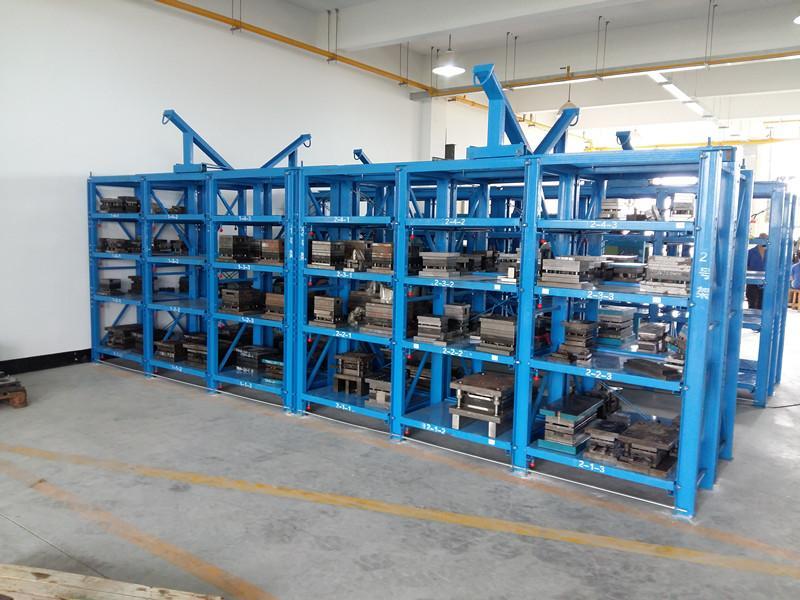
Pharmaceutical batch records, automotive tooling dies, and aerospace spares
require both security and random-access retrieval. A mobile pallet racking
system enables “aisle-on-demand” — each bay becomes accessible within 25 seconds
of command. A tier-1 automotive supplier stored 8,700 different die sets
(ranging 800–2,500 kg) using 18 mobile carriages, cutting retrieval time by 41%
compared to a static cantilever layout.
Production Line Buffer Zones
Just-in-sequence manufacturing demands precise material staging. Mobile racks
installed adjacent to assembly lines create dynamic supermarkets: as one rack
row serves the pick-face, the rear row is reloaded. This reduces work-in-process
inventory by 30% and eliminates rehandling. An electronics manufacturer
integrated their mobile pallet
racking system with a warehouse control system (WCS), achieving
99.3% order accuracy for kitting operations.
Cost-Benefit Analysis: Mobile vs. Static Racking
Initial capital expenditure for a motorized mobile system is 65–85% higher
per pallet position than static selective racks due to motors, rails, and
control panels. However, the total cost of ownership (TCO) over a 15-year
horizon frequently favors mobile solutions when land, energy, and labor are
factored. Below is a data-backed comparison for a 10,000-pallet facility in a
metropolitan industrial zone:
Floor space cost: Static racking needs 9,200 m² (including
aisles). Mobile system needs 5,300 m². At $120/m² annual lease, yearly saving =
$468,000.
Forklift travel reduction: Shorter aisles reduce average
travel distance from 215 m to 98 m per cycle. With 250 cycles/day, annual
fuel/electricity saving = $22,500.
Maintenance: Mobile systems require annual rail cleaning,
gearbox oil change (every 5,000 hours), and sensor calibration — estimated
$0.08/pallet stored vs $0.02 for static racks. Net extra cost = $6,000
annually.
ROI timeline: Additional upfront cost = $520,000; annual
net savings = $484,500. Payback period ≈ 13 months. Over 10 years, cumulative
benefit exceeds $4.3 million.
These figures align with case studies documented by the Material Handling
Institute (MHI), provided the warehouse floor flatness is within FM2 tolerances
(FF/FL 35).
Implementation Roadmap: Site Assessment, Installation, and Operator
Training
Converting to a mobile pallet racking system requires a phased methodology.
The following steps mitigate operational disruption:
Floor survey and remediation: Laser leveling identifies
depressions >3 mm over 2 m. Self-leveling polymer grout corrects deviations.
Load-bearing tests must confirm concrete compressive strength ≥25 MPa.
Power distribution: 380–480 V AC, 3-phase, 50 A minimum per
rack row. Cable carriers or slip ring assemblies supply moving carriages.
Staggered migration: Install mobile rows in 25% increments,
relocating pallets over weekends. Temporary static racks support peak season
inventory.
Certification training: Operators require 8-hour
certification covering emergency release procedures (manual handwheels for power
failure), load overhang limits (max 200 mm beyond beam), and daily inspection of
light curtains.
Guangshun offers a
turnkey installation package including laser floor scanning, custom rail layout,
and on-site commissioning — typically completing a 5,000 m² facility within 14
working days.
Safety and Regulatory Compliance: Beyond Standard Guarding
OSHA 1910.176 and ANSI MH28.3 define requirements for mobile racking systems
in the US, while EU directives mandate CE marking. Critical compliance points
include:
Anti-collision sensors with redundant monitoring (SIL 2 according to IEC
62061).
Maximum sound pressure level below 70 dB(A) during travel.
Electromagnetic brake testing: automatic self-test every 24 hours or 500
cycles.
Emergency manual movement: mechanical override with 40:1 gear reduction — 80
N force on handwheel moves a fully loaded 25-ton carriage.
For facilities storing hazardous materials (Class I, Division 2),
explosion-proof motors and sealed limit switches are mandatory. Many mobile pallet
racking system components from Guangshun are
ATEX-certified for Zone 22 combustible dust environments.
Frequently Asked Questions (FAQs)
Q1: What is the minimum ceiling height required for a mobile pallet
racking system?
A1: For optimal density, a clear
height of 8 m or higher is recommended. However, systems function down to 4.5 m
using single-deep beams. Lower heights (3–4 m) see reduced payback because
static racking already uses limited cubic volume efficiently. Always perform a
space utilization analysis — a rule of thumb: if the existing static racking
uses less than 35% of floor area for actual pallet storage (the rest being
aisles), mobile racking will be cost-effective even at 5 m height.
Q2: How do you handle power failures? Can the racks still be
moved?
A2: Every carriage includes a mechanical
manual override system. An integrated handwheel with a planetary gearbox allows
one person to move a fully loaded 30-ton row at a speed of 0.3 m per 20
handwheel revolutions. Some designs also provide a portable battery-powered
motor unit (24 V, 100 Ah) that clips onto the drive shaft — sufficient for 50–80
movements per charge. Both options comply with EN 528 emergency operation
clauses.
Q3: Is a mobile pallet racking system compatible with automated
guided vehicles (AGVs) and forklifts?
A3: Yes, with
the addition of laser positioning reflectors and RFID floor tags. The control
system can interface via MQTT or Modbus TCP to AGV fleet managers, sending
real-time aisle status (open/closed). For counterbalanced forklifts, travel
speed should be limited to 6 km/h inside the moving aisle. Many users maintain a
hybrid operation: AGVs for replenishment and manual forklifts for full-pallet
picking. The WCS coordinates access scheduling to avoid conflicts.
Q4: What happens if the light curtain detects an obstruction during
movement?
A4: The safety PLC triggers an immediate
emergency stop (stopping distance < 15 mm at 5 m/min). The carriage reverses
300 mm to release any trapped object. A visual indicator (flashing red beacon)
and audible alarm activate until manual reset. If the obstruction persists after
three attempts, the system locks out and requires a maintenance override. This
logic is fail-safe: the brakes engage even if control power is lost.
Q5: Can existing static racking be converted into a mobile
system?
A5: Typically no, due to differing base
plate designs and column gauges. Mobile racking requires reinforced base
channels and precise mounting holes for carriage attachment. Retrofitting static
racking risks structural failure under dynamic horizontal forces (braking
acceleration). However, some manufacturers, including Guangshun, offer
exchange programs — your existing uprights and beams are accepted as trade-in
credit toward a purpose-built mobile system. New carriages and rails are
engineered to match your current pallet dimensions and load levels.
Q6: How do you maintain floor flatness for multiple moving rows over
10+ years?
A6: Concrete floors undergo constant
micro-settlement. A preventative maintenance contract includes annual laser
scanning of rail top surfaces. Should deviation exceed 3 mm over 3 m, epoxy
leveling compound or rail shims correct the profile. For high-cycle facilities
(>1,000 movements per row daily), steel wear plates under the rail joints
distribute impact forces. Regular cleaning with a rail sweeper (polyurethane
blade) removes debris that could cause point loading. With proper care, rail
life exceeds 20 years.
Matching Density with Operational Realities
The selection of a mobile pallet
racking system ultimately depends on inventory turnover, floor
flatness, and capital allocation priorities. Facilities with low-to-medium SKU
velocity (< 150 picks per aisle per day) and premium square footage costs
(land > $300/m²) consistently achieve sub-18-month payback. Conversely,
high-throughput cross-dock operations benefit less due to frequent simultaneous
aisle accesses. Engineering due diligence must include dynamic load simulation,
safety circuit validation, and integration testing with existing warehouse
software. Manufacturers like Guangshun provide
site-specific ROI calculators and seismic certification packages, enabling
data-driven decisions. When correctly specified, a mobile pallet racking system
transforms underutilized floor space into a high-density asset without
compromising safety or accessibility.