In high-density storage environments, the structural performance of
warehouse racking
beams determines not only storage capacity but also operational
safety and facility longevity. Unlike generic shelving components, industrial
rack beams must resist bending moments, torsion from eccentric loads, and impact
forces from material handling equipment over decades of service. A failure in
beam design—whether through excessive deflection or connection fatigue—can
result in catastrophic load drops, inventory loss, and workplace injuries.
With extensive experience engineering storage structures for distribution
centers and manufacturing facilities across seismic zones, I have observed that
the most frequent points of structural compromise are beam connections and
improper load distribution assumptions. This article provides a technical
examination of beam engineering—from steel grade selection and section
properties to safety factors and compliance with RMI (Rack Manufacturers
Institute) and FEM standards.
1. Structural Mechanics: How Racking Beams Carry Load
A warehouse racking beam functions as a simply supported
flexural member. Its capacity is governed by three interdependent factors:
section modulus (S), yield strength (Fy), and
unbraced length (Lb). Engineers must calculate allowable
bending stress while accounting for lateral-torsional buckling—a phenomenon
where slender beams twist under load.
1.1 Section Profiles and Their Applications
Different beam profiles offer distinct structural efficiencies:
Box-section beams (closed profile): High torsional
resistance, ideal for applications with offset loads or where forklifts may
contact the beam. Commonly used in seismic zones due to superior lateral
stability.
C-channel beams (open profile): Cost-effective for light to
medium loads where torsion is minimal. Requires careful bracing to prevent
twisting under eccentric loading.
Step beams (structural with integral ledge): Designed for
pallet support without additional wire decks. The stepped profile increases
section modulus at the flange, optimizing material usage.
Reinforced beams with welded stiffeners: Used for spans
exceeding 4 meters or loads above 2,500 kg per beam level. Stiffeners prevent
web buckling at support points.
1.2 Material Specifications and Yield Strength
Steel grades directly impact beam capacity. The industry standard for
cold-formed beams is ASTM A1008 with yield strength of 230–340 MPa. Hot-rolled
beams (ASTM A36 or S235JR) provide 250 MPa minimum yield but offer better
weldability. For high-load applications, high-strength low-alloy (HSLA) steel
such as ASTM A572 Grade 50 (345 MPa yield) allows reduced beam depth while
maintaining capacity, improving storage density.
2. Load Ratings: Static vs. Dynamic and Safety Factors
One of the most misunderstood aspects of warehouse racking
beams is the distinction between published load capacities and actual
safe working loads. Industry standards (RMI MH16.1-2022, FEM 10.2.08) mandate
safety factors that many specifiers overlook.
Static load rating: The maximum uniformly distributed load
a beam can support when loads are placed gently and remain stationary. This
applies only to manual picking areas.
Dynamic load rating: Accounts for impact forces from
forklifts or pallet jacks entering the rack. RMI requires a safety factor of 1.5
for dynamic applications, meaning a beam rated for 2,000 kg static should not
exceed 1,333 kg under dynamic conditions.
Point load vs. uniform load: Beams subjected to
concentrated loads (e.g., a single heavy pallet positioned at mid-span)
experience higher bending moments than uniformly distributed loads. Engineering
calculations must use maximum point load, not average load per linear
meter.
Additionally, beam deflection limits are specified in most standards: maximum
vertical deflection under full load should not exceed L/180 (span divided by
180). For a 3-meter beam, this limits deflection to 16.7 mm. Excessive
deflection can cause pallet instability and misalignment with adjacent
beams.
3. Connection Systems: The Critical Failure Point
Beam-to-column connections account for over 60% of rack failures in
documented incidents. The connection must transfer shear forces and moment from
the beam to the upright while resisting pull-out under seismic or impact
loading. Common connection types include:
Rivet/slot connections (boltless): Used in lighter-duty
systems. Relies on interlocking tabs and rivets. Connection integrity depends on
precise hole alignment and adequate engagement depth.
Bolted connections: Heavy-duty systems use grade 8.8 or
10.9 bolts with lock washers. Bolted connections provide superior moment
resistance and allow for field adjustments. Torque specifications (typically
80–120 Nm) must be verified during installation.
Safety locks and retention clips: All beam connections
require positive locking mechanisms to prevent dislodgement from vertical
impact. Step beams incorporate integral safety tabs that engage the column
slot.
Reputable manufacturers like Guangshun conduct third-party
connection testing per ANSI MH16.1 to verify that connections withstand 150% of
rated load without permanent deformation.
4. Seismic Design Considerations for Racking Beams
In regions with seismic risk (California, Japan, Chile), warehouse
racking beams must be engineered to resist horizontal forces without
connection failure. Seismic design per ASCE 7-22 introduces additional
requirements:
Combined loading: Beams must resist simultaneous vertical
gravity loads and horizontal seismic forces. The interaction equation (M/Mn +
V/Vn ≤ 1.0) governs capacity.
Ductility requirements: Connections must exhibit ductile
behavior—yielding rather than brittle fracture—to absorb seismic energy. Welded
connections often require backing bars and full-penetration welds to achieve
required ductility.
Beam-to-column moment transfer: In high-seismic zones, some
configurations require moment-resisting connections that transfer bending moment
to the column, reducing sway.
A major cold storage facility in California recently upgraded 8,000 beam
positions with seismic-certified warehouse racking
beams from Guangshun, incorporating base isolators and extended
end-plate connections. The retrofit ensured compliance with updated building
codes and reduced earthquake insurance premiums by 18%.
5. Application-Specific Beam Configurations
Standard beam selections often fail to address specialized operational
requirements. Below are three scenarios where customized beam engineering is
required.
5.1 Cold Storage (Freezer Environments)
Temperatures below -20°C introduce two critical factors: steel
embrittlement and condensation-induced corrosion.
Beams in cold storage must:
Use steels with specified low-temperature impact toughness (Charpy V-notch
testing at -30°C).
Feature hot-dip galvanized coating (ASTM A123) with minimum 85µm thickness
to resist corrosion from freeze-thaw cycles.
Incorporate heated connection zones to prevent ice formation on safety
locks.
5.2 Automotive Manufacturing (High-Dynamic Impact)
Facilities with frequent forklift traffic require beams with reinforced
impact zones. Solutions include:
Sacrificial beam end protectors that absorb impact energy without
transferring force to connections.
Box-section beams that resist torsional damage from off-center impacts.
Bolted beam connections with shear keys that maintain alignment after
impact.
5.3 E-Commerce Fulfillment (Multi-Level Pick Modules)
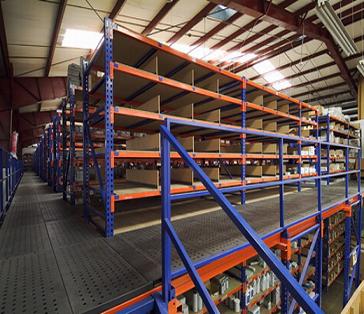
Mezzanine-supported shelving requires beams that carry both pallet loads and
personnel traffic. These applications demand:
Live load ratings incorporating uniform loads for walking surfaces.
Deflection limits of L/240 or stricter to prevent vibration perception by
pickers.
Integrated handrail attachment points engineered into beam
profiles.
6. Damage Assessment and Repair Protocols
Forklift impacts are the leading cause of beam damage. Immediate response to
impact is critical to prevent progressive collapse. Industry guidelines (RMI
ANSI MH16.1) specify inspection criteria:
Visual indicators: Any visible bend, twist, or connection
gap requires engineering evaluation.
Permissible damage limits: Localized flange damage less
than 5% of section depth may be acceptable if no deformation in the web. Any
deformation exceeding 10 mm in the beam depth warrants replacement.
Repair methods: Welded repairs are generally prohibited on
cold-formed beams due to heat-affected zone softening. Replacement with
identical beam sections is the standard approach.
Facilities should maintain documented inspection logs and replace damaged
warehouse racking beams immediately rather than attempting
field repairs.
7. Lifecycle Cost Optimization: Material Quality vs. Initial Price
Procurement focused solely on lowest beam price ignores total cost of
ownership. A 15-year lifecycle analysis reveals that higher-quality beams with
superior coatings and thicker sections reduce replacement frequency and downtime
costs. Key factors:
Coating durability: Premium powder coating (80–100 micron
thickness, 1,000+ hour salt spray resistance) adds 15–20% to upfront cost but
eliminates repainting in corrosive environments.
Damage tolerance: Beams with thicker flanges (2.5mm vs.
1.8mm) resist minor impacts without permanent deformation, extending service
life.
Interchangeability: Standardized beam profiles across a
facility allow replacement from stock, reducing downtime from weeks to
hours.
Data from 120 warehouses surveyed in 2024 showed that facilities using
certified heavy-duty beams with impact protection had 65% fewer structural
repairs over a decade compared to those using entry-level beams.
8. Installation and Quality Assurance
Even properly engineered beams will fail if installed incorrectly. Critical
installation steps include:
Anchor bolt verification: Column base plates must be
torqued to engineering specifications (typically 80–150 Nm depending on anchor
diameter).
Beam leveling: All beams at the same level must be within
±3 mm of horizontal to ensure even load distribution.
Safety lock engagement: Each beam connection must be
physically checked for full lock engagement—audible clicks are not
sufficient.
Post-installation inspection: Third-party inspection
verifies alignment, torque, and connection integrity before loading.
Suppliers like Guangshun provide certified
installation supervision and post-installation load testing to verify system
integrity, reducing owner liability.
Engineering for Safety and Longevity
The selection and specification of warehouse racking
beams demands rigorous engineering attention—from material grade
and section modulus to connection design and seismic compliance. Beams are not
commodities; they are structural members that must perform reliably under
dynamic loads, impact forces, and environmental stresses. By prioritizing
certified load ratings, verified connections, and damage-tolerant designs,
facility operators build storage infrastructure that supports continuous
operations without structural risk.
Frequently Asked Questions
Q1: What is the maximum allowable deflection for warehouse racking
beams?
A1: Industry standards (RMI MH16.1, FEM 10.2.08) specify
maximum vertical deflection under full load as L/180 for standard applications,
where L is the beam span. For example, a 3,000 mm beam should deflect no more
than 16.7 mm. For mezzanine-supported beams or areas with personnel traffic,
stricter limits of L/240 or L/300 apply to prevent vibration and ensure
safety.
Q2: How do I determine the correct beam capacity for my pallet
loads?
A2: Beam capacity must be calculated based on maximum point
load, not average load per level. Consider the heaviest pallet weight, plus
safety factor (1.5 for forklift access). Then verify beam section modulus and
yield strength using manufacturer load tables. Always specify beams with
published static and dynamic ratings from RMI-certified testing. For complex
configurations, consult structural engineering documents from the supplier such
as Guangshun.
Q3: Can I replace damaged beams with beams from a different
manufacturer?
A3: Mixing beam manufacturers is strongly discouraged
unless engineering documentation confirms compatibility. Differences in
connection profiles, hole spacing, and steel grades create unpredictable load
paths and connection failures. For consistent performance, use beams from the
original rack manufacturer or a supplier like Guangshun that provides full
system engineering documentation.
Q4: How often should warehouse racking beams be
inspected?
A4: RMI recommends formal inspections every 12 months for
active warehouses. Additionally, inspections must occur after any forklift
impact, seismic event, or visible deformation. Inspections should check for:
beam end connector engagement, flange deformation, vertical alignment (within
0.25% out-of-plumb), and corrosion. Any beam with visible bending, twisting, or
connector damage must be replaced immediately.
Q5: What is the typical lead time for custom-engineered racking
beams?
A5: For systems requiring seismic engineering, special
coatings, or non-standard spans, lead times range from 6 to 12 weeks. This
includes structural calculations, shop drawings, fabrication, and coating
application. Expediting may compromise quality control. Reputable suppliers like
Guangshun provide
detailed project schedules during the design phase to align with construction
timelines.