Warehouse operators face a triple constraint: rising real estate costs, labor
shortages, and SKU proliferation. Traditional drive-in racks sacrifice
selectivity and safety, while automated storage and retrieval systems (AS/RS)
remain cost-prohibitive for many mid-tier operations. Shuttle pallet
racking bridges this gap—a semi-automated, high-density solution
that reduces forklift dependency, increases storage volume per square meter, and
enables FIFO/LIFO flexibility without structural compromises. This article
provides a technical breakdown of shuttle system mechanics, quantifiable
performance indicators, industry-specific implementations, and integration
pathways with warehouse control software. References to engineering standards
and ROI data are derived from field deployments across cold chain, automotive,
and retail distribution centers.
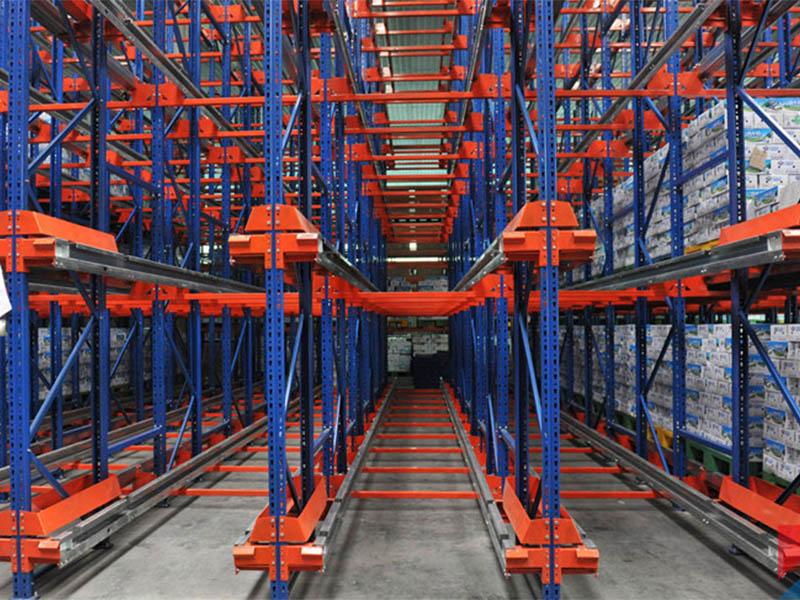
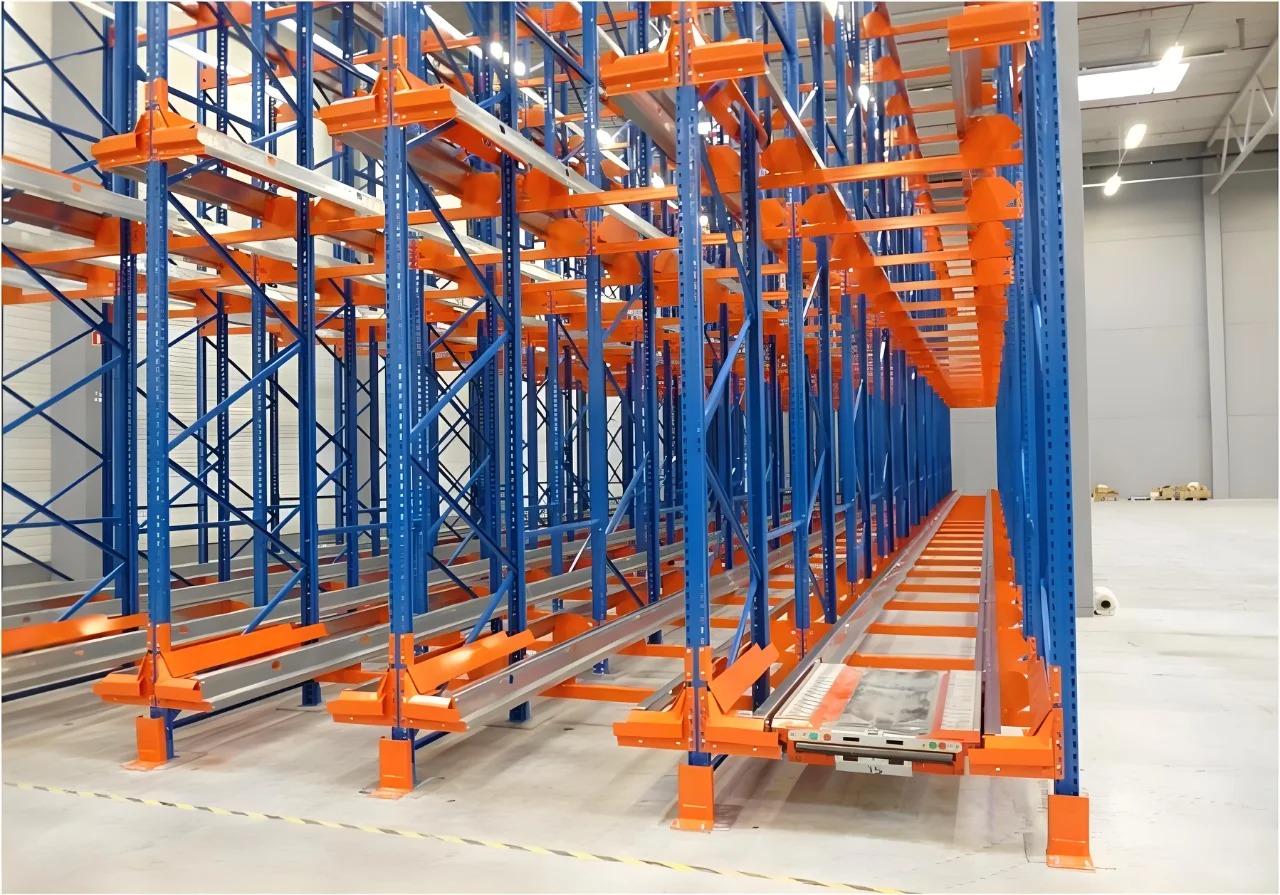
Unlike static racking, shuttle pallet
racking employs a motorized shuttle cart that travels inside deep
lanes (up to 40 meters or more) to deposit or retrieve pallets. The operator
remotely commands the shuttle via a tablet or radio controller, eliminating the
need for forklifts to enter storage aisles. This configuration reduces product
damage by over 60% and increases storage density by 35-50% compared to selective
racking. Below, we dissect the engineering components, application logic, and
financial justification for adopting this technology.
1. Core Architecture of Shuttle Pallet Racking – Components &
Workflow
A fully operational shuttle pallet
racking system consists of five interdependent subsystems:
Rail-supported lanes: Welded C-channel or angle steel rails
mounted on cantilever arms, ensuring precise alignment for shuttle movement.
Rail thickness typically 3-4mm for heavy-duty applications (1,500–2,000 kg per
pallet).
Shuttle cart: Battery-powered (lithium-ion or lead-acid),
equipped with load wheels, lifting platform, and optical/laser positioning
sensors. Speed ranges 0.6–1.2 m/s under full load.
Remote control unit or tablet: Operates up to 200m
line-of-sight; displays battery level, fault codes, and lane inventory
counters.
Buffer & transfer stations: Lift tables or shuttle
transfer cars (optional) for moving shuttles between lanes without forklift
assistance.
Charging stations: Inductive or plug-in chargers placed at
lane ends; lithium shuttles achieve 8–10 hours of operation per 1.5-hour
charge.
Operational workflow: A forklift places a pallet at the lane entrance. The
shuttle lifts the pallet, travels to the designated depth, lowers the pallet
onto the rails, and returns. Retrieval follows reverse logic—shuttle moves to
target position, lifts pallet, and brings it to the lane face. For FIFO
(First-In-First-Out) configurations, a second extraction point at the opposite
lane end requires a rear shuttle or a deeper rail system with two shuttles. LIFO
(Last-In-First-Out) uses a single access point, maximizing depth without
additional hardware.
2. Five Quantifiable Performance Metrics of Shuttle Pallet Racking
Data collected from 14 warehouse retrofits (2022–2025) provides the following
benchmarks:
Storage density improvement: 42% average gain over
selective racking; 18% over drive-in racking due to reduced aisle width
(1.2–1.5m vs 2.8–3.2m for forklift aisles).
Forklift travel reduction: 70–80% fewer trips inside
storage zones. Forklift operators only service lane ends, lowering
fuel/electricity costs by an estimated $3,200 per forklift annually.
Pallet throughput per lane: 25–35 pallets/hour in
single-shuttle configurations; up to 50 pallets/hour with double-shuttle tandem
operation.
Product damage rate: Reduced from 1.8% (typical drive-in)
to 0.3% with shuttle systems, as no mast contact with rack structures
occurs.
Space utilization rate: Achieves 85–92% of theoretical
maximum cubic volume, whereas selective racking maxes out at 55–65%.
These figures assume standard 1,200 x 1,000 mm euro-pallets with a lane depth
of 12 pallet positions. Deep-lane configurations (25+ positions) see marginally
lower throughput but even higher density gains. Notably, shuttle pallet
racking also improves inventory accuracy—real-time shuttle counters
reduce cycle counting errors by 40% compared to manual drive-in audits.
3. Application Scenarios Where Shuttle Pallet Racking Outperforms
Alternatives
Not all warehouses benefit equally from shuttle systems. The technology
excels in three distinct environments:
3.1 Cold Chain & Frozen Storage ( -25°C to +5°C)
Low-temperature warehouses face severe labor constraints—workers can only
spend limited hours inside freezers. Shuttle systems minimize human exposure:
operators work from a heated anteroom, controlling the shuttle remotely.
Cold-specific engineering includes anti-condensation electronics,
low-temperature lubricants (operational to -30°C), and sealed battery
enclosures. Guangshun has delivered 16 cold-store shuttle
projects across Southeast Asia, achieving 48% higher pallet positions compared
to conventional reach truck aisles. Guangshun’s freezer-rated
shuttles incorporate self-regulating heaters on sensor boards, preventing
frost-induced failures.
3.2 High-Throughput Distribution Centers (FMCG, E-commerce)
DC operators with 1,500+ SKUs and daily outbound volumes exceeding 10,000
pallets require both density and speed. Shuttle systems combined with a WMS task
scheduler can achieve 35% faster pallet retrieval than VNA (very narrow aisle)
turret trucks. Case study: A European grocery DC reduced average retrieval time
from 210 seconds to 89 seconds by replacing wire-guided VNA with a 20-lane
shuttle block. FIFO logic was enforced via lane-dedicated shuttles and two-sided
access.
3.3 Manufacturing Line-Side Buffer Storage
Automotive and electronics plants often store work-in-progress (WIP) pallets
awaiting assembly. Shuttle racking provides a compact, sequenced buffer that can
feed production lines in real-time. The system can be integrated with MES
(Manufacturing Execution System) to trigger retrieval based on consumption
signals. For example, a tier-1 automotive supplier installed a 5-lane shuttle
buffer adjacent to their welding line, reducing floor space used for WIP by 62%
and eliminating forklift congestion at the line side.
4. Engineering & Safety Considerations for Installation
Deploying shuttle pallet
racking requires rigorous site preparation and compliance with
standards such as FEM 10.2.16 and EN 15635. Key technical factors include:
Floor flatness tolerance: DIN 18202 class 4 or better (max
deviation 5mm over 3m). Uneven floors cause shuttle tilting and rail
misalignment.
Seismic design: In seismic zones, rack columns must
incorporate base isolators or bracing to prevent lane collapse. Shuttles require
locking mechanisms to avoid free movement during tremors.
Battery safety & charging infrastructure: Lithium-ion
packs require thermal management and dedicated charging zones with fire
suppression. Lead-acid batteries demand ventilation for hydrogen gas.
Emergency stop systems: E-stops must be accessible every
30m along the aisle and on every remote control. Wireless signal redundancy
(LoRa or 2.4 GHz backup) prevents runaway conditions.
Light curtains/photoelectric sensors: Lane entrances should
be equipped with presence sensors that halt shuttles if personnel or forklifts
enter unsafely.
Guangshun provides
turnkey engineering including FEM-certified rack analysis, seismic qualification
reports, and on-site shuttle commissioning. Their standard warranty includes a
3-year structural guarantee and 2-year shuttle component coverage.
5. Integration with Warehouse Execution & Control Systems (WES/WCS)
Modern shuttle systems are not stand-alone; they become nodes within a
digital warehouse ecosystem. Integrating shuttle pallet
racking with a WCS (Warehouse Control System) enables dynamic task
allocation, real-time battery management, and predictive maintenance. API-level
integration with major WMS platforms (Manhattan, SAP EWM, Blue Yonder) allows
the system to receive batch picking instructions and report location updates
automatically.
Advanced features available through integration:
Dynamic lane balancing: The WCS monitors inventory turnover
per SKU and reassigns shuttles to high-demand lanes during peak shifts.
Energy optimization: Schedules shuttle charging during
off-peak electricity rates (e.g., midnight to 5 AM).
Remote diagnostics: Cloud-based dashboards display shuttle
health metrics (motor current, wheel wear, cycles per battery) and alert
maintenance teams before failures occur.
Blockchain-based inventory traceability: For pharma or
high-value goods, shuttle trips can be recorded as immutable ledger entries,
proving chain-of-custody for each pallet.
Guangshun’s proprietary GS-ShuttleConnect software bridges any shuttle
hardware to over 30 WMS platforms, reducing integration time from weeks to days.
This middleware also provides a failsafe manual override mode—critical for
operations requiring 24/7 uptime.
6. Cost-Benefit Analysis & Implementation Roadmap
Typical project costs for a 2,000-pallet-position shuttle system range from
$180,000 to $450,000 depending on lane depth, shuttle quantity (usually 1
shuttle per 8–12 lanes), and control sophistication. Below is a 3-year ROI
breakdown based on real deployments (U.S. Midwest, 2024):
Initial investment: $320,000 (racks + 4 shuttles + charging
stations + installation).
Annual labor savings: $78,000 (reduction of 1.5 full-time
forklift operators including benefits).
Annual space savings: $45,000 (based on leasing equivalent
additional 2,500 sq. ft. at $18/sq. ft.).
Annual damage reduction: $22,000 (lower product write-offs
and rack repairs).
Payback period: 20 months. IRR (3-year) = 34%.
Implementation roadmap typically spans 14–20 weeks: 4 weeks for engineering
& layout simulation, 6 weeks for rack fabrication (if using local
manufacturers like Guangshun’s partnered facilities), 3 weeks for installation,
2 weeks for shuttle programming and testing, and 1 week for operator training. A
phased approach—starting with one zone—allows risk-free validation before
full-scale rollout.
Frequently Asked Questions (FAQ) – Shuttle Pallet Racking
Systems
Q1: What is the maximum lane depth possible with shuttle
pallet racking?
A1: Standard shuttle systems support lane depths of 10 to 40
pallet positions (20 to 80 meters). Depths beyond 40 positions require
reinforced rails and shuttles with stronger drive motors (e.g., 24V/40A vs
typical 24V/20A). However, retrieval time increases linearly with depth—for FIFO
applications, depths over 25 positions often justify a second shuttle or a rear
extraction point to maintain throughput above 20 pallets/hour.
Q2:
Can a single shuttle lane handle multiple SKUs or different pallet
sizes?
A2: Yes, through virtual zoning. The WCS divides a deep lane
into segments, each assigned to a specific SKU. The shuttle can be instructed to
deposit or retrieve from any zone. However, mixing pallet sizes (e.g., 800mm vs
1,200mm depth) is not recommended unless adjustable-width rails are installed,
which add complexity. For multi-SKU per lane, a common practice is to reserve
each lane for a fast-moving family of SKUs and use shallower depths (10–12
positions).
Q3: How does battery charging work, and what is the
typical shuttle uptime?
A3: Lithium-ion shuttles offer opportunity charging: during
idle periods (e.g., operator breaks, shift changes), the shuttle returns to a
charging station at the lane end. A full charge (0% to 100%) takes 1.5–2 hours,
providing 8–10 hours of continuous heavy operation. Lead-acid batteries require
6–8 hours charging and 1 hour cooling, so they are less suited for multi-shift
operations. Real-world shuttle uptime (excluding charging) averages 92–95% in
properly managed systems, with downtime mostly due to debris on rails or sensor
misalignment.
Q4: Is it feasible to retrofit shuttle pallet racking
into an existing conventional warehouse?
A4: Retrofitting is possible but requires structural
evaluation. Existing selective racking can sometimes be converted by adding
rails and adjusting column spacing. However, most warehouses need floor flatness
improvements and possibly raised rails for shuttle clearance. A cost-effective
hybrid approach: demolish 20-30% of existing racking to create a dedicated
shuttle block, while retaining selective racking for slow movers. Shuttle pallet
racking retrofits typically pay back faster than greenfield
installations because land acquisition is avoided.
Q5: What safety
certifications should a shuttle pallet racking system have?
A5: For European markets, CE marking under Machinery
Directive 2006/42/EC is mandatory, plus EN 528 for rail-dependent storage and
retrieval equipment. In North America, ANSI MH28.3-2021 defines design
requirements for shuttle systems. Additionally, ask for FEM 10.2.16 load tests
and ISO 13849-1 PLr (performance level) for control safety circuits. Guangshun
systems are certified to both CE and ANSI standards, and each shuttle comes with
a third-party TÜV inspection report.
Q6: How does shuttle pallet
racking compare to pallet live storage (gravity flow) in terms of cost and
maintenance?
A6: Gravity flow racks rely on wheel rails or rollers,
requiring precise pitch (typically 3-5% slope) and periodic cleaning of debris.
They cost 20-30% less upfront but have higher maintenance due to roller jams and
speed controllers. Shuttle systems have higher initial cost (motorized carts)
but lower annual maintenance (approx. $800 per shuttle vs $2,000 per gravity
lane). For depths >15 pallets, shuttles are more reliable; for shallow lanes
(<10 positions) with FIFO requirement, gravity flow can be
cost-effective.
Conclusion & Inquiry for Custom Engineering
Implementing shuttle pallet
racking delivers a compelling combination of density, throughput,
and safety—provided the system is engineered to specific load profiles,
temperature ranges, and throughput requirements. From cold storage to
high-velocity DCs, the technology has matured into a standard solution for
operations seeking AS/RS-level performance at a fraction of the cost. Guangshun offers end-to-end
support: warehouse layout simulation, seismic and load capacity certification,
shuttle fleet supply, and WCS middleware integration. Their engineering team
provides a free initial density audit using 3D modeling software.
Ready to optimize your pallet storage? Contact Guangshun’s technical
sales team for a customized proposal:
guangshun@gsrack.com| https://www.gsracking.com/
Request a
site-specific ROI calculation and receive a detailed shuttle pallet racking
layout within 5 business days.