If you’re looking for a smarter way to store pallets, especially when you have lots of the same product, you’ve probably heard the term pallet shuttle racking. It sounds technical, but the concept is all about simplicity and automation. This system sits in a interesting space between traditional push-back racks and full-scale automated storage.
At its core, pallet shuttle racking is a semi-automated, high-density storage system. It uses a battery-powered shuttle car that runs on rails inside a storage lane, moving pallets in and out. The goal is to reduce the need for a forklift to enter the racking structure, speeding up operations and allowing for incredibly tight storage.
It’s not a one-size-fits-all solution. For the right operation, it can be a game-changer. For the wrong one, it’s an expensive complication. Let’s break down how it actually works, where it makes sense, and what you need to know before considering it.
What is Pallet Shuttle Racking and How Does It Work?
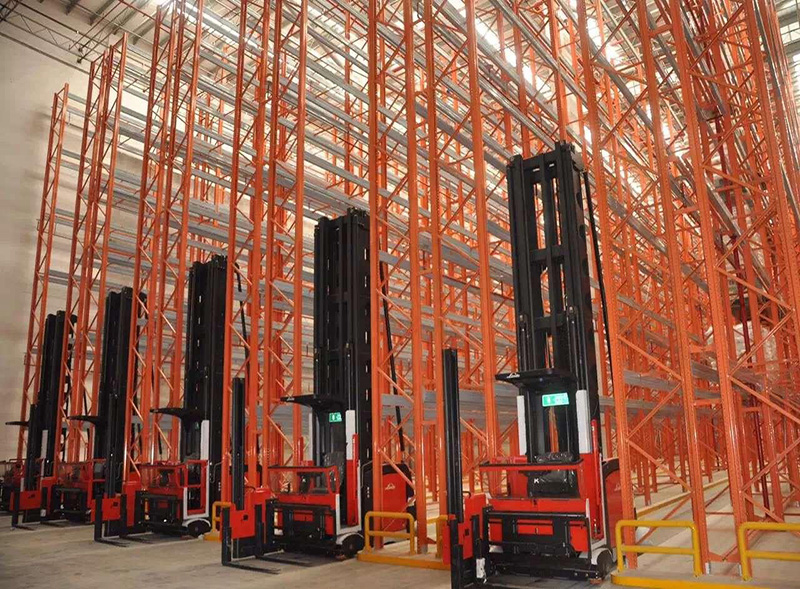
Imagine a deep row of racking, maybe five, ten, or even twenty pallets deep. In a traditional drive-in rack, a forklift has to slowly navigate all the way in to place the last pallet. Pallet shuttle racking removes the forklift from that equation.
The system consists of a few key parts. First, you have the rack structure itself, which is essentially a series of deep, guided lanes. Each lane has rails installed on the beam level. Then, you have the shuttle—a small, radio-controlled battery-powered cart.
Here’s the basic process: A forklift driver places the shuttle onto the rails at the front of a specific lane. The driver then loads a pallet onto the shuttle. Using a remote control, the operator commands the shuttle to carry that pallet down the lane. It travels to the first available empty spot, deposits the pallet, and returns to the front. The forklift never enters the lane.
For retrieval, the process reverses. The shuttle is sent into the lane to fetch the front-most pallet (first-in, first-out) or can be programmed to retrieve a specific pallet in some systems, bringing it back to the aisle for pickup.
The Key Advantages of a Shuttle System
Why would a warehouse move to this technology? The benefits are significant for operations that fit its profile.
Exceptional Storage Density
This is the biggest draw. By eliminating the need for forklift maneuvering space within the lane, pallets can be stored much deeper and closer together. You can achieve densities similar to drive-in racking but with much faster throughput.
Increased Throughput and Speed
A forklift operator’s job becomes simpler: just drop the shuttle, load a pallet, and press a button. The shuttle does the time-consuming travel down the long lane. This can cut loading and unloading times by more than half compared to traditional drive-in systems.
Enhanced Safety
Since the forklift never enters the rack structure, the risk of damaging the racks or causing a collapse from an impact is drastically reduced. Operators work in the clear, open aisle.
Better Product Protection
The shuttle moves pallets smoothly on rails. There’s no jerking, sudden stops, or risk of a forklift driver nudging other pallets in the lane. This is a major plus for fragile or high-value goods.
Reduced Labor Fatigue and Error
The physical and mental demand on the forklift operator is lower. The repetitive, precise work of navigating deep lanes is handled by the machine, leading to more consistent performance.
The Drawbacks and Realities to Consider
It’s a sophisticated system, and that sophistication comes with costs and constraints.
Higher Initial Investment
The pallet shuttle racking system itself, plus the shuttles (you may need several for different lanes or levels), represents a much larger capital outlay than traditional static racking. You’re paying for automation.
Lane Dedication and SKU Mix
This system works best with high volume of a limited number of SKUs. Each lane is typically dedicated to one product. If you have 500 different SKUs each moving only a few pallets a week, this system becomes inefficient and impractical.
Dependence on Equipment and Battery Management
Your warehouse operation now relies on the shuttles. If a shuttle breaks down, any lane that uses that model (or all lanes if you only have one) is effectively blocked. You need a maintenance plan and spare batteries charged and ready.
Not Truly "First-In, First-Out" by Default
In a standard configuration, each lane operates on a Last-In, First-Out (LIFO) basis. The last pallet put in is the first one out. For true FIFO (First-In, First-Out) inventory management, you need a more complex design with an entry and exit lane at opposite ends, which increases cost and footprint.
Is Your Warehouse a Good Candidate?
Pallet shuttle racking isn't for everyone. It shines under specific conditions. You should strongly consider it if:
- You have high-volume storage of a limited number of SKUs (e.g., beverages, packaged food, certain chemicals, paper products).
- Your facility has high ceilings but a limited footprint, making density a top priority.
- You need higher throughput than a drive-in system can provide but aren't ready for a fully automated AS/RS.
- Product weight is consistent and within the shuttle's capacity (typically up to 3,500 lbs).
You might want to look at other options if:
- Your SKU count is very high and inventory changes constantly (a traditional selective rack is better).
- Your budget is very tight. The ROI needs to be calculated based on labor and space savings.
- You have extremely heavy loads beyond standard shuttle capabilities.
- You require strict FIFO for all products and cannot accommodate a lane-based LIFO flow.
Planning and Implementation: Key Steps
If you're moving forward, careful planning is non-negotiable.
- Deep-Dive Analysis: Audit your inventory. You need solid data on your top-moving SKUs, pallet dimensions, and weights. This determines lane depth and shuttle specifications.
- Choose the Right Shuttle Type: There are different shuttles for different tasks. Standard pallet shuttles, heavier-duty models, and even shuttle systems that can change levels automatically (raising the cost considerably).
- Design the Layout: Work with an expert to design the rack layout. This includes deciding lane depth, number of levels, and whether you need a FIFO or LIFO configuration. Aisle width is still needed for forklifts, but it can be minimal.
- Factor in Total Cost: Budget for the racking, the shuttles (plus spares), professional installation, a charging station, and training for your team. Don't forget ongoing maintenance.
- Prepare Your Team: This changes workflows. Operators need training on remote control use, shuttle battery management, and new safety protocols for the system.
Making the Final Decision
Pallet shuttle racking offers a compelling middle ground. It provides a significant boost in automation, density, and speed without the astronomical cost of a fully robotic warehouse. For a business storing large quantities of a few products, the gains in efficiency and space utilization can justify the investment quickly.
The decision hinges on your product profile and growth plans. The best next step is to consult with a specialist who can analyze your inventory data and run a proper feasibility study. They can model your storage needs and show you a realistic comparison of throughput and density against your current system.
It's a step toward the warehouse of the future, available with technology you can implement today.
Frequently Asked Questions (FAQs)
Q1: How many shuttles do I need to buy for a system?
A1: It depends on your throughput and layout. Often, one shuttle can service multiple lanes on the same level. You might start with 2-3 shuttles for an entire system and move them between lanes as needed. For maximum speed, you could dedicate a shuttle to every high-throughput lane. Most operations find a shared pool is cost-effective.
Q2: Can pallet shuttle racking work with different pallet sizes in the same warehouse?
A2: Yes, but it requires planning. You would need adjustable or switchable rails in the lanes, and you must use shuttles compatible with the different pallet dimensions. Typically, it's more efficient to dedicate specific lanes or even entire rack zones to a single pallet size to avoid constant shuttle and rail adjustments.
Q3: What happens if the shuttle breaks down or its battery dies in the middle of a lane?
A3: This is a critical consideration. Reputable systems have manual retrieval modes or simple tools to manually pull the shuttle out. Having a spare, charged shuttle on hand is essential for continuous operation. Proper battery management and scheduled maintenance minimize this risk.
Q4: Is FIFO (First-In, First-Out) inventory possible with shuttle racking?
A4: Yes, but it requires a specific design called a "flow-through" or "dynamic" system. This uses two aisles—one for loading and one for unloading—with the shuttle moving pallets from the loading end to the unloading end. It's more complex and expensive than the standard single-aisle LIFO design but is used for products with expiration dates.
Q5: How does pallet shuttle racking compare to drive-in racking in terms of cost?
A5: The upfront cost for pallet shuttle racking is significantly higher due to the automated shuttles and more precise racking. However, the long-term operational costs are often lower. You save on labor (faster cycles), experience less product and rack damage, and achieve higher throughput. The ROI calculation must factor in these ongoing savings, not just the initial price.