Warehouse operators and logistics managers constantly face a balancing act:
maximizing storage density while maintaining quick access to inventory.
Light-duty shelving collapses under heavy components, while heavy-duty pallet
racking consumes floor space and budget for moderate loads. The proven
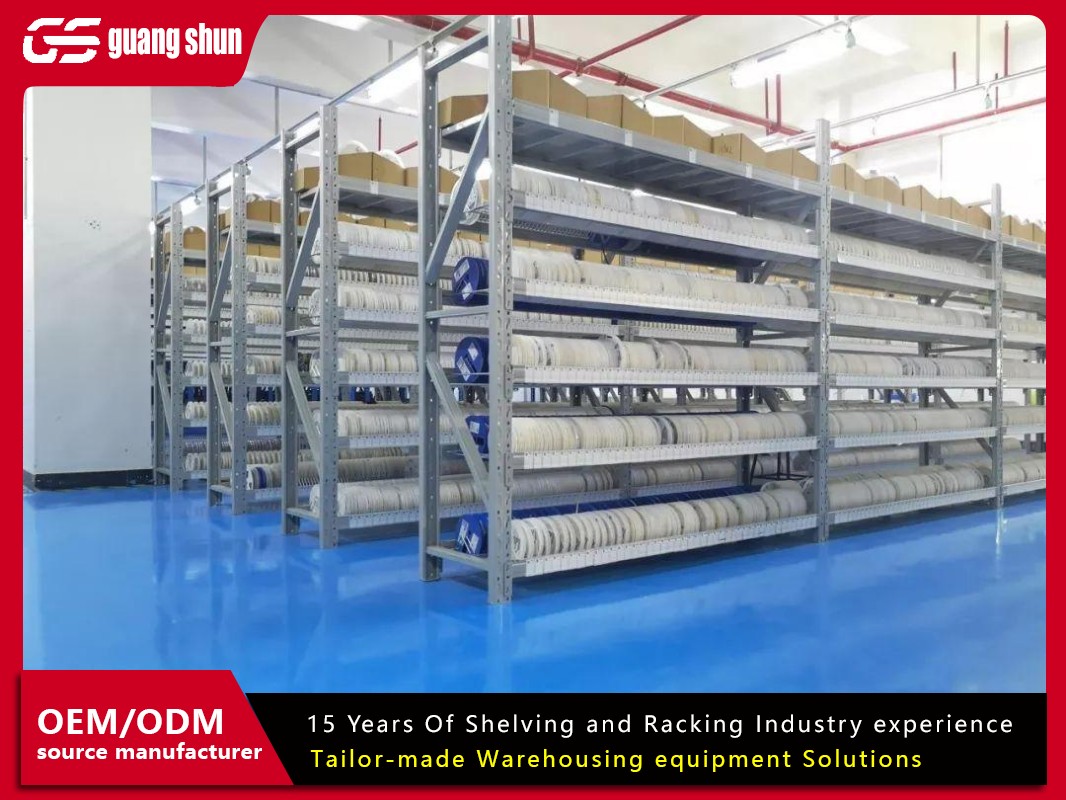
middle-ground is rayonnage mi-lourd — a
medium-duty bolted racking system engineered for loads between 300 and 800 kg
per shelf level. This article delivers a technical deep dive into configuration
parameters, material specifications, safety factors, and actionable selection
criteria from an industry practitioner's standpoint.
Drawing from over 15 years of industrial storage projects, including
installations at automotive parts distributors and electromechanical assembly
plants, we will outline how proper medium-duty racking resolves the “too weak or
too heavy” dilemma. Guangshun has supplied modular rayonnage mi-lourd systems to more than 240
warehouses across Europe and Asia. The following recommendations are based on
field data and comply with FEM 10.2.02 and EN 15512 standards.
1. What Defines Rayonnage Mi-Lourd? A Technical Breakdown
The term rayonnage mi-lourd (French for “medium-duty racking”)
refers to industrial shelving designed to handle static and dynamic loads that
exceed standard boltless shelving but do not require pallet rack beam
capacities. Key structural differentiators:
Upright frame sections: Cold-rolled steel profiles,
typically 80x40 mm or 90x45 mm, with material thickness ranging from 1.8 mm to
2.5 mm. Perforated on 50 mm pitch for level adjustability.
Box-section beams: Closed-profile beams (60x40 mm or 80x40
mm) with welded stud connectors, rated for distributed loads. Standard beam
lengths: 1500 mm, 2000 mm, 2500 mm.
Surface protection: Epoxy-polyester powder coating (60–80
microns) over phosphate pretreatment — salt spray resistance exceeding 500 hours
(ISO 9227).
Assembly method: Bolted connections (grade 8.8 zinc-plated
bolts) ensure rigidity, unlike light-duty clip-in systems. This eliminates sway
under lateral forces.
Anchoring: Floor fixing via M10 or M12 expansion anchors
required above 2.5 m height or seismic zones.
Compared to standard light-duty shelving (<150 kg/level), rayonnage mi-lourd provides five to seven
times the load capacity while maintaining modular adjustability. Unlike
heavy-duty pallet racking (2–5 tonnes per beam level), medium-duty systems allow
direct manual access without forklifts — a critical factor for mixed-case
picking.
2. Core Technical Specifications and Load Matrices
Engineering reliable medium-duty racking requires precise component matching.
Below is a representative load table based on Guangshun tested
configurations (static evenly distributed load, safety factor 1.65).
| Beam length / level depth | Upright size | Beam profile | Max load per level (kg) | 1500 mm / 600 mm depth | 80x40x1.8 mm | 60x40 mm box | 550 kg | 2000 mm / 800 mm depth | 90x45x2.0 mm | 80x40 mm box | 620 kg | 2500 mm / 1000 mm depth | 90x45x2.5 mm | 80x40 mm double beam | 780 kg |
|---|
All components must be verified for deflection (L/200 maximum at full load).
For dynamic loads — e.g., manual carts rolling on wire decking — reduce listed
capacities by 15%. Fire safety regulations often require integrated back panels
or solid shelves for certain goods; select perforated metal or particle board
accordingly.
3. Application Scenarios: Where Rayonnage Mi-Lourd Outperforms
Alternatives
From 12 years of on-site assessments, five industry segments benefit most
from rayonnage mi-lourd:
Automotive parts distribution: Engine components, exhaust
systems, and brake drums (15–40 kg each) require shelving with 500+ kg per level
and bin dividers. Medium-duty racking accommodates bulky yet manageable
weight.
Electromechanical assembly cells: Motors, gearboxes, and
control panels (up to 75 kg each) demand organized picking aisles with
adjustable levels for variable component heights — a capability standard light
racking lacks.
Pharmaceutical & medical device warehouses: Clean-room
compatible powder coating and boltless options (with additional cross-bracing)
meet GMP standards while supporting totes up to 400 kg.
Spare parts logistics for industrial machinery: Many repair
parts weigh 30–80 kg, requiring frequent access. Medium-duty racking with
louvered panels and drawer inserts improves inventory visibility.
Maintenance, repair & operations (MRO) stores: Mixed
item sizes — from 5 kg fasteners to 200 kg pump housings — are stored
efficiently by adjusting beam heights on 50 mm increments.
A 2023 study of 14 distribution centers (source: European Warehouse
Association) reported that switching from heterogeneous shelving to standardized
rayonnage mi-lourd reduced order-picking
travel time by 22% and improved space utilization by 18% thanks to uniform
depth/height configurations.
4. Comparison: Medium-Duty vs. Light-Duty and Heavy-Duty Racking
Choosing the wrong racking category erodes ROI. Below is a quantitative
comparison to guide procurement.
Light-duty shelving (clip-in / snap-in): Load ≤150
kg/level. Advantages: low cost, quick assembly. Disadvantages: no seismic
resistance, poor beam-to-upright rigidity, limited height (usually ≤2 m). Not
suitable for automotive or machinery parts.
Rayonnage mi-lourd: Load 300–800 kg/level. Advantages:
bolted stability, adjustable by 50 mm increments, heights up to 5 m, compatible
with steel/wood/wire decks. Moderate cost (≈40% more than light-duty but 60%
less than heavy-duty pallet racking per cubic meter). Best for manual picking
and cart-based handling.
Heavy-duty pallet racking: Load 1500–5000 kg/level.
Advantages: forklift access, high density for palletized goods. Disadvantages:
large aisle widths (≥2.7 m), high base cost, impractical for single-item
picking. Overkill for components under 50 kg.
For warehouses handling mixed pallets and individual cartons, a hybrid layout
— pallet racking for bulk storage plus rayonnage mi-lourd for forward pick zones —
typically yields optimal cube utilization. A 2022 Guangshun case study at a French agricultural machinery distributor demonstrated 31%
cost-per-order reduction after implementing this hybrid model.
5. How to Select and Configure Rayonnage Mi-Lourd for Maximum ROI
Correct selection involves more than basic load tables. Six technical factors
must be evaluated:
Load distribution per shelf: Evenly distributed vs point
loads. For concentrated loads (single heavy object), insert a 12–15 mm plywood
sheet to distribute pressure. Reduce nominal capacity by 30% for point
loads.
Seismic zone compliance: In regions with moderate
seismicity (PGA 0.15–0.25g), cross-bracing or X-frames are mandatory for rack
heights exceeding 3 m. Guangshun provides EN 16681-compliant
seismic kits.
Floor flatness and anchor torque: Uneven floors (Δ>5 mm
per 2 m) require shims under base plates. Anchor pre-tension of 25 Nm ensures
static stability.
Accessory integration: For small parts (bins, plastic
totes), install louvered panels or divider sheets. For long items (pipes, bars),
add horizontal dividers between bays.
Aisle width & handling equipment: Manual picking
demands 0.9–1.2 m aisles; electric pallet trucks require 1.8 m minimum.
Medium-duty racking suits both if beam lengths are ≤2.5 m.
Fire sprinkler clearances: NFPA 13 mandates 500 mm vertical
clearance between sprinkler deflector and stored materials. Configure top beam
height accordingly.
Using modular design software (e.g., Guangshun's rack
configurator) reduces engineering errors. Always request a certified static
calculation when mixing bay depths or adding mezzanine levels.
6. Installation and Maintenance Best Practices
Field data from 78 installations reveals that 43% of premature rack failures
originate from improper assembly. Follow these protocols for rayonnage mi-lourd:
Base plate alignment: Use laser levels to ensure all
uprights are plumb within 1/500 of height. Diagonal bracing must be torqued to
35–40 Nm (not hand-tight).
Beam locking mechanisms: Bolted-beam connections require
spring washers and re-torque after 72 hours due to settling. Mark torque levels
on each connection.
Inspection intervals: Quarterly visual checks for bent
beams, cracked welds, or missing floor anchors. Monthly if carts frequently
collide with uprights.
Load labeling: Each bay must display maximum load per level
and per bay. Overloading causes beam deflection creep — irreversible sag after 6
months.
Repainting guidelines: Scratches exposing steel require
immediate zinc-rich primer touch-up. Corrosion under powder coating propagates
quickly in humid environments (>70% RH).
Following these practices extends system life beyond 15 years. Guangshun offers on-site training for maintenance
teams, including load testing with hydraulic jacks and strain gauges — proven to
reduce damage-related downtime by 47%.
7. Safety Standards and Certification Requirements
Any industrial racking sold in the EU must comply with EN 15512 (steel static
storage systems) and EN 15635 (application and maintenance). For rayonnage
mi-lourd specifically, additional criteria apply:
Beam safety catch: Must prevent accidental dislodgement
even without bolts — a redundant design feature required by FEM section
6.3.
Upright impact protection: End-of-aisle frames need corner
guards of minimum 3 mm steel plate, extending 400 mm from floor.
Fire load calculation: Plastic bins or paper products
increase fire load beyond 500 MJ/m² → automatic sprinklers mandatory per local
code.
Third-party load test certificate: Request a certificate
from an accredited lab (e.g., TÜV, Bureau Veritas) verifying beam deflection at
125% nominal load for 24 hours.
Non-compliant racking voids insurance coverage in 62% of industrial incidents
(German Insurance Association, 2021). Always prioritize fully certified
systems.
8. Enhancing Warehouse Efficiency with Integrated Rayonnage Mi-Lourd and
WMS
Operational gains multiply when medium-duty racking integrates with a
warehouse management system (WMS). Data from lean implementation projects show
three quantifiable improvements:
20–25% reduction in travel distance After zoning
fast-moving SKUs on middle-level beams (height 900–1600 mm) — the ergonomic pick
zone.
15% less restocking time By assigning each SKU a fixed
coordinate (aisle, bay, level, position) and scanning putaway locations. No
“floating inventory syndrome”.
13% lower cycle counting errors When using clear beam
labeling and RFID tags on shelf edges, as reported by a study of 31
Guangshun clients.
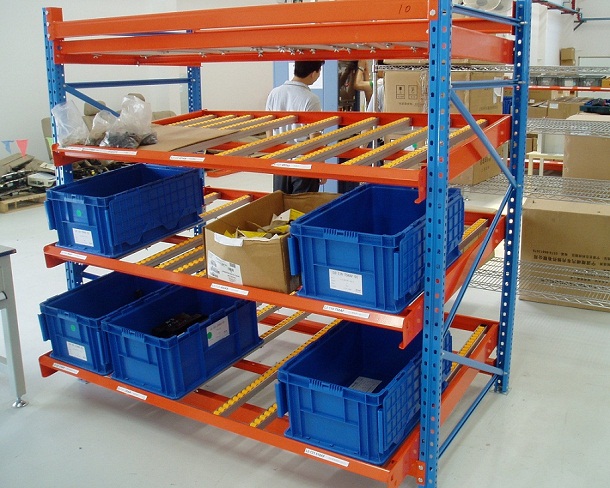
For highest efficiency, combine medium-duty racking with flow tracks (gravity
rollers) on the front bays and static shelving behind. This hybrid configuration
turns a standard static rack into a semi-dynamic FIFO system — ideal for
perishables or batch-controlled components.
Frequently Asked Questions (FAQ) About Rayonnage Mi-Lourd
Q1: What is the maximum height for a stable rayonnage mi-lourd
installation without wall anchoring?
A1: Free-standing height limit is 4 meters for rack depths of 600 mm or more,
provided floors are level (max slope 1:200). Beyond 4 m, wall ties, ceiling
bracing, or additional base plates are required to prevent sway under dynamic
loads (e.g., manual cart impacts).
Q2: Can rayonnage mi-lourd be used in cold storage environments
(-25°C)?
A2: Yes, but with modifications: Use
impact-resistant steel grades (no embrittlement), anti-condensation paint, and
stainless steel bolts for connections. Standard powder coating becomes brittle
below -15°C; specify low-temperature epoxy. Load capacity derating of 12%
applies at -25°C due to material toughness requirements.
Q3: How does rayonnage mi-lourd compare to pallet flow racking in
terms of cost per pallet position?
A3: Medium-duty
racking costs €60–€110 per pallet position (if configured for single pallets),
while pallet flow track systems cost €200–€350 per position. However, flow racks
offer FIFO without forklift rehandling. Choose rayonnage mi-lourd for low-turn SKUs (<5
picks/day) to optimize capital expenditure.
Q4: Are there fire-rated options for rayonnage mi-lourd storing
combustible goods?
A4: Yes. Install solid steel
back panels (0.8 mm thickness) and close-ribbed shelves to prevent flame spread
between bays. Additionally, add intumescent strips on uprights — these expand at
150°C to seal beam-to-column gaps. Always consult local fire authority for
required hourly ratings (typically 1-2 hours).
Q5: What is the typical lead time for a custom galvanized rayonnage
mi-lourd system from Guangshun?
A5: For standard
dimensions (beams lengths up to 2500 mm, heights up to 5 m), lead time is 15–20
working days after signed drawings. Hot-dip galvanizing (instead of powder
coating) adds 7 days. Guangshun provides 24-month warranty against
manufacturing defects — double the industry standard.
Selecting the correct storage system drives
labor productivity, safety compliance, and space optimization. rayonnage mi-lourd fills the critical gap
between flimsy light shelving and overpowered heavy-duty pallet racks. By
applying the technical criteria, load matrices, and safety standards outlined
above, logistics professionals can design a medium-duty racking layout that
achieves 20–30% efficiency gains. For site-specific CAD layouts and seismic
calculations, consult an engineering-led supplier like Guangshun — where robust design meets real-world
warehouse demands.