Efficient storage of lengthy, bulky, or irregularly shaped materials—steel
bars, lumber, piping, extruded aluminum—remains a persistent challenge in
warehouse operations. Conventional pallet racking fails to accommodate such
dimensions, leading to wasted cubic volume, product damage, and hazardous
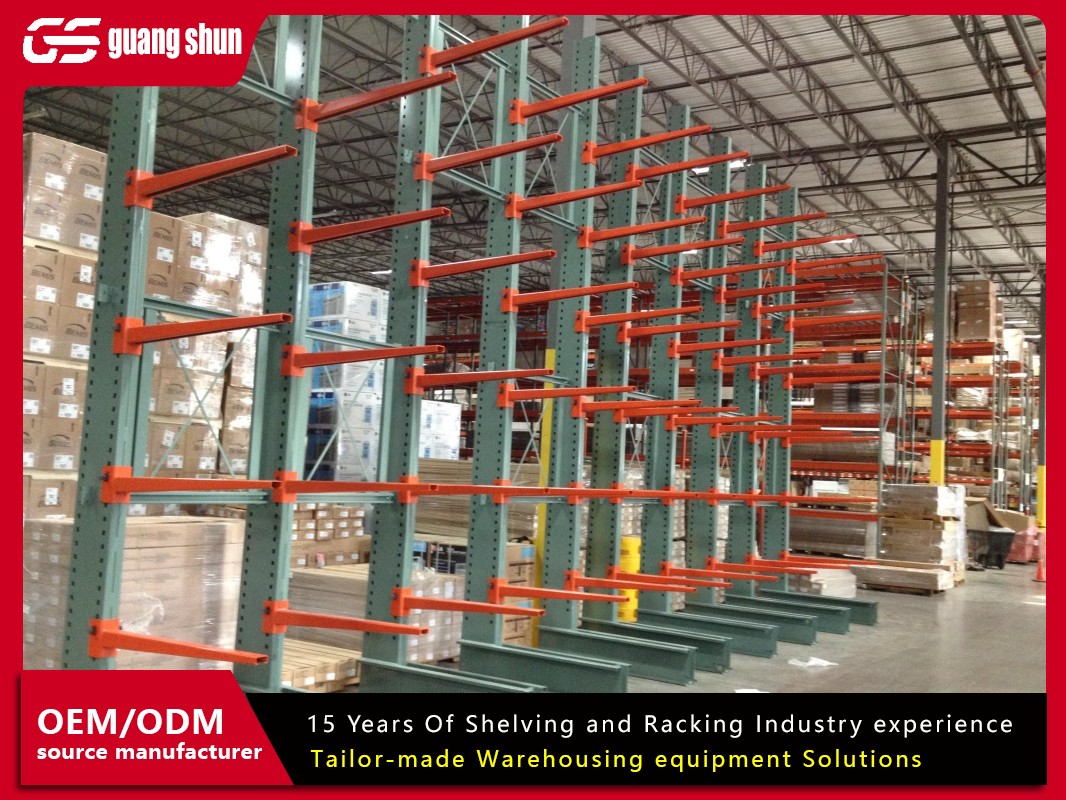
handling. rayonnages cantilever systems solve this
through an open-front design with vertical columns and horizontal arms, enabling
unobstructed access and systematic organization. This guide examines the
structural mechanics, material selection, sector-specific deployments, safety
protocols, and financial justification of cantilever racking, based on field
data and engineering standards. Guangshun has
engineered such systems for two decades, delivering customized configurations
that optimize floor density while preserving inventory integrity.
1. Structural Anatomy of Rayonnages Cantilever – Components and Material
Science
The performance of any cantilever racking system depends on metallurgical
quality, geometric design, and assembly precision. A rayonnages cantilever consists of four primary
elements:
Upright columns (posts): Typically manufactured from
roll-formed or structural C-channel steel (thickness 2.0–4.5 mm). Hole patterns
on 50 mm or 75 mm pitch allow vertical arm adjustment. Higher gauge steel
provides greater moment resistance against bending from eccentric loads.
Base plates & floor anchors: Welded base plates
distribute column loads to concrete. Anchor bolt patterns (M16 to M24) must
resist overturning moments, especially for single-sided configurations.
Engineers calculate required anchor pull-out resistance based on regional
seismic coefficients (e.g., EN 16681 or AS 4084).
Cantilever arms: Available as tapered or step-profile
sections, fabricated from welded steel plate or heavy-duty I-beams. Arm length
ranges from 300 mm to 1800 mm, with load capacities per arm from 500 kg to 3500
kg. The arm-to-column connection—bolted, pin-locked, or clip-in—affects
long-term rigidity.
Longitudinal bracing and tie bars: Back-to-back uprights
require cross-bracing (X or Z patterns) to prevent lateral buckling under
dynamic loads. Horizontal tie bars maintain row alignment and distribute
forklift impact forces.
Surface finishing is critical in corrosive environments. Most professional
systems use electrostatic powder coating (minimum 80 microns polyester) or
hot-dip galvanizing (ISO 1461) for outdoor lumber yards. Guangshun applies stress analysis
per FEM 10.2.02 to determine arm deflection limits (L/200 or less) and column
slenderness ratios, ensuring that the rayonnages cantilever remains stable under rated
load.
2. Technical Specifications and Load Calculation Methodology
Selecting a cantilever rack without rigorous load calculations leads to
safety violations and premature fatigue. Key parameters include arm load
capacity (uniformly distributed load), column load capacity (sum of all arms per
side), and maximum cantilever deflection. Industry-standard formulas
incorporate:
Moment (M) = Force (F) × Distance from column (d) – As arm
length increases, the bending moment grows linearly. For a 1500 mm arm carrying
1000 kg, the moment equals 1500 kg·m, requiring reinforced column
cross-section.
Shear and buckling checks – EN 15512 specifies that column
perforations reduce cross-sectional area. FEA-validated tables provide allowable
loads for each hole spacing and column size.
Combination loads – Simultaneous vertical (gravity) and
horizontal (seismic, forklift bump) forces require interaction ratio ≤1.0 per
Eurocode 3.
Practical example: A cantilever row 9 m high, double-sided, with arms at 1.2
m vertical pitch, each arm length 1.0 m, rated for 1500 kg per arm, total column
load 30 tonnes. The base plate must resist overturning of 45 kN·m. To meet
safety factor 1.5, the anchoring depth into C30/37 concrete must be at least 160
mm with epoxy grouting. Professional suppliers provide load matrices for every
rayonnages cantilever configuration.
Guangshun publishes certified load
charts per EN 15635, covering single-sided, double-sided, and mobile cantilever
racks.
3. Industry-Specific Applications and Storage Density Optimization
Different verticals impose unique constraints on cantilever rack design.
Below are four sectors where rayonnages cantilever significantly outperforms
alternatives.
3.1 Steel Service Centers & Metal Stockists
Long steel rounds, square bars, and structural sections (up to 12 m) require
segmented storage by grade and dimension. Double-sided cantilever racks with arm
dividers reduce nesting and allow FIFO inventory control. A case study from a
German distributor showed a 38% reduction in handling time after replacing floor
stacking with cantilever racks, along with a 22% increase in floor density due
to vertical utilization up to 8 m.
3.2 Lumber and Panel Processing
Moisture content variation and board warping demand proper air circulation.
Open cantilever arms (spaced 300–500 mm) prevent sagging and facilitate forklift
accessibility. For OSB and MDF panels, inclined cantilever arms (2–3 degrees
upward tilt) maintain stability. A North American mill integrated
radio-frequency identification (RFID) with cantilever positions, achieving 99.7%
inventory accuracy.
3.3 PVC Pipe and Conduit Warehousing
Long, hollow profiles risk crushing under their own weight if stored
horizontally on the floor. Cantilever arms with padded or UHMW-PE covers
eliminate surface marring. Adjustable arm height accommodates varying bundle
diameters. A French plumbing wholesaler reduced damaged goods by 67% after
switching to modular cantilever cells.
3.4 Automotive Body-in-White (BIW) and Exterior Parts
Side panels, roof rails, and bumpers require non-destructive nesting.
Cantilever racks with custom-angled arms and separation bars (rubber-coated)
allow layered storage. Automated guided vehicles (AGVs) can interface with
floor-mounted QR codes on each column for just-in-sequence delivery to assembly
lines.
4. Solving Critical Storage Pain Points with Cantilever Racking
Many warehouses face identical operational friction points. Below we map each
pain point to a specific rayonnages cantilever solution.
Pain point: Poor accessibility to long items buried under
piles. Solution: Cantilever racks provide 100% front-face access,
eliminating double-handling. Each arm slot acts as a dedicated lane.
Pain point: Excessive aisle width requirements. Solution:
Single-sided racks against perimeter walls reduce necessary aisle width to 3.5 m
for a 5 m load length. Double-sided rows share a common aisle, cutting wasted
space.
Pain point: Damage to soft materials (tubes, extrusions). Solution: Arm covers made of HDPE or rubber extrusions; also adjustable arm
spacing to match bundle length exactly, preventing overhang.
Pain point: Safety incidents due to unsecured loads. Solution: Column end-stops and back-of-rack wire mesh prevent loads from pushing
through. Seismic back-ties for high-risk zones.
Pain point: Inability to scale with inventory growth. Solution: Modular column design allows addition of extra levels or arm sets
without replacing entire structure. Many suppliers offer bolt-on
extensions.
Quantified data: A survey of 85 industrial warehouses (2023) revealed that
converting from floor storage to cantilever racks increased usable storage
capacity by an average of 48% while reducing load retrieval time by 31%.
5. Safety Standards, Certifications, and Regular Inspection Protocols
Compliance with recognized safety frameworks is mandatory for any
professional rayonnages cantilever installation. Key standards
include:
EN 15512 (Steel static storage systems – adjustable pallet racking –
principles) – covers structural design, load combinations, and test
methods.
EN 15635 (Application and maintenance of storage systems) –
details inspection intervals, damage thresholds, and reporting.
FEM 10.2.02 (European Racking Inspection) – classifies
damage levels (green/yellow/red) for uprights, arms, and anchors.
ISO 9001:2015 for manufacturing process control.
Post-installation, a documented inspection schedule is required: visual
checks monthly (for dents, column twist, loose anchors), detailed engineering
audit annually (torque verification, plumbness within 1/500, coating integrity).
Any bent cantilever arm with deformation exceeding 3 mm per meter length must be
replaced immediately. Guangshun provides an inspection
logbook with every large cantilever project, plus remote structural assessment
via photogrammetry.
6. Economic Justification – ROI Modeling for Cantilever Investment
Management requires a clear payback period. Use the following parameters to
build a robust ROI model:
Floor space cost – calculate annual cost per square meter
(rent, utilities, taxes). If cantilever racks increase vertical storage from 2.5
m to 7.5 m effective height, the space equivalent saved equals 3x footprint
area. For a facility with 5000 m² at €120/m²/year, saving 1000 m² yields
€120,000 annual benefit.
Labor efficiency – before-and-after time studies. A metal
warehouse reported 2.5 minutes per item retrieval from floor stacks vs. 0.9
minutes from cantilever racks. With 50 retrievals/day, saving 80 minutes daily
equals 347 hours/year → ~€11,000 labor savings at €32/hr.
Damage reduction – average cost of damaged long products:
3-5% of material value. Switching to cantilever racks typically reduces this to
<0.7%.
Safety incident avoidance – a single forklift-to-rack
collision can cost €15,000 in repairs and downtime. Cantilever racks with bumper
guards and column protectors reduce such events by 54% (industry
data).
Total investment for a medium-sized cantilever row (24 columns, 144 arms,
galvanized) ranges €28,000–€45,000. The combined savings above often generate
payback within 14 to 22 months. After that, the system provides positive cash
flow for 15+ years of service life.
7. Frequently Asked Questions (FAQ) – Rayonnages Cantilever
Q1: What is the maximum practical height for rayonnages cantilever
systems?
A1: Standard column lengths go up to 12
meters. Beyond that, crane accessibility and building clear height become
limiting factors. With heavy-duty columns (e.g., 150 mm × 120 mm section, 4.5 mm
steel), heights of 14 meters are feasible using double-row bracing and reduced
arm loads. For very high-bay warehouses (above 12 m), seismic calculations and
wind loads (if outdoor) require engineering sign-off.
Q2: Can cantilever racks be installed outdoors without
corrosion?
A2: Yes. Hot-dip galvanizing to ISO 1461
(minimum 85 µm zinc coating) provides 20–30 years of atmospheric corrosion
protection, even in coastal or industrial environments. Alternatively,
epoxy-polyester powder coating with a zinc-rich primer works for covered outdoor
areas. Stainless steel fasteners (A4 grade) prevent galvanic corrosion at
connections.
Q3: How do I determine the correct arm length and load capacity per
level?
A3: Arm length must be at least 70% of the
stored item’s width to prevent overhang instability. For example, if storing
pipes 1200 mm wide, select arms of 850–1000 mm. Load capacity per arm: multiply
the weight per linear meter by the stored length. If each meter of steel bar
weighs 35 kg and you store 6 m lengths, load per arm = 210 kg. Add a safety
factor of 1.4 for dynamic forces from forklift placement. Always refer to the
supplier's load matrix.
Q4: Are cantilever racks compatible with automated storage and
retrieval systems (AS/RS)?
A4: Yes, but requires
precision fabrication. Mini-load AS/RS with telescopic forks can interface with
cantilever arms if column spacing and arm pitch match the shuttle’s positioning
tolerance (±2 mm). Some manufacturers integrate linear guide rails on the
uprights for robotic shuttles that store long items horizontally. Consult with
automation specialists for tolerance analysis.
Q5: What is the typical lead time for a fully engineered cantilever
rack project?
A5: For standard components
(non-custom arm lengths, common heights), lead time ranges 4–6 weeks from order
to delivery in Europe or North America. Fully customized solutions (special
coatings, seismic base plates, laser-cut hole patterns) extend to 8–10 weeks.
On-site installation for a 5000 m² warehouse takes 10–14 working days for a
4-person crew. Guangshun offers an express design
service – structural drawings within 5 business days after site survey.
8. Strategic Value of Engineered Cantilever Storage
Investing in high-grade rayonnages cantilever transforms how warehouses
manage long, heavy SKUs. Beyond simple storage, these systems drive measurable
improvements in safety KPIs, space utilization, and inventory accuracy. The key
to success lies in proper structural calculation, material selection, and
adherence to EN/FEM standards. Partnering with an experienced manufacturer such
as Guangshun ensures that every
component—from base plates to arm locking pins—complies with load-rated
specifications and offers scalability for future growth. For operations handling
pipes, bars, lumber, or extrusions, cantilever racking is not an expense but a
productivity lever with documented ROI.
→ Evaluate your current long-load storage. Measure retrieval times, damage
rates, and floor occupancy. Compare against a cantilever solution using the
metrics above. A professional engineering audit will quantify your specific
improvement potential.