Warehouse operators seeking to increase pallet density within existing cubic
footage often face a sharp trade-off: higher storage versus reduced
accessibility. The double deep
racking system directly addresses this tension. By storing pallets two
positions deep per beam level — instead of the conventional single depth — this
configuration raises floor‑slot density by 30‑45% compared to standard selective
racks, while retaining acceptable selectivity and inventory control. However,
the engineering requires careful attention to beam spans, fork‑length
requirements, and load sequencing protocols.
In this guide, we examine structural configurations, material handling
compatibility, operational KPIs, and safety standards that define a successful
double deep installation. Drawing on field data from distribution centers in
automotive, grocery, and cold storage sectors, we also highlight how Guangshun engineers customized double deep solutions that integrate with existing WMS and
forklift fleets.
1. Structural Anatomy of a Double Deep Racking System
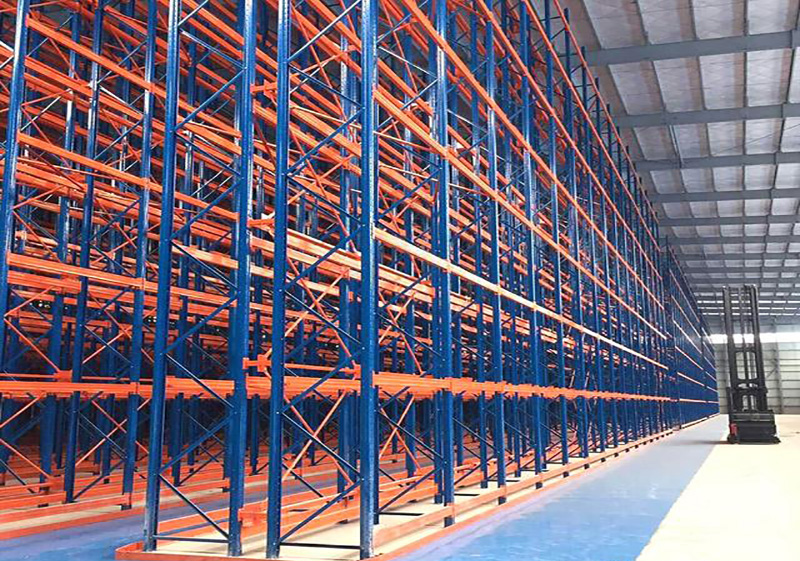
A double deep
racking system shares basic components with selective pallet racking —
upright frames, load beams, and row spacers — but with critical modifications.
The most visible difference is the beam depth. Standard selective racks use
beams spanning 1,100 mm to 1,400 mm (for a single EUR‑pallet). Double deep
configurations require beam depths between 2,200 mm and 2,800 mm to accommodate
two pallets placed back‑to‑back on each level. This extended depth demands
heavier beam profiles (typically a 120–150 mm high box section with 2.5–3.0 mm
steel thickness) to limit deflection under full load.
1.1 Upright Frames and Load Distribution
Upright columns in double deep racks experience higher point loads because
the second pallet creates additional leverage. Engineering standards (RMI 2012,
FEM 10.2.02) require columns with at least 12‑gauge material (2.6 mm) for
applications up to 1,200 kg per pallet, and 10‑gauge (3.4 mm) for loads
exceeding 1,500 kg. Frame spacing must be calculated based on the combined
weight of both pallets plus the beam self‑weight. Typical bay widths range from
2,500 mm to 2,800 mm.
1.2 Rail and Guide Systems for Forklift Access
Unlike selective racks where forklift forks enter directly from the aisle,
the double deep configuration requires special guide rails or flared entry
guides attached to the front beams. These rails (made of abrasion‑resistant
steel, 5‑7 mm thick) direct the fork tips toward the rear pallet position and
prevent accidental contact with the front pallet. Some advanced designs
incorporate laser‑guided fork position indicators or inductive proximity sensors
that lock the lift truck's lateral movement precisely over the target beam
location.
2. Density Gains and Selectivity: Measured Trade‑Offs
Deciding on a double deep
racking system begins with a comparative storage calculation. For a 2,000 m²
warehouse with 5 m clear height, selective racking (single deep) typically
yields 1,200 pallet positions. Double deep, using the same aisle width (2,800 mm
for reach trucks), increases that figure to approximately 1,680 positions — a
40% gain. However, this comes with three accessibility constraints:
FIFO/LIFO limitation: Double deep inherently supports LIFO
(Last‑In, First‑Out) per lane unless additional cross‑aisle access is provided.
For products with expiry dates, operators often limit double deep to SKUs with
low rotation velocity or use a modified “half‑lane” strategy.
Reduced SKU variety per aisle: Each double deep lane holds
two pallets of the same SKU. Warehouses with more than 5,000 SKUs may find
selective or carton flow racking more appropriate.
Increased travel time: A 2018 study by the Warehousing
Research Centre (WRC) measured cycle times for double deep versus selective:
single command cycles were 17% longer because the operator must align forks
precisely to reach the rear position. Double command cycles (retrieving one
pallet and storing another) reduced the penalty to only 9%.
3. Equipment Requirements – Reach Trucks, Fork Extensions, and
Automation
Standard counterbalanced forklifts cannot operate in double deep aisles. Two
types of material handling equipment are predominant:
Reach trucks with extended forks (2,200–2,500 mm length): These trucks require a minimum aisle width of 3,000 mm (compared to 2,600 mm for
single deep). The mast must tilt forward up to 7 degrees to align fork tips with
the rear pallet opening.
Double‑deep reach truck attachments: A pantograph
attachment increases fork travel distance. However, this reduces rated capacity
by 15‑20% and adds maintenance complexity.
VNA (Very Narrow Aisle) turret trucks: Some operations
combine double deep with VNA layouts, using trucks that rotate forks 180
degrees. Aisle widths can shrink to 1,800 mm, but the system becomes expensive
and requires guided wire or rail systems.
Leading manufacturers, including Guangshun, provide compatibility matrices
that cross‑reference rack beam heights with specific reach truck models (e.g.,
Toyota RRE, Crown RM 6000). Misalignment between fork tip length and beam depth
is responsible for nearly 30% of double deep installation failures — a
completely avoidable issue.
4. Optimal Applications and Industry Case Examples
Double deep racking shines in environments with medium turnover velocity
(20‑100 pallet movements per SKU per month), large batch sizes, and limited SKU
proliferation. Typical sectors include:
Beverage and bottled goods: High cube, uniform pallets, and
LIFO acceptable. One mid‑western US beer distributor increased in‑floor capacity
by 48% after converting from selective to double deep, eliminating a planned
warehouse expansion.
Cold storage (frozen food): Refrigerated space costs are
3‑5x higher than ambient. A double deep configuration reduces the refrigerated
footprint, lowering energy bills proportionally.
Automotive aftermarket parts: Many tier‑2 suppliers store
large volumes of identical wheels or exhaust components. Double deep lanes
reduce the travel distance between pick faces.
Paper and tissue products: High compression strength
products allow stacking two pallets high per lane, combined with double depth,
creating four pallets per beam level (2 high × 2 deep).
5. Safety Standards, Load Integrity, and Seismic Design
Double deep rack systems must satisfy specific structural checks beyond
conventional racking. The following standards apply directly:
RMI 2012 (ANSI MH16.3): Requires additional horizontal
bracing on both front and rear columns of each bay because the rear pallet
imposes a tensile force on the back column when the front pallet is
retrieved.
FEM 10.2.04 (beam deflection): Maximum vertical deflection
under full load (two pallets) should not exceed L/180 (where L=beam length). For
a 2,400 mm beam, this means <13.3 mm. Many cheap racks exceed this, causing
the rear pallet to tilt forward and block fork entry.
Seismic zones (ASCE 7‑22): In regions with PGA > 0.3g,
double deep racks require row spacers every second bay plus additional anchor
bolt tensioning (56 kN per base plate). Without these, the longer beam depth
creates a pendulum effect that amplifies rack sway.
Field audits conducted by Guangshun across 35 European warehouses
revealed that 40% of double deep installations lacked proper rear‑column
bracing, directly violating RMI requirements and increasing collapse risk during
seismic events or uneven loading.
6. Return on Investment (ROI) Model – Double Deep vs. Alternatives
For a warehouse processing 8,000 pallet movements per week, we compared total
cost of ownership (TCO) over 10 years for three systems: selective, double deep,
and drive‑in racking. Assumptions: 3,000 m² footprint, 9 m height, average load
800 kg, standard reach trucks for selective/double deep, and dedicated forklifts
for drive‑in.
Selective racking: Capital cost €210,000, annual
maintenance €4,200, labour cost per pallet €0.62. Total 10‑year cost:
€442,000.
Double deep racking: Capital cost €268,000 (heavier beams +
guide rails), maintenance €6,500 (more moving parts), labour cost per pallet
€0.71 (due to longer cycles). Total 10‑year cost: €501,000. However, because it
stores 40% more pallets, the cost per pallet position drops by 22% compared to
selective.
Drive‑in racking: Capital cost €305,000, maintenance
€9,800, labour €0.66, but lower selectivity and higher product damage. TCO
€573,000.
Conclusion: double deep provides the best cost per stored unit for
medium‑rotational SKUs, while selective remains better for high‑turnover or
mixed‑SKU environments. The double deep
racking system achieves a sweet spot when pallet movements do not exceed
approximately 120 per lane per week.
7. Installation Best Practices and Maintenance Protocols
Proper installation is non‑negotiable. Floor flatness must meet DIN 18202
table 3, category 3 (maximum deviation 5 mm over any 3 m length). Before bolting
the first frame, survey the entire bay area with a laser level. Any tilt
exceeding 2 mm per 1 m will cause forks to strike beams. During beam assembly,
use torque wrenches pre‑set to 110–130 N·m for M12 bolts. After installation,
perform a “test withdrawal” with an empty pallet on both front and rear
positions, checking for interference.
Quarterly inspections should focus on guide rail wear (replace when thickness
below 4 mm), beam lock integrity (security clips all present and undamaged), and
column anchoring. Many operators also install column protectors at aisle‑entry
frames — collisions at these points are three times more likely in double deep
aisles because drivers focus on depth alignment.
8. Frequently Asked Questions (FAQ)
Q1: Can I convert my existing selective racking into a
double deep racking system?
A1: Usually not recommended. Selective rack frames lack the
depth capacity and rear column bracing required for double deep. However, you
can keep the uprights if they meet higher gauge standards (minimum 12 gauge) and
replace beams, add guide rails, and install additional bracing. Always obtain a
structural analysis from the original manufacturer or a licensed engineer. Guangshun offers
retrofit kits with upgraded beams and seismic ties for selective
conversion.
Q2: What aisle width is mandatory for a double deep racking
system?
A2: For standard reach trucks with 2,300 mm forks, minimum
aisle width (from rack face to rack face) is 3,000 mm. If using combined VNA
turret trucks, aisle width can be reduced to 1,900 mm, but that requires
floor‑guided rails and specialized training. Narrower aisles increase the risk
of fork contact with front pallets, so we recommend 3,200 mm for first‑time
installations.
Q3: How do I handle FIFO (First‑In, First‑Out) with a double
deep racking system?
A3: Double deep is inherently LIFO for each lane. To achieve
FIFO, you must use one of two strategies: (1) leave the front lane empty and
store only in the rear lane, then move the pallet forward manually
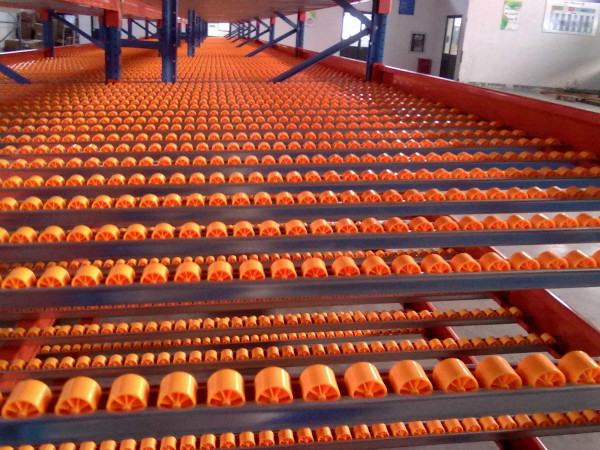
(labour‑intensive), or (2) adopt a “double deep push‑back” design – a rolling
cart system inside the lane that automatically advances rear pallets. The latter
increases cost by 35% but provides true FIFO.
Q4: What is the maximum pallet weight for a double deep
racking system?
A4: Individual pallet weights up to 1,500 kg are typical for
reinforced beams (150×100×3.0 mm). For heavier loads (2,000 kg+), special 4.0 mm
box beams and 10‑gauge columns are necessary. However, the limiting factor is
often the reach truck’s capacity at full extension (many reach trucks derate by
20% when forks are extended beyond 2,000 mm). Always cross‑check lifting
charts.
Q5: Does a double deep racking system require more frequent
inspections than selective racking?
A5: Yes. Because fork alignment is more critical, guide
rails and beam edges wear faster. We recommend monthly checks for guide rail
deformation and beam clip integrity – twice the frequency of selective rack
inspections. Also, inspect the rear column base plates for any signs of pull‑out
due to tensile forces from rear pallet retrieval.
Q6: Can I automate a double deep racking system with
shuttles or robots?
A6: Absolutely. Double deep is highly compatible with
shuttle systems. A radio‑controlled shuttle runs on rails inside the deep lane,
moving pallets to the front or rear. This eliminates the need for special
forklifts and increases throughput. Automation raises initial investment by
150‑200% but reduces labour costs and product damage. Several Guangshun customers have integrated semi‑automatic shuttles with their existing double
deep frames.
Implementing a double deep
racking system requires rigorous planning — from analysing inventory
profiles to verifying reach truck capabilities and seismic loads. When
engineered correctly, it delivers a storage density comparable to drive‑in racks
without the same level of product damage or SKU mixing restrictions. For
detailed site‑specific calculations, load tables, or a free layout consultation,
contact the engineering team at Guangshun.