Warehouse operators face a persistent challenge: balancing immediate
inventory access with maximum cubic utilization. The correct selection from the
primary types of
racking directly impacts order picking speed, storage cost per pallet,
and long-term structural integrity. With global warehousing rents increasing
12-15% annually across major logistics hubs, choosing an incompatible system
results in either 20-30% wasted floor space or unsafe load configurations. This
guide examines seven established types of
racking through the lens of engineering standards (RMI, FEM, SEMA),
real-world cycle times, and total cost of ownership. Each analysis includes
specific load metrics, aisle width requirements, and operational trade-offs.
1. Selective Pallet Racking – Benchmark for Direct Accessibility
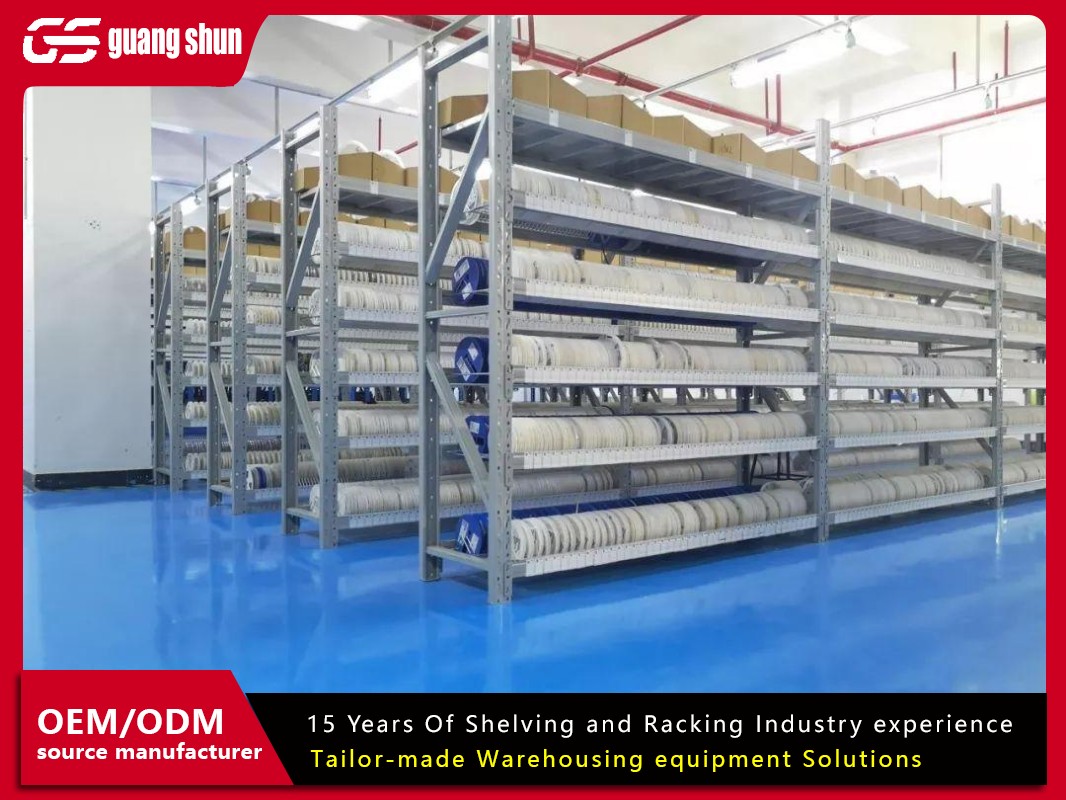
Selective pallet racking remains the most widely deployed configuration,
representing over 65% of industrial installations. Its design uses load beams
and upright frames to create individual pallet positions with 100% selectivity.
Beam levels adjust in 75mm increments to accommodate varying load heights.
Standard depth capacities range from 1,000 mm to 1,500 mm, supporting per-level
dynamic loads up to 2,500 kg when using reinforced step beams.
Technical specifications & pain points: While offering
immediate access to any SKU (ideal for high-turnover inventory with >15 daily
picks per SKU), the system sacrifices density. A typical layout with 3.2m aisles
(counterbalance forklift) yields only 35-40% space utilization.
Solution: Narrow-aisle variants reduce aisle width to 2.0-2.4m
using reach trucks, increasing utilization to 55-60% without changing the
fundamental types
of racking design. Guangshun provides seismic load
calculations and custom beam profiles for selective racking in seismic zones up
to Zone 4 (ASCE 7-16 standards).
Application case: A Midwest automotive parts distributor
reduced retrieval time from 4.2 to 1.8 minutes by implementing a selective
system with wire mesh decks and guided pallet positioning. Their SKU count
(8,200 active) required full accessibility; the selective design paired with VNA
forklifts delivered 40% more pallet positions than conventional wide-aisle
layouts.
2. Drive-In & Drive-Through Racking – High-Density for Homogeneous
SKUs
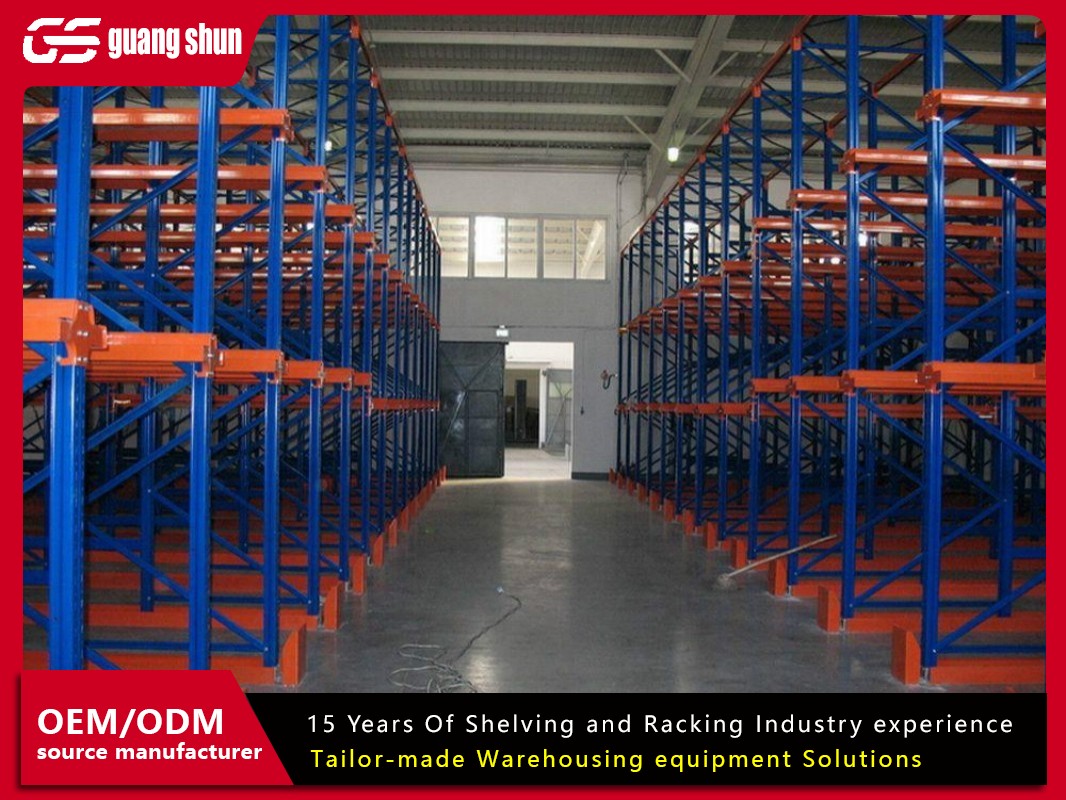
Drive-in racking eliminates active aisles by allowing forklifts to enter the
storage structure. Pallets rest on cantilevered rails supported by continuous
upright frames, creating deep lanes (typically 4 to 10 pallets deep).
Drive-through variants provide access from both sides, enabling
first-in/first-out (FIFO) flow; standard drive-in forces last-in/first-out
(LIFO). Lane depth directly affects density—a 6-pallet deep lane achieves 75-80%
space utilization compared to selective racking.
Structural considerations & industry limitations: Horizontal bracing must withstand lateral forces from forklift entry. Maximum
pallet weight should not exceed 1,200 kg per position to avoid rail deflection.
Common failure modes include bent rails from off-center insertion (mitigated by
floor guide rails and laser alignment tools). This types of
racking suits industries with low SKU diversity but high volume:
beverage, frozen food, and chemical storage where product families occupy full
lanes. FIFO compliance requires drive-through design with separate entry/exit
faces.
ROI example: A third-party cold storage operator converted
5,000 m² of selective racking to drive-in, increasing pallet positions from
4,200 to 9,100. The $780,000 investment achieved payback in 11 months through
reduced leased space costs.
3. Push-Back Racking – Dynamic Density with Selectivity Compromise
Push-back racking utilizes nested carts traveling on inclined rails, offering
LIFO storage at depths of 2 to 6 pallets per lane. Each cart supports a single
pallet; loading a new pallet pushes the existing row backward. When the front
pallet is removed, gravity moves the next pallet forward. This design achieves
60-70% density—significantly higher than selective racking—while maintaining
aisle-only access (no entry into storage lanes required).
Technical specifications & load parameters: Rails must
maintain precise slope (typically 3.5° to 4.5°) for smooth cart movement.
Dynamic load ratings per cart range from 800 kg to 1,500 kg, depending on wheel
material (nylon vs. polyurethane). Frequent jam risks occur with distorted
pallets or debris; maintenance intervals should include monthly rail cleaning
and cart bearing inspection. Push-back works best for medium-turnover SKUs (5-10
picks per week) where LIFO does not cause obsolescence. Compared to other
high-density types
of racking, push-back offers 20-30% faster retrieval than drive-in
because the forklift never enters the lane.
Industry data: A tire distribution center processing 1,200
SKUs reduced travel time per pick by 38% after installing 4-deep push-back
lanes. Upright protection frames and reinforced column guards decreased impact
damage by 52% over two years.
4. Cantilever Racking – Engineered for Long, Bulky Items
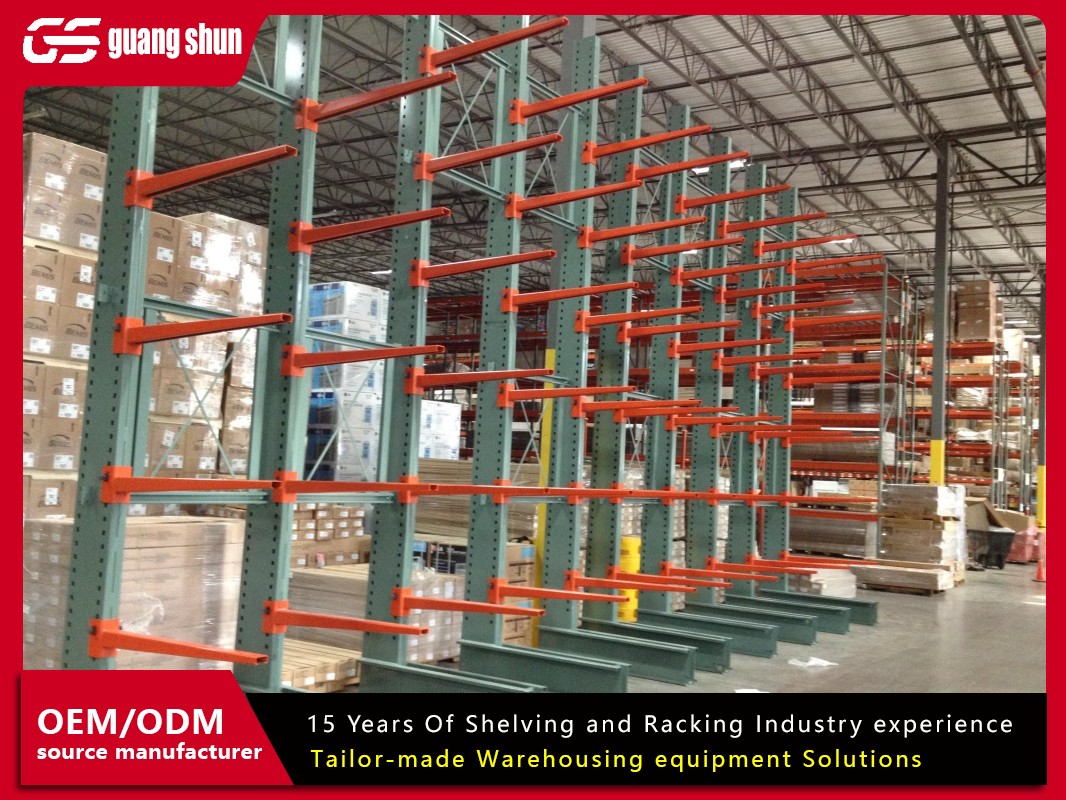
Cantilever racking solves the problem of storing materials that exceed
standard pallet dimensions: steel bars, lumber, piping, and sheet goods.
Vertical columns support horizontal arms (cantilevers) extending on one or both
sides. Arm lengths vary from 600 mm to 1,800 mm, with load capacities per arm up
to 1,500 kg. Column heights reach 12 meters in heavy-duty versions, allowing
vertical storage of 6-meter-long bundles.
Structural engineering specifics: Base plates require
substantial anchor bolt patterns (minimum M20 bolts every 300 mm) to resist
overturning moments. Arm deflection under full load should not exceed L/150
(e.g., 1,500 mm arm < 10 mm deflection). This types of
racking excels in metal service centers, construction supply warehouses,
and furniture manufacturing. Pain points include limited horizontal stability;
cross-bracing every 2-3 bays is mandatory. Guangshun offers bolted cantilever
systems with retrofitted safety stops and rubber end caps to prevent material
sliding off arms during seismic events.
Cost-saving case: A steel profile supplier reduced floor
clutter by 74% after switching from ground storage to 7m-high double-sided
cantilever racks. Storage capacity increased from 1,200 to 3,800 metric tons
within the same 2,200 m² footprint.
5. Mobile Racking Systems (Movable Aisle) – Maximum Density via Elimination
of Fixed Aisles
Mobile racking mounts static racking bays onto electrically powered carriages
that move laterally on floor-mounted rails. A single movable aisle opens only
where operator access is required, compressing all other bays together. This
technology achieves 85-95% space utilization—the highest among all types of
racking—but with added mechanical complexity. Each carriage requires
independent motor drives (0.75 kW to 2.2 kW) and integrated safety sensors
(infrared light curtains or pressure-sensitive floor mats).
Operational trade-offs & throughput: Aisle opening time
ranges from 15 to 40 seconds depending on bay weight and motor power. This delay
limits mobile systems to applications with low-to-medium pick frequency (cold
storage archives, static inventory, evidence rooms). Maximum load per bay can
exceed 50 metric tons when using heavy-duty rails with dual wheel assemblies.
Floor flatness tolerance is critical: DIN 18202 specification Table 4, with
variation ≤ 2 mm over 2 meters. Incompatible floors cause tracking errors and
carriage skewing.
Modern enhancements: Radio remote controls and warehouse
control system (WCS) integration allow pre-staging aisles based on batch pick
lists. A pharmaceutical cold store reduced energy consumption by 28% because
mobile racking minimized illuminated aisle volume, allowing lower HVAC loads.
Payback periods typically range 2-4 years for high-density needs where real
estate costs exceed $15/m²/month.
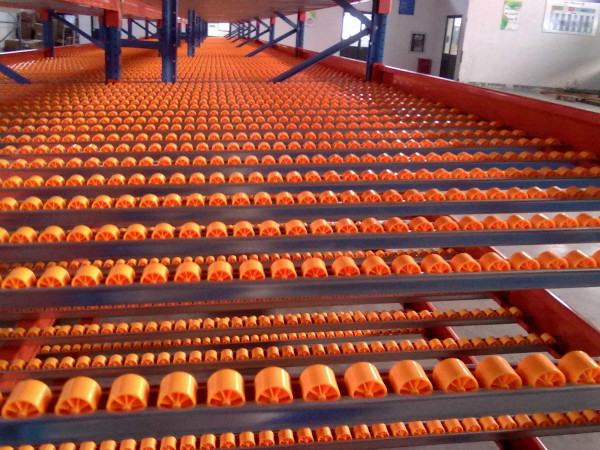
6. Carton Flow Racking – Gravity-Based FIFO for Pick-to-Cart Operations
Carton flow racking uses gravity roller tracks or wheel beds inclined at 6°
to 11° to deliver individual cartons or totes to the pick face. Each lane stores
a single SKU in FIFO sequence; rear loading and front picking eliminate walking
inside aisles. Typical applications include e-commerce fulfillment, spare parts
distribution, and pharmaceutical repackaging centers. Lane widths accommodate
carton sizes from 150 mm to 600 mm, with capacities ranging 25 kg to 150 kg per
lane.
Technical components & maintenance: Tracks consist of
galvanized steel rollers (spaced 50-75 mm) or full-width skate wheels. Speed
controllers (brake rollers) prevent excessive carton acceleration—critical for
fragile items. Flow separators or lane dividers prevent product mixing. This
types of racking reduces travel time by 50-70% compared to static
shelving. Common pain points include roller contamination (dust, shrink wrap
debris) requiring quarterly cleaning; replace bearings every 500,000 cycles.
Dynamic load testing per lane should follow ANSI MH16.1-2021 standards.
Performance data: An automotive aftermarket e-commerce
warehouse with 4,200 fast-moving SKUs implemented carton flow lanes across 320
pick faces. Pick rate improved from 85 to 210 lines per operator hour. Error
rate dropped 43% due to visual lane differentiation and illuminated
pick-to-light integration.
7. Mezzanine Floor Racking – Vertical Layering for Underutilized Height
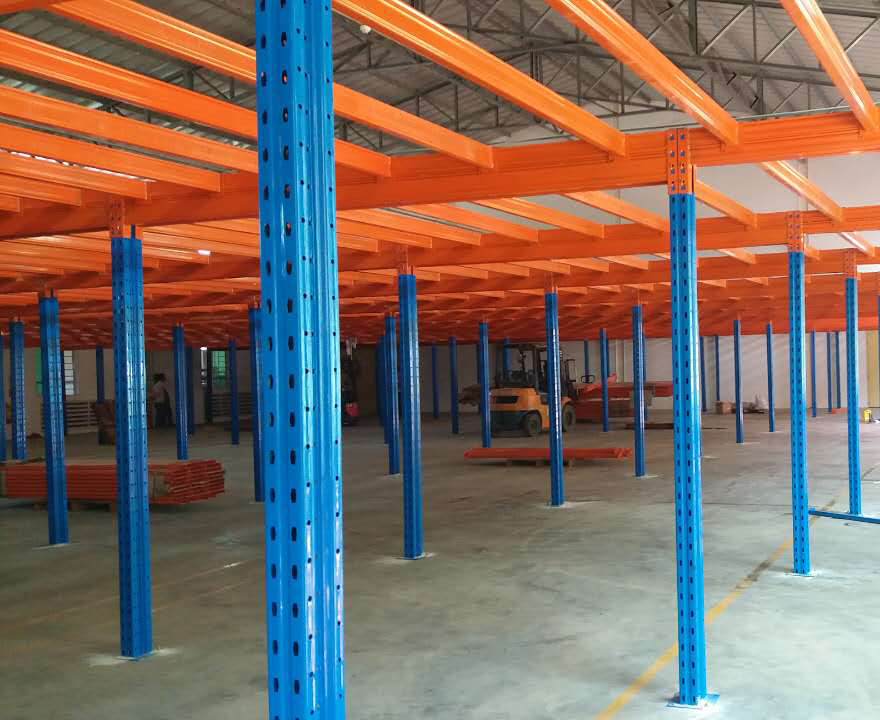
Mezzanine racking combines structural steel platforms with standard pallet
racking below, creating two or three storage levels within the same cubic
volume. Clear heights of 8 meters or more allow second-level selective racking
accessed via pallet gates and VNA trucks, or manual pick modules with stair
access. The mezzanine structure transfers loads through rack uprights or
independent support columns. Typical floor loading for mezzanine levels ranges
500 kg/m² to 1,200 kg/m² depending on intended use (light assembly vs. bulk
storage).
Engineering requirements & safety: Pallet drop gates
with self-closing mechanisms are mandatory at all mezzanine edges (OSHA
1910.29). Sprinkler system modifications must follow NFPA 13 guidelines for
multi-level rack structures. Vibration analysis between upper level racking and
lower level picking activity can prevent harmonic resonance. Guangshun provides integrated
mezzanine designs with seismic bracing certified for site-specific spectral
acceleration values. This solution works best when ceiling height exceeds 9.5
meters and SKU diversity allows vertical stratification (slow movers on upper
levels).
Return analysis: A consumer goods 3PL added a second level
to 6,500 m² warehouse at $45/m² construction cost, gaining 5,800 additional
pallet positions. Alternative greenfield expansion would have cost $145/m².
Payback achieved in 14 months.
Comparative Selection Matrix: Load, Throughput, and Investment Criteria
Selecting among types of racking requires quantitative trade-off
analysis across three core vectors:
Storage density (% of theoretical max): Selective (40-50%),
Drive-in (75-85%), Push-back (65-75%), Mobile (90-95%), Carton flow (55-70% for
cartons), Mezzanine (dependent on height).
Annual throughput capacity (pallets retrieved per hour per
aisle): Selective (45-60), Drive-in (25-35 due to deep LIFO
constraints), Push-back (35-45), Mobile (10-20 with moving aisles).
Cost per pallet position (USD, 2025 estimates): Selective
($65-100), Drive-in ($85-120), Push-back ($110-150), Mobile ($250-400),
Cantilever ($120-200 depending on arm length).
SKU compatibility: High mix (Selective, Carton flow), Low
mix high volume (Drive-in, Push-back), Bulky/irregular (Cantilever), Static/low
turnover (Mobile).
Industry best practice: model total cost of ownership over 10 years,
including maintenance, opportunity cost of lost space, and labor for retrieval.
For mixed SKU profiles, hybrid designs (e.g., selective front rows with
push-back rear blocks) often outperform single-system deployments. Guangshun engineering team provides
3D warehouse simulation using AutoCAD and Revit to compare multiple types of
racking configurations before capital commitment.
Operational Pain Points & Engineering Solutions Across Racking
Types
Regardless of which types of racking you select, five common failure
modes require proactive mitigation:
Floor flatness non-compliance: Many racking types
(especially mobile and drive-in) require DIN 18202 or ACI 117 tolerances.
Solution: laser screed finishing with F-number requirements (FF 50 / FL 35
minimum).
Seismic unseated loads: Pallet displacement during
earthquakes leads to progressive collapse. Solution: bolted clip retainers,
seismic sway bracing per ASCE 7-22 Chapter 15, and load-locking beam
connectors.
Corrosion in cold storage or chemical environments: Standard zinc plating fails within 2 years at -25°C with condensation cycles.
Solution: hot-dip galvanizing (minimum 85µm coating) or stainless steel uprights
for aggressive environments.
Rack damage from forklift impacts: 72% of rack failures
originate from impact damage. Solution: full-height column protectors (8mm steel
plate), anchored safety barriers, and real-time telemetry alert systems.
Incorrect load beam deflection: Excessive deflection causes
pallet instability. Follow FEM 10.2.02 standards: maximum deflection L/180 for
loaded beams. Use laser profiling during annual safety audits.
Future-Proofing Strategy: Automation-Ready Racking Infrastructure
As warehouses integrate autonomous mobile robots (AMRs) and shuttle systems,
types of racking must accommodate automated interfaces. Key
considerations: consistent floor flatness (AMR navigation requires ±5 mm over
10m), integrated QR code location markers, and clear horizontal clearances for
robot lifting mechanisms. For automated storage and retrieval systems (AS/RS),
rack structures become load-bearing elements requiring enhanced vertical
tolerance (≤ 2 mm deviation over 20m). Guangshun now offers pre-engineered
interfaces for common AMR brands (MiR, GreyOrange, Fetch) with integrated
docking stations and charge ports within rack footplates. Investing in
automation-ready racking today reduces retrofit costs by an estimated 55-70%
when scaling operations over 5 years.
Strategic Racking Selection Drives Operational Alpha
The diversity of types of racking provides warehouse operators with
precise tools to match inventory behavior—but each choice carries structural,
throughput, and cost implications. High-turnover, high-SKU environments demand
selective or carton flow systems; homogeneous bulk storage favors drive-in or
push-back; long materials require cantilever; extreme density mandates mobile
racking. Engineering due diligence (load calculations, seismic compliance, floor
flatness surveys) is not optional—it determines system lifespan and worker
safety. Leading logistics firms now combine two or three types of racking within a single facility, using zoning strategies based on ABC inventory
analysis. For organizations seeking independent validation of racking designs,
Guangshun provides third-party
engineering certifications (PE-stamped drawings) and on-site installation
supervision to global warehouse projects. Correctly applied, the right racking
system reduces operating costs by 18-27% and increases storage capacity by over
40% without expanding building footprint.
Frequently Asked Questions (FAQ) – Industrial Racking
Systems
Q1: How do I determine whether selective racking or
push-back racking is better for my warehouse?
A1: Run a SKU activity profile. If more than 70% of SKUs have daily picks (high
velocity) and require random access, selective racking is mandatory—push-back’s
LIFO limitation will create inventory aging. Conversely, if 60% of SKUs have
weekly picks but share similar dimensions (e.g., cases of beverages),
push-back’s 4+ pallet depths will increase density by 35-50%. Use cube
utilization software (e.g., AutoMod, FlexSim) with your actual SKU velocity data
before finalizing types of racking choice.
Q2: What is the
maximum safe load per upright frame for typical industrial
racking?
A2: Load capacity depends on column gauge,
steel grade (typically ASTM A1011 Grade 33 or 50), and frame spacing. Standard
3" x 2" uprights (2.0mm thickness) support 5,500 kg per frame at 3m height;
heavy-duty 4" x 3" frames (2.5mm) support up to 11,000 kg. Derate capacities by
25% for seismic zones or add horizontal bracing. Always request load charts
stamped by a licensed structural engineer—do not rely on generic tables.
Q3: How often should professional racking safety inspections be
conducted?
A3: OSHA and RMI guidelines mandate
formal inspections by a competent person every 12 months minimum.
High-throughput facilities (over 200 forklift cycles per day) require quarterly
visual inspections. Include laser measurement of beam deflection, bolt torque
verification (if bolted systems), and upright verticality check (± 1/4" over 10
feet). Any bent column flange exceeding 10mm requires immediate offloading and
engineering review.
Q4: Can drive-in racking be converted to push-back
racking without replacing all uprights?
A4: Partial
conversion is possible but rarely economical. Drive-in uprights lack the rail
support brackets and horizontal crossbars needed for push-back cart systems.
However, some manufacturers (including Guangshun) offer retrofit kits
using existing column hole patterns—but requires removing all load rails and
installing new inclined tracks plus carts. Estimated conversion cost per bay is
65-80% of new push-back system. Typically better to repurpose drive-in lanes for
block stacking and install fresh push-back rows in adjacent zones.
Q5:
What floor flatness specification is required for mobile racking
systems?
A5: Mobile racking demands the strictest
floor tolerances: maximum variation of 2 mm over any 2-meter length and no
differential settlement exceeding 1 mm over 5 meters between carriage wheel
paths. The floor must meet F-number specification FF 50 / FL 35 (ACI 117-10) or
DIN 18202 Table 4, line 3 (flatness category "E"). Prior to installation,
conduct a floor profileograph survey. Any deviation exceeding tolerance requires
diamond grinding or self-leveling polymer topping. Ignoring this causes uneven
carriage wear, motor overcurrent faults, and safety interlock failures.